So, what exactly is a Customer Engagement Platform (CEP)?
Think of it less as a single piece of software and more like the central nervous system for all your customer interactions. It’s the hub that connects and makes sense of every conversation you have with your audience, whether that’s through email, a social media comment, an in-app message, or a live chat session.
Essentially, a CEP acts like an orchestra conductor, making sure every channel plays its part in harmony to create one seamless experience for the customer.
From Scattered Touchpoints to Unified Conversations
Not too long ago, customer interactions were a mess. A support ticket was stuck in one system, marketing emails were managed in another, and a customer's website chat history was lost somewhere else entirely. This created a jarring experience for customers who had to repeat themselves constantly, and it left businesses blind to the full story of their relationship with each person.
A Customer Engagement Platform flips that model on its head.
Instead of just blasting out one-way marketing messages, a CEP helps you build real-time, two-way conversations that actually feel personal and relevant. It pulls in data from every single touchpoint—a previous purchase, a recent support question, a clicked ad—and uses that context to shape the very next interaction, no matter where it happens.
The Core Mission of a CEP
At its heart, a customer engagement platform is built to do three things that completely change how you connect with people:
- Unify Customer Data: It brings together information from all over the place to build a single, complete profile for every customer.
- Orchestrate Customer Journeys: It uses that unified data to design and automate personalized paths that guide customers smoothly from one step to the next.
- Analyze and Optimize: It gives you the insights to see what's actually working, so you can stop guessing and start making smarter decisions.
This move toward unified experiences is fueling some serious growth. The global customer engagement platform market was valued at around USD 12.5 billion in 2023 and is on track to hit USD 38.4 billion by 2032. That explosion shows just how critical customer experience has become for staying competitive.
A CEP’s true power is its ability to turn fragmented interactions into a cohesive relationship. It helps a business move from simply talking at customers to building a continuous dialogue with them.
A great way to see what a Customer Engagement Platform can really do is by exploring a summary of its main functions.
Core Functions of a Customer Engagement Platform
This table breaks down the four foundational pillars that define a modern CEP. Understanding these roles is key to seeing how the platform moves beyond simple communication tools to become a strategic asset for growth.
| Core Function | What It Does | Business Impact |
|---|---|---|
| Data Unification | Consolidates customer data from all sources (CRM, e-commerce, support, etc.) into a single, comprehensive customer profile. | Provides a 360-degree customer view, eliminating data silos and enabling true personalization. |
| Omnichannel Messaging | Enables consistent communication across multiple channels like email, SMS, push notifications, in-app messages, and social media. | Delivers a seamless and cohesive experience, allowing customers to interact on their preferred channels without losing context. |
| Journey Orchestration | Designs, automates, and manages personalized customer journeys based on user behavior, triggers, and segments. | Increases conversion rates and lifetime value by guiding customers with relevant, timely interactions. |
| Analytics & Optimization | Tracks key metrics, provides performance insights, and allows for A/B testing to continuously improve engagement strategies. | Drives data-informed decisions, maximizes ROI, and helps refine marketing and service efforts. |
Each of these functions builds on the last, creating a powerful system for managing the entire customer lifecycle.
To really make a CEP work for you, it’s crucial to pair the technology with proven customer engagement best practices that drive loyalty and sales. These principles are what turn a platform’s features into real business results. When you understand these strategies, you can see how a CEP makes exceptional enterprise customer service not just a goal, but a scalable reality.
How a Modern Customer Engagement Platform Works
So, how does all this actually come together? To really get what a customer engagement platform is, it helps to look under the hood. The best analogy I've found is to think of it like building a smart home. Every layer you add brings in a new level of intelligence and automation, all working together to create a seamless, responsive environment for your customers.
It all starts with a solid foundation.
The Data Layer: The Foundation
First things first, you have the Data Layer. This is the bedrock of the entire system, and its whole job is to gather and unify customer information from every possible source. Just like a smart home's central hub connects to every sensor—thermostats, lights, security cameras—the Data Layer pulls in data from your:
- CRM System: Contact details and sales history.
- E-commerce Platform: Purchase history and abandoned carts.
- Website and App: Browsing behavior and pages viewed.
- Support Desk: Past tickets and service interactions.
By pulling all this information together, the platform builds a single, coherent profile for each customer. This is huge. It completely eliminates that frustrating experience where a customer has to re-explain their entire history to different departments.
The Intelligence Layer: The AI Brain
Once the data is in one place, the Intelligence Layer gets to work. This is the brain of the operation, powered by artificial intelligence and machine learning. It sifts through the massive amounts of data to find patterns, predict what customers will do next, and surface insights you can actually act on.
For modern marketers, understanding the power of AI is a game-changer when it comes to anticipating customer needs. This layer can flag customers who are at risk of churning, pinpoint who is most likely to buy, or even figure out the perfect time to send a message for maximum impact.
This diagram shows how these core functions stack up to create a powerful system.
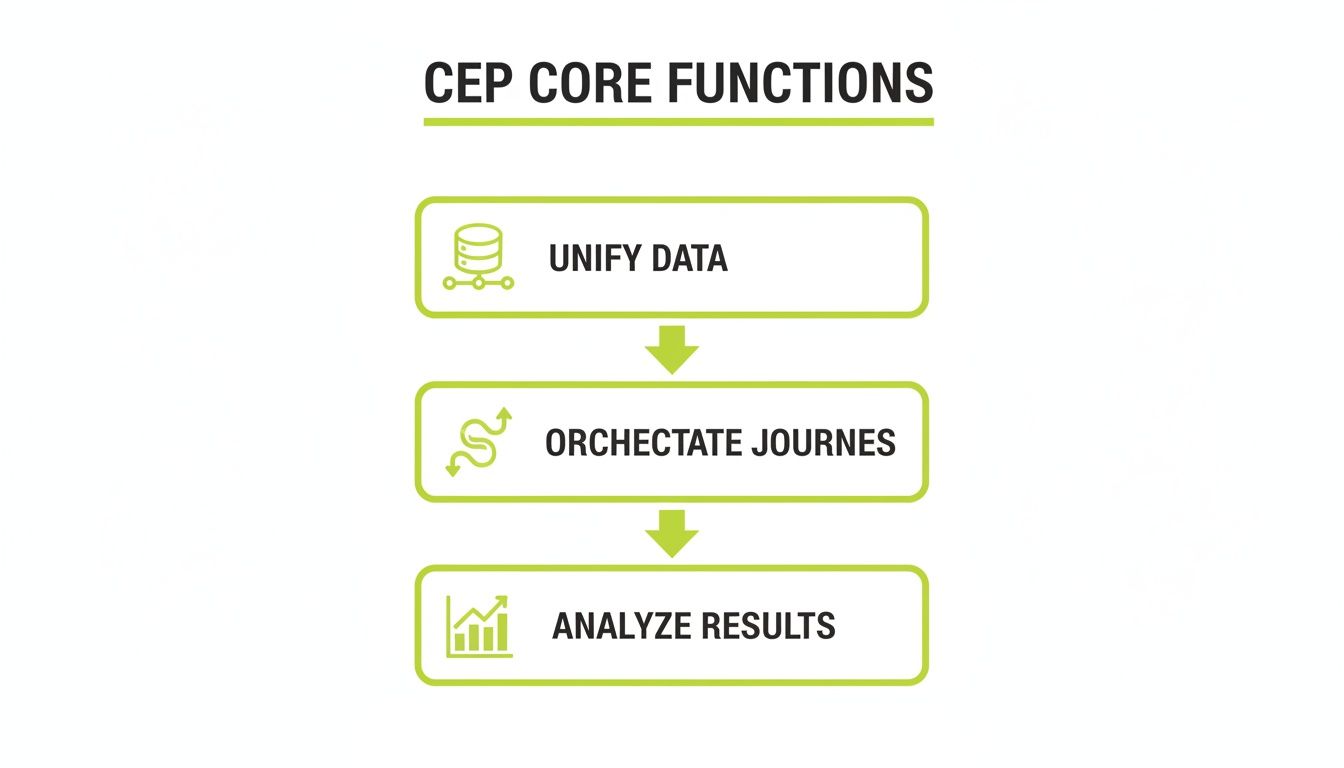
You can see the logical flow here: it starts with unifying data, moves to orchestrating personalized journeys, and finishes by analyzing the results so you can keep getting better.
The Orchestration Layer: The Action Planner
With all those predictive insights from the Intelligence Layer, the Orchestration Layer acts as the central command center. This is where you actually design and automate the customer journeys. If the brain (the Intelligence Layer) predicts a customer is interested in a product, the Orchestration Layer can kick off a pre-defined sequence of actions.
For example, if someone adds an item to their cart but doesn't check out, this layer can automatically schedule a reminder email in 24 hours. If they still haven't purchased, it can follow up with an SMS message offering a small discount two days later.
This layer is what ensures every interaction feels like part of a thoughtful, cohesive strategy rather than just a series of disconnected, one-off messages.
The Engagement Layer: The Delivery Network
Finally, we get to the Engagement Layer. This is the part of the platform responsible for delivering the actual messages to the customer on their preferred channel. It's the most visible part of the system, executing the commands sent down from the Orchestration Layer.
Any modern customer engagement platform worth its salt relies on sophisticated multi-channel marketing automation to handle these conversations.
Whether it's an email, a push notification, an in-app message, or a social media DM, this layer makes sure the right communication is delivered flawlessly. By connecting all four of these layers, a CEP turns raw data into personalized, timely, and meaningful customer conversations that build real relationships and drive business growth.
Essential Features That Drive Real Business Growth
Knowing the architecture of a customer engagement platform is a good start, but the real "aha!" moment comes when you see how its features translate into actual business results. These platforms aren't just a random collection of tools. They're tightly integrated systems built to solve specific, nagging growth challenges.
Let’s dig into the four core capabilities that make a modern CEP so powerful and see how they work together to deepen customer relationships and, just as importantly, drive revenue.
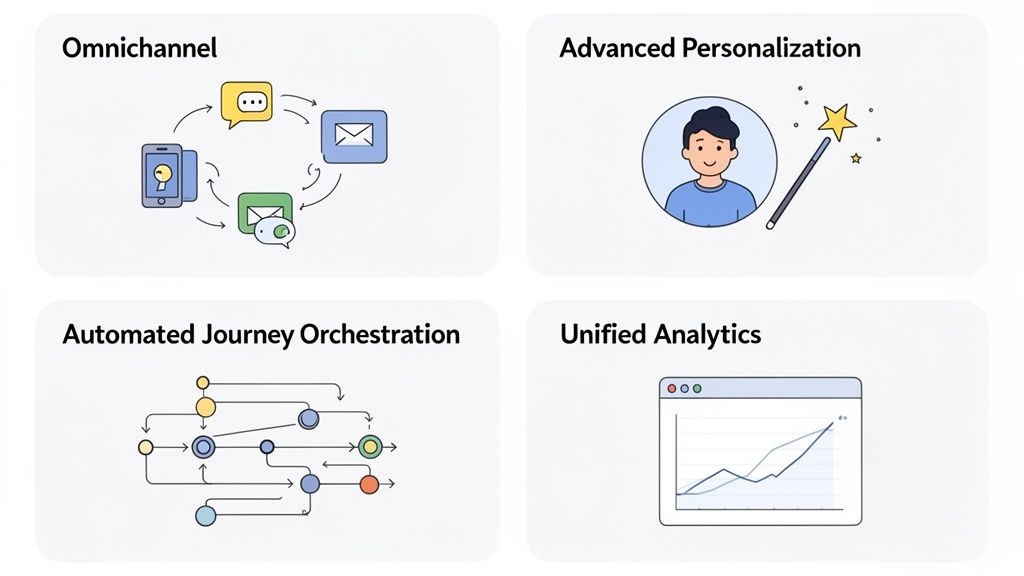
Seamless Omnichannel Communication
Your customers don't live on a single channel, so why should your marketing? They might discover a product on Instagram, ask a question via a website chatbot, and expect an order update via SMS. Omnichannel communication makes sure that no matter where the conversation happens, the context is never lost.
A CEP pulls all these different touchpoints into one continuous dialogue. This means a support agent in a live chat can see a customer's recent email history, or an automated text message can reference an item they just browsed in your app. This consistency is everything—it gets rid of the frustrating experience of customers having to repeat themselves over and over.
This seamlessness has a direct impact on the bottom line. Research shows engaged customers can be 23% more profitable, and strong omnichannel strategies are key to making that happen. By providing a fluid experience, a customer engagement platform can boost retention by 15-20%—a huge advantage when you consider 90% of customers will jump ship after a poor experience.
Advanced AI-Powered Personalization
Let's be honest: generic, one-size-fits-all marketing messages are dead. A CEP goes way beyond just slotting a customer’s first name into an email. It uses AI to deliver advanced personalization based on real-time behavior, past purchases, and even predictive analytics.
Imagine a customer is browsing a specific category on your website. Instead of just sending a generic "you left something in your cart" email later, the platform can instantly:
- Trigger a push notification with a limited-time offer on a related item.
- Display a personalized banner on the homepage the next time they visit.
- Send a follow-up email with recommendations that actually match what they were looking at.
This is the kind of relevance that makes customers feel understood, not just targeted. It’s a perfect example of blending smart push vs. pull marketing strategies within one intelligent system.
Automated Journey Orchestration
The customer journey is almost never a straight line from A to B. Automated journey orchestration is the feature that lets you map out and automate complex, multi-step pathways that react to what individual customers do in real time.
Think of it as a smart GPS for each customer. You set the destination (like making a purchase or finishing an onboarding sequence), and the CEP figures out the best route, giving turn-by-turn directions along the way. If a customer takes an unexpected detour—say, they abandon their cart—the system automatically reroutes them with a relevant message to get them back on track.
Journey orchestration transforms marketing from a series of disconnected campaigns into a cohesive, goal-oriented conversation that guides customers toward valuable outcomes.
For instance, a new user journey might kick off with a welcome email, followed by an in-app tour, and then a friendly check-in message three days later. If the user seems stuck on a certain feature, the platform can automatically send a link to a helpful article or an invite to a webinar.
Unified Analytics and Reporting
At the end of the day, you can't improve what you don't measure. A CEP delivers unified analytics, pulling performance data from every single channel and campaign into one central dashboard. This gives you that elusive 360-degree view of what's working and what's falling flat.
Instead of trying to stitch together reports from your email platform, social media tools, and Google Analytics, you can see the entire customer journey in one place. This allows you to finally answer the big questions:
- Which channels are actually driving the most conversions?
- Where are people dropping off in their journey?
- What's the true lifetime value of customers we acquired from our latest campaign?
This unified view empowers you to make smarter, data-driven decisions, optimize your ad spend, and constantly fine-tune your engagement strategy for the biggest possible impact.
Understanding CEP vs CRM vs CDP vs Marketing Automation
In the world of marketing technology, the alphabet soup of acronyms can get overwhelming. You’re hearing about CRMs, CDPs, and Marketing Automation platforms, and now, CEPs are in the mix. While they all touch customer data and interactions in some way, they play fundamentally different roles in your tech stack.
Getting a handle on the unique purpose of each tool is the first step toward building a system where every piece works together smoothly, without weird overlaps or confusion.
Think of it like building a high-performance car. You need an engine, a chassis, a fuel system, and a dashboard. Each component is critical, but none can do another's job. Let's break down exactly what each of these platforms does and, more importantly, what makes a Customer Engagement Platform a distinct and powerful addition.
CRM: The System Of Record
A Customer Relationship Management (CRM) platform is your company's memory. Its main job is to be the central database or system of record for all the factual information you have on your customers, mostly managed by sales and service teams.
CRMs are fantastic at storing static and slowly changing data. This includes things like:
- Contact Information: Names, email addresses, phone numbers, and company details.
- Sales History: Past purchases, deal stages, and contract information.
- Service Interactions: Support tickets and communication logs with account managers.
Its focus is internal, giving your teams the historical context they need to manage long-term relationships. But a CRM was never built to handle the massive flood of real-time behavioral data or to actively orchestrate complex, multi-channel customer journeys on its own.
CDP: The Data Unifier
Next up is the Customer Data Platform (CDP). If the CRM is your company’s memory, the CDP is the brain's data processing center. Its sole mission is to pull in customer data from tons of different sources—your website, mobile app, CRM, point-of-sale system, you name it—and stitch it all together into a single, persistent customer profile.
A CDP cleans, merges, and organizes this data, creating a comprehensive 360-degree view of each person. This unified profile is then pushed out to other systems that need it. While a CDP is a master at data unification and building audiences, it is not an action or engagement engine. It gets the data ready but doesn't have the tools to actually deliver messages across email, SMS, or push notifications.
Marketing Automation: The Campaign Scheduler
A Marketing Automation (MA) platform is designed to execute scheduled, often one-way marketing campaigns. It shines at tasks like sending out email newsletters, managing lead nurturing sequences, and scoring leads based on a set of predefined rules.
Tools like HubSpot or Marketo are campaign-centric. You build a list, create a message, and schedule it to go out. While they are absolutely essential for top-of-funnel activities, they often struggle with real-time, two-way conversations that adapt to a customer's behavior as it's happening. They’re built for planned communication, not for spontaneous, context-aware interaction.
CEP: The Action Layer
This brings us to the Customer Engagement Platform (CEP). The CEP is the action layer that sits on top of all this technology. It pulls the rich, unified data from the CDP and the historical context from the CRM, then uses that intelligence to power real-time, two-way conversations across every single channel.
A CEP is the conductor of the orchestra. It doesn’t store the history (CRM) or unify the sheet music (CDP); it uses that information to ensure every instrument plays in perfect harmony at the exact right moment.
The CEP is what allows you to send a push notification based on a user's real-time app behavior or trigger an SMS message because they just finished a call with a service agent. It's the engine that drives immediate, relevant, and personal interactions.
Putting It All Together: A Quick Comparison
To clear up any final confusion, let's look at how these four platforms stack up against one another. It's not about which one is "best," but about understanding their specific jobs.
Marketing Technology Platform Comparison
| Platform | Primary Function | Data Focus | Core Use Case |
|---|---|---|---|
| CRM | Manages sales and service relationships. | Known customer data (contact info, sales history). | Tracking deals, managing support tickets. |
| CDP | Unifies anonymous and known data into one profile. | All customer data from all sources (behavioral, transactional). | Creating a single customer view. |
| MA | Automates scheduled marketing campaigns. | Prospect and lead data (email, engagement scores). | Nurturing leads with email sequences. |
| CEP | Orchestrates real-time, two-way conversations. | Real-time behavioral and event data. | Powering personalized, omnichannel customer journeys. |
As you can see, each platform serves a unique and vital purpose. A modern tech stack doesn't force you to choose one over the other; it integrates them to create a system where data flows seamlessly from record-keeping to unification and, finally, to intelligent, real-time action.
How to Implement a CEP for Maximum Impact
Bringing a customer engagement platform into your company isn't just about buying another piece of software—it's a full-blown strategic initiative. To get it right, you need a thoughtful plan that connects the technology directly to your business objectives. Without a clear roadmap, even the most powerful platform is just an expensive tool that won't deliver.
The whole journey starts with a simple question: What does success actually look like for us? Before you even think about looking at vendors, you have to set clear, measurable goals. Are you trying to cut down customer churn by 15%? Maybe you're focused on boosting customer lifetime value (CLV). Or perhaps the goal is to improve first-contact resolution rates in your support center.
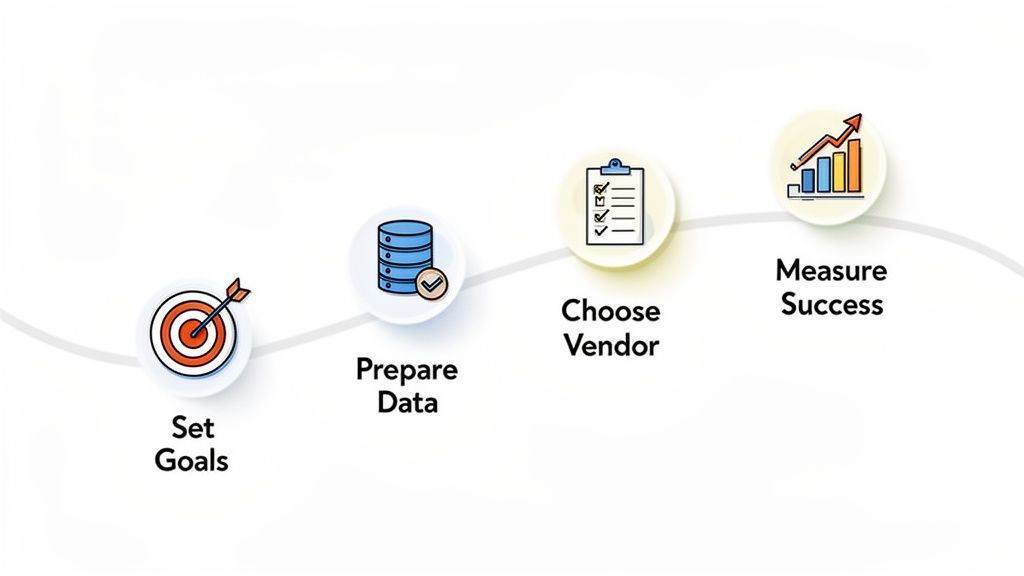
Start with Clear Goals and Use Cases
Once you have your primary goals nailed down, the next step is to map them to specific, real-world use cases. This is what makes your objectives tangible and helps you figure out where the CEP will make the biggest splash first.
Some common starting points we see include:
- Reducing Cart Abandonment: Setting up automated, personalized reminders via email and push notifications for anyone who leaves items in their cart.
- Improving New User Onboarding: Building a guided journey with in-app messages and tutorials to help new customers see the value of your product, fast.
- Boosting Customer Retention: Proactively spotting at-risk customers based on their behavior and reaching out with targeted offers or a helping hand from support.
These initial use cases become the foundation for your entire implementation. They keep your team laser-focused on actions that directly move the needle on your main goals.
Prepare Your Data and Systems
Let’s be honest: a CEP is only as good as the data it can get its hands on. Before you start, do a thorough audit of all your data sources. You need to make sure your customer data is clean, accessible, and ready to be integrated. This means hooking up your CRM, e-commerce platform, and other key systems so the CEP can build that coveted 360-degree view of each customer.
Seamless integration isn't a "nice-to-have"—it's non-negotiable. The platform has to be able to pull data from your existing tech stack and push instructions back out to your different engagement channels without any friction.
Choose the Right Vendor Partner
Picking a vendor is a huge decision. Your choice should come down to how well their platform lines up with your specific use cases, technical needs, and future growth plans. The market for these platforms is booming, especially in North America where it was valued at USD 9.17 billion in 2024. This growth is happening because businesses are seeing real results—effective engagement can drive a 20-30% lift in revenue. You can explore the full market research on customer engagement solutions to get more details on the trend.
Use a checklist to size up potential partners:
- Scalability: Can the platform grow with your business? Can it handle more data and more complex interactions as you expand?
- AI and Automation Capabilities: Does it have the predictive analytics, journey orchestration, and AI-driven personalization you need to hit your goals?
- Ease of Use: Is the interface intuitive enough for your marketing and support teams, or will they need a PhD in computer science to use it?
- Support and Onboarding: What kind of training, strategic advice, and technical support does the vendor actually provide?
Your goal is to find a partner, not just a provider. The right vendor will work with you to ensure the platform is configured to achieve your specific business outcomes.
Measure What Matters
Finally, to prove the ROI and fine-tune your strategy, you have to track the right success metrics. These should tie directly back to the goals you set in step one.
Key metrics to keep your eye on include:
- Customer Lifetime Value (CLV): Are customers spending more with you over time?
- Churn Rate: Are you holding onto more customers?
- Channel Engagement Rates: Are your messages actually being opened, clicked, and acted upon?
- Conversion Rates: Are your automated journeys leading to more sales or sign-ups?
By focusing on these metrics, you can clearly show the platform's impact and use real data to continuously refine your customer engagement efforts.
The Future of Customer Engagement Platforms
The world of customer engagement is always moving, and the platforms driving it are evolving at a dizzying pace. What worked yesterday is already starting to look outdated. To really get a handle on what a customer engagement platform is becoming, we need to look at the powerful trends shaping its future. These aren't just minor tweaks; we're talking about a fundamental shift in how businesses connect with people.
The next wave of engagement is less about reacting to what customers do and more about anticipating what they'll need. This evolution is being fueled by huge leaps in artificial intelligence, smarter automation, and a much deeper integration of conversational tools across the entire customer journey. We’re moving from scheduled campaigns to real-time, predictive conversations.
The Rise of Generative AI and Hyper-Personalization
Generative AI is completely redefining what personalization can be. We’re moving way beyond just dropping a customer's first name into an email. The future is about AI creating unique, one-to-one content for every single person, on the fly. Just imagine an e-commerce site where the product descriptions rewrite themselves to highlight the features that are most relevant to a visitor's specific browsing history.
This incredible level of detail makes interactions feel less like marketing and more like getting helpful advice from a personal consultant. Generative AI will also give support agents a major boost by instantly summarizing complex customer histories and drafting empathetic, context-aware replies, freeing them up to tackle the really tough problems.
Conversational Commerce Becomes the Norm
The line between chatting and shopping is basically disappearing. Conversational commerce, powered by intelligent chatbots and virtual assistants, is turning every messaging app and website chat into a potential storefront. Customers can now ask a bot for product recommendations, get styling tips, and check out without ever leaving the chat window.
The future of customer engagement is proactive, not reactive. Platforms will predict customer needs and offer solutions before the customer even has to ask, turning service into a seamless, almost invisible experience.
This seamless integration makes the buying process smoother and more natural than ever. It meets customers on the channels they’re already using every day, transforming passive browsing into an interactive, transactional dialogue.
A Shift Towards Predictive Engagement
Maybe the biggest leap forward is the move toward predictive engagement. Instead of waiting for a customer to abandon their cart or reach out to support with a problem, the CEPs of tomorrow will use predictive analytics to spot friction points before they ever become real issues.
Key predictive capabilities will include:
- Proactive Support: Automatically offering help via chat when a user seems stuck on a complex checkout page for too long.
- Anticipatory Offers: Sending a personalized discount for a product a customer is likely to buy next, based on their behavior and data from similar users.
- Churn Prevention: Identifying patterns that suggest a customer might be losing interest and automatically triggering a retention campaign to win them back.
Keeping up with these changes is essential for any business that wants to stay competitive. To get a better sense of where the market is headed, exploring current digital marketing trends can give you valuable context for your strategy. This kind of forward-thinking ensures your engagement efforts don't just meet today's expectations but are ready for whatever comes next.
Frequently Asked Questions
Even after getting a solid grasp on what a customer engagement platform is, a few practical questions always pop up. Let's tackle the most common ones we hear from businesses trying to figure out if a CEP is the right move for them and what to expect along the way.
My goal here is to clear up any lingering doubts you might have, from company size to how long it takes to get one up and running.
What Size Business Needs a Customer Engagement Platform?
This question comes up a lot, but the answer isn't really about revenue or employee headcount. It's about complexity.
You hit the point where you need a CEP when your customer touchpoints become too numerous and chaotic to manage with separate tools. If your customers are bouncing between your website, a mobile app, email, and social media, you're already there.
A small e-commerce startup can get just as much value from a CEP as a massive enterprise if the goal is a smooth, unified customer experience. The real tipping point is when you can no longer follow the entire customer conversation and their experience starts to feel broken.
A CEP is less about business size and more about the complexity of your customer journey. If your customers use multiple channels to engage with you, a platform is essential for maintaining a single, coherent conversation.
How Long Does a CEP Implementation Take?
The timeline can really vary, but a typical rollout is done in phases. You can often get a foundational setup done in 4 to 8 weeks. That usually includes integrating a key data source like your CRM and launching one or two high-impact campaigns, like a cart abandonment journey.
More involved projects—the kind that pull in multiple data systems, use advanced AI models, and span several business units—could take anywhere from 3 to 6 months. The smart approach is to start small with a focused use case, score some early wins, and build momentum before you tackle the more complex strategies.
Can't I Just Use a Mix of Different Tools?
You could, but piecing together different point solutions—an email tool here, a chatbot there, a social media manager over there—creates some serious headaches down the road. This approach inevitably leads to data silos, trapping customer information in separate systems. A unified view of the customer becomes impossible.
The result? A clunky, disjointed experience. A customer might have to explain their issue to a chatbot after they've already detailed it in an email to support, simply because the two systems don't talk to each other.
A customer engagement platform is designed to fix this exact problem. It acts as the central hub, ensuring every channel has the full context of the conversation. That's how you deliver the kind of seamless experience modern customers don't just want, but expect.
At Magic Logix, we specialize in building powerful digital strategies that forge real connections between businesses and their customers. Our expertise across data, technology, and creative execution can help you implement a customer engagement platform that drives meaningful growth. See how we can transform your customer interactions at https://www.magiclogix.com.