Stop for a moment and think about your website as if it were a brick-and-mortar store. People walk past, some glance in the window, and a few even come inside to look around. But what really matters is how many of those browsers actually pull out their wallets and buy something.
Marketing without conversion tracking is like running that store completely in the dark. You’d have no idea how many sales you made, what products were popular, or which of your fancy window displays actually brought people inside. You’re just guessing and hoping for the best.

Conversion tracking is your digital cash register, foot traffic counter, and customer survey all rolled into one powerful system. It’s the structured process of identifying, measuring, and analyzing the valuable actions your visitors take.
More importantly, it connects those actions—like a purchase or a form submission—back to the specific ad, social media post, or email that brought them to you in the first place. That single connection is what transforms marketing from a vague expense into a measurable, performance-driving investment.
The idea isn’t new. It became a pillar of digital marketing when Google AdWords launched back in 2000, giving advertisers their first real taste of click-to-conversion measurement. By 2006, Google Analytics made this kind of in-depth tracking accessible to everyone, and the game changed forever.
Macro vs. Micro Conversions
Of course, not all customer actions carry the same weight. To get a truly clear picture of what’s working, you need to separate your goals into two distinct categories:
Macro Conversions: These are the big wins. The primary, high-value actions you want users to take that directly impact your bottom line. Think of these as the main event—the final sale or the signed contract.
Micro Conversions: These are the smaller, but still meaningful, steps a user takes on their way to a macro conversion. They signal interest and engagement, showing you that a prospect is moving down the funnel.
It's tempting to focus only on the big macro goals, but micro conversions tell a huge part of the story. They help you understand the entire customer journey, not just the finish line.
To illustrate the difference, here’s a quick breakdown:
Macro vs. Micro Conversions At a Glance
| Conversion Type | Definition | B2C Example | B2B Example |
|---|---|---|---|
| Macro | The ultimate, primary goal that directly generates revenue or a high-value lead. | Completing a purchase, Subscribing to a paid plan. | Requesting a demo, Submitting a "Contact Sales" form. |
| Micro | A smaller action that indicates interest and moves a user closer to a macro goal. | Adding an item to the cart, Creating an account, Signing up for a newsletter. | Downloading a whitepaper, Watching a case study video, Subscribing to a blog. |
See the difference? A user who downloads a whitepaper (a micro-conversion) might not be ready to buy your software today, but they’ve just raised their hand and identified themselves as a warm lead. Ignoring that signal is like ignoring a customer asking for help in your store.
To truly optimize the path to a sale, you first have to understand all the little steps people take along the way. Learning how to track website visitors and their behavior is the key to identifying those crucial micro-moments and nurturing them toward the final purchase.
Why Conversion Tracking Is Essential for Business Growth
So, we know what conversion tracking is, but let's talk about why it's completely non-negotiable. This is what separates businesses that are truly thriving from the ones just getting by. Without it, you’re basically driving blindfolded, throwing money at different marketing ideas and just hoping one of them works.
Conversion tracking changes everything. It turns your marketing budget from a vague, hopeful expense into a precisely measured investment.
Think about it like this: a company is spending $10,000 a month on digital ads spread across four platforms. Without tracking, they see a bump in sales, but they have no clue which platform—or which specific ad—is actually doing the heavy lifting. They could be pouring 80% of their budget into a channel that only brings in 10% of their sales, while their best-performing channel is starved for cash. This isn't a rare scenario; it's a common and incredibly expensive mistake.
From Guesswork to Growth
Putting conversion tracking in place creates a powerful "before and after" picture. Before, you’re making decisions based on gut feelings and vanity metrics like clicks and impressions. Afterward, every single decision is backed by hard data that draws a direct line from a marketing action to a business result.
This shift gives you the power to answer critical questions with total certainty:
- Which marketing channels are actually delivering sales? Is it your organic search traffic, your paid social media campaigns, or that email newsletter you send out every week?
- Which specific ads or keywords are the most profitable? This is where the magic happens. You can double down on what works and cut what doesn't, dramatically improving your Return on Ad Spend (ROAS).
- Where are customers dropping off in the sales funnel? Tracking helps you find the exact friction points—like a confusing checkout page or a broken form—that are silently bleeding money every day.
By getting real answers to these questions, you stop wasting money on strategies that just aren't cutting it. You can then reallocate that budget to the campaigns you know are driving growth, creating a powerful feedback loop that gets better and better over time.
A Real World Example of Data-Driven Success
Imagine an e-commerce store that sells handmade leather goods. In the beginning, they were running broad ad campaigns on both Instagram and Google Search, splitting their budget evenly. Sales were okay, but their profit margins were razor-thin. They felt stuck.
Then they implemented conversion tracking, and the data told a completely different story. While their Instagram ads were generating tons of clicks and likes (what we'd call micro-conversions), it was the Google Search ads targeting specific phrases like "durable leather work bag" that were driving 75% of actual purchases (the all-important macro-conversions). The Instagram crowd was browsing; the Google searchers were buying.
Armed with this single insight, the company shifted its ad budget heavily toward Google Search. The result? Their sales doubled within three months, even as their total ad spend decreased by 20%. They stopped guessing and started making strategic, data-backed decisions.
Empowering the Entire Organization
The impact of this data ripples far beyond the marketing team. When you know which products are converting best from which ads, your product development team gets a direct line into what the market truly wants. When you see the most common questions from customers who end up buying, your sales team can refine their pitch to address those points upfront.
Ultimately, conversion tracking gives you a clear, unbiased picture of what your customers want and how they behave. It's the compass that guides not just your marketing strategy, but your entire business toward sustainable, predictable growth.
How Modern Conversion Tracking Technology Works
To really get what conversion tracking is, you have to pop the hood and see how the engine works. It might sound intimidatingly technical, but the core concepts are actually pretty simple once you get the hang of them. It all boils down to tiny, invisible messengers doing the heavy lifting behind the scenes.
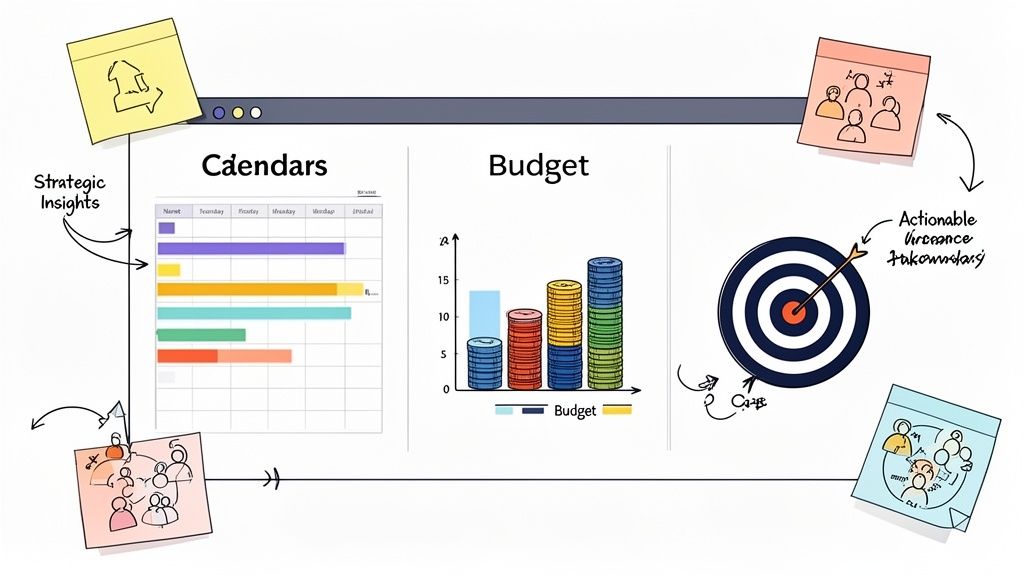
This is the strategic leap businesses make—from just guessing and hoping for the best to achieving predictable growth, all because they started tracking what works.

As you can see, tracking is the bridge that connects uncertainty to success. It's how you turn a pile of raw data into a real strategic advantage.
The Foundation: Tracking Pixels and Tags
At the very heart of most conversion tracking systems, you'll find two key players: tracking pixels and tags.
Think of a tracking pixel as a tiny, invisible digital scout. It’s a 1×1 pixel image that you place on a super important page, like the "Thank You for Your Order" confirmation page. When a user lands there, their browser has to load everything on the page—including this invisible pixel. The simple act of loading it sends a signal—a quick "ping"—back to the ad platform like Google or Meta, telling it a conversion just happened.
A tag is the modern, more powerful evolution of this idea. It’s a small piece of code, usually JavaScript, that lives in your website’s header. Instead of just loading an image, this tag can follow more complex commands. It can collect much richer data, fire based on specific user actions (like a button click), and send all that detailed info back to your analytics and ad platforms.
Key Takeaway: Think of tags as digital messengers. You place them on your site, and when a user takes an action you care about, the tag sends a message back to headquarters (your analytics or ad platform) saying, "Hey, it happened! We got one."
Server-Side Tracking for Better Reliability
Most tracking traditionally happens on the user's browser, which we call client-side tracking. It gets the job done, but it’s not foolproof. Things like ad blockers, strict browser privacy settings, or even just a slow internet connection can stop the tag from firing, leading to missing or just plain wrong data.
This is where server-side tracking steps in. Instead of the user's browser sending data directly to Google or Meta, it first sends a single, more reliable signal to your own server. Your server then plays the role of a secure middleman, forwarding that conversion data on to all your various marketing platforms.
Here’s an analogy: client-side tracking is like sending a postcard. It’ll probably get there, but it could get lost, smudged, or read by someone else. Server-side tracking is like using a private, armored courier. The message is more secure, far more reliable, and you have complete control over what information is being sent. In today's privacy-first world, this method is quickly becoming essential for data accuracy.
The Shift to Event-Based Tracking
For a long time, the gold standard for web analytics was session-based tracking. This approach was all about "pageviews," grouping user interactions into visits, or "sessions." It was useful, but it didn't always paint the full picture of a user's journey, especially on modern single-page applications or mobile apps.
Today, the industry has largely shifted to an event-based tracking model, with Google Analytics 4 (GA4) leading the charge. Instead of just counting page loads, this model treats every single meaningful user interaction as its own distinct "event."
Here’s what that looks like in practice:
- A page view is an event.
- Scrolling 75% down a blog post is an event.
- Watching a product video is an event.
- Clicking a "Request a Demo" button is an event.
- Making a purchase is, of course, a very important event.
This approach gives you a much more detailed and flexible view of what people are actually doing. It lets you define precisely which actions matter to your business and track them consistently across your website and apps. A crucial part of this is using UTM parameters to tag your campaigns so you know which ones are driving these valuable events. To really nail this, you need to know how to use UTM parameters effectively to feed your event data rich, actionable source information.
Key Metrics for Measuring Marketing Success

Collecting data is one thing; knowing what it’s actually telling you is where the magic happens. Conversion tracking gives you a ton of information, but to turn those numbers into profitable decisions, you have to zero in on the right metrics. These are the figures that paint a clear, honest picture of your marketing performance and, ultimately, your business's health.
It’s not enough to just count your wins. You need to dig deeper to see how efficient your campaigns are, whether they’re making money, and what kind of long-term value you’re creating. By getting comfortable with a few essential key performance indicators (KPIs), you can stop just tracking activity and start truly measuring your impact.
To make sense of it all, let's break down the most critical metrics you'll be looking at. The table below gives a quick overview of what each one measures, how it's calculated, and why it's so important for making smart business decisions.
| Metric (KPI) | What It Measures | How to Calculate It | Why It Matters |
|---|---|---|---|
| Conversion Rate (CVR) | The percentage of visitors who take a desired action (e.g., purchase, sign-up). | (Total Conversions / Total Visitors) x 100 | Measures the effectiveness of your website, landing page, and messaging at persuading users. |
| Cost Per Acquisition (CPA) | The average cost to acquire one new customer or lead through a specific campaign. | Total Marketing Spend / Total Conversions | Reveals the financial efficiency of your marketing channels and helps you manage your budget. |
| Return on Ad Spend (ROAS) | The amount of revenue generated for every dollar spent on advertising. | Total Revenue from Ads / Total Ad Spend | Directly measures the profitability of your ad campaigns, showing which ones are worth scaling. |
| Customer Lifetime Value (CLV) | The total projected revenue a single customer will generate over their entire relationship with your business. | (Average Purchase Value x Purchase Frequency) x Customer Lifespan | Puts acquisition costs into perspective and guides long-term growth and retention strategies. |
Each of these metrics tells a different part of the story. When you look at them together, you get a complete view of what’s working, what isn’t, and where your biggest opportunities are hiding.
Conversion Rate (CVR)
Your Conversion Rate, or CVR, is probably the most fundamental metric in the game. It’s the percentage of people who complete a goal out of the total number of visitors. Think of it as your marketing’s batting average—it tells you how good you are at turning eyeballs into action.
A high CVR is a sign that your messaging, ad creative, and landing page are all clicking. On the flip side, a low CVR is a red flag that something in the user journey is broken or just isn’t connecting with your audience.
The math is simple:
(Total Conversions / Total Visitors) x 100 = Conversion Rate (%)
So, if your landing page gets 1,000 visitors and 50 of them fill out your form, your CVR is 5%. That one number gives you a powerful pulse check on how well your campaign is performing.
Cost Per Acquisition (CPA)
While CVR tells you how effective your page is, Cost Per Acquisition (CPA) tells you how efficient your spending is. This metric breaks down exactly how much you paid, on average, to get a single customer to convert.
CPA answers the all-important question: "How much did it cost me to get this new customer?" Knowing your CPA is non-negotiable for managing your budget and making sure your campaigns are actually profitable. A runaway CPA might mean you're overbidding on an ad channel or your targeting is way off.
Here’s the formula:
- Total Marketing Spend / Total Conversions = Cost Per Acquisition ($)
If you spent $500 on a campaign that brought in 20 new customers, your CPA is $25. By stacking that CPA against the value of a customer, you can instantly see if your campaign is a smart investment. To truly master your marketing, it's essential to define and track the right Key Success Indicators that align with your business objectives.
Return on Ad Spend (ROAS)
Return on Ad Spend (ROAS) takes the analysis a step further by focusing squarely on profitability. Instead of looking at costs, ROAS calculates how much revenue you earn for every single dollar you put into advertising. It’s the ultimate report card for your ad campaign’s financial success.
A ROAS of 4:1, for instance, means you’re making $4 in revenue for every $1 you spend. This metric lets you spot your most profitable campaigns with total clarity, so you can double down on what’s working. To dive deeper, you can also explore our guide on the most important digital marketing performance metrics.
Calculating it is straightforward:
- Total Revenue from Ads / Total Ad Spend = Return on Ad Spend
Customer Lifetime Value (CLV)
Finally, Customer Lifetime Value (CLV) is a forward-looking metric that pulls the lens back from a single sale to the entire customer relationship. It estimates the total revenue you can expect from a single customer over their entire time with your business.
Understanding CLV is a game-changer because it helps you make much smarter decisions about how much you're willing to pay to acquire a customer. A $50 CPA might look steep for a $30 first-time purchase, but if that customer’s CLV is $500, then that initial cost was an absolute steal. This long-term view is what separates sustainable growth from short-term gains.
In fact, modern tracking has made this kind of optimization far more accessible. Nearly 56% of marketers now say that improving conversion rates is easier than it was a decade ago, thanks to better tools and technology. You can learn more about these trends in the HubSpot State of Marketing Report.
The marketing playbook we've all followed for years is being rewritten on the fly. We got used to a steady stream of data from cookies and user devices, but a huge wave of privacy-focused changes has completely upended how we measure success. This new reality calls for a much smarter way to think about conversion tracking.
New rules like GDPR in Europe and Apple’s App Tracking Transparency (ATT) framework are putting data control back into the hands of users. While this is a big win for consumer privacy, it's created a massive headache for marketers: signal loss.
When a user opts out of tracking, that digital breadcrumb connecting their ad click to a purchase just vanishes. It’s like trying to follow a conversation where half the words are muted—you get the gist, but you miss the crucial details that tell you which marketing efforts are actually paying off.
The Rise of Modeled Conversions
To patch up these data gaps, platforms like Google are turning to modeled conversions. This is a pretty slick approach that uses AI and machine learning to fill in the blanks left by signal loss. By analyzing aggregated, anonymous data from users who did opt-in, these systems can make a highly educated guess about the conversions you can no longer see directly.
Think of it like a sophisticated statistical forecast. If the system sees that a thousand opted-in users from a specific campaign converted at a 5% rate, it can logically assume that a similar number of untrackable users from that same campaign also converted. This is all about keeping your performance data as whole and accurate as possible in a world that puts privacy first.
This isn't just a minor trend; it's the new standard. By 2026, it's expected that up to 70% of conversions reported in Google Ads will rely on this kind of modeled data, a direct result of privacy rules and the fight against signal loss. For more on how conversion benchmarks are evolving, First Page Sage has some eye-opening data.
Understanding Attribution Models
Just as important as what you track is how you give credit for it. That’s the job of an attribution model—a set of rules that decides which touchpoints in a customer's journey get the credit for the final sale. Picking the right model is absolutely critical for knowing what your marketing channels are truly worth.
For a long time, the default was last-click attribution. It's simple: 100% of the credit goes to the very last ad or link someone clicked before buying. While it's easy to grasp, it’s like giving all the glory for a Super Bowl win to the player who scored the final touchdown, completely ignoring the quarterback, the offensive line, and the defense that got them there.
Last-click attribution has a major flaw: it over-rewards channels that close the deal (like a branded search) while completely ignoring the channels that introduced your brand in the first place (like social media or display ads).
To get a more complete and honest picture, marketers are shifting to smarter models:
- First-Click Attribution: This gives all the credit to the very first touchpoint. It's great for figuring out which channels are your best lead generators and awareness drivers.
- Linear Attribution: This model is the diplomat—it splits credit equally across every single touchpoint in the journey. It acknowledges that every step played a role, but it doesn't distinguish between a casual glance and a game-changing interaction.
- Data-Driven Attribution: This is the gold standard. It uses machine learning to sift through all your converting and non-converting user paths to figure out which touchpoints were genuinely the most influential. Credit is assigned based on actual impact, not just a random spot in line.
Moving away from simplistic, one-touch models is a huge step forward. When you adopt models that respect the entire customer path, you start to see how all your marketing channels truly work together. To dig deeper, it’s worth understanding what is customer journey analytics and how it paints a complete picture of what your users are doing.
Putting Your Conversion Data into Action
Understanding what conversion tracking is, how it works, and which metrics matter is a huge first step. But let’s be honest—data sitting in a dashboard doesn’t grow your business. Action does.
The real magic happens when you turn those insights into a strategic growth engine. It’s about using what you’ve learned to build smarter, more personal customer experiences that turn casual browsers into loyal fans. This is the final, crucial step, but it’s often where businesses hit a wall, bogged down by technical headaches or a simple lack of resources.
This is where a partner like Magic Logix comes in. We bridge that gap between raw data and real-world results, helping you turn complex numbers into a clear, actionable game plan.
Designing a Bulletproof Tracking System
Any great marketing strategy is built on data you can actually trust. We start by designing and implementing a robust tracking framework that’s tailored specifically to your business goals. Our team handles all the technical heavy lifting, from sophisticated tag management to deploying secure server-side solutions.
This makes sure your data is not only dead-on accurate but also tough enough to withstand challenges like signal loss and privacy updates. When you have a clean, reliable data stream, every decision you make is built on a foundation of certainty, not guesswork.
Turning Data into Automated Growth
Once your tracking is dialed in, we put that data to work. Our expertise in business intelligence and predictive analytics lets us zero in on your most valuable customer segments and understand their behavior on a much deeper level.
We use these insights to build and launch automated marketing campaigns that deliver the right message to the right person at exactly the right time. This means creating personalized journeys that guide prospects from their first click to their final purchase—and beyond.
Instead of one-size-fits-all marketing, you get a dynamic system that adapts to user behavior, nurtures leads, and systematically increases customer lifetime value. For a deeper dive into improving your on-site performance, explore our detailed guide on website conversion optimization.
By combining precise conversion tracking with intelligent automation, we help you create a self-improving marketing ecosystem. Your campaigns learn and adapt from real-time data, constantly refining their performance to maximize your return on investment and drive sustainable growth.
Frequently Asked Questions
Even after you've got a handle on the basics of conversion tracking, a few common questions always seem to pop up. Let's clear those up so you can move forward with confidence and start applying these ideas to your own strategy.
What Is the Difference Between Google Analytics and Conversion Tracking?
Think of Google Analytics as the entire library of everything happening on your website. It's a massive collection of data about your visitors—who they are, where they came from, and what pages they looked at.
Conversion tracking, on the other hand, is like putting a special bookmark only on the pages that really count. It’s the focused act of identifying and measuring the specific actions that actually move your business forward, like when someone fills out a contact form or buys a product.
So, Google Analytics is the giant data warehouse. Conversion tracking is the specific, high-value process you run inside that warehouse to find your most important results.
How Do I Start with Conversion Tracking if I Have No Technical Skills?
Getting started is a lot more accessible than you might think. Honestly, the easiest way in is to use the built-in goal-setting tools on the platforms you’re probably already using. Google Analytics, for example, has guided setups that can track something as simple as a user landing on your "thank you" page after submitting a form.
Many website builders like Shopify or Wix also have dead-simple integrations for major ad platforms. A lot of the time, it's as straightforward as copying and pasting a single ID number.
For anything more complex, though, teaming up with a digital marketing specialist is a smart move. An expert will make sure your setup is accurate, built to last, and perfectly aligned with your business goals right from the start.
Can I Track Conversions That Happen Offline?
Absolutely, and for many businesses, it’s a game-changer. This is called offline conversion tracking, and it's all about connecting a digital touchpoint, like someone clicking your ad, to a real-world result, like a phone call or an in-store purchase.
A popular way to do this is by using unique, trackable phone numbers on your website that are tied to specific ad campaigns. Another common method involves taking customer data from online lead forms, uploading it, and matching it against your in-store sales records. This finally closes the loop, giving you a complete picture of your marketing ROI by connecting offline sales back to the online ads that drove them.
Ready to turn your data into a real growth engine? Magic Logix designs and implements rock-solid tracking systems that give you the clarity you need to make smarter marketing decisions. Discover our analytics and automation services today!