Think about the smartphone in your pocket. It’s a phone, a high-def camera, a music library, and a portal to the entire internet, all packed into one device. That, right there, is the heart of media convergence—the weaving together of once-separate technologies, content, and industries into a single, unified experience that has completely changed how we live and work.
The Great Media Mashup: Understanding Convergence
At its core, convergence is simply the breaking down of old barriers. It’s the magic that lets you start a movie on your smart TV, pick it up on your tablet during your commute, and then jump on your phone to debate the ending on social media. It’s one continuous journey.
But this isn't just a tech story. It’s a massive cultural and economic shift. Industries that used to operate in their own silos—like telecommunications, computing, and media—have now crashed into each other and merged.
A good way to picture this is to think of a river delta. Decades ago, media flowed like distinct, powerful rivers. The "print" river carried newspapers and magazines. The "broadcast" river carried TV and radio. The "telecom" river handled phone calls. Convergence is the point where all those rivers meet the ocean, their waters mixing so thoroughly you can no longer tell where one ends and the other begins.
The Modern Media Flywheel
This blending creates a powerful flywheel. A simple podcast can be repurposed into a YouTube video series. That series might inspire a book, which is then promoted with short video clips across social media. Each piece of content feeds the next.
This isn't just a neat trick; it's a massive economic engine. The global media market is projected to grow from $2,581.85 billion in 2025 to $2,765.89 billion in 2026, growth driven almost entirely by this kind of cross-platform integration.
For us as consumers, this new ecosystem means incredible convenience and access. For businesses, it rewrites the entire rulebook for how to connect with an audience.
To help you get a quick handle on these concepts, here is a simple breakdown of the core pillars we'll be exploring.
The Pillars of Media Convergence at a Glance
| Pillar | Brief Description | Impact on Your Business |
|---|---|---|
| Technological | The merging of devices and platforms (like your smartphone). | Enables you to reach customers on multiple devices with a single campaign. |
| Economic | The consolidation of media companies to control content across platforms. | Changes the competitive landscape and partnership opportunities. |
| Cultural | The shift in how audiences consume and participate with media. | Requires more interactive, user-driven content strategies. |
| Regulatory | The evolution of laws governing media ownership and distribution. | Creates new compliance challenges and opportunities for market entry. |
This table is just the starting point. As we dig deeper, you'll see how these forces work together.
Convergence means that a single piece of content can now live, breathe, and evolve across multiple formats and platforms, creating a persistent and immersive brand presence. It’s about building a universe, not just a single product.
Understanding this great media mashup means recognizing how technology is constantly blurring these lines. Take tools like ShortGenius text to video AI, for example. They allow anyone to turn a simple block of text into a dynamic video, showing exactly how one form of media can flow seamlessly into another. This foundational idea is the key to unlocking marketing strategies that actually connect with people today.
The Four Forces Driving Media Convergence
Media convergence isn't some happy accident; it’s a massive shift powered by four interconnected forces. You can think of them as the engines pushing separate streams of media—technology, business, culture, and global markets—to merge into one powerful river. If you want to really get what media convergence means, you have to understand these drivers and how they shape everything we do online.
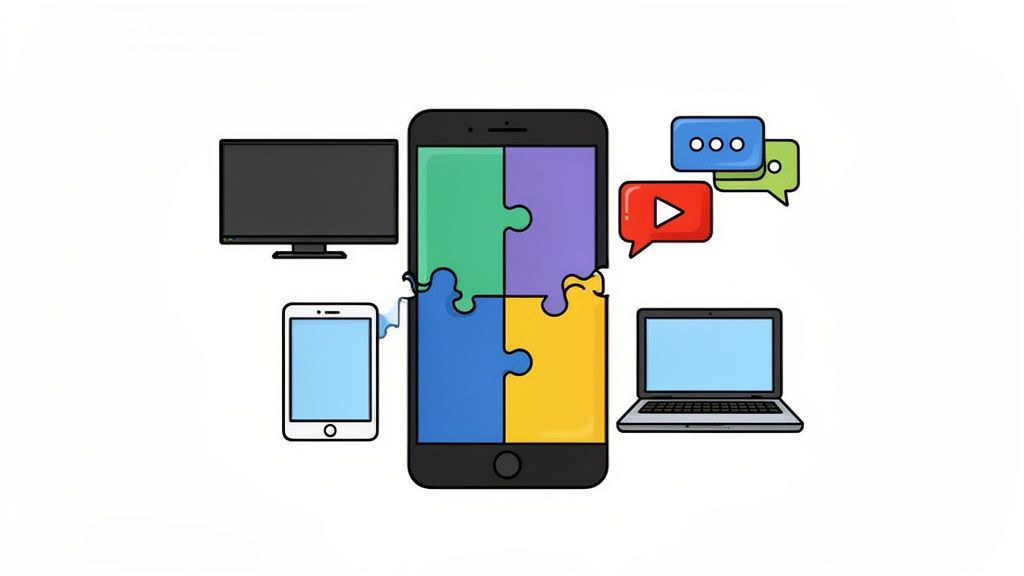
This map helps visualize how technology, content, and platforms are the key ingredients that get blended together in media convergence.

As you can see, technology is the catalyst. It allows totally different kinds of content to flow seamlessly across all sorts of platforms, creating that unified experience we all now take for granted.
Technological Convergence
The most obvious driver is technological convergence. This is the physical blending of devices and networks into one. Your smartphone is the perfect case study—it’s swallowed up your old digital camera, MP3 player, GPS, and maybe even your landline phone.
This fusion is really only possible because of two major developments:
- Digitization: This is the process of turning every form of content—text, audio, video—into digital data. Once it's all just ones and zeros, any digital device can process and share it.
- Network Infrastructure: The boom in high-speed internet and the spread of Wi-Fi means all this digital content can be accessed anywhere, anytime, on pretty much any connected device.
This is the technical backbone that lets a single story be told through a podcast, a video series, and an interactive website, all at the same time.
Economic Convergence
Next up is economic convergence, a powerful force rearranging the business of media. This is all about the horizontal and vertical integration of media companies. Huge corporations are buying up competitors and related businesses to control the whole media supply chain, from the moment an idea is born to the screen it’s viewed on.
Just think of a major entertainment giant that owns movie studios, TV networks, streaming apps, and theme parks. They can make a movie, show it on their own channels, stream it on their own platform, and then sell you a t-shirt with the characters on it.
Economic convergence is about creating self-contained media ecosystems. Companies aren't just selling content anymore; they're selling you access to a massive, interconnected world of entertainment and information.
This consolidation naturally leads to bundled services. For instance, current media and entertainment trends show that next-gen bundles will take over, with distributors embedding streaming apps directly for more convenience. This strategy is getting a massive boost from advertising growth, with U.S. ad spend expected to hit $389.1 billion by 2029, driven in large part by connected TV (CTV) on these very platforms. For a business working with Magic Logix, this means using business intelligence to find your audience in this newly fragmented world. You can discover more insights on next-generation media bundles from EY.
Cultural And Global Convergence
Finally, we have cultural convergence and global convergence, which really go hand-in-hand. Cultural convergence is the change from a passive audience to one that actively participates. Thanks to social media and platforms like YouTube and TikTok, consumers have become creators, critics, and distributors themselves.
This participatory culture means media is no longer a one-way broadcast. A TV show’s success isn't just measured by ratings anymore, but by the number of tweets, fan theories, and memes it sparks.
This flows right into global convergence, where media content jumps across geographical and cultural lines with stunning ease. A hit Korean drama on Netflix can become a worldwide phenomenon overnight, while a viral TikTok dance gets copied by people in dozens of countries in a matter of hours. This cross-pollination of ideas is a direct result of the technological and economic structures that make it all possible, bringing the whole concept full circle.
Real World Examples of Media Convergence in Action
To really get your head around what is convergence in media, you have to see it in action. The theory clicks into place once you notice it in the apps, shows, and games you probably use every single day. Convergence isn't just a stuffy academic idea; it's the practical reality of how we get our content.

These examples aren't just about cool tech. They show a huge shift in how stories are told, how communities form, and how brands now have to operate. They’re a clear blueprint for any business trying to build its own presence across multiple platforms.
The Streaming Giants Netflix and Disney+
Streaming services like Netflix and Disney+ are perfect examples of economic and technological convergence. They push massive libraries of movies, shows, and documentaries to just about any device with a screen. That’s technological convergence at its most basic—all that content, digitized and sent over one network.
But the real story here is their economic strategy. Just look at Disney. It runs a sprawling media ecosystem:
- Content Creation: It makes blockbuster movies and hit shows through studios like Marvel, Pixar, and Lucasfilm.
- Distribution: It sends all that content straight to you through its Disney+ streaming app.
- Ancillary Products: It then spins those stories out into theme park rides, merchandise, and video games.
A character who gets their start in a Disney+ series might end up starring in a new movie, which then inspires a ride at Disneyland. This creates a powerful, self-sustaining loop where every part of the media empire promotes the others, locking you deeper into their world. Netflix has a similar playbook, creating its own original content and then pushing it hard across social media, podcasts, and even interactive shows.
Key Takeaway: Modern media giants don’t just create content; they build entire universes. They use convergence to control the whole lifecycle of a story, from its birth to how it’s consumed on countless different platforms.
Fortnite From Video Game to Social Hub
Video games, especially titles like Fortnite, have completely redefined what a single media platform can be. Fortnite started out as a battle royale game, but it has since morphed into a converged social space. This is cultural convergence in full swing.
It’s not just a game anymore; it’s a virtual world. Players go there to watch live concerts from huge artists like Travis Scott and Ariana Grande. It hosts exclusive movie trailer premieres and interactive brand events. The lines between gaming, music, movies, and social media are completely blurred. Players don't just consume the content—they live inside it and experience it together. You can dive deeper into how these experiences are built by exploring a well-crafted immersive media strategy.
Modern News A Multi-Platform Story
News organizations have also had to adapt to this converged world. Today, a major news story is rarely stuck in one format. A breaking event might pop up first as a push notification on your phone, quickly followed by a live blog on a website.
As the story unfolds, it expands into:
- A deep-dive article packed with embedded videos and data charts.
- A podcast episode featuring interviews with the experts.
- A series of short video explainers for platforms like TikTok and Instagram Reels.
- Live Q&A sessions with journalists on social media.
This approach recognizes that different people want their news in different ways. It uses convergence to tell a richer, more complete story that meets people wherever they are. This is all part of a bigger trend where the lines between creators, studios, and platforms are disappearing. Forecasts for 2026 predict that studios will start weaving social media influencers into their development process, using them to test out ideas and build a fanbase before a single scene is even shot. This fusion is a key reason the media market is projected to hit $3,746.1 billion by 2030, fueled by our demand for authentic, multi-channel experiences. You can read more about these entertainment trend forecasts from All Things Insights.
How Convergence Impacts Your Marketing and Customer Engagement
Media convergence isn’t some abstract academic theory; it’s the new ground truth for how your business connects with customers. It completely redraws the map of how people discover you, research your products, and decide to buy, creating a web of touchpoints that’s both a huge opportunity and a serious challenge.
Your audience no longer lives in one predictable place. They might stumble upon your brand in a TikTok video, dig deeper on your blog, hear about you on a podcast during their commute, and finally pull the trigger on a purchase after seeing an ad on a streaming service. This scattered reality means that old-school, channel-by-channel marketing just doesn't cut it anymore.
From Siloed Channels to Omnichannel Journeys
If you're still thinking about your marketing in separate buckets—a "social media strategy" here, an "email strategy" there—you're setting yourself up for a fragmented and confusing customer experience. Convergence isn't just a suggestion; it demands an omnichannel approach, where every single platform works in concert to tell one, unified brand story.
Stop seeing your YouTube channel and your blog as separate entities. Instead, think of them as two chapters in the same book. The real goal is to build a seamless journey, letting a customer drift from one touchpoint to the next without hitting any dead ends or feeling any friction. That unified experience is what builds genuine trust and keeps people engaged.
This isn't a small tweak. It's a complete shift in mindset, moving away from isolated campaigns and toward integrated narratives. Let's break down how the old and new ways stack up.
Old vs New Marketing A Comparison
This table shows the stark contrast between the traditional, siloed way of thinking and the integrated approach that convergence requires.
| Marketing Element | Traditional Siloed Approach | Converged Omnichannel Approach |
|---|---|---|
| Strategy | Separate plans for each channel (social, email, blog). | One unified strategy where all channels support each other. |
| Customer View | Sees the customer as a "social follower" or "email subscriber." | Sees one customer who interacts with the brand across many platforms. |
| Content | Content is created for a single channel and rarely reused. | Content is designed to be adapted and repurposed across multiple formats. |
| Measurement | Success is measured in channel-specific metrics (likes, open rates). | Success is measured by the entire customer journey and lifetime value. |
It's pretty clear: the converged approach is far more holistic. It puts the customer’s entire experience front and center, rather than getting lost in the performance of a single, isolated channel.
Creating Immersive Brand Stories
To win in this converged world, you have to become a master storyteller. That means creating "transmedia" content—stories that don't just exist on one platform but unfold and expand across many different ones.
A modern, converged campaign might look something like this:
- The Hook: It all starts with a high-impact video on YouTube, introducing a core idea or a new product.
- The Deep Dive: Next, a detailed blog post goes live, exploring the "why" behind the video, complete with data, insights, and expert commentary.
- The Social Buzz: Short, snappy clips from the main video are cut for Instagram and TikTok to spark conversation and drive people back to the main content.
- The Conversation: A podcast episode features an interview with the experts from the video, answering questions directly from the audience.
- The Connection: Finally, an email newsletter pulls all the pieces together, offering exclusive insights and a clear path to take the next step.
Each piece works on its own, but it also adds value to all the others. This is how you create an immersive brand world that people actually want to be a part of. The secret is knowing that different platforms play different roles in the customer’s journey. For more on this, you can explore ideas around marketing on Spotify and other audio platforms, which shows how audio can be a powerful piece of a much larger transmedia puzzle.
Convergence forces marketers to move beyond simple advertising and become multi-platform content creators. Your brand is no longer just what you sell; it's the sum of all the stories you tell and the experiences you create across every channel.
This shift from single-channel tactics to a multi-platform "flywheel" is happening everywhere. Just look at the podcasting world. What was once a simple audio show is now expected to be a video series on YouTube, a daily newsletter, and a thriving social media community, all at once. The most successful creators aren't just making podcasts; they're building entire media ecosystems. This is a direct response to what is convergence in media—a blending of formats and expectations that rewards those who build a consistent, engaging presence everywhere their audience is.
How to Put Media Convergence to Work for Your Business

Knowing what media convergence is and actually using it to drive growth are two completely different things. This is where the theory ends and the real work begins. For any business today, tapping into convergence is about building a marketing engine where every single part works in harmony to create a compelling, unified customer experience.
This isn't just about showing up on every platform. It's about being on the right platforms, telling a consistent story that makes sense. The real goal is to create a flywheel effect—your blog, social media, videos, and emails all feeding one another, building momentum and pulling customers deeper into your brand's world.
Map the Complete Customer Journey
The first thing you have to do is break out of channel-specific thinking. Stop looking at your marketing in silos and start seeing it through your customer's eyes. The modern customer journey isn't a straight line; it's a winding, unpredictable path. You need to map out every single touchpoint where someone might encounter your brand.
This is more than just sketching out a standard marketing funnel. You have to ask the nitty-gritty questions:
- Where does my audience actually get their information?
- Which social platforms do they use for casual discovery versus serious research?
- Are they listening to podcasts on their commute or watching YouTube tutorials on their couch?
Once you have a real understanding of this behavior, you can place your content where it will make the biggest splash. A short, snappy video on TikTok could be the perfect hook, leading an interested viewer to a detailed blog post that explains the "why." You have to see the journey as one continuous experience, not a collection of random interactions.
Create Transmedia Content That Tells a Story
After you've mapped the journey, you need content that can travel with your customer along that path. This is the core of transmedia storytelling: creating a single, powerful narrative that unfolds across different platforms, where each piece adds a new layer to the experience.
Think of a single, major piece of content—like a deep research report or a comprehensive webinar—as the sun in your content solar system. From that one asset, you can spin off a whole universe of related content:
- Blog Posts: Break down the main findings into easy-to-read articles.
- Infographics: Turn the most powerful data points into shareable visuals.
- Short Videos: Create quick clips for social media highlighting key quotes or stats.
- Podcast Episodes: Host a discussion that takes your audience behind the scenes of the research.
This "build once, distribute everywhere" model is how you respond directly to media convergence. It guarantees your core message hits different audience segments in the formats they actually prefer, cementing your brand's authority at every single step.
A transmedia strategy is not just repurposing content—it's about expanding a story. Each platform should offer a unique piece of the puzzle, rewarding your audience for sticking with your brand across multiple channels.
Use Data for Personalized Engagement
In a world of converged media, data is the glue that holds everything together. Every single interaction—a click, a video view, a form fill—is a piece of valuable insight into what your customer actually wants. This is precisely why collecting and activating your own information is no longer optional. To get a better handle on this, you can learn more about what is first-party data and how to put it to use.
With the right marketing automation tools, you can use this data to deliver the perfect message at the perfect time. Think about it:
- Someone watches 75% of your product demo video. They could automatically get an email with a case study for that exact product.
- A user downloads a whitepaper about a specific problem. You could start showing them social media ads for an upcoming webinar that solves it.
This level of personalization transforms your marketing from a generic broadcast into a genuine one-on-one conversation. It’s what makes customers feel seen, heard, and understood, which dramatically boosts engagement and conversions.
Foster a Community with User-Generated Content
Finally, you can truly embrace cultural convergence by turning your audience from a passive crowd into an active community. User-generated content (UGC) is one of the most authentic and powerful tools in a converged marketing playbook. It delivers social proof that money can't buy and builds a powerful sense of belonging around your brand.
Encourage your customers to share their own experiences through reviews, unboxing videos, or photos. You can spark this by running contests, creating branded hashtags, or simply featuring the best customer content on your official channels.
When you amplify your audience's voice, you're not just getting free content. You're building a loyal tribe that feels a real connection to your brand and, just as importantly, to each other. This is the ultimate payoff of media convergence: a dynamic, collaborative relationship between a business and its community.
The Future of Media Convergence and What to Watch
If you think media convergence has peaked, think again. It’s not just continuing; it's accelerating and spinning off into areas we're only beginning to imagine. The next chapter will be written by intelligent, immersive, and deeply interconnected technologies that will blur the lines between our physical and digital worlds for good.
These trends aren't happening in a vacuum. They are actually converging with each other, creating a powerful ecosystem. Artificial intelligence, immersive digital worlds, and new ways of consuming content are all starting to work in concert, pushing the limits of what's possible.
The Rise of AI and Hyper-Personalization
Artificial intelligence (AI) is quickly becoming the central nervous system for the next phase of media convergence. Its power to chew through massive amounts of data in real-time is paving the way for a level of hyper-personalization we've never experienced. We're moving beyond AI that just recommends content to AI that actively shapes it.
Think about a streaming service that doesn't just suggest a movie but can subtly tweak a show's pacing or character development based on your unique viewing patterns. Or imagine a news app that builds a custom video briefing for you every morning, pulling clips from dozens of sources to perfectly match your interests. This is the future AI is building—a truly one-to-one media experience.
The next frontier isn't just about getting content on any device. It's about getting content that feels like it was made just for you and delivered at the exact right moment, all thanks to AI.
Immersive Tech and the Metaverse
Technologies that once felt like sci-fi, like augmented reality (AR) and virtual reality (VR), are shifting from niche toys to foundational platforms. They represent the ultimate converged space, blending digital experiences and information directly into our physical reality.
This evolution leads us straight to the concept of the metaverse—a persistent, shared virtual world where we can all interact with each other and with digital creations. This is much bigger than gaming. We're talking about a new arena for work, socializing, and business. For companies, this cracks open entirely new ways to think about marketing and customer engagement.
This shift is a core piece of a much larger business evolution. You can get a better handle on these foundational changes by reading about the benefits of digital transformation and seeing how they connect to building a business that's ready for what's next.
At the end of the day, media convergence isn't a passing fad—it's the fundamental reality of our world. Keeping up with its constant evolution is no longer a choice. It’s the single most essential strategy for future-proofing your business and guaranteeing success in a world where media is everywhere.
Frequently Asked Questions About Media Convergence
Diving into a topic like media convergence is bound to bring up a few questions. It’s a big concept, and it’s natural to wonder how all these moving parts fit together in the real world.
Let's tackle some of the most common questions to clear things up. Think of this as a quick-reference guide to help solidify your understanding.
Common Questions on Media Convergence
| Question | Answer |
|---|---|
| What is the difference between media convergence and cross-media marketing? | They're related, but media convergence is the big picture. It’s the broad technological and cultural shift where platforms themselves merge (like a smartphone). Cross-media marketing is a strategy you use because of convergence, like running a campaign that spans TV, social media, and email. One is the environment; the other is an action within it. |
| How can a small business use media convergence with a limited budget? | Focus on consistency and clever repurposing. Ensure your brand voice and visual identity are identical across your website, social profiles, and emails. A single blog post can be transformed into a series of tweets, an infographic, a short video, and a newsletter segment. The goal is a unified experience, not being on every single platform. |
| Is media convergence a threat to traditional media like TV or print? | It's more of an evolution than a threat. Smart traditional media companies are adapting by launching streaming apps, creating digital-first content, and engaging on social media. Instead of disappearing, they are integrating their legacy strengths with new digital platforms to meet their audience wherever they are, creating powerful hybrid models. |
As you can see, the core idea is a shift from isolated platforms to an interconnected web. It's less a threat to old media and more a complete evolution of how all media operates, creating new challenges and opportunities for businesses of every size.
The Next Frontier: Answer Engines
As AI continues to drive this integration, how people search for information is changing dramatically. It's no longer just about keywords and rankings; it's about providing direct answers.
Understanding What Is Answer Engine Optimization is critical for seeing how this new wave of convergence is reshaping content. The game is shifting from ranking on a results page to becoming the definitive answer, which is the ultimate goal of a great converged content strategy.
At Magic Logix, we help businesses turn these complex shifts into clear, actionable strategies that drive growth. Let us help you build a marketing engine that thrives in a converged world. Learn more about our solutions.