In the simplest terms, Instagram impressions are the total number of times your content pops up on someone's screen. That’s it. If a single person sees your post five different times, you've just earned five impressions. Think of it as a running tally of every single view, not a headcount of unique viewers.
What Are Instagram Impressions Really
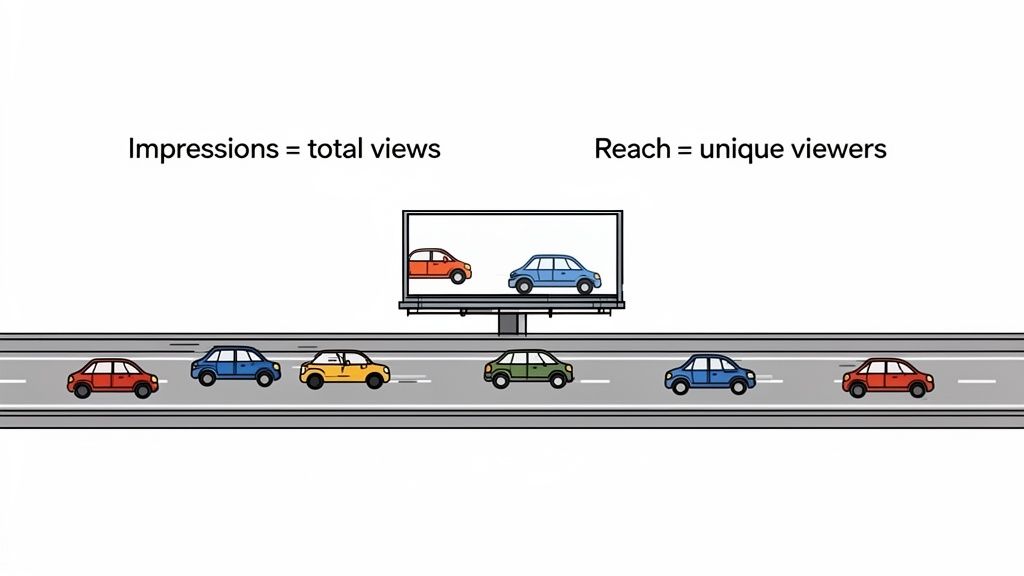
Let's ditch the marketing-speak for a second and use an analogy. Imagine your latest Instagram post is a brand-new billboard on a busy highway. Impressions are the total count of every single car that drives by and lays eyes on it.
It doesn’t matter if it’s the same commuter driving past that billboard on their way to work and back home again. Each time they pass, it adds to your impression count. This metric is all about exposure and frequency—how often is your content actually being seen?
This is where impressions and its close cousin, reach, part ways. While impressions count every view, reach only counts the unique cars that passed your billboard. So, that one commuter driving by five times? That's five impressions, but a reach of only one. Nailing this difference is the first big step to really understanding your Instagram analytics.
Impressions vs. Reach vs. Engagement
These three metrics are the bedrock of your Instagram performance analysis. Each one tells a different, crucial part of your content's story, from its initial visibility to how your audience actually interacts with it. They're all connected, but they measure distinct outcomes that are absolutely vital for a smart social media marketing strategy.
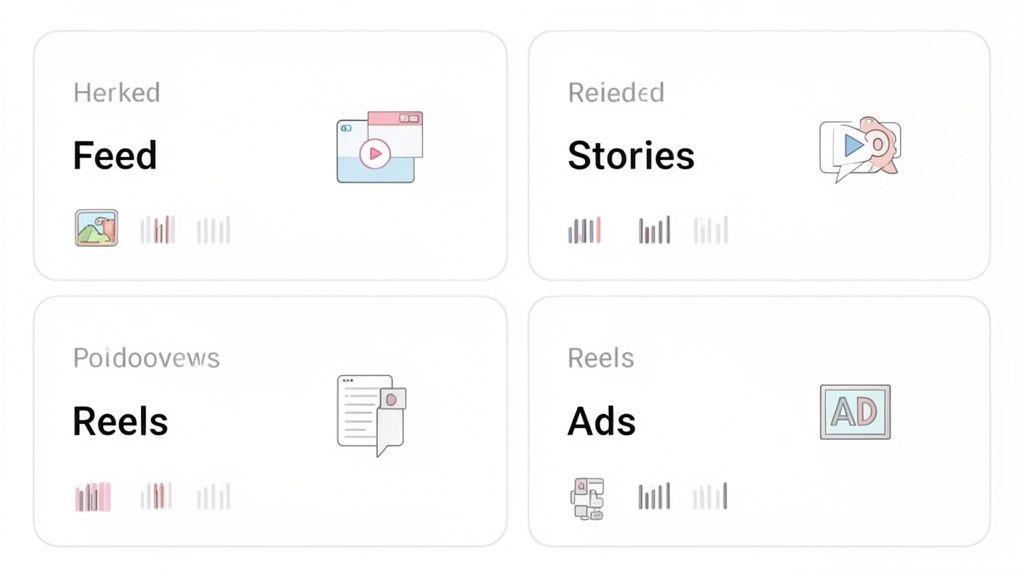
To make these core concepts crystal clear, this visual map breaks down the key Instagram metrics at a glance.
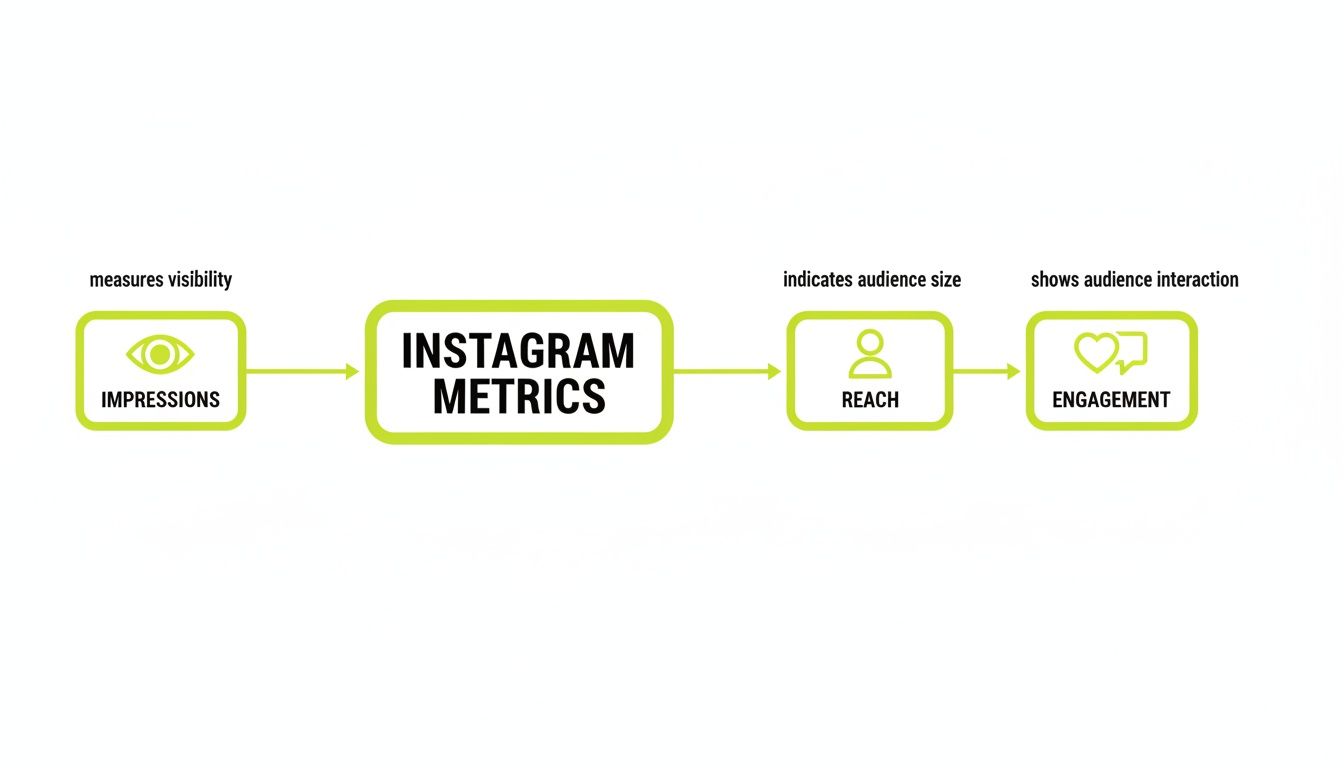
As you can see, impressions are all about total views, reach is about the unique size of your audience, and engagement captures direct actions like likes, comments, and shares. Getting these differences right is essential for reading the tea leaves of your content's performance and making sharp decisions that drive real business growth.
To make it even simpler, here's a quick cheat sheet to help you keep these fundamental metrics straight.
Quick Guide to Core Instagram Metrics
| Metric | What It Measures | Why It Matters for Business |
|---|---|---|
| Impressions | The total number of times your content was displayed on screen. | Shows the overall visibility and frequency of your content. Great for measuring brand awareness. |
| Reach | The number of unique accounts that saw your content. | Reveals the actual size of your audience. Key for understanding how far your message is spreading. |
| Engagement | The number of interactions (likes, comments, shares, saves). | Indicates how well your content resonates with your audience. A strong sign of community and loyalty. |
Think of this table as your go-to reference. Impressions tell you how often you're seen, reach tells you by how many, and engagement tells you how much they care. Using them together gives you the complete picture.
The Critical Difference Between Impressions and Reach
It’s easy to see impressions and reach grouped together and assume they’re interchangeable. But they actually tell two completely different stories about your content. Understanding this difference is the first step to moving beyond surface-level metrics and really digging into what your audience responds to.
Simply put, impressions count the total number of times your content was displayed on a screen. Reach, on the other hand, counts the number of unique accounts that saw it.
Think of it like a billboard on a busy highway. The reach is the number of individual cars that drive past it in a day. If 1,000 unique cars pass by, your reach is 1,000. The impressions are the total number of times the billboard was seen. If one person drives past that same billboard on their way to work and again on their way home, that one person accounts for two impressions.
This is the core difference: reach tells you how wide your audience is, while impressions measure the frequency and overall exposure of your content.
Why the Impression-to-Reach Ratio Matters
The real magic happens when you look at these two numbers together. The relationship between them reveals your content’s “stickiness”—how compelling it is.
When your impression count is much higher than your reach, it's a huge clue that people are coming back for more. It means the same users are viewing your content multiple times.
A high impression-to-reach ratio is a sign that your content is good enough to earn a second, third, or even fourth look. This might happen when a user:
- Plays your Reel on a loop.
- Comes back to your post to read through the comments.
- Sends your Story to a friend, who then views it.
- Sees your content in their main feed and then again on the Explore page.
A high impression-to-reach ratio is one of the clearest indicators that your content isn't just being seen—it's being re-engaged with. This "stickiness" factor tells the Instagram algorithm that your content is valuable, which can lead to even greater visibility.
This ratio is a powerful diagnostic tool. Say 1,000 unique accounts (reach) saw your post, but it generated 4,000 total views (impressions). That means the average viewer saw your content four times. That’s a massive win.
Decoding Ad Frequency and Content Stickiness
This dynamic is especially crucial when you're running ad campaigns. For ads, high impressions relative to reach translate to a high ad frequency. That's the average number of times a single person sees your ad.
Conventional marketing wisdom says it can take around seven exposures before someone remembers or acts on an ad. So, a higher frequency isn't necessarily a bad thing; it can be exactly what you need for brand recall and conversions.
But there’s a tipping point. If impressions are wildly high compared to reach, you risk ad fatigue. Your audience sees the same ad so many times that they start to tune it out or, worse, get annoyed by it.
By keeping an eye on both metrics, you can find that sweet spot. For a deeper dive, you can explore more about key digital marketing performance metrics to get a more complete picture.
Ultimately, to really understand impressions on Instagram, you have to look at them side-by-side with reach. This comparison turns them from simple vanity numbers into strategic tools that help you gauge what’s truly connecting with your audience and fine-tune your campaigns for the best results.
How Instagram Counts Impressions Across Its Different Formats
Knowing what Instagram impressions are is one thing, but understanding where those numbers actually come from is a whole other ball game. Instagram logs an impression the second your content pops up on someone's screen, but the specific rules change a bit depending on the format.
Think of it this way: each content type gives you a unique way to rack up impressions. For a classic Feed Post (a single image or video), it's simple. One appearance in a user's feed or on the Explore page equals one impression.
But things get a lot more interesting—and powerful—with multi-part content. Some formats are practically impression-generating machines.
Counting Impressions for Carousels, Stories, and Reels
With Carousel Posts, Instagram doesn't just count an impression for the post itself. It counts one for each slide a person swipes through. If someone sees your 10-slide carousel and swipes through all of them, you just scored 10 impressions from that single viewer. This makes carousels an incredible tool for juicing your total impression numbers.
Instagram Stories play by a similar rulebook. Every individual frame or video clip in your Story sequence is its own separate impression. So, if a user taps through all five parts of your daily Story, that's five impressions right there. This is exactly why multi-part, engaging Stories often have such massive impression counts compared to a simple, one-and-done update.
Finally, we have Reels. These generate an impression every single time they're played, whether that's in the Reels tab, on the Explore page, or right in someone's main feed. Given how hard Instagram's algorithm pushes them, Reels are built for massive visibility and repeat views, making them a cornerstone for any brand focused on maximizing impressions.
And the data backs this up. Reels and carousels are true impression powerhouses. Influencer Reels boast the highest engagement rate at 2.08%, with carousels close behind at 1.7%—both crushing traditional video posts. You can get a deeper look at just how dominant these formats are by exploring the latest Instagram statistics.
Where to Find Your Impression Data in Instagram Insights
Ready to see these numbers for yourself? You’ll need an Instagram Business or Creator account. Switching over unlocks Instagram Insights, the platform's native analytics tool where all this juicy performance data lives.
Here’s a quick look at where you can spot these metrics for an individual post.
As you can see, the screenshot lays out "Accounts reached" (your Reach) right next to "Impressions," making it easy to compare how many unique people saw your post versus the total number of times it was seen.
To get to your data, just follow these simple steps:
- Head to your profile and tap the Professional Dashboard button.
- Choose Account Insights for a high-level overview of your performance.
- Tap on Accounts Reached to dive into a detailed breakdown of your impressions over different timeframes.
You can also pull up the stats for specific posts, Reels, or Stories by tapping the View Insights button located directly on that piece of content. This granular view is where the magic happens—you can analyze which formats are driving the most impressions and start making smarter, data-driven decisions to get your content in front of more eyes.
Why High Impressions Drive Business Growth
It’s tempting to write off a high impression count as just another vanity metric, but that’s a big mistake. In reality, impressions are the bedrock of your entire marketing funnel. Think of them as the fuel for your growth engine. Without that consistent visibility, even the most creative message or unbeatable offer is dead in the water.
Impressions are that crucial first handshake in the customer journey. Before anyone can follow you, love your content, or buy your product, they have to see you first. Piling up impressions keeps your brand top-of-mind, building the kind of familiarity that breeds trust and, eventually, action.
This isn’t a new-fangled social media idea; it’s rooted in a classic marketing principle called effective frequency. The concept is simple: a customer usually needs to see a message several times before it truly sinks in and they feel motivated to do something about it. High impressions make that repeated exposure a reality, drilling home your brand’s value.
Building Brand Awareness and Recall
At the end of the day, business growth starts with awareness. If potential customers don’t know you exist, they can’t buy from you. Period. Impressions tackle this head-on by putting your brand in front of a wide audience, over and over again. This steady presence is what turns an unknown name into a familiar one.
This constant visibility is absolutely vital on a jam-packed platform like Instagram. The platform’s global ad reach has climbed to a staggering 1.74 billion people, a 5.5% jump year-over-year. That scale shows you just how massive the opportunity—and the competition—is for brands trying to get seen.
Impressions are like planting seeds of brand recognition. Every single view, even if it doesn't lead to a like or a follow, helps build a mental footprint in your audience's mind. Over time, all that exposure makes your brand feel credible and established.
This process is critical whether you're a small local shop or a huge enterprise. A neighborhood bakery, for instance, can use repeated impressions on Instagram Stories to build hype for a weekend sale. By popping up in their followers' feeds multiple times, they create anticipation and drive people through the door.
Fueling the Entire Customer Journey
On the other end of the spectrum, a national brand can use millions of ad impressions to launch a new product with a bang. That initial wave of visibility creates widespread awareness, pushing customers right into the consideration phase of their buying journey.
Look at how it plays out in the real world:
- Local Coffee Shop: They post frequent, high-impression Reels of their baristas crafting specialty lattes. That repetition keeps them top-of-mind when locals are deciding where to grab their morning coffee.
- E-commerce Clothing Brand: They run targeted ads that rack up impressions with a specific demographic. Someone might see an ad for a dress a few times before they finally click to check out the website.
- B2B Software Company: They share carousel posts loaded with industry tips. High impressions make sure their expertise is consistently seen by potential clients, positioning them as the go-to thought leaders.
In every one of these cases, impressions aren’t the end goal; they’re the catalyst. They create the fertile ground for other, more concrete marketing results to grow. Nailing this relationship is a core part of any successful marketing campaign planning template. Impressions feed reach, which drives engagement, which leads to clicks and sales.
Actionable Strategies to Increase Your Instagram Impressions
Knowing what impressions are is the first step. The next is figuring out how to get more of them. Driving up your impressions simply means getting your content in front of more eyeballs, more often. This isn’t a game of chance; it’s about following a reliable framework of proven tactics designed to grab attention and win over the Instagram algorithm.
Think of these strategies as your personal visibility toolkit. Each one is a different tool you can pull out to build a stronger presence, get people to view your content again and again, and ultimately grow your brand’s footprint on the platform.
Let's get into the practical, step-by-step playbook for boosting your impression count.
Optimize Your Posting Schedule for Peak Visibility
One of the easiest wins for getting more impressions is to post when your audience is actually online and scrolling. When you post at these peak times, your content hits the feed right when it’s buzzing with activity, giving you an instant visibility bump from the get-go.
Consistency is a huge part of this. Learning how to schedule posts on Instagram is a game-changer because it guarantees your content shows up during these prime windows, which has a direct effect on your impressions.
Here’s how to find your own personalized peak hours:
- Head over to your Professional Dashboard.
- Tap on Account Insights and then select Total Followers.
- Scroll down to the Most Active Times section. You'll find a breakdown showing you exactly which days and hours your followers are most engaged.
Leverage High-Impact Content Formats
When it comes to racking up impressions, not all content formats are created equal. As we've touched on, some formats are basically built-in impression machines. Making these a priority in your content strategy is a surefire way to maximize your views.
Reels: The algorithm absolutely loves short-form video. Reels get pushed out to your followers and to people who don't follow you yet through the Reels tab and the Explore page. This makes them your single best tool for explosive visibility.
Carousel Posts: These are brilliant for earning multiple impressions from a single person. Every single swipe to a new slide in a carousel counts as a brand-new impression. So, a detailed 10-slide educational post could potentially deliver 10 impressions from one very interested viewer.
Why It Works: It's simple—these formats naturally encourage people to watch again or interact more deeply. A looping Reel or an informative carousel keeps a user’s attention locked in, which signals to the algorithm that your content is valuable and worth showing to more people.
Think about a real estate agent. They could create a Reel that gives a fast-paced tour of a new property. The quick cuts and upbeat music will make people want to watch it a few times, racking up impressions with every single loop.
Master Your Hashtag Strategy
Hashtags are the discovery engine for your content. They categorize your posts and make them visible to users who aren't following you but are actively looking for content in your niche. A smart hashtag strategy puts your posts right in front of a relevant, interested audience.
- Mix Hashtag Sizes: Use a healthy mix of broad, popular hashtags (like #DigitalMarketing), more niche-specific ones (like #SMBMarketingTips), and your own branded tags (like #YourBrandNameHere).
- Keep Them Relevant: Every hashtag should directly relate to what your post is about. Using irrelevant tags can actually hurt your visibility.
- Aim for 5-10: You can use up to 30, but a focused group of 5 to 10 highly relevant hashtags usually delivers the best results.
A local coffee shop, for instance, could use a mix like #CoffeeLovers (broad), #DallasCoffeeShops (niche/local), and #MorningBrewMagic (branded) to hit different audience segments. Driving traffic from different sources is vital; you can dig into other ways to boost your social media traffic in our other guide.
Encourage Saves and Shares
Likes and comments are nice, but saves and shares are what the algorithm truly values. When someone saves your post, they're telling Instagram it’s valuable enough to come back to. When they share it, they’re doing the marketing for you, generating fresh impressions from their own network.
Here's how to get more of these high-value actions:
- Create "Saveable" Content: Think checklists, quick tutorials, infographics, or any valuable tips people will want to reference down the line.
- Use Clear Calls-to-Action: Don't be afraid to straight-up ask your audience to "Save this post for later" or "Share this with a friend who needs to see it."
By putting these strategies into practice, you can systematically work to boost your Instagram impressions and make sure your awesome content gets the visibility it deserves.
Frequently Asked Questions About Instagram Impressions
Even after getting a handle on the basics, a few questions about Instagram impressions always seem to pop up. Let's tackle the most common ones head-on so you can put this knowledge to work with total confidence.
Why Did My Instagram Impressions Suddenly Drop?
Seeing your impressions take a nosedive can be jarring, but don't panic. It's usually a sign that something in your approach needs a second look. More often than not, it's the algorithm's way of telling you that your latest content just isn't hitting the mark like it used to.
There are a few usual suspects:
- A Shift in Content Strategy: Did you recently pivot your content style, format, or posting schedule? The algorithm might be recalibrating how and where it shows your posts as it learns your new pattern.
- Audience Disengagement: If your likes, comments, and shares are dipping, Instagram takes that as a signal that your content is less compelling, which naturally leads to less visibility.
- Increased Competition: A competitor could be having a great week, capturing more of your audience's attention and screen time. It happens.
- Algorithmic Changes: Instagram is always tweaking things behind the scenes. A drop might just mean that your tried-and-true strategy isn't lining up with what the platform is currently prioritizing.
Your first move should be to dive into your Instagram Insights. Look for patterns in the content that's underperforming and stack it up against your greatest hits. The answer is usually hiding in the data.
Do My Own Views Count as Impressions?
Yes, they do. When you view your own post, Instagram counts it as an impression. The platform doesn't distinguish between you, a loyal follower, or a brand-new user seeing it for the first time.
While that might sound like it could throw off your numbers, it's really not a big deal in the grand scheme of things. As a creator, you'll probably only look at your own post a handful of times, which is just a drop in the bucket compared to your total impressions.
The best advice? Focus on the big picture. Don't sweat the small stuff like your own views. Instead, pour your energy into creating content so good that thousands of other people can't help but view it over and over again.
Are Impressions Important for Small Businesses?
Absolutely—they're essential. For a small business, impressions are your currency for building brand awareness and staying top-of-mind, especially in a local market or a tight-knit niche.
High impressions mean your brand is consistently showing up where your potential customers are. That visibility builds the familiarity and trust you need to eventually drive foot traffic to your store or clicks to your website.
Think of it like this: a potential customer might see your post about a new seasonal coffee blend three or four times before they finally decide to stop by. Each one of those impressions is a critical touchpoint, nudging them closer to making a purchase. Impressions are what lay the groundwork for real growth.
Ready to turn those impressions into measurable business results? At Magic Logix, we blend creativity with data to build digital marketing strategies that capture attention and drive growth. Discover how we can elevate your brand's presence by visiting us at https://www.magiclogix.com.