The core difference between a push and pull strategy boils down to one simple question: are you going to your customers, or are you making them come to you? Think of it this way: push marketing proactively sends a message out to an audience, while a pull strategy naturally draws in an audience that's already looking for a solution.
Your choice hangs on whether you need to create demand right now or capture interest that already exists.
Understanding Push And Pull Marketing Fundamentals
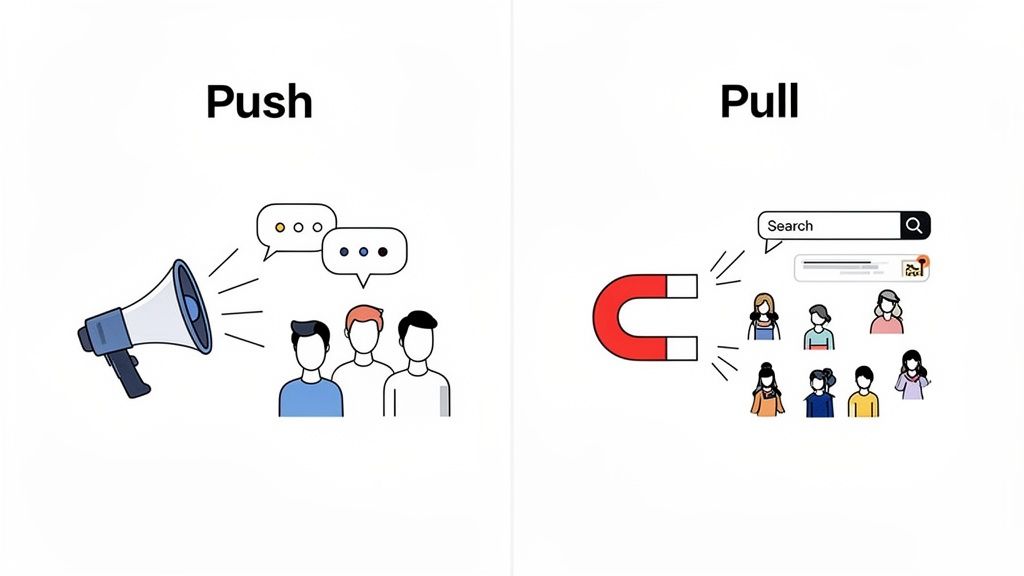
In marketing circles, we often talk about the push vs. pull dynamic as the difference between a megaphone and a magnet. It's a simple but powerful analogy. A push strategy is the megaphone, broadcasting a message far and wide to build awareness and, hopefully, spark immediate action. It’s an outbound approach designed to put a product or service right in front of people, whether they were looking for it or not.
A pull strategy, on the other hand, is the magnet. It works by attracting customers who are actively searching for information or a solution to a specific problem. This inbound method is all about creating valuable, discoverable content that builds authority and trust, making your brand the obvious choice when someone is ready to buy.
Core Concepts Of Each Approach
Push marketing is what most people think of as traditional advertising and direct sales. It’s about getting quick visibility and driving short-term sales lifts. Common tactics include:
- Paid Advertising: Display ads, social media ads, and pay-per-click (PPC) campaigns targeting specific demographics.
- Direct Outreach: Cold emailing, direct mail, and even telemarketing that initiate the first contact.
- In-Person Promotions: Trade show booths and in-store displays are classic examples, designed to grab immediate attention.
Pull marketing is a longer game, built on a foundation of creating real value and letting people discover you organically. The goal isn't just a sale; it's to become a trusted authority that customers actively seek out. This is where tactics like these shine:
- Search Engine Optimization (SEO): The absolute cornerstone of any pull strategy is optimizing your website to rank high in search results. You can learn more about our SEO services here.
- Content Marketing: Creating blogs, videos, and guides that genuinely answer customer questions and solve their problems.
- Organic Social Media: Building a community by sharing useful content that sparks engagement and fosters brand loyalty.
Modern consumer behavior has tipped the scales heavily in favor of pull marketing. A staggering 71% of consumers now prefer to do their own online research before buying anything. This shift is why pull strategies, which focus on providing value, just work better for engagement. In fact, 72% of marketers report that creating quality content directly boosts interaction rates.
Core Differences Between Push and Pull Strategies
To quickly break down the fundamental distinctions, this table contrasts how each strategy operates across key areas. It's a handy reference before we dive deeper into the analysis.
| Dimension | Push Strategy (Proactive Outreach) | Pull Strategy (Inbound Attraction) |
|---|---|---|
| Communication Flow | One-way communication from brand to consumer. | Two-way dialogue where the consumer initiates contact. |
| Primary Goal | Generate immediate demand and short-term sales. | Build long-term brand equity and customer loyalty. |
| Consumer Intent | Targets passive audiences who may not be aware of the need. | Attracts active seekers who are already problem-aware. |
| Key Tactics | PPC Ads, Direct Mail, TV Commercials, Trade Shows. | SEO, Content Marketing, Organic Social Media, Referrals. |
This at-a-glance view sets the stage perfectly, showing the clear contrast in approach, goals, and the type of customer each strategy is designed to reach. Now, let's explore when and why you'd choose one over the other.
Comparing Push vs Pull Marketing Across Key Metrics
Once we get past the definitions, the real meat of the push vs pull strategy debate is how they perform against the metrics that actually matter to a business. This isn't just a simple tactical choice; it's a strategic decision that ripples through everything from your budget allocation to the future of your brand. Each approach comes with its own distinct set of trade-offs.
It's absolutely crucial to understand these differences to put your resources where they'll have the most impact. A push campaign might give you an immediate shot of traffic, but a pull strategy is what builds a sustainable, cost-effective marketing engine for the long haul. Let's break down how they really stack up.
Speed To Results And Targeting Precision
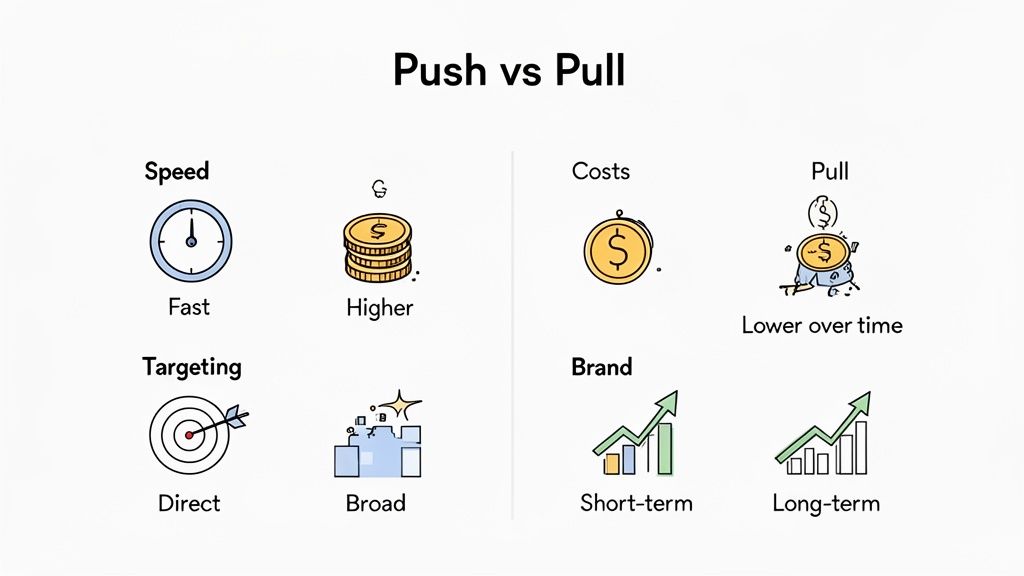
One of the sharpest contrasts between the two is how quickly you can expect to see a return. Push marketing is engineered for speed. A properly configured paid ad campaign can start delivering impressions, clicks, and even leads within a few hours of going live. That kind of immediacy is gold for new product launches, seasonal promotions, or anytime you need to get a fast read on market response.
The targeting precision of push marketing is another huge plus. Platforms like Google and Meta let you get incredibly specific, segmenting audiences by demographics, interests, past behaviors, and even purchase history. You're literally "pushing" your message right in front of a hand-picked group that's most likely to be interested, which cuts down on wasted ad spend. For a closer look at how this works, check out our guide on Google Ads marketing.
On the flip side, pull marketing plays the long game. Building up organic authority through SEO and great content is a marathon, not a sprint. You could be waiting 3-6 months to see any real movement from an SEO initiative, with the most significant impact often taking a year or more to materialize. The targeting here is also broader by nature—you attract anyone searching for your chosen keywords, which then requires careful content and funnel refinement to capture the users with the highest intent.
Customer Acquisition Cost And Scalability
Customer Acquisition Cost (CAC) is where the long-term payoff of pull marketing really starts to shine. While push tactics like PPC deliver those quick wins, they often come with a higher, more persistent CAC. You are, in essence, renting an audience. The second you turn off the paid ads, the lead flow dries up. On top of that, costs can creep up as more competitors bid for the same keywords and audience attention.
Pull strategies, however, demand a hefty upfront investment of time and resources for things like content creation and technical SEO. But over time, they can drive your CAC progressively lower. A single, well-ranked blog post can become a durable asset, generating organic leads for years without any additional cost. The cost per lead from that initial investment just keeps dropping with every new conversion it brings in.
A core distinction lies in the financial model: Push marketing is an ongoing operational expense tied directly to lead volume, while pull marketing is a capital investment that builds a lead-generating asset with appreciating value.
When you look at scalability, each has its own flavor. You can scale push campaigns quickly just by upping the budget, but you might eventually hit a ceiling where the audience is saturated or your returns start to diminish. Pull marketing scales more organically. As your domain authority grows, your capacity to rank for even more competitive keywords expands, creating a compounding effect on your traffic and lead generation.
Long-Term Brand Equity And Customer Trust
Finally, the way each strategy impacts your brand equity uncovers a deep psychological difference. Push marketing is, by its very nature, interruptive. It's effective for getting your name out there, but it can sometimes feel intrusive to the user, which isn't the best recipe for deep brand loyalty. It's great at creating urgency and awareness, but it relies on sheer repetition to build memory.
In contrast, pull marketing is the bedrock for building genuine brand equity and trust. When you consistently create valuable, helpful content that solves real problems for your audience, you establish your brand as a credible authority. A customer who discovers you organically through a helpful guide or an insightful article forms a much stronger, more positive connection with your brand. That relationship is built on a value exchange, not an interruption, which is how you foster true long-term loyalty and turn customers into advocates.
When to Use Push vs. Pull: Real-World Scenarios
Understanding the theory behind push and pull strategies is one thing. Knowing exactly when to deploy each is what separates a killer campaign from a wasted budget. The right move depends entirely on your business goals, your position in the market, and what you need to achieve right now. A strategy that works wonders for a product launch could fall completely flat when you're trying to build long-term brand loyalty.
Let's translate that theory into practice. We'll break down a few real-world business situations to show you how these strategies get applied for maximum impact. Each example gives clear, actionable context to help you match your tactics to your goals.
Push Strategy Use Cases: Generating Immediate Demand
A push strategy is your go-to when you need to manufacture demand, grab immediate attention, or drive quick action. It’s proactive and direct, perfect for times when your audience isn't actively looking for what you offer—either because your product is brand new or the need is tied to a specific event.
Think about a startup launching an innovative product, like a smart coffee mug that keeps your drink at the perfect temperature. Nobody is searching for this yet, so a pull strategy would be dead in the water. Instead, a targeted push campaign using Instagram and Facebook video ads can showcase the mug in action, interrupting users' feeds to create instant desire and drive those crucial early sales.
Another classic push scenario is a seasonal retail promotion. A clothing store running a Black Friday sale can't afford to sit back and wait for customers to show up. They have to proactively "push" their offer out with aggressive email marketing, SMS alerts, and retargeting ads. This creates urgency and lets them cash in on a limited-time shopping frenzy, ensuring their message hits a huge audience right when they're ready to buy.
When you're trying to figure out which push tactics are most effective, exploring different methods for outbound lead generation can give you some powerful ideas.
Key Takeaway: Use a push strategy when speed is everything, the market doesn't know your solution exists, or your goal is to trigger an immediate, time-sensitive response. It's about starting the conversation, not waiting to join one.
Pull Strategy Use Cases: Capturing Existing Intent
A pull strategy shines when your target audience already knows they have a problem and are actively hunting for a solution. This approach is all about positioning yourself as the best answer when a potential customer raises their hand. It’s about building authority and trust to attract high-intent leads naturally.
For instance, an established B2B tech company selling complex project management software would get massive value from a pull strategy. Their audience—managers and team leads—is already searching for phrases like "best software for remote teams" or "how to improve team productivity." By creating in-depth whitepapers, comparison guides, and webinars optimized for those keywords, the company "pulls" in qualified leads who are already deep in the buying cycle.
Building a niche online community is another powerful pull tactic. Imagine a company selling sustainable home goods. They could create a blog and social media group dedicated to eco-friendly living tips. By consistently dishing out valuable content, they attract an audience that's passionate about the subject, building trust that makes their products the obvious choice when it's time to buy. This fosters a kind of loyalty that a single transaction never could.
How to Choose Your Marketing Strategy
Picking between a push and pull strategy isn't about finding a single "best" approach. The smart move is to treat it like a strategic decision that changes based on your business, your goals, and where you stand in the market. The most effective marketing plan is almost always a fluid one, adapting as your company grows and evolves.
Your choice should really be guided by a few key factors: your product’s lifecycle stage, how much brand awareness you currently have, and what your competitors are doing. Getting a clear handle on these elements will show you exactly where to put your resources to get the biggest bang for your buck, whether that means creating demand from scratch or capturing it.
This simple decision tree can help you visualize the initial choice. If you're launching something new, you almost always have to start with a push strategy to build awareness. For established markets where people are already searching, a pull approach makes more sense.
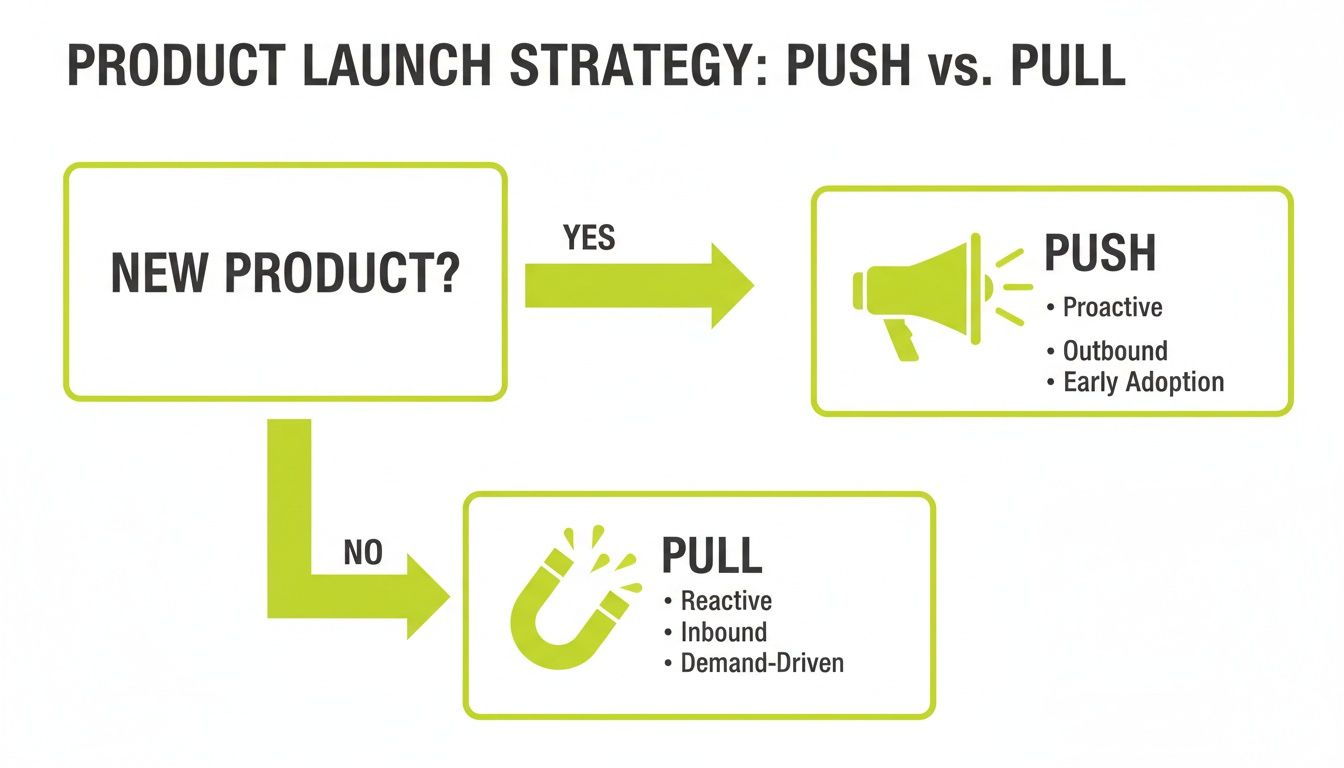
The flowchart boils it down: if you need to teach the market about something they've never seen before, you have to proactively push that message out. If an audience is already out there looking for what you offer, your job is to pull them in.
Assess Your Product Lifecycle Stage
How mature your product or service is can be one of the most reliable signs of which strategy to lead with. Every stage of a product's life comes with its own marketing challenges that naturally fit either a push or pull model.
Introduction Stage: When you're launching something brand new, your main goal is education. People can't search for a solution they don't even know exists, which makes a push strategy essential. You'll need targeted ads and direct outreach to introduce the idea and create that initial spark of demand.
Growth Stage: As your product starts getting some traction, things begin to shift. Push tactics are still great for breaking into new market segments, but now a pull strategy becomes critical. It's time to focus on SEO and content marketing to attract people who are actively looking for and comparing solutions.
Maturity Stage: In a mature market, it's all about brand loyalty and setting yourself apart. At this point, a strong pull strategy is what keeps you top-of-mind and cements your authority. Building a content moat around your brand is the name of the game. We dive deeper into this idea in our guide explaining why blogging is important for marketing.
Analyze Your Brand Awareness and Audience Behavior
Where you stand in the market right now also plays a huge role. A household name can lean on its reputation to pull customers in, while a startup has to get in people's faces.
If you’re the new kid on the block in a crowded industry, a targeted push campaign can help you carve out a niche and get noticed. You literally have to interrupt potential customers to let them know you’re an option. On the flip side, if you're an established leader, your focus should be on defending that position with high-value pull content that captures organic search traffic.
Just as important is understanding how your audience acts. Are they typing questions into Google? Or are they discovering new things scrolling through their social media feeds? Tools like Google Trends and various keyword research platforms can show you how much search demand already exists, helping you decide whether to capture it (pull) or create it (push).
The Power of a Hybrid Push-Pull Model
For most companies, the real answer isn't choosing one over the other—it's blending them. Modern marketing is at its best when it uses a hybrid approach, playing to the strengths of each method to build a plan that's both comprehensive and resilient.
A hybrid strategy uses push tactics to amplify high-value pull assets. For example, running a targeted ad campaign (push) to promote a comprehensive industry report (pull) drives immediate traffic to a long-term resource, accelerating lead generation and authority-building simultaneously.
This integrated model is so common because it delivers both short-term wins and long-term loyalty. Research shows push can drive initial awareness, contributing to 33% of retail revenue through channels like PPC. At the same time, pull strategies are masters at nurturing leads, boasting conversion rates that can be up to 68% higher. Push works wonders for standardized products with stable demand, while pull is often better for customized products in more volatile markets.
Putting Your Strategy to Work (And Proving It Works)
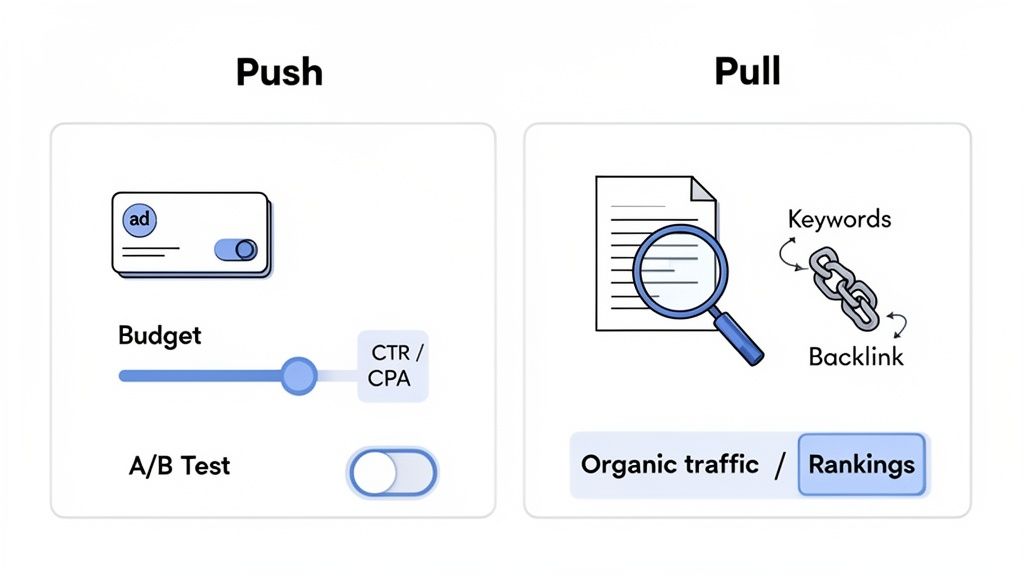
Choosing between push and pull is just the opening move. The real win comes from solid execution and knowing exactly what to measure. Each approach demands its own playbook and a unique set of Key Performance Indicators (KPIs) to tell you if you're on the right track.
Launching a campaign without the right metrics is like flying blind. A push campaign lives and dies by its immediate response and efficiency. On the other hand, a pull strategy is a long game—its value shows up over time as you build organic traffic and become a trusted authority.
Let’s get into the nitty-gritty of how to implement each one and, crucially, how to measure the results.
Executing a High-Impact Push Strategy
A winning push campaign is all about precision and constant tweaking. You're aiming to get the right message in front of the right person at the perfect moment, all while keeping costs in check. This isn't a "set it and forget it" deal; it requires a methodical approach.
The whole game is proactive targeting. Since you're the one starting the conversation, you have to know your audience inside and out to avoid burning through your budget.
Here are the essential steps to get started:
- Define and Segment Your Audience: Get granular. Use demographic, psychographic, and behavioral data to build out detailed customer personas. Platforms like Meta and Google Ads let you target with surgical precision based on interests, past purchases, or even major life events.
- Allocate Your Budget Strategically: Don't go all-in at once. Start with a test budget to see which channels and audience segments are hitting the mark. Keep a close eye on performance and be ready to shift your spend to the campaigns that deliver the best Return on Ad Spend (ROAS).
- A/B Test Your Creative Assets: Never assume you know what will connect with your audience. You should always be testing different ad copy, headlines, images, and calls-to-action (CTAs). Sometimes the smallest tweak can cause a massive jump in click-through and conversion rates.
Key Insight: Push marketing is a numbers game fueled by rapid iteration. Your job is to quickly find the winning formula—the right audience, creative, and channel—then scale what's working and kill what isn't.
Building a Sustainable Pull Strategy
Pull is a whole different beast. Here, you're building a long-term asset that draws customers to you organically. It takes patience and a real commitment to creating high-quality content that actually solves your audience's problems. It all starts with understanding what they're looking for.
Your goal is to become the go-to resource in your space. This isn't a single project; it's a process built on a few key pillars:
- Comprehensive Keyword Research: Figure out the exact terms and questions your ideal customers are typing into search engines. Build your content around topic clusters—groups of interlinked articles focused on a central pillar page—to show search engines you're an authority on the subject.
- Consistent Content Creation: Get a content calendar in place and stick to it. Regularly publish genuinely helpful blog posts, guides, and videos that address your audience's pain points. Quality and relevance always trump quantity.
- Strategic Content Promotion: Just hitting "publish" isn't enough. You have to get your content out there. Share it on the right social channels, feature it in your newsletters, and do outreach to build backlinks, which are absolutely vital for SEO.
Of course, a huge part of executing your strategy is knowing how to track its impact. You can get a deeper dive into measuring content marketing ROI to help you prove the value of your work.
Measuring Success With the Right KPIs
You can't use the same yardstick for push and pull. They have fundamentally different goals, and tracking the right metrics is critical. Mixing them up is a classic mistake that can lead you to shut down a pull initiative that’s slowly gaining momentum simply because it isn't delivering the instant gratification of a push campaign.
KPIs for Push Marketing Success:
- Impression Share: How often are your ads being seen compared to how often they could be?
- Click-Through Rate (CTR): What percentage of people who see your ad actually click on it?
- Cost Per Acquisition (CPA): How much does it cost, on average, to get one new customer?
- Return on Ad Spend (ROAS): For every dollar you spend on ads, how much revenue are you bringing in?
KPIs for Pull Marketing Success:
- Organic Traffic Growth: Are more people finding you through search engines over time?
- Keyword Rankings: Where do you show up in search results for your target keywords?
- Backlink Acquisition: Are other reputable sites linking back to yours?
- Lead Quality and Conversion Rate: What percentage of your organic visitors turn into qualified leads or customers?
Don't underestimate the power of pull. A fascinating case study of Danish companies found that search engine traffic accounted for a massive 48.7% of total visits, crushing the 8.2% from social media push efforts. Even better, that pull traffic delivered conversion rates 68% higher, proving its long-term value. This is a perfect example of why tracking the right numbers is so important for understanding what each strategy really brings to the table.
Common Questions About Push and Pull Marketing
When you get down to the brass tacks of push vs pull strategy, a few practical questions always come up. Marketers constantly wrestle with where to put their budget, how long to wait for results, and how to make these two seemingly opposite approaches work together. Let's clear up some of the most common queries to help you make smarter decisions.
Each of these questions gets into a real-world marketing challenge, from the tight budgets of a small business to the long-haul patience that a great pull campaign demands.
Can a Small Business Afford a Push Marketing Strategy?
Absolutely. When people hear "push marketing," they often picture expensive Super Bowl ads, but the digital age has completely changed the game. Today's push marketing is incredibly affordable and scalable, making it a perfect fit for small businesses.
Platforms like Google Ads and Meta give you pinpoint control over your spending—you can start with just a few dollars a day. The secret isn’t a huge budget; it's hyper-targeting. A local bakery, for example, can push ads directly to people who live within a 10-mile radius.
This kind of focused targeting cuts out wasted ad spend and drives up your return. Better yet, the instant feedback from these campaigns lets you test your messaging on the fly, figure out what works, and then confidently scale up your budget.
How Long Does It Take for a Pull Strategy to Show Results?
If you're going to invest in a pull strategy, your most important asset is patience. Unlike a paid ad that delivers clicks the moment it goes live, pull marketing is a long-term play. You're not just renting attention; you're building a brand asset.
Take Search Engine Optimization (SEO), which is the heart and soul of most pull strategies. You can expect to wait anywhere from 3 to 6 months just to see your rankings start to budge for competitive terms. Seeing a real, traffic-driving impact often takes a year or more of consistent work.
Content marketing works the same way. When you publish a blog post or a video, you're laying another brick in your foundation. A single piece of content might get some initial views, but the real power comes from building an entire library of valuable resources over time. That library becomes a durable asset that pulls in leads for years, but it requires a serious commitment to the long game.
Is One Strategy Better for B2B and the Other for B2C?
This is a classic marketing question, but the old rules don't really apply anymore. Traditionally, B2C brands leaned on push tactics—think flashy retail displays and TV commercials—to create mass awareness and encourage impulse buys.
On the other hand, B2B companies, with their longer sales cycles and high-consideration purchases, have always favored pull strategies. They use things like whitepapers, case studies, and webinars to slowly build trust and educate potential buyers.
The most effective approach depends more on the specific product, customer journey, and business goal than a simple B2B versus B2C distinction. Modern marketing success lies in adapting tactics to the situation, not adhering to outdated labels.
But today's marketing is far more nuanced. B2B companies are crushing it with hyper-targeted push ads on LinkedIn to get in front of key decision-makers. At the same time, many B2C brands are building fiercely loyal communities using pull tactics like authentic content and organic social media.
How Do I Blend Push and Pull Strategies Effectively?
Thinking of push and pull as separate is the first mistake. The magic happens when you weave them together into a hybrid model where one strategy amplifies the other.
A perfect example of this is content amplification. You start with a fantastic piece of pull content—an in-depth industry report or a detailed "how-to" guide. This is your long-term asset, designed to attract organic traffic for months or even years.
But instead of just waiting for people to find it, you give it a boost with a push strategy. You run targeted social media ads or sponsored posts pointing directly to that content. This gets your best asset in front of a relevant audience immediately, kickstarting the engagement and lead generation process.
Retargeting is another powerful way to blend the two. Someone might find your blog through an organic search (pull), read a post, and then leave. That's where push comes in. You can use retargeting ads to follow them across the web, gently reminding them of your brand and nudging them back to your site to make a purchase. The key is creating a seamless journey where push and pull work together to guide customers from discovery to conversion.
At Magic Logix, we specialize in crafting and executing the perfect blend of push and pull strategies to drive sustainable growth. Discover how our data-driven approach can transform your marketing efforts by visiting https://www.magiclogix.com.