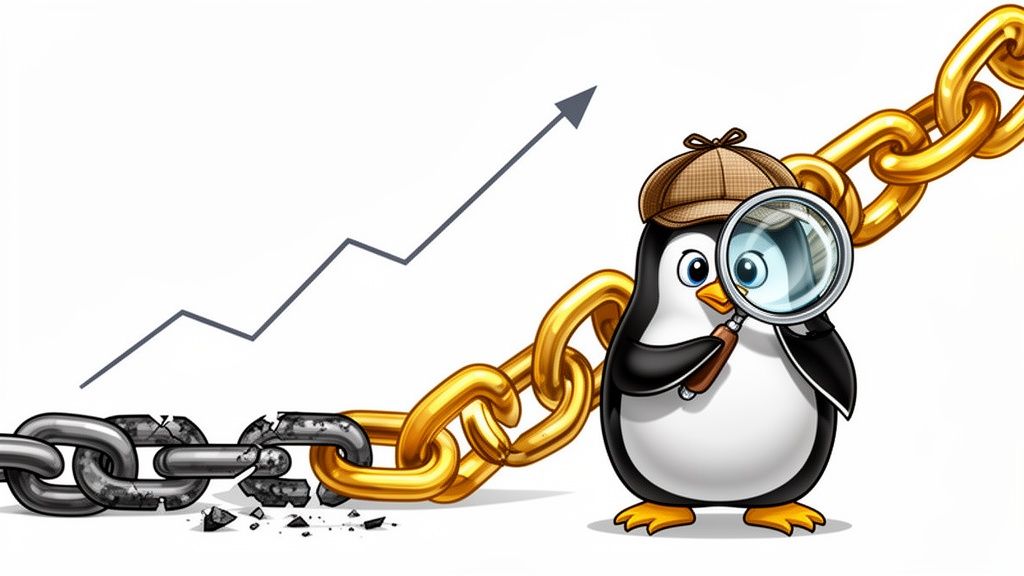
The Google Penguin update was a game-changer for anyone doing SEO. At its core, it’s an algorithm designed to sniff out and penalize websites that were trying to cheat their way to the top of search results with bad links. It serves as a powerful quality filter that rewards sites earning their authority the right way.
What Is the Google Penguin Update in SEO
Think of Google Penguin as the new sheriff that rolled into town to clean up the Wild West of SEO. Before it arrived on the scene in 2012, gaming Google’s rankings was almost laughably easy. You could buy thousands of cheap, irrelevant links from "link farms" or spammy directories to trick the search engine into thinking your site was a big deal.
This flood of low-effort tactics created a messy and frustrating experience for everyone. Users would often click on a top result only to land on a low-quality page that clearly didn't earn its spot. Penguin was Google's direct response, built with one goal in mind: to stop manipulative link schemes in their tracks and punish the sites that depended on them.
The Shift from Quantity to Quality
Imagine you’re running for office. You could get a handful of genuine endorsements from respected community leaders, or you could hire a massive crowd to show up and cheer for you. The crowd might look impressive for a moment, but it’s hollow and everyone knows it’s fake. Before Penguin, a lot of SEO was about hiring the biggest "paid crowd" of links.
The Penguin update flipped the entire script. It forced a massive strategic shift, making link quality the most important currency in SEO.
Here’s a quick overview of what Penguin targets and how it can affect your site.
Penguin Update Key Characteristics
| Characteristic | Impact on Your Website |
|---|---|
| Link Quality Analysis | Devalues or penalizes sites with a high number of low-quality, spammy, or irrelevant backlinks. |
| Anchor Text Scrutiny | Flags over-optimized or unnatural anchor text that clearly aims to manipulate rankings. |
| Real-Time Operation | As of Penguin 4.0, it runs in real-time within Google's core algorithm, so penalties and recoveries happen faster. |
| Granular Impact | It can affect specific pages or sections of a site rather than demoting the entire domain. |
This update fundamentally changed the definition of good link building.
- Before Penguin: Success was often just a numbers game. The more backlinks you had, the better, no matter where they came from.
- After Penguin: The focus snapped to the quality and relevance of every single link. One backlink from a trusted industry publication suddenly became more valuable than a thousand links from spam sites.
This ushered in a new era for search engine optimization. It became clear that earning links through exceptional content, real relationships, and providing genuine value was the only way to build a sustainable business online. You can learn more about building a strong foundation with our in-depth guide to effective SEO.
The core idea behind Penguin is simple: reward websites that earn their authority and penalize those who try to fake it. This ensures search results are filled with sites that offer real value, not just those with deep pockets for shady tactics.
In the end, the Penguin update did exactly what it was meant to do—it cleaned up the search results by making sure a website's reputation is earned, not bought. Whether you're a local Dallas business or a global enterprise, understanding this principle is the first step to building an online presence that can stand the test of time.
The Evolution of Penguin: From Filter to Core Algorithm
When Google’s Penguin update first landed, it wasn't just another algorithm tweak—it was an earthquake for the SEO world. Before 2012, gaming search rankings was common practice. Many so-called "strategies" were just a mad dash to build as many links as possible, regardless of quality, to artificially boost a site's authority.
Penguin arrived to tear down that entire house of cards.
It didn't start as a subtle, ongoing process. Instead, it was a disruptive filter that ran periodically. Imagine a city building inspector who only shows up every few months. When they did, any site with code violations (spammy links) was hit with a massive penalty, often causing traffic and rankings to disappear overnight.
This infographic perfectly captures the fundamental shift Penguin forced upon the industry, moving the goalposts from spammy tactics to genuine quality.

As you can see, the update was a clear turning point. It slammed the door on link spam and ushered in an era where high-authority, trustworthy backlink profiles became the only path forward. This leveled the playing field, making quality content and legitimate outreach the new cornerstones of SEO.
From Periodic Shocks to Real-Time Adjustments
Those early versions of Penguin operated on a frustratingly slow refresh cycle. If your site got penalized, you’d have to scramble to clean up your toxic links and then simply wait—sometimes for months—for the next refresh. It created long, agonizing recovery periods for countless businesses.
But Google was just getting started. The very first iteration, originally dubbed the "Webspam Update," rolled out on April 24, 2012, and immediately shook up roughly 3.1% of all English search queries. Black-hat shortcuts that had worked for years were suddenly a liability. Later versions, like Penguin 2.0 and 3.0, continued to refine this process. You can dig into the complete history of these changes over on Search Engine Land to see how Google’s vision for search quality has evolved.
Then, in 2016, everything changed with Penguin 4.0.
Penguin 4.0 was the last major update of its kind because it stopped being a separate, periodic filter. It was fully baked into Google's core algorithm, where it now runs continuously and in real-time.
This shift was monumental. The "inspector" was no longer making periodic visits; they were now on-site 24/7, constantly evaluating your link profile as Google’s crawlers found new links pointing to your site.
The Impact of a Real-Time Penguin
Integrating Penguin into the core algorithm had two massive effects on how we all approach SEO.
Continuous Evaluation: The days of sweeping, site-wide penalties are mostly gone. Now, Penguin works more granularly. It can simply devalue individual spammy links as it finds them, often impacting the ranking of a single page rather than tanking your entire domain.
Faster Recovery: This is the good news. Since the algorithm is always running, you no longer have to wait for the next refresh to see improvements. Once you remove or disavow toxic backlinks, Google can recognize those changes much more quickly as it re-crawls and re-indexes your site.
This real-time model forced a permanent change in mindset across the industry. You can no longer get away with "cleaning up" your link profile every so often. The only way to win is with proactive and continuous digital hygiene, ensuring that you’re building a strong, high-quality backlink profile from day one.
How to Diagnose a Penguin-Related Ranking Drop
That sinking feeling when you check your analytics and see your organic traffic has fallen off a cliff—it’s a moment every site owner dreads. It’s easy to panic, but your first job is to play detective. While plenty of things can tank your rankings, a classic symptom of the penguin update in seo is a sharp, brutal drop that doesn’t line up with any other changes you’ve made.
First, you need to figure out if you're dealing with a direct penalty from a human reviewer at Google or an algorithmic hit. A formal manual action is the easy one; you’ll find a clear notification for "Unnatural links" right in your Google Search Console account. If you log in and see no messages, a Penguin-related issue becomes a very strong suspect.

Because Penguin now runs in real-time as part of Google’s core algorithm, that traffic drop won’t necessarily match a big, publicly announced update. This means you need to look inward and correlate your traffic data with your own recent link-building history. Did the drop happen right after you tried out a sketchy new link-building service?
Start Your Investigation in Google Analytics
Your first stop on this diagnostic journey is Google Analytics. Pull up your organic traffic reports and look for a sudden, steep drop-off. A gentle, gradual slide might point to other problems, like new competition muscling in on your keywords or your content just getting stale. A "cliff-edge" drop, though? That has Penguin written all over it.
Once you’ve found the exact date the decline started, check it against any known Google updates. Even though Penguin itself is always on, its effects can be magnified by broader core algorithm updates. This helps you narrow down the list of potential causes. It's also a smart move to learn how to analyze competitor website traffic to see if your rivals were hit at the same time, which could signal an industry-wide shift.
A sudden nosedive in organic search traffic, particularly for your most valuable keywords, without a corresponding manual action message in Google Search Console, is the number one sign of a potential Penguin issue.
This pattern strongly suggests that an algorithm—not a person—has just devalued the unnatural links pointing to your site, causing your rankings to collapse. Now it’s time to go find the evidence in your backlink profile.
Common Red Flags in Your Backlink Profile
If your traffic data is pointing toward Penguin, a deep-dive backlink audit is your next move. Using tools like Ahrefs, Semrush, or even the free Links report in Google Search Console, you need to hunt for the toxic links that Penguin is built to sniff out.
Look for these tell-tale signs:
- A high percentage of exact-match anchor text: If way too many of your incoming links use the precise keyword you want to rank for (like "best dallas plumber"), it looks incredibly manipulative to Google.
- Links from low-quality directories: These are the junky, made-for-SEO directories that provide zero real value to anyone.
- Spammy blog comments: Those links you (or someone you hired) dropped in the comment sections of completely unrelated blogs are a massive red flag.
- Links from Private Blog Networks (PBNs): A network of websites built for the sole purpose of passing link equity is a direct violation of Google’s guidelines and a prime target.
- Backlinks from irrelevant or foreign language sites: If you run a local bakery in Ohio, having hundreds of links from Russian or Chinese websites is an obvious sign of unnatural activity.
Finding one or two of these might not be the end of the world. But if your audit shows that a significant portion of your link profile is built on this kind of toxic foundation, you’ve almost certainly found the smoking gun behind your ranking drop.
So, you've done the digging, and all signs point to a Penguin problem tanking your rankings. Don't panic. A hit from Penguin isn't a death sentence; it's a very loud, very clear signal from Google to clean up your site's reputation and rebuild on a much stronger foundation.
The path to recovery really has two parts. First, you have to get your hands dirty, auditing your backlink profile to find and neutralize the toxic links that got you into this mess. After that, your focus needs to shift to building a healthy, resilient link profile that not only gets you back in Google's good graces but also protects you from future algorithm updates.
Think of it this way: first, you pull all the weeds. Then, you plant a healthy garden that can thrive for years to come.

Phase 1: The Backlink Cleanup and Audit
The first step is a full-scale backlink audit. This isn’t something you can rush through in an afternoon. It requires a deep dive into every single link pointing to your website. You'll need tools like Ahrefs, Semrush, or Moz here—they are essential for pulling the raw data you'll need to see your entire link profile.
Once you export your list of backlinks, the real work begins: categorizing each one. This manual review is absolutely critical because no tool can perfectly understand the context of a link.
I recommend creating a simple spreadsheet with your linking domains and adding a "Status" column. You'll then sort every link into one of three buckets:
- Healthy: These are your keepers. They come from relevant, authoritative sites in your industry and, ideally, send actual referral traffic.
- Toxic: These are the obvious offenders. We're talking about links from spammy directories, known paid link networks, or totally irrelevant sites in other languages. They add zero value and are actively hurting you.
- Suspicious: Here's the gray area. A link might come from a decent site but use jarring, overly-optimized anchor text. Or it could be from a low-authority site that isn’t blatantly spammy but isn't great, either. These require your best judgment.
After you have a list of all your toxic and highly suspicious links, it's time for removal. The absolute best way to do this is to get the link removed at the source. This means reaching out to the site owner and politely asking them to take the link down. Make sure to keep a record of every outreach attempt, including dates and any responses you get.
Important Note: You will not always get a response. In fact, many webmasters of low-quality sites won't have contact info or will simply ignore you. This is exactly what the Disavow Tool is for.
Using the Google Disavow Tool
For all those bad links you can't get removed manually, your next move is to use Google's Disavow Tool. This is how you tell Google which backlinks you don't trust and don't want to be associated with. You should only use this tool as a last resort, after you've made a real effort to get the links taken down yourself.
Think of the Disavow Tool as a formal declaration to Google: "I know these links are bad, I don't endorse them, and I've done my best to remove them. Please ignore them when you evaluate my site."
You'll create a simple text file listing all the domains or specific URLs you want Google to ignore and upload it. Then, you have to be patient. Because the Penguin update in SEO now runs in real-time, you might see changes faster than in the old days, but it can still take weeks or months for Google to re-crawl those links and re-evaluate your site. The initial cleanup is the most intensive part, and it highlights why a proactive SEO audit is a smart business decision that really pays off down the road.
Phase 2: Building a Resilient Link Profile
Just cleaning up the bad stuff isn't enough. The second phase of recovery is all about building a backlink profile so strong and natural that it's practically immune to future Penguin updates. This requires a fundamental shift in mindset from "building" links to "earning" them.
Here’s how you can build a Penguin-proof strategy moving forward:
Create Exceptional Content: This is the bedrock of modern SEO. When you create content that is genuinely useful, incredibly interesting, or just plain entertaining, people will want to link to it without you even asking. Think about creating definitive guides, publishing original research, or developing helpful free tools.
Focus on Digital PR: Instead of paying for placements, invest in building real relationships. Connect with journalists, bloggers, and influencers in your niche. Share your expertise, offer them unique data, or give them compelling stories. A single link from a respected industry publication is worth more than a thousand spammy directory links.
Use Guest Blogging Strategically: Yes, guest blogging still works, but only when you do it right. Focus on contributing high-quality, truly helpful articles to reputable, relevant sites. Your goal should be to provide value to their audience and build your own authority, not just to snag a quick link.
By focusing on earning high-quality, relevant links, you're doing more than just recovering from a Penguin issue—you're aligning your entire strategy with Google's core mission to reward the best content on the web. This proactive approach is the only way to build a durable, long-lasting presence in search.
Here’s the rewritten section, crafted to sound completely human-written and natural, following all your specific instructions.
Best Practices for Proactive Link Profile Monitoring
Ever since the Penguin update in SEO was baked into Google's core algorithm, the game has changed. There's no longer a "penalty day" to dread; instead, the inspector is always on duty, constantly evaluating your link profile in real-time.
This means a reactive approach—waiting for your rankings to tank before you clean house—is a recipe for disaster. What you need is a proactive strategy for digital hygiene, not a panicked cleanup operation. Constant vigilance over your backlinks is your best defense. This doesn't mean obsessing over every link daily, but it does require a simple, sustainable plan to protect your hard-earned rankings.
Establishing a Regular Monitoring Cadence
For most businesses, a full backlink audit every quarter is the perfect rhythm. It’s frequent enough to catch problems before they fester but not so often that it becomes a burden. If you're a larger company or in a brutally competitive niche, you might want to tighten that up to a monthly check-in.
Think of it like regular maintenance on your car. You don’t wait for the engine to seize up before getting an oil change. A quarterly backlink check-up serves the same purpose, ensuring everything is running smoothly and helping you avoid a catastrophic breakdown in your organic traffic.
Your goal here is to spot odd patterns and red flags early. During your reviews, keep an eye out for:
- Sudden spikes in new links: Did you get a flood of new backlinks overnight for no apparent reason? Especially from low-quality sites? That’s a classic warning sign of a sloppy SEO campaign or even a negative SEO attack.
- A wave of irrelevant links: If you sell handmade leather goods in the US and suddenly get hundreds of links from Russian gambling sites, you've got a problem that needs immediate attention.
- Over-optimized anchor text: Noticing a jump in new links that all use the exact same commercial keyword? That's precisely the kind of manipulative pattern Penguin was built to sniff out.
Leveraging SEO Tools for Automated Alerts
Manually checking for new links is a massive waste of time. A much smarter approach is to let SEO tools do the heavy lifting for you. Platforms like Ahrefs, Semrush, and Moz have features that will automatically alert you whenever you gain or lose a backlink.
These alerts are your early-warning system. An email notification pops into your inbox, you take a few seconds to review the new link, and you’re done. If the link is good, fantastic. If it’s from a sketchy source, you simply add it to a running list for your next disavow file update.
This proactive monitoring turns link management from a massive, time-sucking project into a simple, ongoing maintenance task. It puts you in control, allowing you to make quick, decisive moves instead of waiting for disaster to strike.
By making these practices a regular part of your routine, you're not just giving yourself more work. You're building a resilient foundation for your SEO that can withstand algorithm shifts and protect your rankings for the long haul. This is what a mature, future-proof SEO strategy looks like.
Penguin Strategies for Small Businesses vs Large Enterprises
Everyone wants to stay on Google's good side. When it comes to the Penguin update in SEO, the core principle is the same for all: build a clean, high-quality backlink profile. But how you get there is a completely different story for a local pizza shop versus a global corporation.
The reality is, your strategy is dictated by the scale of your operation and the resources you have. A small business wins with precision and a laser-focused local approach. An enterprise, on the other hand, is playing defense, managing immense complexity across a massive digital footprint.
Penguin Tactics for Small and Medium Businesses
If you're running a small or medium-sized business (SMB), you probably don't have a huge marketing budget or a team of SEO specialists at your beck and call. And that's perfectly fine. Your greatest asset is your agility and your ability to forge real connections within your community.
This is where your link-building strategy should shine. It’s all about quality, not quantity. A few powerful, relevant links will serve you far better than a thousand generic, weak ones.
Here’s what your playbook should look like:
- Hyper-Local SEO: Focus on earning links from other local businesses, community groups, and neighborhood events. A link from the local Chamber of Commerce or the sponsor page for a charity 5K is absolute gold for a small business.
- Niche Industry Focus: Your goal is to be the go-to expert in your small pond. A link from a well-respected industry blog, even one with a modest audience, carries far more weight than a mention on a generic, high-traffic news site.
- Building Real Relationships: You have the unique ability to personally connect with local reporters, bloggers, and fellow business owners. These genuine relationships often lead to the kind of natural, high-quality backlinks an enterprise could only dream of getting.
For SMBs, the strategy is about being a scalpel, not a sledgehammer. Every single link should be earned and have a clear, logical reason to exist. You can dive deeper into building a powerful online presence on a budget by reading our guide on a digital marketing strategy for small business.
The key takeaway for SMBs is that you don't need a massive link profile to succeed. Focus on earning a small but mighty collection of backlinks from sources that are highly relevant to your specific location and industry.
Enterprise-Level Penguin Defense
For large enterprises, the game is played on a completely different field. Your website might have a backlink profile with hundreds of thousands, or even millions, of links. At this scale, reviewing each link by hand is simply not an option.
The main concern shifts from building links to managing and protecting the ones you already have. The sheer size of an enterprise's link profile makes it a juicy target. Suddenly, the threat of negative SEO—where a competitor deliberately points thousands of toxic links at your site to try and trigger a penalty—becomes a very real danger.
An enterprise-level strategy must cover:
- Advanced Link Profile Management: This means using sophisticated analytics tools to monitor a massive backlink portfolio in real-time. These systems can automatically flag suspicious or toxic links for your team to review.
- Proactive Negative SEO Defense: You have to be constantly on the lookout for unnatural spikes in low-quality links. A solid process must be in place to find and disavow these threats quickly before they can do any real damage.
- Brand Consistency and Governance: With dozens of marketing campaigns, regional offices, and third-party agencies all in the mix, you need strict link-building guidelines. This ensures no one accidentally violates Google's policies and puts the brand at risk.
The challenges of enterprise SEO are so complex that many organizations turn to a strategic partner. This allows them to implement the advanced analytics and scalable processes needed to manage these risks effectively, keeping the brand’s online presence Penguin-proof while driving sustainable growth.
Penguin Strategy for SMBs vs Enterprises
While the goal of earning high-quality backlinks is universal, the focus and execution differ dramatically between a small business and a large enterprise. Small businesses need to be agile and community-focused, while enterprises must prioritize risk management and scalable oversight.
| Strategy Focus | Small & Medium Business (SMB) | Large Enterprise |
|---|---|---|
| Primary Goal | Building a foundational profile of high-quality, relevant links. | Managing and protecting a massive, existing backlink profile. |
| Link Building | Quality over quantity. Focus on local, niche, and relationship-based links. | Scaled outreach, brand mentions, and PR-driven link acquisition. |
| Risk Management | Periodic manual link audits. Low risk of large-scale negative SEO. | Real-time monitoring with automated tools. High risk of negative SEO. |
| Tooling | Basic SEO tools (e.g., Google Search Console, Ahrefs, SEMrush). | Advanced, enterprise-grade analytics and backlink monitoring suites. |
| Biggest Advantage | Agility, personal relationships, and deep community/niche relevance. | Brand authority, vast resources, and ability to earn links at scale. |
Ultimately, both paths lead to the same destination: a healthy backlink profile that Google trusts. The key is to choose the path that aligns with your resources, scale, and specific business realities.
Frequently Asked Questions About the Penguin Update
Even with Penguin being a part of Google’s core algorithm for years, there's still a lot of confusion floating around. Let's clear the air and tackle some of the most common questions I hear from business owners and marketers.
What Actually Triggers a Penguin Penalty?
At its core, what we call a "Penguin penalty" is really just the algorithm flagging a pattern of shady link-building. Think of it less like a manual penalty and more like the system detecting that you've crossed a line—you've stopped earning links and started manufacturing them.
Google's algorithm is smart enough to spot the tell-tale signs. The biggest red flags are:
- A flood of unnatural links: This happens when you get a ton of backlinks from low-quality sites, irrelevant blogs, or those notorious "link farms."
- Obvious link schemes: If you're part of a network built just to swap links and artificially pump up rankings, Google will figure it out.
- Over-optimized anchor text: A huge, unnatural percentage of your inbound links using the exact same commercial keyword (like "best running shoes") is a dead giveaway.
Basically, if your backlink profile looks like it was built by a machine instead of earned through genuine credibility, Penguin will take notice.
How Do I Know If My Site Was Hit by Penguin?
This is the tricky part. Since Penguin now runs in real-time, you won't get a nice, neat notification in your Google Search Console inbox (unless you also have a separate manual action for unnatural links, which is a different problem).
Your biggest clue will almost always be a sudden, sharp drop in organic traffic and keyword rankings that you can't explain with other site changes.
If your analytics chart looks like it fell off a cliff and a quick backlink audit reveals a history of sketchy links, Penguin is the prime suspect.
Can I Really Recover from a Penguin Hit?
Yes, absolutely. The good news is that because the algorithm is always running, you don't have to wait months for a "Penguin refresh" like in the old days.
Once you’ve done the hard work of auditing your entire backlink profile, removing the toxic links you can, and disavowing the rest, Google can process these changes fairly quickly. As it re-crawls your site and the pages linking to it, it will see your cleanup efforts.
Recovery isn't just about cleaning up the past; it's about committing to a future of earning high-quality, relevant links. Google rewards this change in strategy as it re-crawls and re-evaluates your site's overall authority and trustworthiness over time.
This real-time process gives you a much faster feedback loop, so you can see the positive results of your cleanup work sooner rather than later.
At Magic Logix, we specialize in building resilient SEO strategies that align with Google's quality standards. Discover how our data-driven approach can protect and grow your online presence by visiting us at https://www.magiclogix.com.