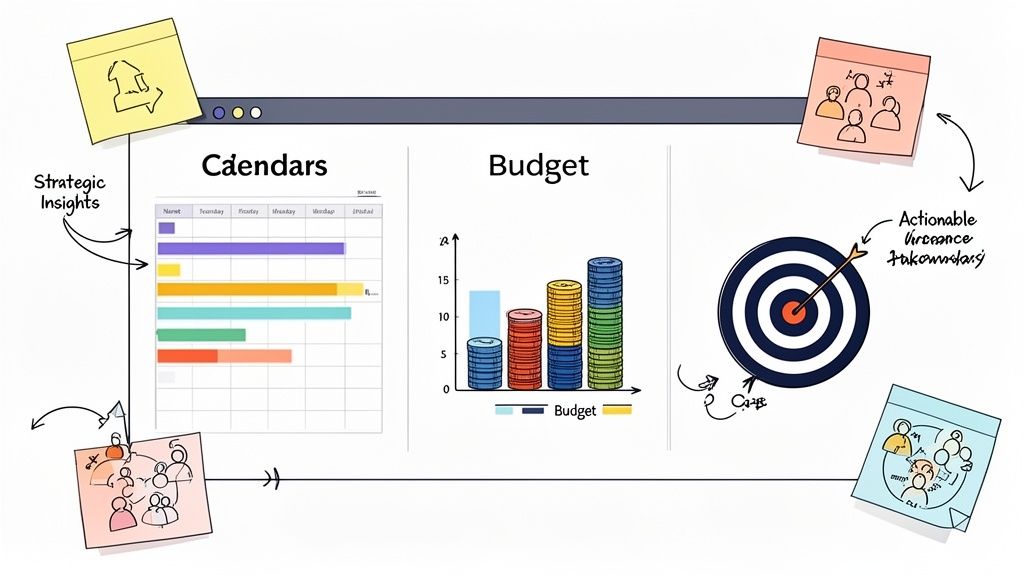
When we talk about "medical practice marketing," we're not just talking about running a few ads. It’s the whole system you build to bring in new patients and keep your current ones coming back. This involves everything from digital strategies like SEO and social media to more traditional outreach, all while staying on the right side of patient privacy laws like HIPAA.
Building Your Modern Medical Marketing Foundation
Think about your marketing strategy like you're building a new clinic. You wouldn't just start pouring concrete without a detailed blueprint, right? The same goes for attracting patients. A winning medical marketing strategy needs a solid foundation to make sure every dollar and every hour you spend is targeted, efficient, and actually grows your practice.
This is the work that separates practices that are thriving from those just struggling to keep their appointment books full. It's about ditching the guesswork and putting a deliberate, repeatable system in place. And it all starts with defining what success actually looks like for you.
Define Your Strategic Goals
Before you even think about a campaign, you need to set clear, measurable goals. A vague target like "get more patients" isn't a strategy; it's a wish. Your objectives need to be specific and tied to real business outcomes.
- Increase new patient appointments by 15% in the next quarter. This is a specific, time-bound goal you can measure your marketing against.
- Boost patient retention rates by 10% over the next year. This shifts the focus to nurturing the relationships you already have, which is almost always more cost-effective.
- Become one of the top three ranked local practices on Google for "pediatrician in Dallas." This is a crystal-clear SEO goal that has a direct line to your practice's visibility.
Ultimately, the goal for any practice is sustainable growth. You can learn how to increase patient volume with proven tactics that cover both your digital presence and the in-office patient experience. If you need a hand structuring these objectives, our guide on how to write a marketing plan offers a great framework to follow.
Understand Your Ideal Patient
With your goals locked in, it's time to get incredibly clear on who you're trying to reach. We do this by creating patient personas—detailed, semi-fictional profiles of your ideal patients. This goes way beyond basic demographics.
Patient personas are the architectural plans for your marketing. They tell you not just who your patients are, but what they need, where they look for information, and what motivates their healthcare decisions.
Let's say you're a dermatology clinic. You might have two very different personas. First, there's "Cosmetic Chloe," a 35-year-old professional interested in anti-aging treatments who finds her providers on Instagram. Then you have "Medical Mike," a 50-year-old construction worker worried about skin cancer who relies on Google searches and local reviews. You wouldn't market to Chloe the same way you'd market to Mike, and that's the whole point.
Prioritize HIPAA and Patient Privacy
In healthcare marketing, trust isn't just a nice-to-have; it's everything. Patient privacy is absolutely non-negotiable, which makes navigating HIPAA compliance a cornerstone of your marketing foundation. Any marketing activity that touches patient data—from an email newsletter to a simple "contact us" form—has to be secure.
This concept map shows how goals, patient understanding, and HIPAA compliance work together to create a stable marketing foundation.

If any one of these pillars is weak, the entire structure becomes unstable. The importance of a privacy-first approach is only growing. In fact, research shows that 70% of patients now actively choose practices that can demonstrate strong data protection. This tells us that compliance isn't just a legal hoop to jump through—it's a powerful way to build trust and gain a real competitive edge.
To put it all together, a solid foundation rests on these key pillars. Each one supports the next, creating a structure that can handle growth and adapt to changes in the market.
| The Four Pillars of Medical Marketing Success |
| :—————- | :————————————————————————————————– | :———————————————————————————————— |
| Pillar | Objective | Key Action |
| 1. Strategy | Define clear, measurable business goals to guide all marketing efforts. | Set specific, time-bound targets for patient volume, revenue, or market position (e.g., +15% new patients in Q3). |
| 2. Audience | Deeply understand the needs, motivations, and online behavior of your ideal patients. | Develop detailed patient personas for each key segment your practice serves. |
| 3. Compliance | Ensure all marketing activities and technologies are fully compliant with HIPAA and privacy laws. | Conduct a HIPAA risk assessment of all marketing tools and patient communication channels. |
| 4. Brand | Establish a unique, trustworthy brand identity that differentiates you from competitors. | Define your practice's unique value proposition and ensure it's communicated consistently. |
Getting these four elements right from the start is what makes all the difference. It ensures that when you do start spending money on ads or creating content, you're building on solid ground.
Becoming the Top Choice in Local Patient Searches

When a potential patient types “cardiologist near me” or “pediatrician in Dallas,” does your practice even show up? For today's patient, the search for a new doctor almost always starts right there, in a search bar. This isn't just about having a website; it’s about being the most visible, trusted, and obvious choice when someone is actively looking for care in your neighborhood.
Think of local SEO as the digital version of having the best-located, most welcoming clinic in town. It's how you signal to search engines like Google who you are, what you specialize in, and why you’re the perfect fit for local patients. The prize is a top spot in the "Local Pack"—that coveted map and list of three practices that appears at the very top of the search results.
Turning Your Google Business Profile into a Patient Magnet
Your Google Business Profile (GBP) is, without a doubt, the single most powerful tool in your local marketing toolkit. It’s that free, detailed snapshot of your practice that patients see first. Neglecting it is like leaving your clinic’s front door locked with the lights off.
When fully optimized, your GBP profile becomes a magnet for new patients. To get there, you have to sweat the details, making sure every piece of information is accurate, complete, and compelling.
- Complete Every Section: Your practice name, address, phone number (NAP), hours, and list of services must be 100% accurate. Inconsistencies will confuse both Google and your patients.
- Add High-Quality Photos: Show off your clean, modern facility, your friendly staff, and any up-to-date equipment. Good photos can increase requests for directions by a massive 42%.
- Utilize Google Posts: Think of these as mini-billboards for your practice. Share updates about new services, health tips, or community events to keep your profile fresh and engaging.
Building Trust Through Patient Reviews
Online reviews are the new word-of-mouth. It’s a fact: a staggering 94% of patients now use online reviews to evaluate and choose their healthcare providers. These reviews are powerful trust signals, not just for potential patients, but for Google’s ranking algorithm, too.
A proactive review management strategy is not optional; it’s a core function of patient acquisition and retention. It’s your chance to listen, respond, and show that you value the patient experience.
Make it a habit to encourage satisfied patients to leave feedback. Then, commit to responding to all reviews, both positive and negative. A thoughtful, professional response to a negative review can sometimes be more powerful than a dozen positive ones because it shows you’re accountable and truly dedicated to patient care.
Dominating Niche Searches with Location-Specific Pages
To really own local search, you need to go beyond broad terms and get specific. This means doing smart keyword research, including finding low competition keywords that patients with high intent are actually typing into Google. Then, you build dedicated pages on your site for each service and location combination.
For instance, a page titled "Sports Medicine in North Dallas" will always perform better for that specific search than a generic "Our Services" page. These pages need to be rich with relevant details: the specific conditions you treat, the doctors available at that location, and clear, unmissable calls-to-action. As you build these pages, think about how they link together. This is a core part of your website's structure, and our guide on SEO site architecture can help you create a site that both users and search engines will love.
Driving Immediate Patient Growth with Paid Ads

While SEO is your long-game for building a rock-solid reputation, sometimes you have more immediate needs. An open appointment calendar, after all, isn't doing your bottom line any favors. This is exactly where paid advertising on platforms like Google and Facebook becomes an indispensable part of your marketing toolkit, giving you a direct line to patients who are actively looking for care right now.
Let’s think of it this way: SEO is like building a strong, healthy immune system for your practice—it works tirelessly in the background to keep you resilient. Paid ads, on the other hand, are like a targeted treatment for a specific symptom, such as a stubbornly empty Tuesday schedule. They deliver immediate relief by putting your practice front-and-center at the exact moment a patient needs you.
Crafting Ethical and Effective Ads
Creating ads in the healthcare space is a bit of a balancing act. You have to be compelling without being sensationalist. More importantly, you have to operate within the very strict advertising policies of Google and Meta, which place tight controls on health claims and targeting personal attributes.
The secret is to pivot your ad copy to focus on solutions, accessibility, and trust. Instead of making grand, unprovable promises, write messages that speak directly to a patient’s immediate problem.
- Focus on Availability: "Same-Day Appointments Available for Urgent Care."
- Highlight a Specialty: "Specialized Knee Pain Consultations in North Dallas."
- Build Trust: "Board-Certified Dermatologists. Schedule Your Skin Check Today."
This approach not only respects platform rules and patient sensitivities but also communicates your value proposition with crystal clarity.
The Power of Intent-Driven Targeting
The real muscle behind paid search advertising, especially on Google Ads, is its uncanny ability to capture high-intent patients. Unlike scrolling through social media where an ad interrupts what you're doing, on Google, you're providing an answer to a direct question. Someone typing "ENT doctor for sinus infection" isn't just browsing—they have a real problem and are on a mission to find a solution.
By targeting specific keywords related to the conditions you treat, you connect with patients at their point of highest motivation. This is far more efficient than casting a wide, generic net and hoping for the best.
This is where all the work you did on your patient personas really pays off. Those personas tell you which keywords to target, what ad copy will resonate, and even the best time of day to run your ads. Getting this right is a cornerstone of building the kind of paid search intelligence that delivers tangible results.
Implementing Availability-Based Marketing
One of the sharpest strategies a medical practice can use is availability-based marketing. It’s a dynamic approach where you strategically turn up your ad spend when you have open slots in your schedule and dial it back down when you're fully booked. This simple tweak does two critical things: it stops you from wasting ad dollars and, just as crucial, it prevents the patient frustration that comes from calling for an appointment only to find there’s no availability for weeks.
This smart tactic has a proven track record. Practices that align their digital campaigns with their real-time capacity can see 30-50% faster growth compared to those stuck on static, "always-on" campaigns. Digging deeper, top-performing practices that dynamically shift ad spend to underutilized services or locations have seen a 25% uplift in conversion rates, according to a recent analysis.
By using paid ads intelligently, you gain a powerful lever to control patient flow, fill your schedule with precision, and maximize the return on every single dollar you invest in your practice’s growth.
Earning Patient Trust Before the First Visit
In healthcare, trust isn't just a nice-to-have; it's the bedrock of the entire patient relationship. Long before someone ever sets foot in your clinic, they're already sizing you up based on what they find online. Gaining their confidence begins the second they discover your practice, which is why your content and reputation are non-negotiable parts of your marketing.
This isn't about just being another name in a directory. The goal is to become a genuinely trusted health authority in your community. You want your website and social media to feel like getting a recommendation from a good friend.
Creating Content That Answers Real Patient Questions
Your potential patients are doing a lot more than just Googling "doctor near me." They’re bringing specific, often nerve-wracking, questions to the search bar. Your content needs to meet them right there, answering those questions directly to calm their fears and showcase your expertise.
Put yourself in the shoes of a first-time patient. What are they worried about? This is your chance to offer real value before they even book.
- Service-Specific Guides: Write a blog post or film a quick video on a topic like, "What to Expect During Your First Cardiology Appointment." You'll demystify the experience and immediately lower patient anxiety.
- Procedural Preparation: Put together a simple, clear FAQ or a checklist on "How to Prepare for Minor In-Office Surgery."
- Condition Explainers: Publish easy-to-understand articles that break down common conditions you treat, covering symptoms, treatment options, and when it’s time to see a doctor.
Content like this immediately positions you as a helpful, knowledgeable expert, building a solid foundation of trust from the get-go.
Building Credibility Through Video and Reputation
While written articles are great, video brings a human touch that’s tough to beat. Short, physician-led videos are fantastic for forging a personal connection and showing a bit of empathy. In fact, practices using short-form videos with their doctors can see 35% higher engagement rates—a huge boost for building credibility. And don't forget reviews. Practices that actively manage their online reputation see up to 50% more bookings. You can dive deeper into these trends in PulsePoint.com's report on the future of health marketing.
Your online reputation is a living testament to your patient care. Every review, positive or negative, is an opportunity to show you are listening and that you care about the patient experience.
Being proactive with your reputation isn't just about damage control; it's a powerful growth strategy. Make a habit of encouraging happy patients to share their stories online. When any feedback rolls in—especially if it’s negative—make sure you respond quickly and with care. That public display of accountability shows potential patients that you’re committed to great care and always looking to improve, reinforcing their trust when it matters most.
Using Technology and Data for Smarter Decisions
Great medical practice marketing isn’t about guesswork. It’s about making smart, data-driven decisions that deliver results you can actually measure. In a field as competitive as healthcare, using the right technology is like having the most advanced diagnostic equipment—but for your business strategy. It gives you a crystal-clear, real-time picture of what’s working, what isn’t, and where your best growth opportunities are hiding.
This whole approach changes marketing from a simple expense into a strategic investment. Think of it as giving your practice’s marketing a complete health check-up. The goal is to get past surface-level metrics like clicks and likes to truly understand how your efforts are impacting patient volume and revenue.
See the Entire Patient Journey with a Healthcare CRM
A Customer Relationship Management (CRM) system is the central nervous system for any modern marketing operation. For medical practices, a specialized, HIPAA-compliant healthcare CRM isn’t just a nice-to-have; it's absolutely essential. It gives you a single, complete view of every single interaction a patient has with your practice, from their first Google search all the way to their most recent follow-up call.
Imagine being able to see that a new patient discovered you through a specific blog post, booked their first appointment after seeing a Facebook ad, and then received an automated reminder for their annual check-up. That complete picture of the patient journey is incredibly powerful.
- Identifies High-Value Channels: A CRM shows you which marketing channels, like organic search or paid ads, are actually bringing in your most valuable patients.
- Improves Patient Communication: It lets you segment your audience to send targeted, relevant messages, like appointment reminders or educational content related to a patient's condition.
- Enhances Patient Retention: By tracking patient history and communications, you can proactively engage with patients to make sure they stick with your practice for the long haul.
Forecast Demand with Predictive Analytics
If a CRM shows you what has happened, predictive analytics helps you forecast what is likely to happen next. This technology sifts through your historical data—appointment trends, patient demographics, even seasonal health patterns—to make surprisingly accurate predictions about the future.
Predictive analytics essentially gives your practice a crystal ball, allowing you to anticipate patient demand and allocate your resources much more effectively. It’s all about making proactive decisions instead of constantly reacting to a full or empty waiting room.
For example, your data might predict a surge in allergy-related appointments in the spring. This allows you to ramp up marketing for your otolaryngology services back in February and March. Or, it could identify that a particular high-value procedure is underperforming, signaling an urgent need for a targeted educational campaign. This is a core piece of what's often called marketing intelligence, where data fuels smarter, more strategic actions.
Track the KPIs That Truly Matter
To really understand the health of your marketing, you have to track the right Key Performance Indicators (KPIs). These are the vital signs that tell you whether your strategy is working or flatlining. While you could follow dozens of different metrics, a few are absolutely critical for any practice focused on growth.
Here’s a breakdown of the key metrics that matter. Tracking these KPIs moves the conversation away from vanity metrics and focuses on what really counts: profitable, sustainable patient growth.
| Essential KPIs for Medical Practice Marketing |
| :— | :— | :— |
| KPI (Key Performance Indicator) | What It Measures | Industry Benchmark |
| Patient Acquisition Cost (PAC) | The total marketing spend required to acquire one new patient. | Varies by specialty, but typically ranges from $150 to $400. |
| Patient Lifetime Value (LTV) | The total revenue a single patient is expected to generate over their entire relationship with your practice. | Should be at least 3x your PAC for a healthy marketing ROI. |
| Lead-to-Appointment Rate | The percentage of new leads (e.g., form submissions or phone calls) that convert into actual appointments. | A strong rate is typically above 25% for qualified leads. |
| Online Appointment Conversion Rate | The percentage of website visitors who book an appointment directly through your online scheduling tool. | A good conversion rate is often between 3% and 5%. |
By keeping a close eye on these numbers, you’ll always know exactly how your marketing is performing and where you need to make adjustments to improve your return on investment.
Your 90-Day Medical Marketing Action Plan

Alright, we've covered the strategy. Now it's time to put it all into practice. Real growth doesn’t happen from just reading; it comes from doing. This is your practical, 90-day roadmap for turning all this theory into results you can actually see and measure.
I’ve broken this down into tailored plans for both smaller private practices and larger healthcare organizations. The idea isn't to give you a rigid checklist but a flexible, step-by-step guide. We're focusing on the high-impact moves that will build momentum and deliver real progress in just one quarter.
First 30 Days: Foundational Wins
The first month is all about getting your digital house in order. Think of it as laying the concrete foundation—it has to be done right, because everything else will be built on top of it. These are the quick wins that set the stage for everything that follows.
For Small Private Practices:
- Google Business Profile (GBP) Optimization: Go through your GBP and fill out every single section. Make sure your name, address, phone number (NAP), and hours are 100% accurate down to the last detail. Then, upload at least 10 new, high-quality photos of your office, your team, and the patient experience.
- Launch a Review Program: Put a simple, HIPAA-compliant system in place to start asking your happy patients for reviews. This can be as easy as a follow-up email with a direct link or a QR code at your checkout counter. Your goal this month? Get 5 new reviews.
For Large Healthcare Organizations:
- Conduct a Brand Consistency Audit: Pull up the online profiles for 5-10 of your key locations or service lines. You’re looking for any inconsistencies in branding, messaging, or contact info across their websites, GBP listings, and social media.
- Integrate CRM and Ad Platforms: This is a critical tech check. Make sure your healthcare CRM is properly talking to Google Ads and your social ad platforms. The goal is to confirm that lead data is flowing correctly so you can track ROI later.
The first 30 days are all about building momentum. For a small practice, this means becoming impossible to miss for local searchers. For a large health system, it’s about making sure your technology and brand message are perfectly aligned before you start scaling up.
Next 30 Days: Building Engagement
With a solid foundation in place, month two is where you start actively reaching out. This is about creating valuable content that builds trust and engaging with potential patients who are looking for you right now.
For Small Private Practices:
- Publish Two Patient-Focused Blog Posts: Write two articles that directly answer the questions your patients are already asking. Think along the lines of, “What to Expect at Your First Physical Therapy Session?” or “5 Signs You Should See a Dermatologist.”
- Launch a Small Google Ads Campaign: You don't need a massive budget. Allocate a modest amount to target one of your high-value services with a tightly focused, geo-targeted search campaign. Zero in on keywords that show clear patient intent, and track every call or form submission.
For Large Healthcare Organizations:
- Develop Service Line Content Pillars: Pick one high-priority service line—let's say cardiology or orthopedics—and build out a "content pillar" page. This will be a massive, comprehensive resource that acts as the central hub for all related blog posts, videos, and physician bios.
- Scale a Pilot Ad Campaign: Take what you learned from a small test campaign and start scaling the budget by 25-50%. Now's the time to introduce A/B testing on your ad copy to find out which messages drive the highest lead-to-appointment conversion rates.
This phase is the shift from setup to active outreach. You're using content and smart advertising to connect with patients who are actively searching for the exact care you provide.
Final 30 Days: Optimizing and Scaling
In the home stretch, your focus moves to the data. It's time to analyze what happened, refine your approach based on real-world feedback, and get ready to scale what’s working.
For Small Private Practices:
- Analyze and Refine: Dive into your Google Ads performance. Find the keywords and ads that actually generated appointments and double down on them. Pause anything that's just costing you money without results.
For Large Healthcare Organizations:
- Report on KPIs: It's time to generate your first real marketing KPI report. Dig into your Patient Acquisition Cost (PAC) and Lead-to-Appointment Rate for those scaled campaigns. This is the data you’ll use to justify your budget for the next quarter and prove your marketing is working.
Frequently Asked Medical Marketing Questions
When you’re running a medical practice, diving into the world of marketing can feel like opening a can of worms. A lot of questions pop up, from how much to spend to how to stay on the right side of the law. Let's walk through some of the most common questions we hear from medical professionals. Getting these fundamentals right is the key to real growth without the compliance headaches.
The first question, almost without fail, is always about money. How much should a medical practice really be spending on marketing? The general rule of thumb is to set aside 7% to 10% of your practice's annual revenue for your marketing budget.
Of course, that isn't a hard-and-fast rule. If you're a new practice trying to get your name out there, you'll likely need to invest on the higher end of that scale. On the other hand, a well-established clinic with a loyal patient base might do just fine spending a bit less. The important thing is to view it as an investment and keep a sharp eye on your returns.
How Do I Measure Marketing ROI?
Measuring the return on your marketing investment (ROI) goes way beyond just counting website clicks. You have to draw a straight line from your spending to the things that actually grow your practice: new patient appointments and revenue. This is where tracking the right numbers becomes non-negotiable.
The most important calculation you can make is comparing your Patient Lifetime Value (LTV) to your Patient Acquisition Cost (PAC).
A healthy, sustainable marketing program should have an LTV that is at least three times greater than its PAC. This 3:1 ratio is your north star. It means that for every dollar you spend to bring in a new patient, you're getting three dollars back over the life of that patient's relationship with your practice.
If you find your LTV is barely inching past your PAC, it’s a big red flag. That tells you it's time to either figure out how to lower your acquisition costs or find ways to improve patient retention and the value you provide.
How Can I Advertise Without Violating Regulations?
Advertising in healthcare means walking a fine line. You have to navigate a maze of strict regulations like HIPAA and the ad policies of platforms like Google and Facebook. The core principle is simple: focus your ads on your solutions, your expertise, and your availability—not on personal health conditions or promises you can't prove.
For instance, an ad that says, "Feeling depressed?" is a major no-go. It targets a personal health attribute and will get flagged. A much better, compliant approach is an ad that says, "Compassionate Mental Health Services Available."
- Focus on the service, not the person's private condition.
- Highlight your credentials and the experience of your medical team.
- Promote ease of access, with messages like "same-day appointments" or "telehealth consultations available."
Stick to these guidelines, and you can create powerful ads that draw in the right patients. More importantly, you'll build trust and stay fully compliant from the very first click.
At Magic Logix, we specialize in crafting data-driven digital marketing strategies that connect medical practices with the patients who need them most. Learn how our expertise can help you grow your practice by visiting us at https://www.magiclogix.com.