To really get the most out of your PPC campaigns, you have to start with a deep-dive audit. This means digging into performance, making sure your conversion tracking is actually working, and looking for any inefficiencies in your account structure. This initial diagnosis is your roadmap—it shows you exactly where to focus your efforts for the biggest impact on ROI. It's about swapping guesswork for a data-backed strategy.
Start with a Strategic PPC Campaign Audit
Before you touch a single bid or rewrite one line of ad copy, you need a crystal-clear picture of where your account stands today. Jumping straight into "optimization" without an audit is like trying to navigate a new city without a map. Sure, you're moving, but are you going in the right direction? An audit is that map, showing you the strengths, weaknesses, and all the hidden opportunities you've been missing.
This isn't just about glancing at your Cost Per Click (CPC) on the main dashboard. It's a full-on investigation into your historical data to spot trends, find out exactly where your budget is being wasted, and confirm that every dollar you spend is being tracked correctly. Think of it as a comprehensive health checkup for your advertising.
Analyze Historical Performance and Identify Red Flags
The first layer of any good audit is a thorough review of past performance. I've lost count of how many accounts I've seen bleeding money on keywords that have spent hundreds of dollars without a single conversion. These are the quick wins, the low-hanging fruit for immediate savings.
Be on the lookout for these specific red flags:
- High-Spending, Low-Converting Keywords: Pinpoint the keywords eating up a huge chunk of your budget but failing to bring in leads or sales.
- Low-Quality Scores: A score below a 5/10 is usually a sign of a major disconnect between your keywords, ad copy, and landing page. This leads to higher costs and worse ad positions.
- Declining Click-Through Rates (CTR): A steady drop in CTR can mean your ads are getting stale (ad fatigue) or your competitors have just written something more compelling.
- Wasted Ad Spend on Irrelevant Search Terms: Your Search Query Report is a goldmine. It shows you the actual phrases people typed before clicking your ad, often uncovering costly mismatches that need to be added as negative keywords ASAP.
This whole process boils down to three core pillars: analyzing performance, checking tracking integrity, and evaluating your account's structural efficiency.
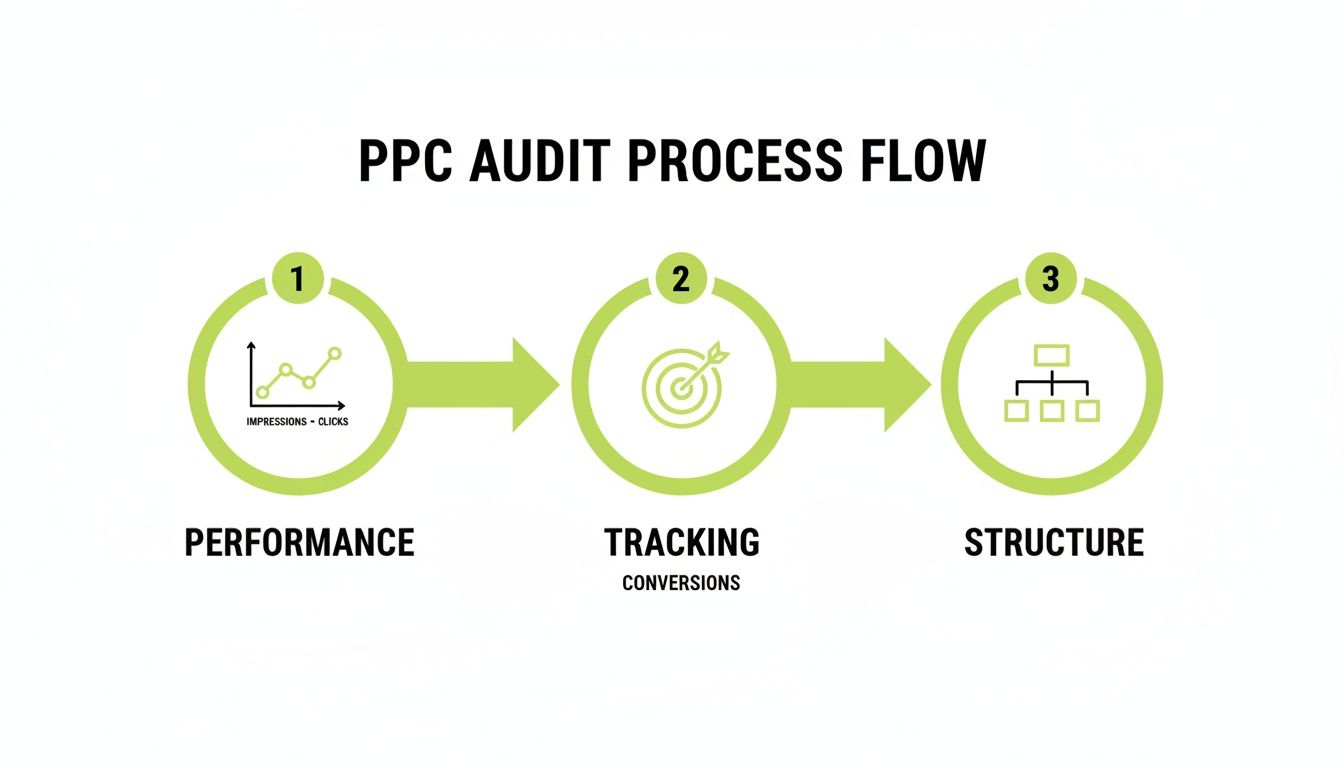
By systematically working through each of these areas, you build a solid foundation for making smart optimization decisions that actually drive results.
Verify Conversion Tracking and Assess Account Structure
An audit is completely useless if your data is wrong. Broken conversion tracking is a silent killer of PPC campaigns. You could be pausing high-performing keywords or scaling up failing ones simply because your tracking isn't telling the whole story. You need to verify that your tracking tags are firing correctly on thank-you pages and that your phone call tracking is properly set up.
Next, it's time to look at your account structure. One of the most common mistakes is lumping dozens of unrelated keywords into one ad group. This makes it impossible to write super-relevant ad copy, which in turn tanks your Quality Score and CTR. A well-organized account uses tightly themed ad groups—often with just a few closely related keywords—to create a powerful connection between the search query, the ad, and the landing page. A clean structure doesn't just improve performance today; it makes managing and optimizing the account so much easier down the road.
An unorganized PPC account is like a library with no catalog system. All the right books might be there, but finding the one you need is nearly impossible. A strategic audit is your way of creating that catalog.
For brands selling on different platforms, the principles are the same, but the details change. For a detailed guide on improving your campaigns on Amazon, for example, the strategies for Amazon PPC optimization offer some great platform-specific insights. The core idea is universal: structure and data accuracy come first. And if you feel like you're in over your head, remember that top-tier search engine marketing agencies have the specialized experience needed to build a winning foundation from the ground up.
Set Campaign Goals and KPIs That Actually Matter
Chasing clicks without a clear purpose is the fastest way to drain your PPC budget. I’ve seen it happen countless times. Before you can even think about optimizing a campaign, you have to define what success actually looks like. Vague objectives like "more traffic" simply won't cut it; you need sharp, measurable goals tied directly to your business's bottom line.
This means getting real about your objectives and moving beyond vanity metrics. Are you trying to generate qualified leads for your sales team, or are you looking to maximize direct e-commerce sales? Each of these goals requires a completely different set of Key Performance Indicators (KPIs) to guide your optimization efforts.
From Business Objectives to Campaign Metrics
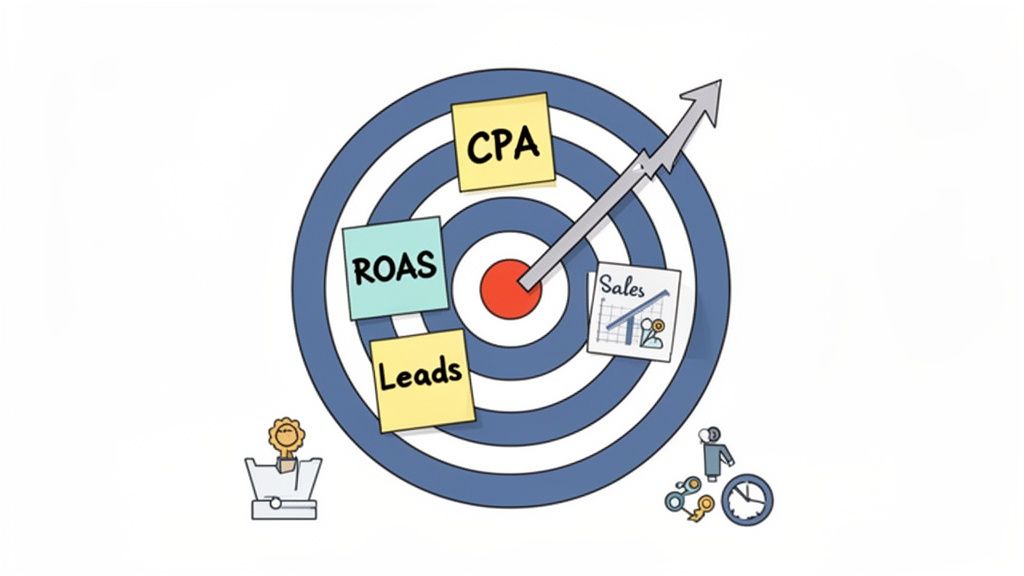
The trick is to translate those high-level business goals into specific, trackable campaign metrics. Let's say your company's big-picture goal is to increase market share this quarter. Your PPC goal might be to aggressively boost impression share on top-of-funnel keywords. On the other hand, if the C-suite is focused on improving profitability, your attention needs to shift to a metric like Return On Ad Spend (ROAS).
This framework is what keeps your advertising efforts aligned with what truly matters to the business. Without this critical connection, you’re just optimizing in a vacuum, celebrating metrics that don’t actually contribute to real growth.
A PPC campaign without clear KPIs is like a ship without a rudder. You'll spend a lot on fuel (your budget) but have no control over where you end up. Defining your destination first is non-negotiable.
Choosing the Right KPIs for Your Goals
Once you've nailed down your primary objective, you can select the right KPIs to obsess over. And I mean obsess. Don't try to track everything under the sun; focus on the one or two metrics that most accurately reflect success for any given campaign.
Lead Generation: If you're a B2B company or a service provider, your world revolves around generating high-quality leads. Your north-star metric should be Cost Per Acquisition (CPA) or Cost Per Lead (CPL). Yes, you'll monitor clicks and CTR, but every optimization decision you make should ultimately be judged by whether it drives down your CPA.
E-commerce Sales: For an online store, it's all about the revenue. The most important KPI here is Return On Ad Spend (ROAS). A campaign might have a high CPA, but if those customers are making large purchases, a strong ROAS tells you it's still highly profitable and worth scaling.
Brand Awareness: If your mission is to introduce your brand to a new audience, you need to be looking at top-of-funnel metrics. The key indicators here are things like Impression Share, Reach, and Video View Rate. The goal isn't an immediate conversion; it's about dominating visibility and mindshare for relevant searches.
To make this even clearer, it helps to map your business goals directly to your PPC KPIs. You need to know which levers to pull and what dials to watch based on what you're trying to achieve.
Mapping Business Goals to PPC KPIs
A clear guide on selecting the right Key Performance Indicators (KPIs) based on your primary campaign objective to ensure you are measuring what truly matters.
| Business Goal | Primary PPC KPI | Secondary Metrics to Monitor |
|---|---|---|
| Generate Qualified Leads | Cost Per Acquisition (CPA) | Conversion Rate, Cost Per Click (CPC) |
| Maximize E-commerce Sales | Return On Ad Spend (ROAS) | Average Order Value (AOV), Revenue |
| Increase Brand Awareness | Impression Share | Reach, Click-Through Rate (CTR) |
By setting these clear goals and tying them to specific KPIs, every decision you make—from keyword selection to bid adjustments—becomes purposeful and data-driven. This strategic clarity is the foundation of every successful PPC optimization effort, turning ad spend from a simple expense into a predictable driver of growth.
Craft Compelling Ads and Pinpoint Your Audience
Effective PPC comes down to a simple truth: you have to deliver the perfect message to the right person at the exact moment they need it. A brilliant ad shown to the wrong audience is just noise, and even the right audience will scroll right past a boring, irrelevant ad.
Mastering both sides of this equation—killer copy and laser-focused targeting—is how you stop just spending money and start investing it for a real return. This isn't about stuffing keywords into a headline; it's about getting inside the head of your customer and understanding the psychology behind the click.
Writing Ad Copy That Grabs Attention
Think of your ad copy as your digital storefront sign. In a sea of competitors, it has milliseconds to do its job and earn that click. To stand out, you need to go beyond just describing your product and tap into the powerful psychological triggers that make people act.
Try weaving these elements into your headlines and descriptions:
- Urgency and Scarcity: Phrases like "Limited Time Offer" or "Only 3 Left in Stock" create a fear of missing out (FOMO). It’s a classic tactic for a reason—it works.
- Social Proof: Mentioning your customer count ("Join 10,000+ Happy Customers") or including star ratings builds instant trust. It tells people that others have already chosen you and are happy they did.
- Benefit-Driven Language: Stop selling features and start selling the outcome. Instead of "Durable running shoes," try "Run Pain-Free for Miles." People buy the solution to their problem, not the product spec sheet.
Your goal is to forge an instant connection between the searcher's problem and your solution, all within the tiny character limits of an ad.
A Structured Approach to Ad Testing
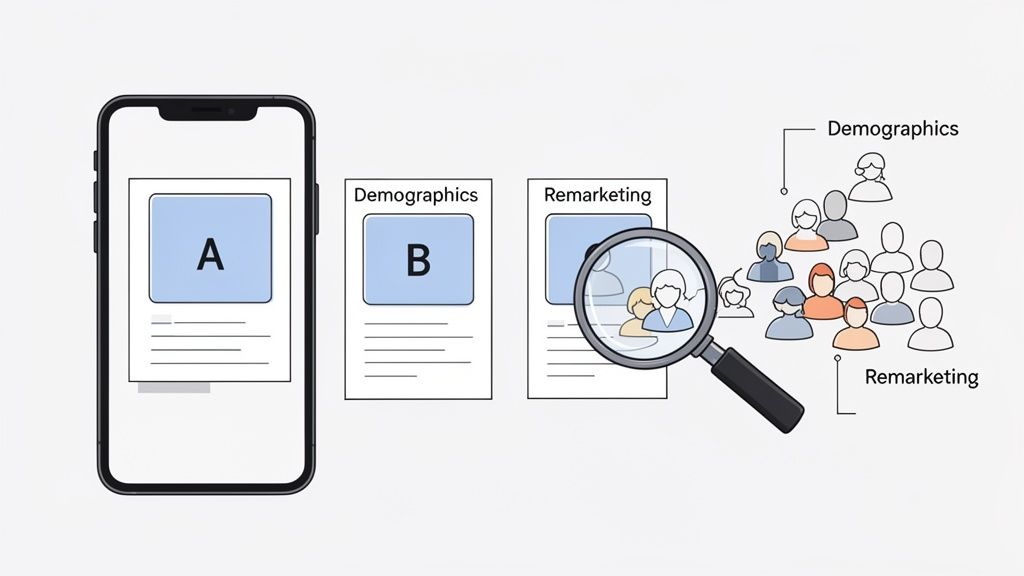
How do you find out which message actually resonates? You test. But randomly throwing things at the wall to see what sticks is a great way to waste money. A structured A/B testing approach—often called split testing—is non-negotiable for anyone serious about optimizing their campaigns.
Start by creating two or three ad variations within an ad group, but only change one element at a time.
For instance, you could test two different headlines:
- Headline A: "Affordable Web Design Services"
- Headline B: "Get a Stunning Website in 7 Days"
By isolating just the headline, you can definitively say whether the "affordability" angle or the "speed" angle drove a higher click-through rate (CTR). Once you have a statistically significant winner, that ad becomes your new control, and you start testing another element against it. It's an iterative process that leads to continuous, data-backed improvement.
Your first ad is just your best guess. Your hundredth ad, refined through relentless testing, is a data-driven conversion machine. Never stop testing.
Moving Beyond Basic Keyword Targeting
Keywords are the foundation of search campaigns, but relying on them alone is a rookie mistake. Today’s platforms offer sophisticated audience targeting layers that let you pinpoint your ideal customer with incredible precision. This is where you really start to pull away from the competition.
Great copy is only half the battle; getting it in front of the right eyeballs is the other half.
Build Highly Specific Audience Segments
Don't just target a keyword; target the person searching for it. By layering different audience signals, you can focus your ad spend on users who are most likely to convert. This is a core pillar of any advanced Google Ads marketing strategy.
Here are a few powerful audience types to get you started:
- In-Market Audiences: These are users Google’s data shows are actively researching and considering products or services like yours right now. This is your low-hanging fruit for capturing bottom-of-the-funnel demand.
- Affinity Audiences: This lets you reach people based on their long-term interests and passions, like "coffee lovers" or "DIY enthusiasts." It’s perfect for building brand awareness with a highly relevant group.
- Demographic Targeting: Narrow your reach by age, gender, parental status, or even household income. A B2B software company, for example, might exclude younger age brackets to focus its budget on likely decision-makers.
The real magic happens when you combine them. Imagine targeting users who are "in-market for CRM software," are between the ages of 35-54, and have a high household income. This multi-layered approach slashes wasted spend and makes your ads dramatically more relevant.
The Power of Remarketing Lists
One of the highest-ROI tactics in the entire PPC playbook is remarketing (or retargeting). This is where you create an audience of people who have already visited your website but left without converting. Since they already know your brand, they are often much easier and cheaper to bring back to close the deal.
You can get incredibly granular here. For instance, create separate audiences for:
- Users who visited a specific product page.
- Users who added an item to their cart but abandoned it.
- Users who watched 75% of a video on your landing page.
By tailoring your ad copy to each segment ("Forgot Something in Your Cart? Get 10% Off to Complete Your Order!"), you create a highly personal and effective follow-up. This is how you turn missed opportunities into loyal customers.
Master Bidding Strategies and Budget Allocation
Think of your bidding strategy and budget as the engine and fuel for your PPC campaigns. If you get them right, you'll power your way to profitability. Get them wrong? You'll just burn through cash with little to show for it. This is where we move past basic setup and start actively steering your campaigns toward your goals.
Choosing the right bidding approach isn't a one-size-fits-all decision. The best strategy really depends on your specific goals, how mature your campaign is, and the amount of historical data you’ve collected. A brand new campaign with zero conversion data simply can't use the same strategy as a seasoned campaign that's tracked thousands of data points.
Choosing Your Bidding Strategy
The bidding landscape basically breaks down into two main camps: manual control and automated power. Each has its place, and knowing the trade-offs is crucial. Manual bidding gives you pinpoint control, which is great early on. Automated strategies, on the other hand, use machine learning to chase specific outcomes for you.
- Manual CPC (Cost-Per-Click): This is the old-school, hands-on approach. You set the absolute maximum you're willing to pay for a click. While it offers the most control, it's incredibly time-consuming to manage, especially at scale. It’s best suited for brand new campaigns where you need to feel out the market and establish a baseline cost-per-click.
- Enhanced CPC (eCPC): Think of this as manual bidding with a smart assistant. You still set your max CPCs, but you give the platform permission to automatically nudge them up or down for clicks it thinks are more (or less) likely to convert. It's the perfect stepping stone from purely manual bidding into the world of automation.
Once your campaign starts bringing in consistent data—a good rule of thumb is 15-30 conversions in the last 30 days—you can confidently switch to more powerful, goal-oriented automated strategies.
Your bidding strategy isn't a "set it and forget it" choice. It's a dynamic decision that should evolve as your campaign matures and gathers more performance data. Start with control, then graduate to automation.
Leveraging Automated and Smart Bidding
Automated bidding strategies are designed to hit a specific goal, like maximizing conversions or achieving a target cost per acquisition. They take the daily guesswork out of bidding by analyzing hundreds of real-time signals for every single ad auction.
Here are the heavy hitters you need to know:
- Maximize Conversions: This one does exactly what it says on the tin—it tries to get you the most conversions possible within your daily budget. It's ideal for lead generation campaigns where the value of each conversion is pretty similar.
- Target CPA (Cost Per Acquisition): You tell the platform exactly how much you're willing to pay for a conversion, and its algorithm will work to hit that average. This is perfect for businesses that know precisely what a new customer or lead is worth to them.
- Target ROAS (Return On Ad Spend): An e-commerce favorite. This strategy is all about hitting a specific return for every dollar you spend on ads. If you set a 400% ROAS target, the system will aim to generate $4 in revenue for every $1 of ad spend.
A quick but critical note: to get the most out of these strategies, your conversion tracking must be clean and accurate. If it’s not, the algorithms are flying blind, making decisions based on faulty data and ultimately wasting your budget.
Intelligent Budget Allocation and Bid Adjustments
A smart bidding strategy is only half the battle. You also need to be strategic with how you allocate your budget, funneling cash to your top-performing campaigns and making precise adjustments to capitalize on opportunities. Don't just spread your budget evenly; treat it like an investment portfolio.
A classic mistake I see all the time is letting one broad match campaign with a few high-volume keywords eat up the entire daily budget before the high-intent, exact match campaigns even get a chance to show up.
Master Your Bid Adjustments
Bid adjustments are your secret weapon for fine-tuning performance. They let you increase or decrease your bids for specific segments of your audience without messing with your core bidding strategy.
Consider applying adjustments for:
- Device: If you know mobile users convert at a higher rate, why not apply a +20% bid adjustment for searches on mobile devices?
- Location: A local service business could apply a +30% adjustment for users within a 5-mile radius of their storefront to attract nearby customers.
- Time of Day: If your own data shows that conversions spike between 9 AM and 12 PM, you can increase bids during that window to maximize visibility when it matters most.
By layering these adjustments, you make every dollar of your ad spend work harder. You're ensuring you pay a premium for your most valuable clicks while saving money on the ones less likely to pan out. This kind of granular control is a hallmark of a truly optimized PPC campaign.
Optimize Landing Pages to Convert Clicks into Customers
Let’s be honest. A perfectly crafted ad campaign that leads to a slow, confusing, or untrustworthy landing page is a massive waste of money. You can do all the hard work on keywords, bidding, and ad copy to get the click, but the landing page is what actually secures the conversion.
This is where Conversion Rate Optimization (CRO) comes in, turning your ad spend into tangible business results. Driving traffic is only half the battle; the real victory is in converting that traffic into customers. A high-converting landing page is your silent salesperson, working 24/7 to turn interested prospects into valuable leads. It’s the final handshake that seals the deal.
Nail the First Impression with a Clear Value Proposition
When someone clicks your ad, they have a specific intent and an incredibly short attention span. Your landing page has just a few seconds to convince them they've come to the right place. That all starts with a crystal-clear value proposition, delivered through a benefit-driven headline.
Your headline absolutely must mirror the promise made in your ad copy. This creates a seamless, reassuring experience. If your ad promises "Fast & Reliable Web Hosting," the landing page headline can't be a generic "Welcome to Our Company." It needs to be something like, "Get Blazing-Fast Web Hosting That Never Lets You Down."
This concept, known as message match, is non-negotiable. It immediately lowers bounce rates because it confirms the user's click was a good one.
Create Frictionless Forms and a Singular Focus
Every single element on your landing page should guide the user toward one specific action. That means ruthlessly cutting out all distractions—get rid of the navigation bar, ditch any competing offers, and, most importantly, strip down your forms.
Think about it: each field you ask a user to fill out adds friction and gives them another reason to abandon the process.
The goal of a PPC landing page isn't to be a comprehensive brochure for your entire company. Its sole purpose is to get one specific conversion. Eliminate anything that doesn't serve that singular goal.
To really get the most out of every click, consider implementing a full Conversion Rate Optimization Strategy. You'd be surprised how small tweaks can lead to massive gains.
Make Page Speed a Top Priority
In the world of PPC, speed isn’t just a nice-to-have; it's a fundamental requirement for success. A slow-loading page is a conversion killer, plain and simple. Users are impatient, and every extra second they wait is another opportunity for them to hit the back button and click on your competitor's ad.
Google also cares deeply about user experience, and page speed is a huge factor in your Quality Score. A faster page often leads to a better Quality Score, which translates directly to lower costs per click and better ad positions. You can dig deeper into how to increase your page speed and see its impact on performance in our detailed guide.
The data backs this up decisively. While the average landing page conversion rate hovers around 4.02%, pages that load quickly can see a boost of as much as 37%. Better yet, just removing unnecessary form fields can lift conversion rates by 29–120%, and adding relevant video has been shown to increase conversions by up to 80%.
Build Trust with Social Proof and a Compelling CTA
Once you've delivered a clear message on a fast-loading page, the final piece is to build trust and tell the user exactly what to do next. This is where social proof becomes your most powerful ally.
Try incorporating these trust signals to ease any user anxiety:
- Customer Testimonials: Short, impactful quotes from happy clients that address common pain points.
- Case Study Snippets: Highlight impressive results with specific numbers (e.g., "Helped Company X increase leads by 150%").
- Trust Badges: Logos of well-known clients, security seals for e-commerce, or industry awards.
Finally, your Call-to-Action (CTA) must be impossible to miss and completely unambiguous. Ditch generic button text like "Submit" and use action-oriented language that reinforces the value they're about to receive.
For example:
Weak CTA: Submit
Strong CTA: Get Your Free Quote Now
Weak CTA: Download
Strong CTA: Send Me the Ebook
By optimizing these critical landing page elements, you ensure that the traffic you worked so hard to acquire has the best possible chance of converting, directly impacting your bottom line.
Common PPC Optimization Questions Answered
Even with the best playbook, you’re going to run into questions when you're in the trenches optimizing PPC campaigns. That's just part of the game. Having solid answers ready helps you sidestep common pitfalls and make smarter, faster decisions with your ad spend.
Let’s tackle some of the hurdles I see advertisers face all the time.
How Long Does It Take to See Results from PPC Optimization?
This is the big one, and the honest answer is always: it depends. You can definitely see immediate wins from quick fixes. For example, adding a sharp list of negative keywords can stop budget bleed on irrelevant searches, often improving your Cost Per Acquisition (CPA) in a day or two.
But the bigger, more strategic changes—like a full campaign restructure or switching to a new smart bidding strategy—need runway. You have to give them time to gather data. As a rule of thumb, plan for at least 2-4 weeks for a new bidding strategy to exit its "learning phase." Only then can you really judge its performance. Patience is a virtue here; knee-jerk reactions after one bad day can completely derail your long-term success.
Should I Use Broad Match Keywords?
Ah, broad match. It has a well-earned reputation for burning through budgets like wildfire. If you just flip it on carelessly, you'll find your ads showing up for all sorts of bizarre, irrelevant searches. But here’s the thing: when you pair broad match with a Smart Bidding strategy like Target CPA, it can be an absolute powerhouse.
The modern way to approach this is to use broad match in campaigns that have a clear conversion goal and a meticulously maintained negative keyword list. This gives Google's AI the freedom to uncover new, unexpected conversion paths you would've never thought to target. My advice? Start with a conservative budget, watch your search query report like a hawk, and let the data tell you what's working.
How Often Should I Optimize My Campaigns?
Campaign optimization isn't a "set it and forget it" task—it's an ongoing rhythm. The right frequency really depends on what you're doing and how much data your campaigns are generating.
Here’s a practical schedule I've found works well:
- Daily (5-10 minutes): A quick pulse check. Scan your overall pacing and performance. Are there any massive, glaring anomalies in spend or key metrics?
- Weekly (30-60 minutes): Time for a bit more detail. Dig into search query reports to find new negative keywords. See which ads are lagging and pause the clear underperformers.
- Monthly (1-2 hours): This is your strategic deep dive. How is performance tracking against your KPIs? Is your bidding strategy the right one? What bigger tests should you plan for the upcoming month?
A quick word of caution: constant tinkering can be just as damaging as outright neglect. Make changes based on data, give them enough time to actually work, and then analyze the results before making your next move.
Answering these questions is a great start. If you want to go a level deeper, you can find more answers to common marketing questions in our detailed FAQ section. It's a great resource for building a more complete understanding of effective PPC optimization.
At Magic Logix, we specialize in turning complex data into clear, actionable strategies that drive real growth. If you’re ready to stop guessing and start getting the most out of your ad spend, let’s talk. Explore our approach at https://www.magiclogix.com.