
Before you even think about hiring a marketing agency, there's some critical homework to do. It all starts with a simple, foundational step: defining your business goals, auditing your current efforts, and setting a realistic budget.
Getting this internal alignment right is the bedrock of a successful partnership. It's the difference between hiring a strategic partner versus just another service provider.
Defining Your Goals Before You Hire a Marketing Agency
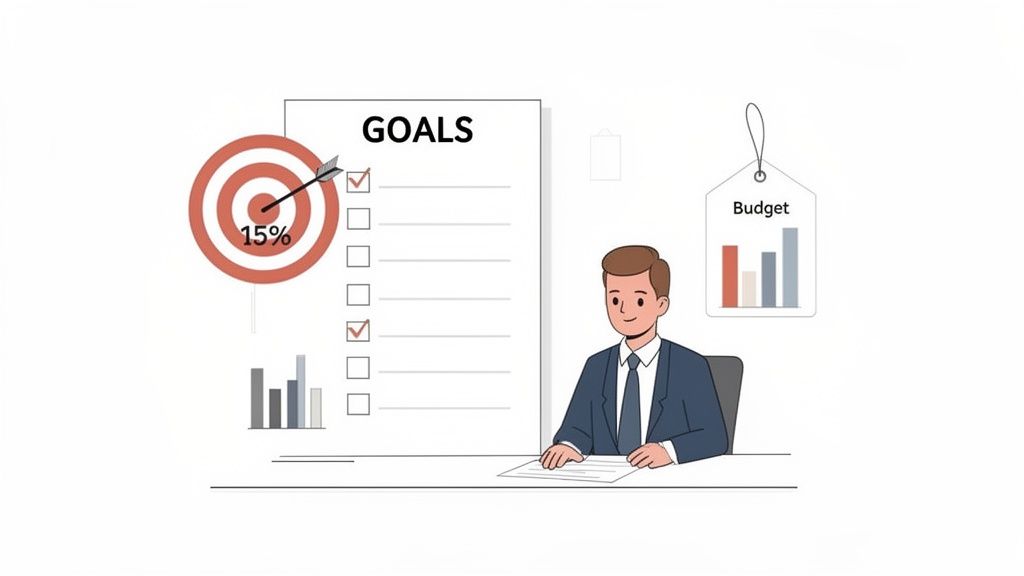
Honestly, the success of your agency relationship is often decided long before you send that first inquiry email. Rushing into the search process without a clear strategy is like starting a road trip with no destination—you’ll just burn fuel without getting anywhere meaningful.
Before you can properly evaluate a potential partner, you have to know exactly what you need them to do. Vague requests like "we need more leads" or "we want to grow our social media" are just too ambiguous to be actionable. The real goal here is to define concrete, measurable business objectives.
For instance, a generic request becomes a powerful directive when you get specific. "More leads" transforms into "Generate 150 marketing-qualified leads (MQLs) per month from organic search within six months." Now that's a target an agency can build a real strategy around.
Moving From Vague Desires to Concrete Objectives
To get that level of precision, you need to start translating broad business goals into specific marketing outcomes. This is how you bridge the gap between your company's high-level ambitions and the day-to-day work an agency will actually perform.
Think about these kinds of transformations:
Vague Goal: "Increase brand awareness."
Specific Objective: "Achieve a 25% increase in branded search volume and secure 10 high-authority media placements in our industry within 12 months."
Vague Goal: "Improve our sales."
Specific Objective: "Reduce customer acquisition cost (CAC) by 15% while increasing customer lifetime value (CLV) by 10% over the next four quarters."
The single most important thing you can do before you hire a marketing agency is to define what success looks like in numbers. A clear destination allows a good partner to map the best route to get there.
Conducting a Realistic Audit of Your Current Marketing
Once your objectives are clear, it’s time for a reality check. A candid self-assessment of your current marketing efforts will reveal the critical gaps and opportunities an agency can jump on.
Don’t just focus on what’s broken; identify what’s working, too. This insight helps an agency know what to build upon instead of starting from scratch.
Your audit should cover a few key areas:
- Performance Review: Dig into your existing data. What channels are driving the most traffic and conversions? Which campaigns have bombed, and why?
- Asset Inventory: What content, creative assets, and tools do you already have? A sharp agency can repurpose and optimize existing materials, saving you time and money.
- Team Capabilities: What skills do you have in-house? Be brutally honest about your team's bandwidth and expertise. This helps define exactly where an agency's support is most needed.
Setting a Practical and Informed Budget
Finally, you have to talk money. Without a clear financial framework, you can't properly evaluate any proposals. Budgets aren't arbitrary numbers; they are investments tied directly to your goals. Understanding the common pricing models is key here.
- Monthly Retainer: A fixed fee you pay each month for a defined scope of work. This is best for ongoing, long-term partnerships.
- Project-Based: A flat fee for a specific, one-time project, like a website redesign or a big product launch campaign.
- Performance-Based: A model where the agency’s pay is tied directly to hitting specific KPIs, such as a percentage of revenue generated. This one can be tricky to structure but powerful when it works.
Getting your internal stakeholders—from finance to sales—aligned on the budget and goals is the final piece of this prep work. This unified front ensures everyone is invested in the outcome.
With this groundwork complete, you'll find the entire process of hiring an agency becomes much more efficient and effective. To help formalize these ideas, you might find it useful to check out our guide on how to write a marketing plan.
Finding and Vetting the Right Agency Partners
Alright, you’ve got your internal strategy locked down and a budget approved. Now for the fun part: the hunt for the perfect agency partner. This isn't just about a few Google searches; it's a methodical process of discovery, evaluation, and finding a team that genuinely clicks with your company's culture and vision.
You’re certainly not short on options. The global marketing agencies market is huge, projected to hit around $432.38 million by 2025. That growth is fueled by businesses like yours needing specialized skills to navigate a constantly shifting landscape, which makes picking the right partner more critical than ever. In fact, agencies that jumped on AI and omnichannel strategies saw a 9.7% growth spurt in 2024—a clear sign of where the industry is heading.
Building Your Initial Longlist of Agencies
First things first, you need to cast a wide—but smart—net. Forget generic searches like "marketing agency." Get specific. Think "B2B SaaS content marketing agency" or "e-commerce performance marketing firm" to get closer to the experts you actually need.
Here are a few tactics I’ve seen work time and again:
- Tap Your Professional Network: This is your best starting point. Ping your mentors, former colleagues, and industry contacts. A referral from someone you trust who has direct experience with an agency is worth its weight in gold.
- Explore Industry-Specific Platforms: Dive into sites like Clutch, G2, and UpCity. They offer verified reviews, client feedback, and detailed case studies, letting you filter by service, industry, and location to find true specialists.
- Analyze Competitor Partners: Take a look at who your successful competitors are working with. You can sometimes find this info in their press releases, case studies, or through industry news. It's a great way to see who’s already delivering results in your space.
This should give you a solid "longlist" of about 10-15 agencies that look good on paper. Now, the real vetting begins.
Evaluating Expertise Beyond the Sales Pitch
A slick website and a polished pitch are just the price of entry. Your job is to dig deeper to uncover an agency's real-world expertise and proven track record. This is where you separate the true pros from the ones who just talk a good game.
As you go through your longlist, scrutinize their client work. Don't just glance at the logos on their homepage—dive deep into the case studies. Are the results they're showing off tied to vanity metrics, or do they connect to actual business outcomes like revenue growth and increased market share?
A great agency won’t just show you their highlight reel. They’ll be open about the challenges they ran into and how they pivoted their strategy to solve them. That’s what demonstrates real problem-solving chops, not just the ability to follow a perfect plan.
Your evaluation should laser-focus on a few key things:
- Relevant Experience: Have they worked with companies of your size, in your industry, and on similar challenges?
- Team Depth: Who will actually be working on your account day-to-day? Look past the founders and the sales team to see the experience level of the strategists, creatives, and analysts.
- Cultural Fit: This is so often overlooked, but it's essential for a good long-term relationship. Do their values, communication style, and general vibe match up with yours?
For a deeper look into this process, especially if you're focused on search, you might find our guide on how to choose an SEO company useful.
From Longlist to Shortlist with an RFI
To efficiently trim your longlist down to a shortlist of 3-5 top contenders, a Request for Information (RFI) is your best friend. An RFI is just a brief document asking for specific, high-level details about the agency's capabilities, team structure, and relevant experience.
This isn’t a full-blown proposal request. The goal of the RFI is simply to gather consistent information so you can make an apples-to-apples comparison. It helps you quickly weed out agencies that aren't a good fit without dragging everyone into a time-consuming proposal process.
Once you get the RFI responses back, you can use a scoring matrix to rank them objectively.
Agency Evaluation Scoring Matrix
This simple matrix will help you score your shortlisted agencies and keep the evaluation process objective and data-driven.
| Evaluation Criteria | Agency A Score (1-5) | Agency B Score (1-5) | Agency C Score (1-5) | Notes |
|---|---|---|---|---|
| Industry Experience | Does their experience align with our niche? | |||
| Case Study Relevance | Do their past results match our goals? | |||
| Team Expertise/Depth | How experienced is the team we'd work with? | |||
| Proposed Approach/Strategy | Does their initial thinking make sense for us? | |||
| Cultural Fit/Communication Style | Do they seem like a good partner to work with? | |||
| Client References & Reviews | What do past clients have to say? | |||
| Pricing & Value | Is their pricing model clear and fair? | |||
| Total Score | Sum of all scores |
By the end of this exercise, you'll have a clear, data-backed ranking that makes it easy to select your final shortlist and move confidently into the proposal stage.
Analyzing Proposals and Asking the Right Questions
You’ve got your shortlist of top agencies. Now the real work begins. This is where you shift from a high-level scan of their capabilities to a deep-dive analysis of their strategic thinking. The next steps are getting a formal proposal in your hands and conducting a structured interview to fill in any gaps.
Think of a well-crafted Request for Proposal (RFP) as your tool for getting a custom-tailored strategy, not a generic, boilerplate pitch. Get specific. Hand over the clear goals, target audience, budget range, and key challenges you mapped out earlier. This context is what empowers an agency to build a proposal that’s actually relevant to your business.
When those proposals finally land in your inbox, fight the urge to flip straight to the pricing page. The most valuable insights are buried in how they propose to solve your problem. A great proposal doesn’t just list services; it outlines a strategic roadmap that ties every single activity directly back to your business goals.
Deconstructing the Agency Proposal
As you lay the proposals side-by-side, you’re looking for signs of genuine strategic effort versus a simple copy-paste job. A truly invested agency will have already done some homework on your brand, your competitors, and your place in the market.
Keep an eye out for these key elements in each proposal:
- Understanding of Your Business: Do they play back your primary goals and challenges in their own words? This is the first sign they were actually listening.
- Customized Strategy: Is the plan tailored to your specific situation, or does it read like a generic menu of services? A strong proposal explains why they recommend certain tactics for your business, not just any business.
- Clear Deliverables and Timeline: The proposal should spell out exactly what they will deliver and when. Look for a phased approach, maybe a 30-60-90 day plan, that shows they have a structured process for hitting the ground running.
- Team Introduction: Who will actually be working on your account? The proposal should introduce the key team members and highlight their relevant experience.
As you analyze their proposed content strategies, it helps to be aware of modern engagement tactics. For example, knowing how brands effectively use things like Marketing Memes can help you ask more pointed questions about their approach to capturing your audience's attention.
Asking Questions That Reveal True Character
The interview is where the proposal comes to life. It’s your chance to assess the human element—the cultural fit, communication style, and real-world problem-solving skills that a PDF can’t convey. Ditch the surface-level queries and dig deeper with questions designed to uncover their true character and capabilities.
Your goal isn't just to understand what they do, but how they think.
The best interview questions aren't about getting the 'right' answer. They're about seeing how an agency thinks on its feet, handles pressure, and approaches problem-solving. Transparency and honesty are what you're really looking for.
Strategic and Tactical Interview Questions
Organize your interview into a few distinct categories to make sure you cover all your bases. Here are some powerful questions that go way beyond the basics:
1. Probing Strategic Thinking
- "Based on what you know about our business, what do you see as our single biggest marketing opportunity, and what would be your first step to capitalize on it?"
- "Walk me through a time you had to pivot a campaign strategy for a client. What was the situation, what data prompted the change, and what was the outcome?"
2. Understanding Team Dynamics and Process
- "Who will be our day-to-day point of contact? What is their background, and what is the escalation path if we have an issue?"
- "How do you handle client communication and reporting? Can we see a sanitized example of a monthly performance report?"
3. Gauging Transparency and Problem-Solving
- "Describe a campaign for a client similar to us that didn't hit its initial goals. What went wrong, what did you learn, and how did you course-correct?"
- "How do you handle disagreements or scope changes? Give us an example of a time you had to have a difficult conversation with a client."
These questions are designed to move past the sales pitch and reveal an agency's adaptability, honesty, and potential as a true partner. Their answers will tell you far more than any polished case study ever could, helping you make a final, confident decision.
Navigating Contracts, Pricing, and KPIs
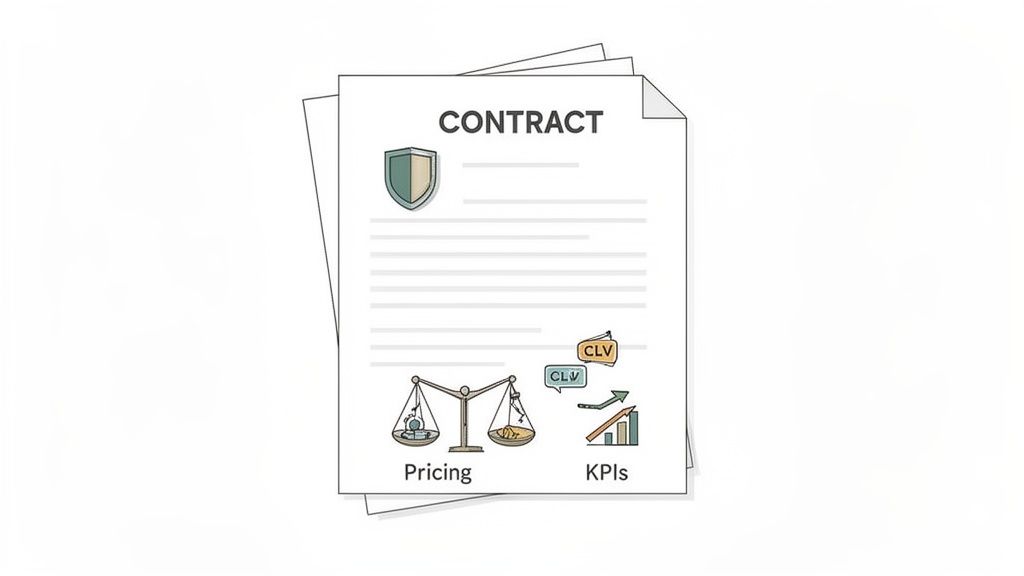
You’ve gone through the proposals, sat through the interviews, and now it's time to make this partnership official. Don't treat the contract as a simple formality. Think of it as the blueprint for your entire relationship—it’s where you define responsibilities, expectations, and what success actually looks like.
Getting these details right from the start protects both you and the agency. It builds a solid foundation for real growth. A huge part of this is getting a handle on the money side of things. Agencies have a few standard ways of charging, and picking the right one for your budget and needs is step one.
Decoding Agency Pricing Models
Before you can negotiate a fair deal, you need to understand how agencies structure their fees. You'll almost always run into one of these three models.
Monthly Retainer: This is a fixed fee you pay each month for a specific set of services. It’s perfect for long-term, ongoing work where you need consistency, like SEO, content marketing, or social media management.
Project-Based Fee: You agree on a flat fee for a single project with a clear beginning and end. This is the way to go for things like a website redesign, launching a new brand, or a targeted advertising campaign.
Performance-Based Model: This is where things get interesting. The agency’s pay is tied directly to hitting specific, measurable goals—think a percentage of revenue generated or a set fee per qualified lead. It’s a powerful motivator, but it requires rock-solid, mutually agreed-upon metrics from day one.
The Scope of Work and Negotiation
The absolute heart of any agency contract is the Scope of Work (SOW). This document needs to spell out every single deliverable, task, and responsibility in painstaking detail. If your SOW is vague, you're just asking for "scope creep"—that slow trickle of extra work that gets added on without any adjustments to your timeline or budget.
Your SOW needs to be crystal clear. Don't just say "monthly content creation." Instead, specify "four 1,200-word blog posts per month, including keyword research, writing, editing, and one round of revisions." That level of detail leaves no room for misunderstanding.
When you're negotiating, try to focus on the value you're getting, not just the lowest number. Ask smart questions. "If we sign a longer-term contract, can we get some flexibility on the monthly retainer?" Or, "Could we try a hybrid model with a base retainer plus a performance bonus if you knock it out of the park?"
A good contract is a balanced contract. It should protect the agency's time and resources while guaranteeing you receive the strategic value and business results you're paying for.
Defining KPIs That Actually Matter
This might be the most important part of the whole deal. The Key Performance Indicators (KPIs) you write into your contract are the yardstick for success. It’s easy to get distracted by "vanity metrics" like social media likes or impressions, but those rarely translate directly to business growth.
Focus on KPIs that are tied directly to your bottom line. To truly see an agency's impact, you need to understand how to measure marketing performance with metrics that mean something.
The market has shifted hard toward accountability. Digital marketing services are on track to make up 61.58% of agency revenue in 2025, with the whole market expected to hit $591.63 billion by 2031. This is all being driven by businesses demanding to see a clear return on their investment, especially when 54% of marketers are planning to cut ad spend and double down on what works.
Tie your KPIs to real business outcomes, such as:
- Customer Acquisition Cost (CAC): How much does it cost you to get a new customer?
- Customer Lifetime Value (CLV): How much revenue does a single customer bring in over time?
- Marketing-Qualified Leads (MQLs): How many leads are genuinely ready for your sales team?
- Conversion Rate: What percentage of people are taking the action you want them to take?
By locking these metrics in upfront, you create a clear framework for accountability. It ensures both you and your new agency are pulling in the exact same direction. For a deeper look, check out this guide on essential digital marketing performance metrics.
Building a Strategic 90-Day Onboarding Plan
Signing the contract isn't the finish line; it’s the starting pistol. The success of your new partnership really hinges on what happens next. A messy start leads to mismatched expectations and wasted momentum, but a solid onboarding process is the single best predictor of a healthy, long-term agency relationship.
This is where you build real trust, set your communication rhythm, and give your new partner the deep institutional knowledge they need to actually succeed. A proactive 90-day plan makes sure the agency starts adding value quickly, moving from foundational learning to smart execution in a logical way. Without this roadmap, you're just asking for weeks of confusion and sluggish progress.
The First 30 Days: Immersion and Alignment
The first month is all about deep immersion. The agency's main job is to become an extension of your team, which means they need to absorb everything they can about your brand, your customers, and how you operate. This isn't the time for big campaign launches; it's the time for audits, discovery, and getting everyone on the same page.
Think of it as handing over the keys to the kingdom. Your responsibility is to provide them with full access to the right people and platforms.
Key activities for this phase usually look like this:
- Comprehensive Kick-Off Meeting: Get all the key players from both sides in a room (or on a call) to walk through goals, timelines, and how you’ll communicate.
- Access and Credentialing: Grant them access to all the essential tools—Google Analytics, your CMS, ad accounts, and social media profiles.
- Technical and Content Audits: The agency should be doing deep dives into your SEO health, existing content library, and past campaign performance.
- Stakeholder Interviews: They need to talk with your sales leaders, product managers, and customer service teams to truly understand the entire customer journey.
That initial 30-day period is foundational. A common mistake is rushing through this discovery phase, which leads to strategies built on assumptions instead of data. Insist on a thorough immersion before you start asking for quick wins.
The Next 30 Days: Strategy and Quick Wins
With a solid base of knowledge in place, month two shifts from learning to planning and initial execution. By now, the agency should have enough insight to put together a detailed strategic roadmap and start testing the waters with a few pilot campaigns. This phase is all about building early momentum.
These "quick wins" aren't just about getting immediate results; they're for testing hypotheses and gathering real-world data that will inform the bigger strategy. For instance, a small-scale paid social campaign can give you invaluable feedback on audience messaging and creative performance before you sink a larger budget into it. To help frame this stage, using a clear marketing campaign planning template can keep both teams aligned on objectives and tactics.
The Final 30 Days: Execution and Optimization
By the last month of onboarding, the training wheels should be off. This is when the core campaigns outlined in that strategic roadmap start rolling out at scale. The focus moves from planning to full execution, constant monitoring, and optimization.
The groundwork laid in the first 60 days is what makes this phase work. Early data from your pilot campaigns should now be fueling your larger rollouts, letting the agency make smarter, data-driven decisions right from the get-go.
Key milestones for this period include:
- Full Campaign Launch: Deploying the main marketing initiatives across all the channels you've agreed on.
- Performance Analysis: Setting up a weekly or bi-weekly check-in to review performance data against the KPIs defined in your contract.
- Optimization Cycles: Actively tweaking campaigns by adjusting targeting, creative, and messaging based on what the initial data is telling you.
- First Monthly Business Review: A formal meeting to go over results, discuss what you've learned, and plan for the next quarter.
This structured approach is non-negotiable in a market where every dollar has to count. Global ad spending is projected to blow past $1 trillion in 2025, with digital advertising making up 75.2% of that total. To get a piece of that massive spend, you need a partner who is not just busy, but strategically effective from day one. This 90-day plan ensures your investment starts working for you, right away.
Agency Onboarding 30-60-90 Day Plan
To make this even more concrete, here’s a simple table you can adapt. It lays out the responsibilities and goals for both sides, ensuring everyone knows what’s expected of them from the moment the contract is signed.
| Timeframe | Key Objectives | Client Responsibilities | Agency Responsibilities |
|---|---|---|---|
| First 30 Days | Deep Immersion & Alignment | Provide access to all tools, data, and key personnel. Share brand guidelines, past performance data, and strategic documents. | Conduct audits (SEO, content, paid). Hold stakeholder interviews. Learn brand voice and internal processes. Define communication protocols. |
| Next 30 Days | Strategy & Quick Wins | Review and approve the strategic roadmap. Provide feedback on initial campaign concepts and creative assets. | Finalize and present the 6-month strategic plan. Launch 1-2 small-scale pilot campaigns. Gather initial performance data. |
| Final 30 Days | Execution & Optimization | Participate in weekly performance reviews. Provide timely feedback for campaign adjustments. | Launch core campaigns at scale. Establish regular reporting dashboards and cadence. Begin optimization cycles. Present the first monthly business review. |
Having a clear, shared plan like this one is the difference between a partnership that flies and one that flounders. It sets the tone for collaboration and ensures that by the end of three months, your agency isn't just a vendor—they're a true strategic partner.
Frequently Asked Questions About Hiring a Marketing Agency
Even with the best plan, you're bound to have questions pop up as you search for the right agency partner. It's a big decision. Let's tackle some of the most common questions we hear from business leaders to give you a bit more clarity before you sign on the dotted line.
How Much Does a Marketing Agency Typically Cost?
This is always the million-dollar question, isn't it? The honest answer is: it's all over the map. Agency pricing really hinges on the scope of work, their reputation in the industry, and the specific outcomes you're trying to achieve.
Generally, you'll run into a few common pricing models:
- Monthly Retainers: For a small or mid-sized business, retainers often fall in the $2,500 to $10,000+ per month range. This usually covers a defined set of ongoing services, like SEO or content marketing.
- Project-Based Fees: One-off projects, like a full website redesign or a major campaign launch, can run anywhere from $5,000 to over $50,000.
- Performance-Based Models: These are less common but are gaining traction. Here, the agency's fee is tied directly to results, like a percentage of revenue generated or a cut of your ad spend.
My advice? Try to shift your focus from the raw price tag to the potential value and ROI. The cheapest option is rarely the best one.
What Are the Biggest Red Flags to Watch Out For?
Knowing what to avoid is just as critical as knowing what to look for. If you see any of these warning signs during the vetting process, it’s a good idea to proceed with caution—or just walk away.
A huge red flag is any kind of guaranteed result, especially something outrageous like promising "#1 rankings on Google in 30 days." Real marketing is complex, and no one can ethically guarantee specific outcomes like that. Also, be wary of a lack of transparency. If they're cagey about who is actually doing the work on your account or how they track results, that's a problem.
A vague, cookie-cutter proposal is another dead giveaway. If it feels like they just slapped your logo on a template without truly digging into your business, it means they haven't done their homework. You're just another sale to them.
What Is the Difference Between a Specialized and Full-Service Agency?
This choice comes down to what you really need right now.
A specialized agency goes deep on one core discipline. Think of a firm that only does B2B SaaS content marketing, or one that lives and breathes PPC advertising. You hire them for their incredible depth of expertise in that single area.
On the other hand, a full-service agency offers a whole spectrum of marketing services under one roof—from branding and web development to PR and social media. They're a great fit if you need a cohesive strategy that spans multiple channels and prefer having a single partner to manage everything.
To give you a better sense of the journey ahead, this visual breaks down what you can expect when you bring a new agency into the fold.
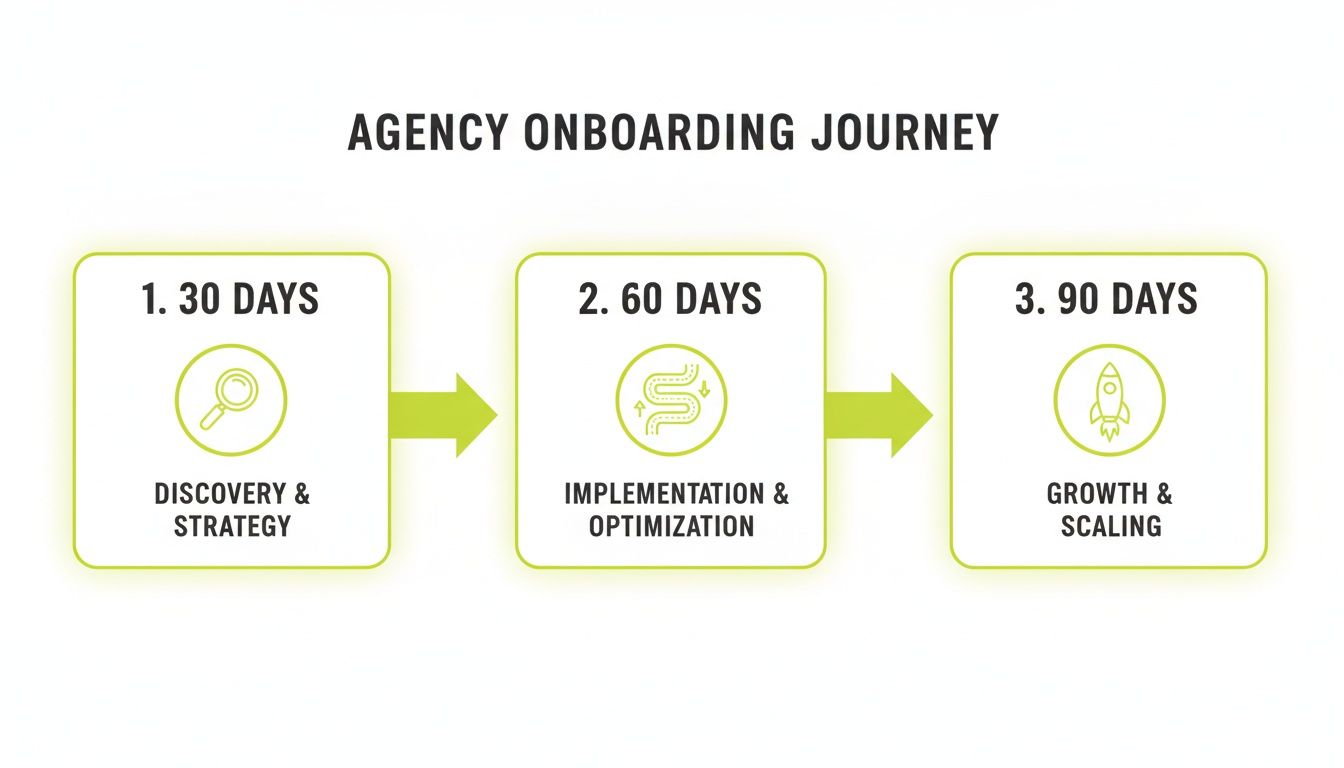
This process maps out how a structured 90-day plan should move from initial discovery and goal alignment to hands-on implementation and, finally, to long-term growth. It's all about building a smooth, effective foundation for the partnership.
At Magic Logix, we believe a successful partnership starts with a clear strategy and a deep understanding of your business goals. If you’re ready to hire a marketing agency that delivers real results, we’re here to help build a custom plan that drives growth for your brand. Learn more about our approach at https://www.magiclogix.com.