If you want to get a real edge, you need to think beyond your own analytics. Diving into your competitor's website traffic isn't just about collecting numbers—it's about adopting a strategic, intelligence-first mindset. Your goal is to decode their digital playbook to find out where their audience comes from, what content wins them traffic, and which marketing channels they rely on most.
This process turns a bunch of estimated data into real, game-changing opportunities for your own strategy.
Why Competitor Traffic Analysis Is Your Secret Weapon
Thinking of competitor analysis as a simple data-gathering task is a huge mistake. In reality, it’s the bedrock of a smarter, more agile digital marketing plan. It lets you benchmark your own performance, find content gaps your rivals have totally missed, and spot weaknesses you can exploit.
This whole process is a form of marketing intelligence. You can get a better handle on the core principles by reading our guide on what marketing intelligence is. The insights you gain will help you ask the right questions and make decisions based on solid information, not just guesswork.
Finding Your True Digital Competitors
Here's something many people get wrong: your biggest real-world competitor might not be your main rival online. The first critical step is identifying your true digital competitors—the ones fighting for the same eyeballs and keywords in the search results. These are the businesses you should be measuring your online performance against.
The objective isn't to copy your competitors. It's to understand their blueprint so you can build a better one. By seeing what works for them, you can reverse-engineer their success, avoid their mistakes, and innovate where they have stagnated.
To get a sense of the scale you're up against, just look at the titans. As of January 2026, google.com saw a staggering 94.76 billion monthly visits, with 70.5% of that coming from mobile devices. For a company like Magic Logix, which works with both SMBs and large enterprises, this just drives home why traffic analytics tools are non-negotiable for turning raw numbers into actionable insights.
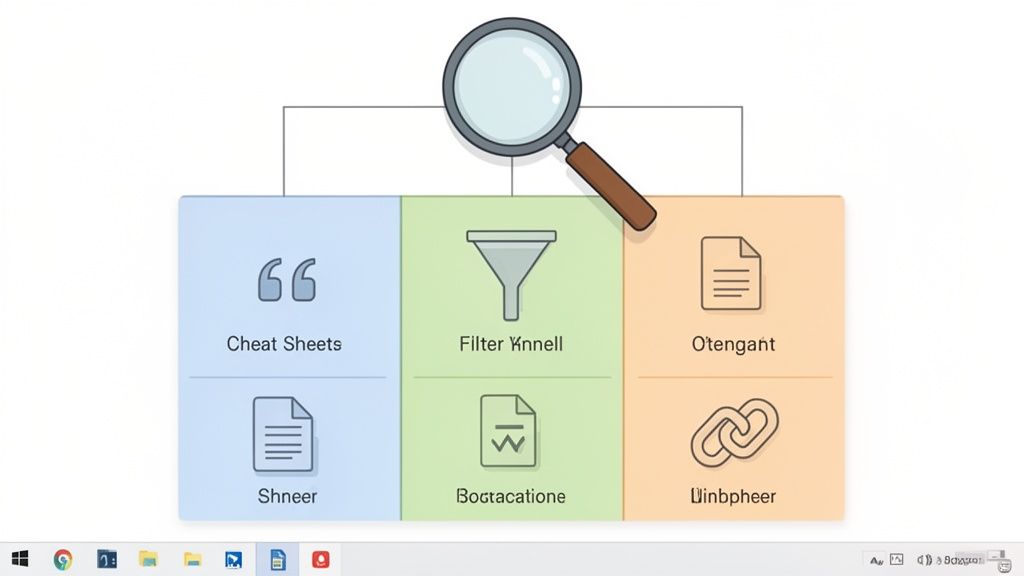
The infographic below breaks down a simple but incredibly effective process for your analysis: Identify, Decode, and Exploit.

This framework isn't just a pretty picture; it's a map. It shows you how to move from discovery to decisive action, turning their data into your advantage.
Your Competitor Analysis Roadmap
Here are the key pillars of an effective competitor traffic analysis. This framework will guide you through the process we cover in this guide.
| Component | Your Objective | Key Question to Answer |
|---|---|---|
| Tool Selection | Choose the right platforms to gather accurate, third-party traffic estimates. | Which tools give the most reliable data for my industry and budget? |
| Key Metric Tracking | Pinpoint the most important metrics that reveal competitor strategies. | What numbers will tell me the story of their traffic acquisition and engagement? |
| Data Validation | Cross-reference data from multiple sources to improve the accuracy of your | How can I be sure these estimates are close enough to reality to be useful? |
| Strategic Translation | Turn your findings into concrete actions that improve your own marketing | What can I do right now to capitalize on what I've learned about their strategy? |
| Ongoing Monitoring | Establish a system to track competitor movements and adapt your strategy over | How can I keep an eye on them without this becoming a full-time job? |
By following this model, you ensure your efforts are focused and actually drive results. If you're looking for a wider view of how this all fits together, check out a proven playbook for competitive analysis in digital marketing.
Ultimately, this is about learning to see competitor traffic not as numbers on a screen, but as a clear roadmap to your own success.
Building Your Competitor Analysis Toolkit

The insights you get from analyzing competitor website traffic are only as good as the tools you use to find them. It's easy to get lost in a sea of options, so let's focus on putting together a practical toolkit that delivers the data you need without overcomplicating things.
Your choice of tools really boils down to your goals and your budget. Are you a lean startup that just needs some quick wins, or a large enterprise needing granular data for heavy-duty market analysis? That question is your starting point.
All-In-One Intelligence Platforms
The heavy hitters in this arena are platforms like Semrush and Ahrefs. Think of these tools as the Swiss Army knives of competitor research. They offer a whole suite of features covering everything from traffic estimates and keyword rankings to backlink profiles. For any deep dive, they're pretty much indispensable.
I was once digging into a competitor in the B2B software space using Semrush. I found they were pulling in a huge amount of traffic—nearly 15% of their organic total—from one very specific, long-tail keyword we had completely ignored. That single piece of information sparked a new content series that helped us capture a valuable, high-intent audience.
These platforms get their data by analyzing massive amounts of clickstream information to create reliable estimates of a competitor's performance. While they're not 100% accurate (only your competitor's own analytics are), they are incredibly powerful for spotting trends, deconstructing strategies, and finding new opportunities.
Specialized and Free Tools
Beyond the big all-in-one suites, you can get unique angles on your competitors' activities by using more specialized tools.
- Similarweb: This platform is brilliant for market-level intelligence. I find it most useful for understanding audience demographics, where traffic is coming from geographically, and bigger industry trends that go beyond just one or two rivals.
- Google Alerts: A simple, free, yet surprisingly powerful tool. Just set up alerts for your competitors' brand names, and you’ll get real-time updates on their new content, press mentions, and brand chatter. It’s a low-effort way to keep a finger on their marketing pulse.
- BuiltWith: Ever wonder what tech a competitor's site is running on? BuiltWith tells you their CMS, what analytics tools they use, their ad networks, and more. This can reveal a lot about where they’re investing and their overall marketing stack.
Choosing the right tool mix is about balancing depth with budget. A startup might begin with free trials and Google Alerts, while a larger company might integrate Semrush's API directly into their business intelligence dashboards for continuous monitoring.
Choosing Tools for Your Budget
The cost of these tools can swing from free to thousands of dollars a month, so it’s critical to choose wisely. Here’s a practical way to think about it based on your company's stage.
| Company Stage | Recommended Tool Strategy | Example Use Case |
|---|---|---|
| Startup/Solopreneur | Leverage free trials of premium tools for intensive, short-term research. Rely on free resources like Google Alerts for ongoing monitoring. | Use a 7-day Semrush trial to perform a deep-dive keyword gap analysis and identify initial content opportunities. |
| Growing Business | Invest in a mid-tier subscription to an all-in-one platform (e.g., Semrush or Ahrefs). This becomes your central source of truth for SEO and content. | Regularly track your top three competitors' keyword rankings and top pages to inform your own content calendar. |
| Enterprise | Combine a premium, all-in-one platform with specialized tools and API access for custom reporting and integration with internal data systems. | Use API data to build a custom dashboard that correlates competitor traffic spikes with their ad spend and your sales. |
Ultimately, your toolkit should empower you to answer critical questions about your competitors' strategies efficiently. Start small, get really good at using one or two key platforms, and then expand as your needs and budget grow. This methodical approach ensures you get the most value from your investment and turn raw data into a real competitive advantage.
Decoding Their Search Engine Strategy

Search is the lifeblood of the modern web. If you want to compete, you absolutely have to understand your competitor’s organic and paid search footprint. This isn't about just swiping a few keywords; it's about meticulously reverse-engineering their entire playbook to find the gaps and opportunities you can exploit.
When you break down their strategy piece by piece, you can see exactly what’s working for them and, just as importantly, where they're vulnerable. This is the intel you need to build a smarter, more effective search presence from day one.
Pinpointing Their Most Valuable Keywords
Your first job is to figure out which keywords are sending the most valuable traffic to your competitors. These are the exact terms their audience is punching into Google when they're looking for answers or solutions. Tools like Ahrefs or Semrush are perfect for this, quickly spitting out a list of a competitor’s top organic keywords.
But don’t just stop at the big, high-volume terms. The real gold is often in the long-tail keywords—those longer, more specific phrases. These tend to come from searchers who are much further along in the buying process and can be surprisingly easy to rank for.
Don't just collect a list of their keywords; you have to analyze the intent. Are people searching for information ("how to improve team productivity"), ready to buy ("best project management software"), or just trying to get to a specific site ("Asana login")? Knowing this tells you exactly what kind of content resonates with their audience.
This is more important than ever. Organic search is a beast, with data showing that by 2026, an estimated 40.65% of all website traffic will come from organic. For our clients at Magic Logix, whether they're Dallas-based startups or global enterprises, this just reinforces why SEO delivers such a powerful return. With Google referrals making up 63.41% of traffic for most sites, you can see why it's a channel you can't ignore. You can dig into more website traffic statistics to see the full picture.
Evaluating Their Backlink Authority
A website’s authority in the eyes of Google is built on its backlink profile. Think of it as a collection of votes from other sites. A strong profile, packed with links from reputable sources, is a massive signal of trust that sends rankings soaring.
When you look at a competitor’s backlinks, you’re not just counting links. You’re on a mission to find patterns and opportunities.
- Spot High-Authority Domains: Which respected industry blogs or news sites are linking to them? These are your prime targets for outreach.
- Analyze the Link Context: Are the links coming from guest posts, resource pages, or directories? This shows you which link-building tactics are actually working in your niche.
- Find "Linkable Assets": Look for their pages that have earned a ton of backlinks. These are often things like original research, data-rich reports, or free tools—giving you a blueprint for content that naturally attracts links.
I once worked with a client in the Dallas market who was getting crushed by a competitor for the term "digital transformation solutions." We dug into their rival's backlinks and found they had landed several powerful links from local business journals by publishing a report on the Dallas tech scene. We decided to create an even better, more comprehensive report, reached out to the same journalists, and quickly earned similar links that helped us close the ranking gap.
Dissecting Their Paid Search Campaigns
Beyond organic, you have to know how competitors are using paid search (PPC). Seeing where they choose to spend their ad budget is like getting a direct look at which keywords and offers they believe are the most profitable. For a deeper dive, our guide on leveraging paid search intelligence is a great place to start.
When you investigate their PPC strategy, zero in on these elements:
- Keywords They Bid On: What terms are they actually paying for? This is a huge indicator of commercial intent.
- Ad Copy and Messaging: How are they talking to customers in their ads? Study their headlines and descriptions to understand their value props and calls-to-action.
- Landing Pages: Where do the ads lead? The design and content of their landing pages reveal their entire strategy for turning clicks into customers.
By pulling together insights from their organic keywords, backlinks, and paid campaigns, you can finally see the complete picture of their search strategy. This holistic view is your key to finding keyword gaps, discovering high-value link targets, and ultimately, creating content that is built to win.
Mapping Their Full Traffic and Audience Picture

If you're only looking at a competitor's search rankings, you're missing most of the story. True competitive analysis means digging into their entire marketing ecosystem—Direct, Referral, Social, and Email—to figure out where they're really winning.
This is where you find the gold. You might discover a rival is pulling a huge 20% of their traffic from a single industry forum you’ve never even heard of. That isn't just a random number; it's a massive, untapped opportunity staring you in the face. Of course, to get started, you first need to understand how to track website traffic with the right tools in your corner.
Uncovering Their Primary Traffic Channels
Every successful website has a unique blend of traffic sources. Your first job is to fire up a tool like Semrush or Similarweb and get a quick breakdown of where their visitors are coming from. This tells you where they’re putting their marketing muscle.
For example, a high percentage of Direct traffic, where users type the URL straight into their browser, points to powerful brand recognition. On the other hand, a big slice of Referral traffic usually signals a strong backlink strategy or valuable partnerships.
Think about it: a competitor with 35% of their traffic from social media isn't just posting randomly. They've built an engaged audience somewhere. Your job is to find out where—is it a bustling LinkedIn group, a vibrant Instagram community, or a niche Facebook page? This discovery should directly inform your own social strategy.
By dissecting these channels, you stop gathering data and start mapping out their entire marketing machine. Our guide on key digital marketing performance metrics can help you translate these numbers into actionable insights.
To keep things organized, I always recommend using a simple table to track what you find. It’s a great way to see everything at a glance and spot opportunities instantly.
Tracking Competitor Traffic Channel Distribution
Use this table to log and compare traffic distribution for your top competitors, helping you identify their marketing focus and potential opportunities for your brand.
| Traffic Channel | Competitor A (% Traffic) | Competitor B (% Traffic) | Your Website (% Traffic) | Strategic Insights |
|---|---|---|---|---|
| Direct | 40% | 25% | 30% | Competitor A has strong brand recall. |
| Organic Search | 30% | 45% | 40% | Competitor B is winning at SEO. |
| Referral | 15% | 10% | 5% | Both have better partnership strategies. |
| Social | 10% | 15% | 20% | We have a stronger social media presence. |
| Paid | 5% | 5% | 5% | All have minimal investment in PPC. |
A simple chart like this immediately shows you where you’re leading, where you're falling behind, and where your next big move should be.
Analyzing Audience Behavior and Engagement
Getting traffic is only half the battle. What visitors do once they land on a site tells you the real story and helps you find the cracks in your competitor's armor.
Look at these key engagement metrics:
- Average Visit Duration: How long are people actually sticking around? A short duration on a long-form content page could mean the content is boring or irrelevant.
- Pages per Visit: Are users clicking around and exploring, or do they hit one page and leave? Low numbers often point to poor internal linking or a confusing site structure.
- Bounce Rate: This is a classic. A high bounce rate means visitors are leaving without taking any action, often because of a bad user experience or a mismatch between their ad and the landing page.
I once analyzed a competitor who was getting tons of mobile traffic but had an abysmal 85% bounce rate on their main product pages. That was a huge red flag pointing to a terrible mobile experience. We made our own mobile site a priority and started scooping up the customers they were frustrating.
Understanding Their Audience Demographics and Device Usage
Finally, you need to paint a complete picture of who their audience is and how they’re browsing. Are they targeting the same cities or countries as you? Is their audience primarily on their phones or sitting at a desktop?
This device-type split can be a game-changer. With mobile expected to command 60% of global website visits by 2026, you can't afford to ignore it. What's interesting is that while desktop traffic might be lower, sometimes as little as 38%, it often boasts nearly double the conversion rate. Knowing these trends helps businesses like Magic Logix design solutions that perform perfectly on every device.
This kind of information is pure strategic gold. When you discover that a competitor is ignoring a key demographic or has a clunky site on a specific device, you've just found your opening. This is how you turn a simple numbers game into a concrete plan for outmaneuvering the competition.
Turning Your Data Into Winning Moves
So, you’ve done the heavy lifting. You have spreadsheets, charts, and a mountain of data on your competitors' website traffic. Now what?
Piling up data is easy. The real win comes from turning that data into a concrete game plan. This is where you move from being a spectator to a player, making decisive moves that give you a real, measurable advantage in the market.
All the insights you've uncovered—from keyword gaps to their top referral sources—are essentially clues. Your job is to piece them together and build a winning strategy.
Building Your Strategic SWOT Framework
A simple but incredibly effective way to make sense of everything is to use a SWOT analysis (Strengths, Weaknesses, Opportunities, Threats). But instead of a generic business SWOT, you'll tailor it specifically to your competitor's traffic profile.
This framework forces you to give context to every data point. For instance, you might see a competitor’s top blog post pulls in thousands of monthly visits but has a sky-high bounce rate. That’s not just a statistic; it's a Weakness for them and a massive Opportunity for you. It’s a clear signal to create a better, more engaging piece of content on that exact topic.
Here’s how to frame your findings:
- Strengths (Competitor): What are they absolutely crushing? Maybe they dominate organic search for high-intent keywords or have a killer referral partner sending them qualified leads. These are threats you need a plan to counter.
- Weaknesses (Competitor): Where are they falling short? This could be anything from a clunky mobile experience and slow-loading pages to a nonexistent social media game. These are your opportunities to outflank them.
The goal is to draw a straight line from a data point to a strategic action. Data without a clear action item is just noise. Your SWOT analysis acts as the bridge connecting the two.
By organizing your findings this way, you’re no longer looking at a messy list of facts. You're looking at a strategic map of the battlefield, with giant arrows pointing to where you should attack, defend, and innovate.
Prioritizing Your Action Items
After your SWOT, you'll likely have a long list of potential moves. The trick now is ruthless prioritization. You can't do it all at once, so you have to focus on what will create the biggest impact with the resources you actually have.
I always recommend a simple "Impact vs. Effort" matrix. For every potential action, grade it on two simple scales:
- Potential Impact: How much will this actually move the needle for our business? (High, Medium, or Low)
- Required Effort: How much time, money, and people-power will this take? (High, Medium, or Low)
This exercise quickly brings your top priorities into sharp focus. Those high-impact, low-effort items are your quick wins and should go straight to the top of your to-do list. For example, if you found a high-volume keyword where your competitor’s content is weak, creating a superior article is often a relatively low-effort, high-impact play.
Creating Your Strategic Game Plan
With your priorities straight, it's time to build a real action plan. This can't be a vague wish list; it needs to be a documented strategy with clear ownership and goals.
A simple table can work wonders here:
| Priority | Action Item | Owner | Key Metric to Track |
|---|---|---|---|
| P1: Quick Win | Create a superior blog post targeting the keyword "X" where the competitor's content is weak. | Content Team | Organic rankings and traffic for the new post. |
| P2: Strategic Project | Initiate outreach to the top 3 industry forums driving referral traffic for Competitor A. | Marketing Lead | Number of new referral links and resulting traffic. |
| P3: Technical Fix | Optimize the mobile user experience for our top 3 landing pages. | Web Team | Decrease in mobile bounce rate and increase in session duration. |
This structured approach turns your analysis from a purely academic exercise into an actionable roadmap. It also makes it infinitely easier to get buy-in from your team. When you can show a direct line from "Competitor B is getting 20% of their traffic from this one source" to "Here's our plan to capture a piece of that," you’re speaking a language that inspires action.
Of course, tracking these efforts properly is critical. To get granular with your measurement, you can learn how to use UTM parameters to see exactly what’s working. This is how your analysis becomes a true competitive advantage.
Your Competitor Analysis Questions Answered
When you first start digging into competitor traffic, a lot of questions come up. How reliable is this data, anyway? Am I doing something unethical? Let's clear the air and tackle some of the most common things people wonder about.
Think of this as your guide to navigating the finer points of competitor research. You'll get straight answers so you can move ahead with an analysis that is both insightful and responsible.
Just How Accurate Is Competitor Traffic Data?
This is always the first question, and for good reason. The honest answer is that traffic data from third-party tools like Semrush or Ahrefs is an estimate. It's not an exact science. The only people who know the real numbers have access to the competitor's own Google Analytics.
But "estimated" absolutely does not mean "useless." These platforms work with sophisticated algorithms, analyzing massive amounts of clickstream data from millions of real internet users. While the absolute numbers might be off by a bit, the trends and proportions are often surprisingly on the mark.
For example, a tool might tell you a competitor gets 100,000 monthly visits when the true number is 120,000. But if that same tool shows their organic search traffic fell by 30% after a Google update, or that 40% of their referrals come from one specific partner—that kind of insight is pure gold.
The real value is in the relative data and directional trends, not the absolute visitor counts. Use the numbers to understand their strategy—where their focus is and what's working—instead of getting hung up on precision.
Can I See Exactly Who Visits Their Site?
No, you can't. This is a critical ethical and privacy line that professional tools will not cross. Competitor analysis platforms do not provide any personally identifiable information (PII) about individual visitors. You won't see names, email addresses, or a specific person's click-by-click journey on a competitor's site.
What you will see are aggregated audience insights, which are incredibly valuable. This includes:
- Demographics: General data about the age, gender, and interests that make up their audience profile.
- Geographics: A breakdown of which countries or regions their traffic originates from.
- Audience Overlap: The percentage of their audience that also visits your website. This is a fantastic metric for understanding true market share.
This level of insight gives you more than enough information to learn how to analyze competitor website traffic strategically, all while respecting user privacy.
What’s the Difference Between Visits and Unique Visitors?
This is a common point of confusion, and getting it wrong can easily skew your analysis. The difference is straightforward but important.
- Visits: This metric counts the total number of sessions on a website. If one person comes to the site three different times in a month, that counts as three separate visits.
- Unique Visitors: This counts the number of individual people who visited at least once during a set time. That same person visiting three times? They only count as one unique visitor.
A wide gap between these two numbers is a strong signal of a loyal, engaged audience that returns again and again. A site with 100,000 unique visitors that generates 300,000 visits, for example, clearly has a very sticky user base.
How Often Should I Check Competitor Traffic?
The right frequency really depends on how fast your industry moves and what your own goals are. Constantly checking can lead to analysis paralysis, but waiting too long means you risk missing major market shifts.
I've found this schedule works well for most businesses:
- Monthly Check-in: A quick, high-level review of overall traffic trends, channel distribution, and any big changes to their top-performing pages. This keeps you informed without becoming a major time commitment.
- Quarterly Deep Dive: This is where you conduct a more thorough analysis. Dig into their new keywords, recent backlink acquisitions, and any shifts in their PPC campaigns. Use this time to update your own strategic plans.
- Event-Triggered Analysis: Don't wait for your next scheduled review if something big happens. Investigate immediately after a known Google algorithm update, a major product launch from your competitor, or a big marketing campaign you've spotted in the wild.
This balanced rhythm ensures you’re always aware of your competitors' moves without getting completely lost in the data.
Ready to turn these insights into a dominant digital strategy? The team at Magic Logix specializes in using data and creativity to help businesses outmaneuver their competition. Discover how our tailored solutions can drive your growth at https://www.magiclogix.com.