Brand positioning is the art and science of carving out a unique spot for your brand in the minds of your customers. It's about deliberately shaping perception so that when someone thinks about your industry, your brand is the first one that comes to mind—and for all the right reasons.
This isn't just about being different; it's about being seen as the best possible choice for a specific group of people.
What Exactly Is Brand Positioning?

Let's ditch the textbook definitions for a moment. Think of your customer's mind as a crowded city. Brand positioning is like claiming a prime piece of real estate in that city—a specific, memorable location that belongs only to you.
It’s the reason people instinctively reach for a Volvo when they think "safety," or why they associate Apple with intuitive design. This doesn't happen by accident. It’s the result of a focused, intentional strategy.
Your positioning acts as a compass for everything you do, from your ad copy and logo design to your customer service script. Without it, you're just another voice in the crowd. With strong positioning, your brand becomes the choice.
The Four Pillars of Positioning
Every solid brand position is built on four core components. These pillars work together to create a powerful and cohesive presence in the market. Getting a handle on each one is the first real step toward building a strategy that sticks.
Below is a quick overview of these essential components.
Core Components of Brand Positioning at a Glance
| Component | Definition & Purpose |
|---|---|
| Target Audience | The specific group of people you're trying to reach. This goes beyond demographics to understand their deep-seated needs, frustrations, and desires. |
| Market Category | The competitive space where your brand lives. This sets the context, telling customers how they should compare you to other options. |
| Brand Promise | The unique value you swear to deliver. It's the core benefit that makes you the obvious choice for your target audience. |
| Unique Differentiators | The tangible proof that backs up your promise. These are the specific features or qualities that make you uniquely equipped to deliver. |
These four pillars form the bedrock of your entire brand identity, ensuring that every message you send is consistent and compelling.
The idea of positioning has been a cornerstone of marketing for decades. Famed marketing mind Philip Kotler offered a definition of brand positioning that still holds up: "the act of designing the company’s offering and image to occupy a distinctive place in the mind of the target market."
This concept, which he introduced way back in 1967, has been shaping business strategy for over 50 years.
Positioning is not what you do to a product. Positioning is what you do to the mind of the prospect.
- Al Ries and Jack Trout, "Positioning: The Battle for Your Mind"
This classic quote really nails it. The real battle isn't fought on store shelves or in feature lists—it's won in the customer's mind. To see how this powerful idea fits with other key marketing concepts, explore our deep dive into essential branding and positioning theories.
Why Strong Positioning Is Your Greatest Asset
Let’s get one thing straight: brand positioning is much more than a slick marketing slogan. It's the North Star for your entire business. When you get it right, it guides every single decision—from product development and customer service to the emails you send—ensuring everything reinforces the same core idea about who you are.
This kind of strategic clarity isn't just a feel-good exercise; it delivers real, measurable results. When customers get what you stand for and why you’re the better choice, they don’t just buy once. They stick around. This clarity cuts through the noise of the market, turning your brand from just another option into the only logical choice for them.
A well-defined position is also what gives you the confidence to command premium prices. Why? Because customers are always willing to pay more for a brand they trust and see as uniquely valuable. It’s the silent force that sets you apart in a sea of competitors.
Turning Perception Into Profit
The benefits here aren’t theoretical—they hit the bottom line. Strong positioning builds a powerful moat around your business. Competitors can copy your features, but they can't replicate the unique space you own in a customer’s mind.
It also brings incredible focus to your internal operations. When the whole team is aligned on your position, marketing campaigns hit harder, sales pitches land with more conviction, and product updates are laser-focused on what your audience actually cares about.
A strong brand position gives you a framework for saying "no." It clarifies which opportunities to pursue and which to ignore, saving valuable time and resources.
This disciplined approach is what truly separates market leaders from the rest. The numbers don't lie. Brands with crystal-clear positioning see 23% higher customer loyalty rates in today's global markets. Digging deeper, an analysis of 1,000 Fortune 500 firms found that companies nailing their positioning grew revenue 2.5x faster over four years. If you want to see the proof, you can explore more brand positioning statistics for yourself.
The Foundation for Lasting Growth
Ultimately, a sharp brand position is an investment in long-term resilience. It’s how you build meaningful equity—not just in dollars, but in the minds and hearts of your customers.
Here’s how that foundation fuels sustainable growth:
- It creates deeper customer connections. When your brand stands for something specific, you attract people who share those values. That fosters a bond far stronger than a simple transaction.
- It improves your marketing ROI. Every dollar you spend works harder because your message is targeted, consistent, and hits home with the right audience.
- It guides your innovation. Positioning provides a clear lens for what comes next, making sure new products strengthen your core promise instead of diluting it.
This clear definition of brand positioning in action is what elevates a company from being just another commodity provider into an iconic brand people can’t live without.
Actionable Frameworks to Define Your Brand Position
Knowing what brand positioning is conceptually is one thing. Actually doing it is a whole different ballgame. To close that gap between theory and reality, you need battle-tested frameworks that turn your abstract ideas into a solid, workable strategy.
These tools give you the structure to nail down your position and talk about it clearly and consistently. We'll walk through three of the most essential ones: the Positioning Statement, the Perceptual Map, and the Unique Value Proposition (UVP). Each has a specific job in your toolkit, helping you move from thinking to doing.
The Classic Positioning Statement
Think of a positioning statement as your brand's internal North Star. It's a short, sharp strategic document that spells out your target audience, the market you play in, the unique value you deliver, and the proof behind your claims.
This isn't catchy ad copy for your homepage. It's an internal guide for your team, making sure everyone is rowing in the same direction. It's the blueprint for your brand.
A tried-and-true template looks like this:
For [Target Audience], who [Audience Need], [Brand Name] is the [Market Category] that [Brand Promise/Benefit] because only [Brand Name] is [Reason to Believe/Differentiator].
This simple structure forces you to make tough, critical decisions about who you’re really for and why you’re their best possible choice. That clarity becomes the bedrock for everything else you do in marketing. To really bring these frameworks to life, it helps to explore different brand positioning strategies and see which ones fit your business best.
Visualizing Your Place with Perceptual Maps
While a statement defines your position with words, a perceptual map helps you see it. Picture a GPS for your competitive landscape. You plot different brands—including your own—on a simple two-axis grid. The axes are based on key attributes your customers care about, like Price vs. Quality or Classic vs. Modern.
Doing this exercise almost always reveals where your competitors are all bunched up and, more importantly, where the wide-open spaces are. There’s a startling gap between perception and reality: research shows that 80% of CEOs believe their company delivers a superior experience, but only 8% of their customers agree.
A perceptual map helps you close that gap by showing you how customers actually see the market, not just how you hope they see it. It’s an incredibly powerful tool for spotting that uncontested territory where your brand can truly own a position.
Positioning vs. Strategy vs. Value Proposition
It's easy to get these terms tangled up, but they each have a distinct and vital role. Your internal positioning statement is the strategic foundation, while your value proposition is the customer-facing promise that stems from it. Let's break down the key differences.
| Concept | Primary Purpose | Audience | Example Analogy |
|---|---|---|---|
| Brand Positioning | To define the specific niche and perception your brand should own in the customer's mind. | Internal Teams (Marketing, Sales, Product) | The blueprint for a house. It details where every room goes and its function. |
| Brand Strategy | The long-term plan for achieving brand goals, encompassing positioning, messaging, and actions. | Leadership & All Departments | The master plan for the entire housing development, including roads, amenities, and growth phases. |
| Value Proposition | A clear, concise statement of the tangible benefits a customer gets from your product or service. | Target Customers | The real estate listing for the house. It highlights the key benefits to attract a buyer. |
Think of it this way: your positioning is the "why" that guides your team. Your overall strategy is the "how" you'll get there over time. And your value proposition is the "what's in it for me?" you communicate directly to your customers.
A great UVP often grows directly out of a strong positioning statement. It translates your internal strategy into a compelling message that resonates instantly with your target audience. You can see this dynamic in different marketing approaches, like those explored in a push vs. pull strategy. Understanding how to use both internal and external tools is essential for building a brand that's as strong on the inside as it appears on the outside.
As this graphic shows, getting your positioning right is what fuels real business outcomes.
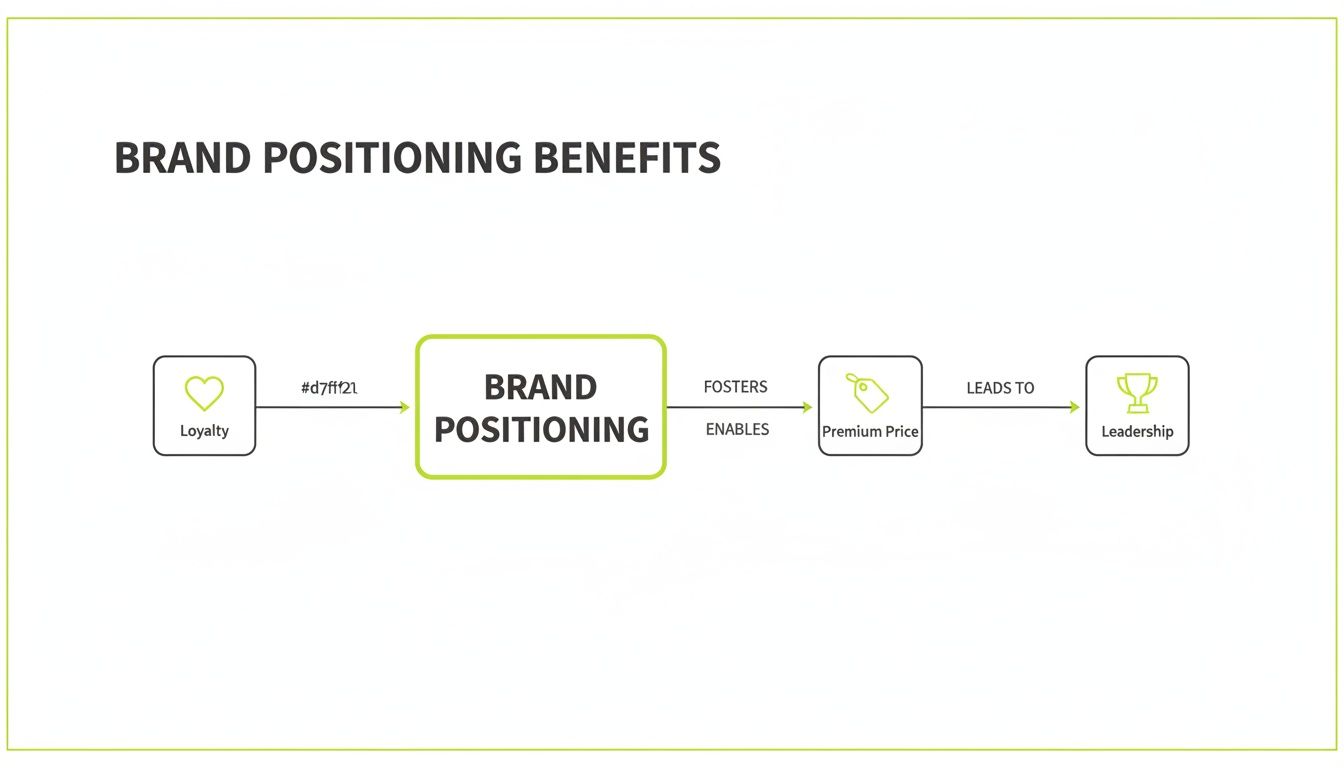
This path is clear: strong positioning builds fierce customer loyalty, which gives you the power to command a premium price. Together, those two factors pave the way to becoming a leader in your market.
A Step-By-Step Process to Craft Your Strategy
Building a strong brand position isn't about a lucky guess or a flash of inspiration in the shower. It’s a disciplined, step-by-step process. Think of it as your roadmap, guiding you from a fuzzy idea to a powerful, market-ready strategy. And remember, this entire exercise fits within your company's broader strategic planning process steps.
I've broken the journey down into four essential stages. Each one builds directly on the last, making sure your final position is authentic, competitive, and actually resonates with the people you’re trying to reach.
Stage 1: Understand Your Target Audience
Everything starts and ends with your customer. You have to go way beyond basic demographics like age and location. It’s time to dig into the psychographics—what are their deepest needs, biggest frustrations, and core motivations?
To get there, you need to create detailed buyer personas. This means conducting interviews, running surveys, and poring over customer feedback to truly understand their world. Your goal is to know them so well that you can articulate their problems better than they can themselves.
Ultimately, you need to answer this: what "job" are they hiring your product to do? A crystal-clear answer to that question is the bedrock of any customer-centric positioning.
Stage 2: Analyze Your Competitors
Once you’ve got a handle on your audience, it's time to map out the competitive landscape. Your brand's position doesn't exist in a vacuum; it’s defined in relation to your rivals. Start by identifying everyone—both your direct and indirect competitors.
Then, you need to dissect their messaging, pricing, and the promises they make to the market. What position do they already own in the customer's mind? Tools like Semrush or Ahrefs are fantastic for analyzing their digital footprint and figuring out what they're saying and to whom.
The whole point of this exercise is to spot the gaps. Look for the unoccupied territory—the needs your competitors are ignoring or just aren't very good at meeting. That’s where your opportunity is hiding.
"Positioning is finding the right parking space for your brand in the crowded marketplace of the consumer’s mind. If you try to take a spot that’s already occupied, you’ll just get into a fender bender."
Stage 3: Identify Your Unique Differentiators
With a sharp picture of your audience and the competition, you can now define what truly makes you different. This has to be more than a single feature; it needs to be a core element of your brand’s DNA.
Your key differentiator should tick three boxes:
- Valuable: It solves a real, painful problem for your target customer.
- Unique: Your competitors can't easily copy it.
- Provable: You can back it up and consistently deliver on the promise.
This could be anything from superior craftsmanship and an unparalleled customer experience to a disruptive business model or a powerful brand story. This is your "reason to believe," the thing that will make your positioning credible and compelling.
Stage 4: Articulate Your Brand Promise
Finally, you bring it all together into a clear, concise promise. This usually starts as an internal positioning statement that gets your whole team on the same page. From there, you can develop all the customer-facing messaging that brings your position to life.
Clarity here is non-negotiable. One study of 15,000 global consumers found that 62% choose brands based on the mental associations formed by positioning, which directly leads to a 25% higher market share. You can dive into the details in this brand positioning research.
Your promise has to be simple, memorable, and focused entirely on the benefit to the customer. This clear articulation becomes the North Star for all your future efforts, which you can organize perfectly with a solid marketing campaign planning template.
Brand Positioning Examples That Inspire
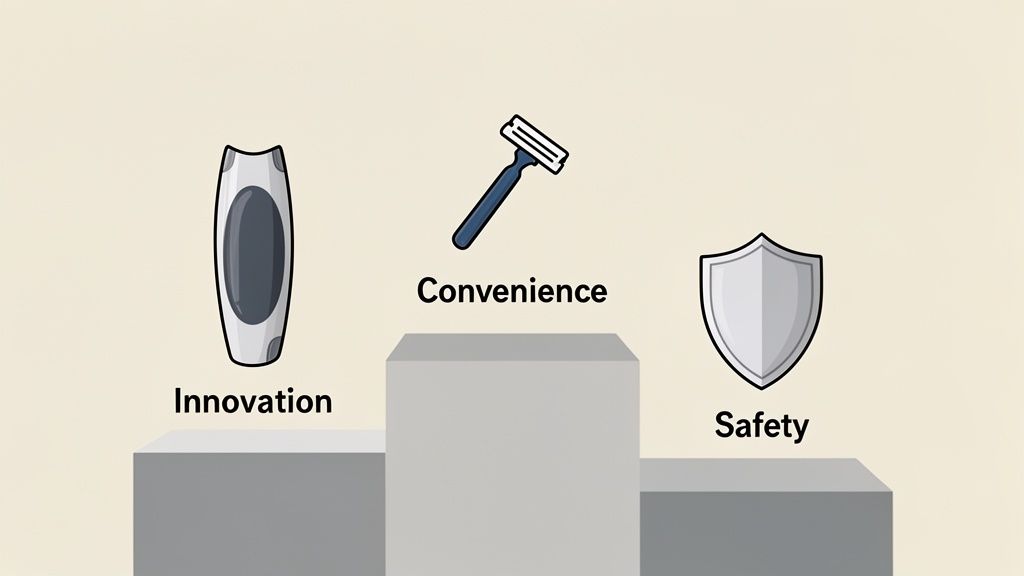
Theory is one thing, but seeing a masterful definition of brand positioning brought to life is where the real lightbulbs go off. Let's pull back the curtain on three iconic brands that have completely owned their space in the customer's mind.
These companies didn't just stumble into success; they meticulously claimed an idea. By breaking down how they did it, you can see the straight line connecting a sharp position to unshakable market leadership. Their stories give us a clear blueprint for what truly great positioning looks like in the wild.
Apple The Innovator
For decades, Apple has owned the idea of innovative, user-friendly design. While competitors were busy shouting about technical specs and processing power, Apple was speaking an entirely different language—one of simplicity, creativity, and elegance. They didn't position themselves as a computer company; they became a lifestyle enabler.
- Target Audience: Creatives, professionals, and everyday people who value a seamless experience and premium design more than raw horsepower.
- Unique Differentiator: Their famously "walled garden" ecosystem, where hardware and software are built in perfect harmony, creates an intuitive feel that competitors still struggle to match.
- Brand Promise: We provide tools that are not only powerful but also beautiful and simple, empowering you to do your best work.
This laser focus allows Apple to command premium prices and has cultivated one of the most fiercely loyal followings in business history. They don't just sell you a phone; they sell you the feeling of being part of the future.
Great positioning is about sacrifice. It’s about choosing to be known for one thing, even if it means you can't be everything to everyone.
Volvo The Protector
Has any brand ever owned a single concept as completely as Volvo owns "safety"? For generations, Volvo has wrapped its entire identity around one thing: protecting families. Every advertisement, every engineering breakthrough, and every public statement hammers this core promise home.
While other automakers chased speed, luxury, or fuel efficiency, Volvo never wavered. They stayed planted in their chosen territory, and that discipline made their brand practically bulletproof. When you think "safe car," you think Volvo. It's an automatic, powerful association they've earned.
Dollar Shave Club The Disruptor
Dollar Shave Club stormed onto the scene by positioning itself as the smart, hilarious, and ridiculously convenient alternative to overpriced razors. They didn't try to build a better razor than Gillette; they decided to change the entire game.
- Target Audience: Young, internet-savvy guys who were sick of the high cost and hassle of buying razors from a locked case at the drugstore.
- Unique Differentiator: A direct-to-consumer subscription model that delivered good-enough razors for a few bucks a month, all wrapped in a witty and relatable brand voice.
- Brand Promise: A great shave for a fair price, delivered to your door with zero BS.
Their viral launch video wasn't just a clever ad; it was the perfect mission statement. It was funny, authentic, and spoke directly to a shared frustration, instantly carving out their spot as the rebellious, common-sense choice in a stale market.
Common Positioning Mistakes You Must Avoid
Crafting a strong brand position isn't just about deciding what you are; it's also about strategically eliminating what you're not. I've seen many promising strategies fall flat, not because of a lack of effort, but because they stumbled into predictable traps that watered down their impact and left customers scratching their heads.
Dodging these pitfalls is critical if you want to build a position with real staying power. By understanding where others have gone wrong, you can keep your own efforts sharp and focused, setting a clear course for your brand instead of getting lost in the noise.
The Trap of Appealing to Everyone
This is probably the most common mistake I see: trying to be the perfect solution for every single person out there. When you try to please everyone, you end up resonating with no one. Your positioning becomes so vague and generic that it's completely forgettable, failing to forge a real connection with any specific group.
A brand that stands for everything ultimately stands for nothing. The whole point of brand positioning is to make a specific promise to a specific audience. This takes discipline. You have to be willing to say "no" to certain markets so you can become the undisputed "yes" for the one that truly matters.
Focusing on Features Nobody Values
Another classic blunder is building your entire position around a feature your target audience just doesn't care about. You might be incredibly proud of your product's groundbreaking tech, but if it doesn't solve a real, urgent problem for your customers, it's just a solution looking for a problem.
Positioning must be rooted in customer reality, not company ego. The features you love internally may be totally irrelevant to the people you're trying to reach.
This kind of disconnect happens when brands don't do their homework. You absolutely must validate that your key differentiators are genuinely valuable to your audience. If you don't, you'll end up shouting about benefits that fall on deaf ears, while your competitors win by focusing on what actually matters to the customer. It's a surefire way to make your marketing feel hollow and completely ineffective.
Answering Your Top Brand Positioning Questions
As you start digging into your brand positioning, a few key questions always seem to pop up. Let's walk through the most common ones I hear from businesses trying to get this right.
How Often Should We Revisit Our Positioning?
This is a big one. You’ve put in all this work, so when do you touch it again? While your core positioning shouldn't shift with every new trend, a yearly check-in is a smart habit.
Think of it like an annual physical for your brand. It’s a chance to see if anything has fundamentally changed. Major market shake-ups, a new competitor changing the game, or a significant shift in what your customers care about might signal that it's time for a deeper reassessment to stay sharp.
Can a Small Business Really Compete with the Goliaths?
Absolutely. But the trick is not to fight them on their turf. A small or medium-sized business can't outspend a massive corporation, so you have to out-think them. The key is to find a specific, underserved niche and own it completely.
A small business wins by becoming the big fish in a small pond. You own a unique space that larger, slower competitors simply overlook.
Instead of trying to be a little bit of everything to everyone, be the absolute best solution for a very specific somebody. That's how you build a loyal following and a defensible market position.
What’s the Difference Between Brand Positioning and Branding?
It's easy to get these two mixed up, but the distinction is critical.
Think of brand positioning as the strategy. It's the blueprint—the internal, behind-the-scenes work of defining where you fit in the market and in your customer’s mind. It answers the question, "What do we want people to think of when they think of us?"
Branding, on the other hand, is the creative execution. It’s the tangible stuff your customers see and experience—your logo, your color palette, your website design, and the voice you use in your marketing. Branding is what brings your positioning strategy to life.
Getting this right means your internal goals will finally line up with your external image. The best way to know if it's working is to keep a close eye on the right digital marketing performance metrics, which will tell you if your strategy is actually hitting the mark with customers.