In a market overflowing with options, a strong branding and positioning strategy is more than just a marketing nice-to-have. It’s the very foundation of your growth. Think of it as the practical game plan for building a brand that not only gets noticed but becomes unforgettable.
Why a Clear Strategy Is Your Competitive Edge
A well-defined strategy cuts through the noise and clarifies two essential concepts. Branding is the heart and soul of your business—the emotional "why" people connect with. Positioning, on the other hand, is the logical real estate you own in a customer's mind. Without getting this right, you’re just another voice in the crowd.
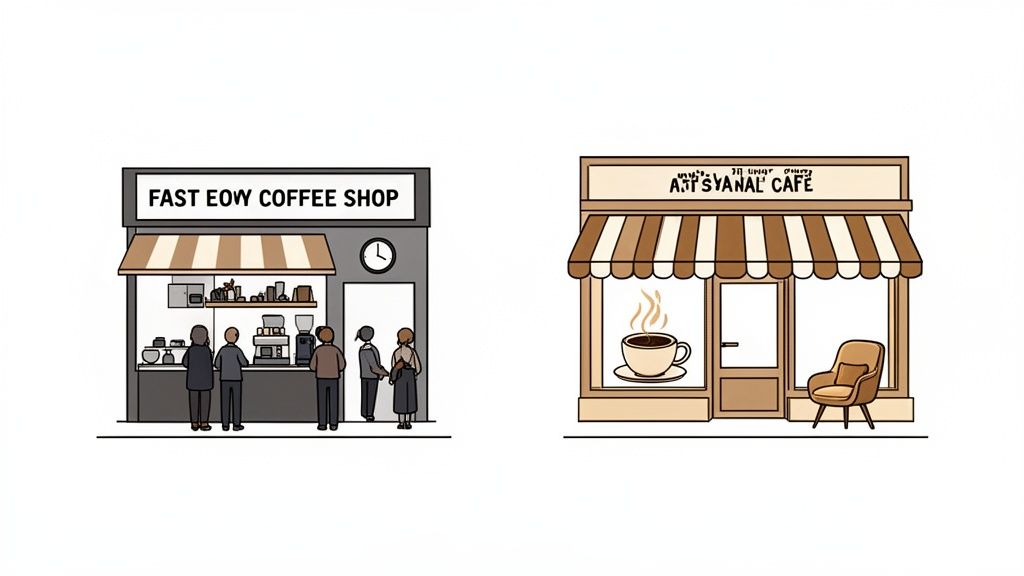
Picture two local coffee shops on the same street. One is the quick, no-fuss stop for commuters, positioned for pure convenience. The other is a cozy, artisanal spot for coffee lovers, positioned for premium quality and experience. Their positioning dictates everything—pricing, store layout, marketing, and the type of loyalty they build.
The Foundation of Growth
To truly get ahead, you have to start by understanding market positioning strategy inside and out. This knowledge is the bedrock of any plan built for long-term, sustainable growth. A solid strategy gives you a few powerful advantages:
- It sharpens your focus. You stop trying to be everything to everyone and zero in on the right market, making your marketing dollars work harder.
- It clarifies your difference. You can finally articulate exactly what makes you the better choice over the competition.
- It guides your messaging. Every piece of content, every ad, and every social media post tells the same consistent story.
A great strategy ensures every marketing dollar reinforces the same core message. It builds brand equity and makes you the obvious choice for your target audience.
This simple visual breaks down the flow perfectly. It all starts with your core brand identity, moves into positioning that identity in the market, and ultimately drives real growth.
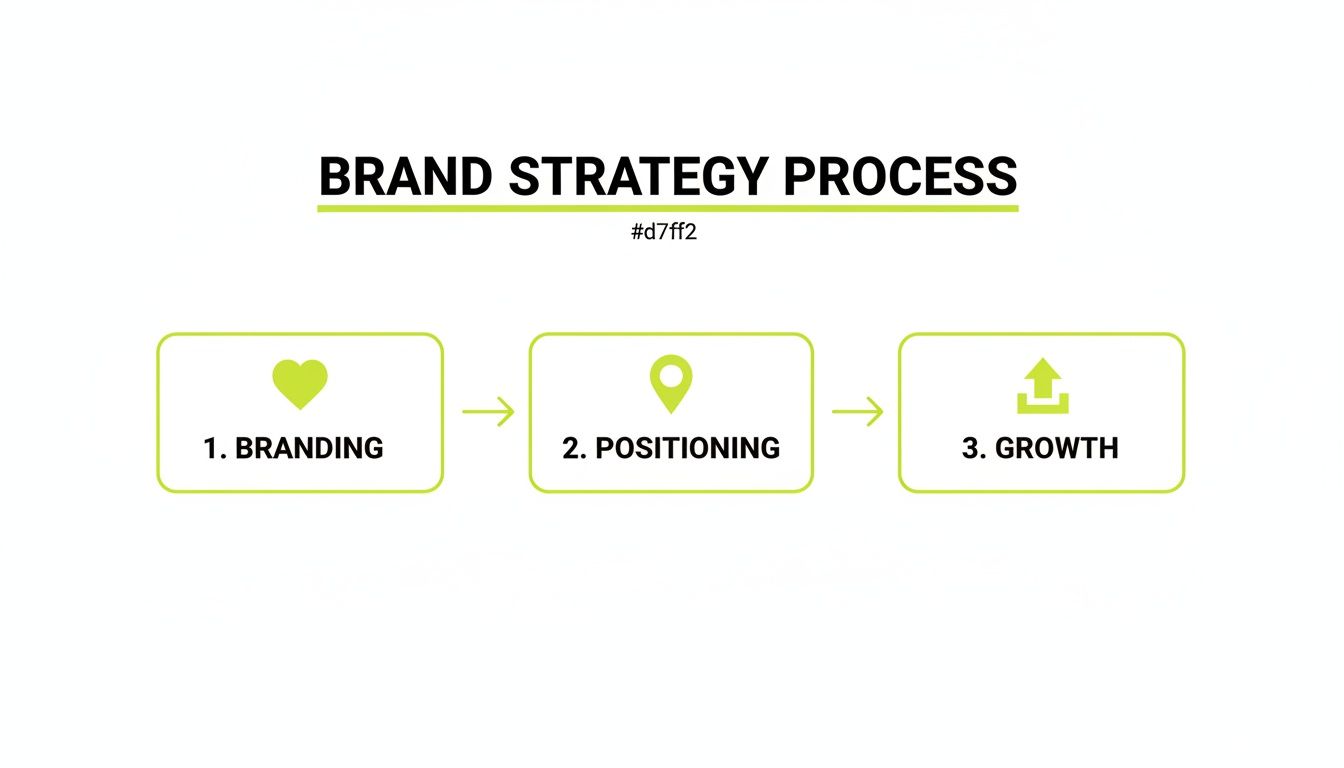
As you can see, positioning is the critical bridge connecting who you are internally with how you succeed externally.
Market Demand and Future Outlook
Putting resources into this process has never been more vital. The global Brand Positioning Strategy market is on a trajectory to hit an incredible $17.3 billion by 2033. That’s fueled by a massive compound annual growth rate (CAGR) of 15.50% starting in 2025. This explosion shows just how seriously businesses are taking the need to carve out their unique space.
Nailing your brand and positioning is a matter of survival and success. It allows you to command attention, build a dedicated following, and see tangible results—a core principle that aligns with today's most effective https://www.magiclogix.com/theories/digital-marketing-trends/.
Building Your Foundation with Market Research
Every powerful branding strategy starts with one thing: a deep, unfiltered understanding of the market. You can't just dream up a clever tagline and hope for the best. Trying to position your brand without this research is like trying to build a skyscraper on sand—it’s just not going to work.
Before you can ever hope to win an audience’s attention, you absolutely have to know who you’re talking to and who you’re up against.
This whole discovery phase really boils down to two things: digging into audience insights and running a thorough competitive analysis. Solid data from both ensures your strategy is grounded in reality, not just wishful thinking.
Uncovering Deep Audience Insights
Knowing your audience means going way beyond basic demographics like age and location. The real gold is in their psychographics—their values, what drives them, their biggest frustrations, and what they secretly hope for. This is how you transform a generic "target market" into a living, breathing customer persona.
To get this right, you need a mix of quantitative and qualitative data. The good news? You probably already have a ton of it.
- Google Analytics: Jump into the Audience and Acquisition reports. Who’s already on your site? Where are they coming from? What content are they actually spending time on? This tells you what's working right now.
- CRM Data: Your customer relationship management software is a treasure chest. Look at purchase histories, customer service tickets, and sales notes to spot behavioral patterns and common complaints.
- Customer Surveys: Sometimes, the best way to get an answer is just to ask. Use a tool like SurveyMonkey or Typeform to send out short, targeted surveys. Ask about their challenges, what they truly value, and what they really think of your brand.
Once you’ve gathered all this info, start piecing it together to create a few distinct personas. Give each one a name, a job title, a backstory. This makes the data feel human and gives your entire team a clear picture of who they’re serving every single day.
A detailed persona isn't just a marketing exercise; it's an organizational compass. It ensures that product development, sales, and customer service are all aligned and focused on solving the right problems for the right people.
Conducting a Ruthless Competitive Analysis
Okay, you know your audience. Now it’s time to figure out who else is trying to talk to them. A competitive analysis is all about spotting opportunities and threats, revealing those little gaps in the market that your brand can strategically own.
The goal isn’t to copy your competitors. It's to learn from what they do well and capitalize on where they fall short.
First, identify two kinds of competitors:
- Direct Competitors: These are the obvious ones—businesses offering a very similar product to the same audience. Think Pepsi vs. Coke.
- Indirect Competitors: These guys solve the same core problem but with a different solution. For a high-end coffee shop, an indirect competitor could be a premium tea house or even a fancy energy drink brand.
Got your list? Now it's time to dissect their strategies. Fire up a platform like Ahrefs or SEMrush and start analyzing their online footprint. Pay close attention to their messaging, the keywords they're targeting, and the overall tone of their content. What promises are they making? What identity are they trying to project?
A pro tip is to set up social listening alerts with a tool like Brandwatch or Mention. Track mentions of your competitors to see what real customers are saying about them. This unfiltered feedback shows you brand perception, common complaints, and where they might be dropping the ball—perfect ammo for building a branding and positioning strategy that highlights exactly where you shine.
To see how this kind of data can shape your outreach, it's worth exploring different push vs. pull marketing strategies.
By combining deep audience empathy with a clear-eyed view of the competition, you’re building an unshakeable foundation for everything that comes next. This isn't just a box-ticking exercise; it's the strategic blueprint you'll come back to time and time again as you grow.
Defining Your Unique Value Proposition
Once you’ve done the hard work of dissecting the market and truly getting inside your audience's head, it's time to shift gears. You've been looking outward; now it's time to look inward and build the very core of your brand identity.
This whole process boils down to one thing: creating a powerful Unique Value Proposition (UVP). Your UVP is your stake in the ground. It's the clear, compelling answer you give your ideal customer when they ask, "Out of all the options, why on earth should I choose you?"
Before you can craft one, you have to get what it is at a fundamental level. A great starting point is understanding what a value proposition is and, more importantly, what it isn't. A UVP isn't just a catchy tagline or some fluffy marketing jargon. It's a rock-solid promise—a clear statement about the tangible results someone gets from your product or service. It lives at the intersection of what your audience desperately needs and what you do better than anyone else.
Crafting Your Core Promise
I’ve found that a simple framework is the best way to cut through the noise and get to the heart of your UVP. It forces you to be brutally clear and customer-focused right from the get-go.
Here's the structure I always come back to:
"For [target customer] who [needs or wants X], our [product/service] provides [key benefit]."
Let’s make this real. Imagine a software startup that built a project management tool specifically for small creative agencies. Using the template, their UVP might look something like this:
"For small creative agencies who struggle with managing client feedback and project timelines, our all-in-one platform provides a streamlined workflow that cuts administrative time in half."
See how potent that is? It’s not vague. It calls out the exact audience, nails their biggest headache, and promises a specific, measurable benefit. It’s not just "another project tool"; it's a lifeline for a very particular type of business drowning in admin work.
From a Promise to a Full Brand Identity
Your UVP is the strategic heart of your brand, but a heart needs a body to function. Now you need to flesh out that core promise into a complete brand identity, giving it a distinct voice, a memorable personality, and a cohesive visual style. The goal is to build something that doesn't just sell, but connects with your audience on an emotional level.
You'll need to define a few key elements:
- Brand Voice: How do you sound? Are you the authoritative expert, or the witty, approachable friend? Your voice should mirror how your audience communicates and what they expect from a brand like yours.
- Brand Personality: If your brand walked into a room, who would it be? Using brand archetypes—like The Hero, The Sage, or The Explorer—is a great shortcut for pinning down your brand's character.
- Visual Direction: This is everything from your logo and color palette to your fonts and photo style. Every single visual choice should reinforce your core message and personality, not fight against it.
A consistent brand experience is everything when it comes to building trust. When your visuals, your voice, and your actions all line up with your core promise, customers start to recognize you, rely on you, and ultimately, choose you.
Don't underestimate the power of aligning your brand with authentic values, especially when consumer trust is so fragile. One study that tracked over 37,600 projects found that branding services were still in high demand, even when the economy took a nosedive. Why? Because people stick with brands they believe in. For instance, 53% of German buyers said they actively choose brands that share their personal values. This shows that a positioning strategy built on authenticity isn't just a nice-to-have; it's what builds unshakable loyalty.
At the end of the day, this stage is all about translation. You're translating your strategic thinking into a tangible brand that people can see, hear, and feel. Consistency across every single touchpoint—from your homepage to your customer support emails—is what turns a solid value proposition into an unforgettable brand.
Nailing Your Positioning Statement and Core Messaging
Alright, you've done the heavy lifting—you know your audience inside and out, and you have a clear picture of the competitive landscape. Now it’s time to take all that brilliant research and forge it into something tangible. We're talking about your positioning statement.
This isn't just marketing fluff. Think of it as the North Star for your entire brand. It's the one-sentence gut check for everything you do, from writing website copy and designing ad campaigns to drafting sales scripts. Without this, your team is flying blind, and you'll end up sending mixed messages that just confuse your audience and weaken your impact.
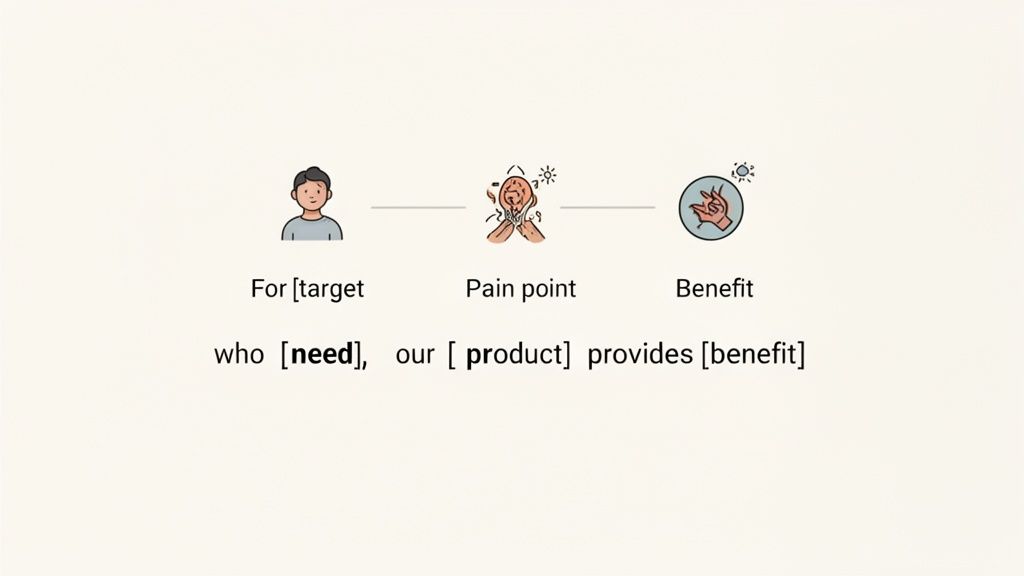
The Go-To Formula for Positioning Statements
There are a few ways to slice this, but one classic formula has stood the test of time because it forces you to be incredibly specific about who you are, who you serve, and why you’re the only real choice.
Here’s the template I always come back to:
For [Target Audience], [Your Brand] is the only [Category] that delivers [Unique Benefit] because [Reason to Believe].
Let’s break that down:
- Target Audience: Get specific. This should come directly from your ideal customer persona work.
- Your Brand: Easy one. That's you.
- Category: The market you play in. Are you a CRM, a project management tool, a coffee shop?
- Unique Benefit: This is your core promise. What's the single most important outcome you deliver?
- Reason to Believe: Your proof. The "secret sauce" that makes your benefit a reality.
Your positioning statement is an internal tool, not a public-facing tagline. Its purpose isn't to be catchy; it's to be brutally clear. It's about aligning your team around one unified direction.
Let’s put it into practice with a fictional B2B tech company:
"For mid-sized e-commerce businesses struggling with cart abandonment, ConvertFlow is the only AI-powered checkout solution that delivers a 15% increase in conversion rates because our proprietary predictive analytics engine personalizes the user experience in real time."
See how powerful that is? It’s laser-focused, driven by a clear benefit, and backed up by a solid differentiator.
Building Out Your Messaging Hierarchy
Your positioning statement is the peak of the mountain, but you need a whole messaging hierarchy to guide people up to it. This framework breaks your big idea into smaller, digestible pieces, making it way easier to create consistent content across all your channels. It ensures your branding and positioning strategy shows up everywhere.
Here’s a simple three-level hierarchy that works wonders:
- Core Message (The "What"): Think of this as the customer-facing, bite-sized version of your positioning statement. For ConvertFlow, it could be: "ConvertFlow boosts your revenue by personalizing the checkout experience."
- Messaging Pillars (The "How"): These are the 2-4 key themes that hold up your core message. They usually map to your main features or benefits. ConvertFlow’s pillars might be AI-Powered Personalization, Seamless Integration, and Actionable Analytics.
- Supporting Points (The "Why"): These are the proof points—the facts, features, data, and testimonials that make each pillar believable. Under Actionable Analytics, you’d list things like "real-time dashboards" or "customer segmentation reports."
This structured system turns your strategy into a practical playbook. Now, whether your team is writing a quick tweet or a deep-dive whitepaper, the DNA of your brand's promise is always present.
Of course, messaging isn't just about the words you use; how you present them matters, too. For a deeper look into the visual side, check out these great insights on color psychology in social media marketing. It’s this combination of clear words and compelling visuals that truly brings a brand to life.
Putting Your Branding and Positioning Strategy Into Action
A brilliant branding and positioning strategy is pure potential until you bring it to life in the market. This is where the rubber meets the road. All that internal work—your positioning statement, your messaging pillars—needs to translate into a real-world marketing plan your audience can actually experience.
Smart execution isn't about chasing every shiny new trend. It's a disciplined process. You have to choose the right channels, craft content that feels undeniably you, and build an integrated customer experience where every single touchpoint reinforces the unique space you’ve decided to own.
Choosing Your Go-To-Market Channels
First things first: you need to decide where to show up. A classic mistake is spreading your efforts too thin across every platform imaginable. Instead, let your market research be your guide. It will point you directly to the channels where your ideal customers are already spending their time.
Think of it this way: if your target audience is B2B decision-makers in the tech industry, throwing your budget at TikTok ads is probably not the best move. Your resources would be far more effective in places like these:
- LinkedIn: This is your home base for publishing insightful thought-leadership articles, jumping into industry groups, and running hyper-targeted ad campaigns aimed at specific job titles or companies.
- Industry-Specific Forums: Find the niche communities where your buyers ask questions. Get in there, provide real value, and build a reputation as a credible expert.
- Targeted Email Marketing: This channel is perfect for nurturing leads with high-value content like whitepapers, case studies, and exclusive webinar invitations.
Now, flip the script. If you're a direct-to-consumer fashion brand targeting Gen Z, your channel mix would look completely different. You’d be all-in on visual platforms like Instagram and TikTok, focusing on influencer collaborations and short-form video that screams your brand's aesthetic.
The goal isn't to be everywhere; it's to be unavoidable where it matters. Dominate a few key channels rather than whispering across many.
Developing a Content Strategy That Embodies Your Brand
Once you know where you're going to be, you need to figure out what you're going to say. Your content strategy is the practical application of your brand voice, bringing your personality and messaging pillars to life. Every single thing you create—from a massive blog post to a simple social media caption—has to feel like it came from the same brand.
Let’s look at how two completely different businesses might activate their strategies through content.
| Business Type | B2B SaaS Company | B2C Sustainable Fashion Brand |
|---|---|---|
| Positioning | "The most secure data analytics platform for healthcare." | "Effortless style that's kind to the planet." |
| Brand Voice | Authoritative, precise, trustworthy. | Passionate, authentic, inspiring. |
| Content Focus | In-depth whitepapers on data security, case studies from hospital clients, webinars with compliance experts. | Behind-the-scenes videos of the production process, user-generated content campaigns, blog posts on sustainable living. |
See how that alignment works? Every piece of content reinforces their unique market position. For more ideas on reaching your audience effectively, you can dive into our complete guide on social media marketing strategies.
Creating an Integrated Customer Experience
Ultimately, successful activation creates a seamless experience. A customer's journey—from seeing your ad on social media, to reading your website copy, to chatting with your customer service team—should feel coherent and consistently on-brand. Every touchpoint needs to echo the same core promise.
This commitment to brand resilience is especially critical when the economy gets choppy. A recent Deloitte report that surveyed over a thousand C-suite executives found that 75% of marketers are actively investing more in their brand right now. They’re focusing on technology and personalization to drive growth, proving that strategic brand investment is a key driver of success, even in uncertain times.
This is the moment your strategy moves from a document to a living, breathing reality that builds trust and drives real growth.
Measuring Success and Refining Your Approach
A powerful branding and positioning strategy isn't some static document you create, file away, and forget about. Think of it as a living, breathing part of your business. It has to adapt to market shifts, customer feedback, and your own company's growth.
Launching your strategy is just the starting pistol, not the finish line. The real work is in the constant measuring and refining.
Without tracking your impact, you're just guessing. You need a clear system to monitor what’s working, what's falling flat, and why. This feedback loop is what turns a good strategy into an unbeatable one over time.
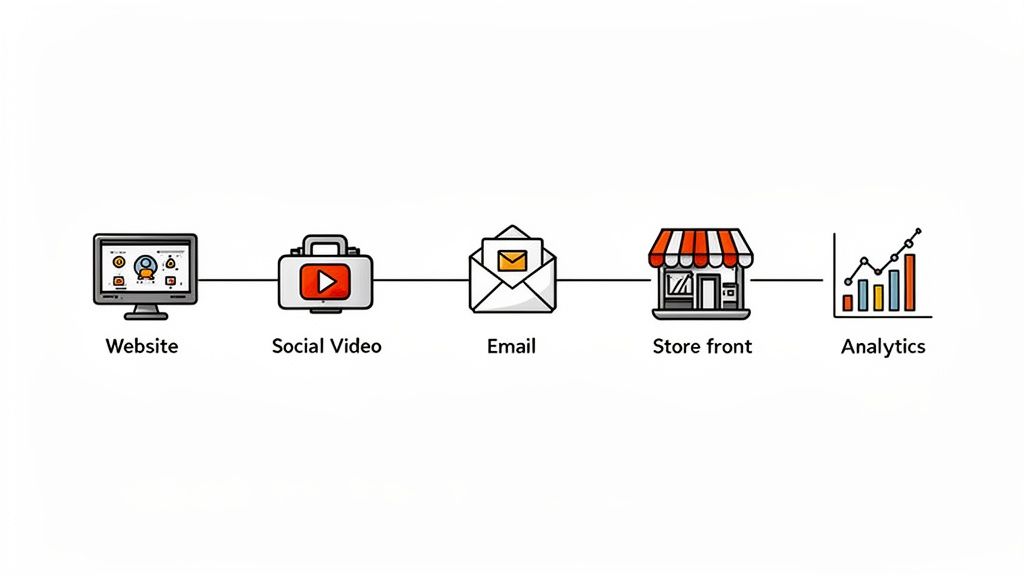
Key Metrics to Monitor
To get the full picture of how your strategy is performing, you really need to track metrics across three distinct areas. Each one tells a different part of the story, from how many eyeballs you're getting to how much money you're making.
Brand Awareness KPIs: These metrics tell you if people are actually seeing and hearing you. Are you making a dent in the market? Key indicators here include social media mentions, raw website traffic, and your share of voice—which is just a fancy way of saying how often your brand is mentioned compared to your competitors.
Brand Perception KPIs: This gets a little deeper. It’s all about how your audience feels about you. Are they just aware of your name, or do they actually like and trust you? You can get a handle on this by tracking sentiment analysis on social media, running customer satisfaction surveys (like the Net Promoter Score or NPS), and keeping a close eye on reviews on third-party sites.
Business Impact KPIs: At the end of the day, your brand has to drive growth. These are the metrics that connect your branding efforts directly to the bottom line. You'll want to focus on things like lead quality, customer lifetime value (CLV), and the conversion rates coming from your brand-led campaigns.
A winning strategy is a living one. Data provides the insights needed to make smart adjustments, ensuring your brand remains relevant and resonant in a constantly changing market.
Establishing a Rhythm for Review and Iteration
Data is completely useless if you don't act on it. The trick is to set up a consistent process for reviewing your KPIs and making smart decisions based on what you see. For most businesses, a quarterly strategy review is a practical and effective rhythm.
This doesn't have to be some massive, time-sucking overhaul. It’s more of a focused check-in.
- Gather Your Data: First, pull the reports from your analytics tools. Something like HubSpot is great for tracking those business impact metrics, while a tool like Brandwatch can give you deep insights into awareness and perception.
- Analyze and Interpret: Now, look for the story in the data. Are you seeing trends? Maybe your share of voice is climbing, but sentiment is dropping. Or perhaps you're getting way more leads, but they aren't converting. You have to connect the dots between the different KPI categories to understand the whole picture.
- Decide and Document: Based on what you find, decide on a few small, actionable adjustments. This could be anything from tweaking your messaging on a specific channel, reallocating some ad spend, or creating a new piece of content to address a common customer question.
For instance, if your surveys show that customers are confused about a key benefit of your product, your action item is clear: create a new explainer video and update your website copy to be more direct.
It's this iterative cycle of listening, learning, and adjusting that ensures your branding strategy doesn't just launch strong—it gets stronger every single quarter.
Your Top Brand Strategy Questions, Answered
Building a solid brand and positioning strategy always sparks a few questions. It's only natural. Here are the answers to the most common ones we field from marketers and founders, designed to give you clarity and confidence.
How often should we revisit our strategy?
Look, your brand strategy isn't something you carve into a stone tablet. Markets change, new players show up, and customer tastes evolve.
You absolutely need to do a formal, deep-dive review at least once a year. It’s also smart to pull the team together any time there's a major market shift—like a disruptive new competitor crashing the party.
On a more regular basis, you should be keeping an eye on your performance metrics every quarter. This allows you to make smaller, smarter tweaks to your messaging and tactics without overhauling the whole ship.
What is the difference between branding and positioning?
This is a classic, and it’s a great question. It’s easy to get them tangled up.
Think of it this way: branding is the whole vibe. It’s the big-picture, emotional stuff—your logo, your voice, the values you stand for, the feeling people get when they interact with you. It’s who you are.
Positioning, on the other hand, is much more specific and tactical. It’s the distinct space you carve out in your customer’s mind, especially compared to your competitors. It answers the simple, brutal question: "Why should I pick you over everyone else?"
You can't have one without the other. Branding builds the connection, and positioning seals the deal.