

Brand safety in programmatic advertising is the set of practices and tools that keep your ads from running next to, or inside, content that could damage your brand. The strongest setups combine four things: a clear definition of what is unsuitable for your brand, pre-bid controls, post-bid verification and regular review of where ads actually ran. Over-blocking has a cost too, so the goal is protection that still leaves enough quality inventory to perform.
This guide walks through the controls, how to set them without choking reach, how to measure them, and how the same discipline applies to B2B channels such as broad match search, Microsoft advertising and connected TV.
TL;DR
- Brand safety is about avoiding harmful adjacency. Brand suitability is about fit with your values, voice and audience. You need both.
- Layer your controls: allowlists, blocklists, private marketplaces and pre-bid signals before the auction, then verification after it.
- Blocking whole categories by keyword often removes good inventory. Use page-level context and review false positives and false negatives.
- Judge ad quality together with viewability, fraud and business outcomes, not any single metric.
- Ask for log-level data and granular cost reporting so you can see what your programmatic spend actually bought.
Table of Contents
- What brand safety means in programmatic buying
- The controls that reduce risk
- How to avoid over-blocking
- How to measure brand safety without fooling yourself
- Applying the same discipline to B2B channels
- A decision framework for setting your controls
- Retainer or project: how to structure the work
- Our perspective
- Getting help with paid media and brand safety
- FAQ
- Sources
What brand safety means in programmatic buying
Programmatic buying is automated and fast. An impression can be bought, filled and served in milliseconds, which is why unsuitable placements are a specific risk in this channel. You rarely pick each page by hand, so your rules have to do that work for you.
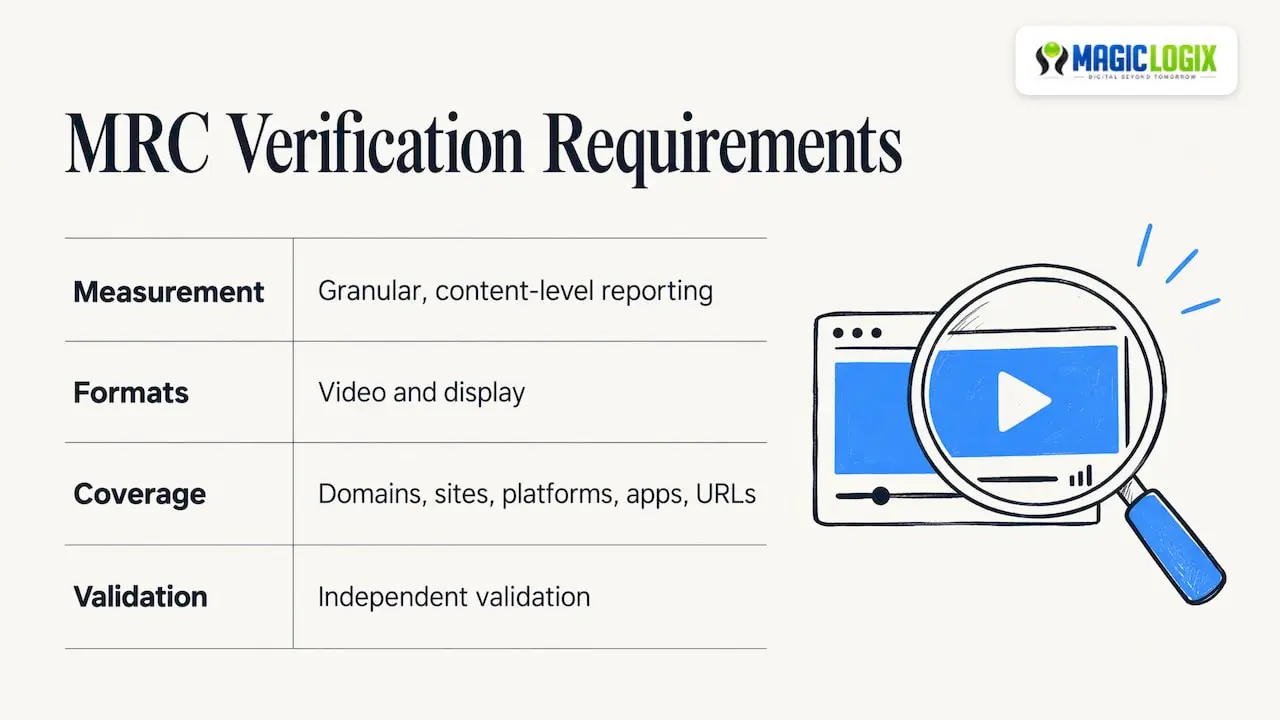
The Media Rating Council (MRC) describes brand safety as the practices and tools that ensure an ad does not appear next to, or in, a context that can damage an advertiser’s brand. Its ad verification supplement calls for granular, content-level measurement and reporting, covering video and display across domains, sites, platforms, mobile apps and URLs, along with independent validation. The MRC’s concern is that social platforms and user-generated content add scale while reducing editorial control, so verification needs to look closer than the domain.
The practical takeaway: a placement report that lists only domains is not enough. You want to know what was on the page or in the video when your ad appeared.
Brand safety versus brand suitability
These two terms get used as if they were the same. Amazon Ads separates them: safety avoids content that is generally inappropriate, while suitability aligns placements with a particular brand’s values, voice, audience and identity.
A simple way to think about it: safety is the floor that every advertiser shares. Suitability is the line you draw for your own company. A cybersecurity software firm and a children’s publisher will agree on the floor and disagree on the rest.
| Concept | Question it answers | Who sets it |
|---|---|---|
| Brand safety | Is this content broadly inappropriate? | Industry norms, verification vendors |
| Brand suitability | Does this content fit our brand, audience and tone? | You, based on risk tolerance |
Buyers can set targeting and avoidance parameters according to their own suitability and risk tolerance, as the MRC supplement notes. That means the first job is internal: write down what your brand will and will not sit beside.
The controls that reduce risk
No single control covers everything. The IAB’s programmatic framework lists verification platforms and pre-bid signals, continuous whitelisting, blacklisting, private marketplaces and supply-management analysis as the main brand-safety controls. It also warns that excessive restriction can reduce scalable inventory and the performance intelligence you gain from broader delivery.
Allowlists and inclusion lists
An allowlist (also called an inclusion list) limits delivery to sites, apps or topics you trust. It is the tightest control and the easiest to explain to a leadership team. Amazon Ads recommends inclusion lists for trusted apps and sites or for relevant topics and keywords.
The tradeoff is reach. A short list protects the brand but can raise costs and cap volume. Start with publishers where your audience already reads, then expand carefully as measurement confirms quality.
Blocklists and exclusion lists
An exclusion list does the reverse: it keeps you off domains or keywords you consider untrustworthy or inappropriate. Blocklists are easier to maintain at scale, but they only catch problems you already know about. Review them on a schedule, and add domains your post-campaign reports flag.
Private marketplaces
A private marketplace gives you access to curated publisher inventory under agreed terms. It sits between a tight allowlist and the open exchange. For B2B advertisers who want trade and business publisher environments, it is often a sensible middle path.
Pre-bid and post-bid verification
Pre-bid controls decide whether to bid at all, based on contextual signals about the page. Post-bid controls check what actually happened after the impression was served and can block or report on it afterward.
Integral Ad Science recommends combining pre-bid contextual controls with post-bid blocking and verification. Its post-bid approach can identify the true page URL and measure brand safety alongside viewability, invalid traffic, geolocation and attention. The reason to layer is simple: pre-bid signals work on what is known before the auction, while post-bid checks catch what the page turned out to contain.
Amazon Ads also advises choosing an established demand-side platform (DSP), since the quality of its built-in controls shapes everything you can configure.
How to avoid over-blocking
Over-blocking is the quiet cost of brand safety. If you exclude every page that mentions a sensitive word, you also exclude news coverage, analysis and neutral reporting that may be perfectly safe for your brand.
The IAB’s Advertising Quality Measurement Buyer’s Guide recommends defining brand safety in a nuanced way. It suggests using the IAB Content Taxonomy, considering both false positives (safe content blocked) and false negatives (unsafe content let through), and avoiding automatic blocking of whole content categories when page-level context could preserve relevance and scale.
Here is a practical routine:
- Write a tiered policy. Separate content that is never acceptable from content that is acceptable in some contexts.
- Use categories, not just keywords. Map your policy to the IAB taxonomy so vendors and your team use the same language.
- Sample blocked impressions. Ask your verification vendor for examples of what was blocked and check whether it was truly a risk.
- Sample delivered impressions. Review a set of served placements the same way, looking for misses.
- Adjust one variable at a time. Change a rule, wait for enough data, then compare.
How to measure brand safety without fooling yourself
A low violation rate on a report looks reassuring, but it is only one number. The same IAB guide says advertisers should evaluate viewability, brand safety and fraud together, alongside business KPIs such as reach, sales conversion and store visits, instead of treating any single quality metric as sufficient.
For a B2B team, replace store visits with pipeline measures: qualified leads, meetings booked, opportunities influenced. If you want a framework for tying channel data to business results, our guide on measuring digital marketing effectiveness covers it in plain steps.
Ask for log-level data and granular costs
Quality and cost are linked in programmatic. The ANA’s 2022 programmatic buying guide recommends collecting supply-chain bills, breaking costs into granular programmatic line items, getting missing data from suppliers, prioritizing agency and platform fees and tracking progress continuously. The ANA’s 2023 study adds that marketers should measure ad quality and price accurately and obtain log-level data from every ad-tech vendor, then ingest, match and harmonize it internally or through a third party.
In practice, this means you should not rely only on summary dashboards from the platform or your agency. Log-level data lets you see which domains, apps and placements your budget reached, and what you paid for each.
A starting scorecard
| Metric | What it tells you | How to use it |
|---|---|---|
| Brand-safety violation rate | Share of impressions flagged unsafe | Track the trend, review flagged examples |
| Block rate | Share of opportunities your rules removed | A sudden jump suggests over-blocking |
| Viewability | Whether ads had a chance to be seen | Read alongside safety, never in place of it |
| Invalid traffic | Non-human or fraudulent delivery | Pair with supply-path review |
| Cost per qualified lead | Business result | Compare across tightened and loosened rules |
These metrics are a framework, not benchmarks. Acceptable levels depend on your category, your risk tolerance and your verification vendor’s definitions, so set your own baseline in the first campaign and compare against it.
Applying the same discipline to B2B channels
Searchers who look up brand safety in programmatic also tend to ask about adjacent B2B channels. Each has its own version of the same question: how much control do you keep once the platform automates delivery?
Broad match in B2B search
Broad match widens the queries your ads can show for. That is a brand-suitability issue as much as a relevance issue, because your ad can appear on queries you would never have chosen. Search Engine Land’s guidance on using broad match without losing control recommends optimizing toward deeper-funnel actions, assigning values to lead-quality tiers, importing offline conversions, keeping shared and campaign-level negatives, reviewing search terms often and validating lead quality outside Google Ads before scaling.
It also warns that CPC or CPA can look better while revenue quality declines, when an account optimizes to the wrong conversion, lacks negative-keyword controls or judges results only on platform metrics. Negative keywords are the search equivalent of an exclusion list. For deeper reading, see our guide to paid search management.
Microsoft advertising for business audiences
Microsoft’s programmatic platform, Microsoft Invest, is one place B2B teams look for business audiences. Microsoft says it combines demographic and in-market audiences, search-intent signals, advertiser or marketplace data, Microsoft-owned properties and premium publisher supply, with cross-device identity, tracking, measurement and attribution tools. The company also states it offers more than 900 in-market audiences across more than 30 categories globally, as of its October 2023 post. Confirm current details on Microsoft’s own pages before planning around any of these figures.
From a brand-safety view, first-party and premium supply can narrow the range of environments you need to police. You still set your own suitability rules and verify delivery.
Connected TV for B2B
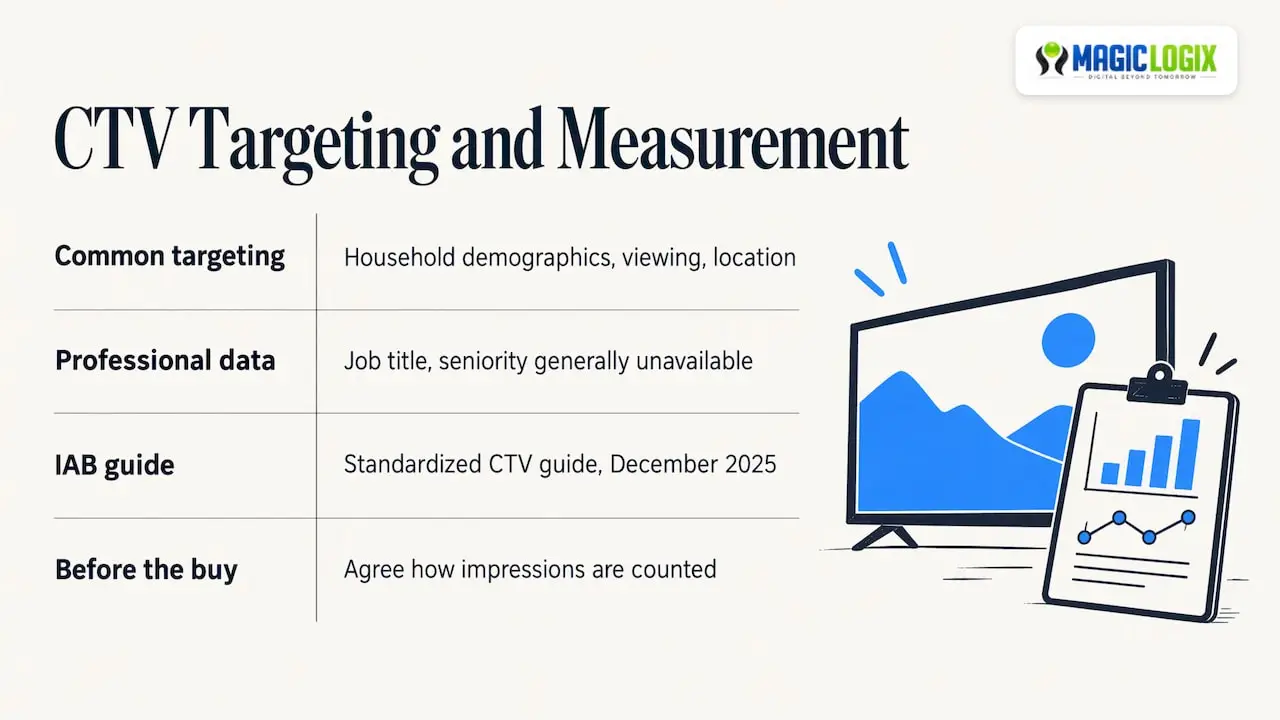
Connected TV (CTV) can support B2B awareness, particularly for brands that want broad reach among decision-makers at home. Two cautions apply. First, consumer-centered targeting is the norm: household demographics, viewing behavior and location are common, while professional attributes such as job title or seniority are generally not available. Second, measurement definitions vary. The IAB released a standardized CTV measurement guide in December 2025 to address inconsistent definitions of impressions, viewability, reach and frequency.
What to do about it: set modest expectations for precision, use geography and content context to approximate your audience, and agree on how an impression is counted before the buy starts. Apply the same brand-safety questions you would on display and video: what content surrounds the ad, and can a third party verify it?
Retargeting
Retargeting can add its own suitability risks, since your ads follow people across many placements. If you run it, build the privacy controls and quality checks in from the start. Our retargeting strategy checklist and guide to cookieless retargeting cover both.
A decision framework for setting your controls
Use these questions to decide how tight to go:
- How costly would one bad placement be? A regulated or highly visible brand may justify allowlists and private marketplaces.
- How much reach do you need? Broader goals call for layered verification instead of narrow lists.
- Do you have the staff to review reports? Tight rules need active maintenance. If your team is small, choose fewer, clearer rules and a verification vendor that reports in plain terms.
- What does your DSP offer natively? Know what is built in before paying for add-ons.
- How will you know if rules are hurting results? Track block rate and cost per qualified lead together.
A reasonable first configuration for many B2B advertisers: an established DSP, a documented suitability policy, a maintained exclusion list, pre-bid contextual controls, post-bid verification and a monthly review of sampled placements. Adjust from there using your own data.
Retainer or project: how to structure the work
Brand safety is not a one-time setup. Lists age, new sites appear and platforms change their tools. That affects how you buy help.
A project fits a defined, finite need: building a suitability policy, auditing current placements, or configuring verification for a launch. A retainer fits continuing work: maintaining lists, reviewing placements, reading reports and adjusting rules as campaigns evolve. Many teams start with an audit project and move to a retainer once the process is in place. Whichever you choose, agree up front on the reports you will receive and the data you will have access to.
Our perspective
Brand safety works best when it is treated as part of media planning, not a filter added at the end. At Magic Logix, our view is that the decision starts with your business: who you want to reach, what you can afford to be seen beside, and which outcomes you will use to judge the spend.
We favor layered controls, plain-language reporting and a regular review of sampled placements. Over-blocking and under-blocking are both avoidable when someone owns the policy and checks it against results. This is how we approach paid media as part of our Digital Beyond Tomorrow positioning: analytics, AI-supported tools and sound creative judgment working together.
We cannot promise any particular placement outcome, because platforms and inventory change. What we can do is help you set clear rules, measure what matters and keep improving them.
Hassan Bawab
Getting help with paid media and brand safety
If you want a second set of eyes on your programmatic setup, our digital marketing and paid media services cover campaign planning, management and measurement for businesses of different sizes. A good first conversation covers your suitability policy, your current reporting and the outcomes you want to track. You can also explore our broader approach to search and paid media performance before you reach out.
FAQ
What is the difference between brand safety and brand suitability?
Brand safety avoids content that is generally inappropriate for any advertiser. Brand suitability is narrower and personal: it aligns placements with your brand’s values, voice and audience. Most advertisers need both, with suitability expressed as written rules.
Are allowlists better than blocklists for programmatic brand safety?
Allowlists give the tightest control but can limit reach and raise costs. Blocklists scale more easily but only stop problems you already know about. Many teams use both, plus pre-bid and post-bid verification, and tune the balance against results.
Can brand safety settings hurt campaign performance?
Yes, if they are too broad. The IAB warns that excessive restriction can reduce scalable inventory and performance intelligence. Review false positives, sample blocked impressions and compare cost per qualified lead as you adjust.
What should a B2B team track beyond violation rates?
Track viewability, invalid traffic and block rate alongside business outcomes such as qualified leads and pipeline influenced. The IAB guidance is to evaluate quality metrics together with business KPIs, not individually.
Do I need log-level data?
It is strongly advisable if programmatic is a meaningful part of your budget. The ANA recommends obtaining log-level data from every ad-tech vendor so you can see what your spend bought and at what cost.
Sources
- MRC Ad Verification Supplement: Enhanced Content Level Context and Brand Safety
- IAB Advertising Quality Measurement Buyer’s Guide
- IAB: An Evolving Framework for Advertising Automation
- Amazon Ads: What is brand safety?
- Integral Ad Science: Approach to brand safety and suitability
- ANA: First guide for programmatic media buying (2022)
- ANA: Programmatic media supply chain study, part 2 (2023)
- Search Engine Land: How to use broad match without losing control
- Microsoft Advertising: Discover programmatic advertising with Microsoft Invest