In the competitive business environment, the difference between a one-time buyer and a lifelong advocate often comes down to one critical factor: engagement. Simply acquiring customers is no longer enough. The real, sustainable growth lies in creating meaningful, personalized interactions across every touchpoint, turning passive consumers into active, loyal participants in your brand's story. This is where the right technology becomes a game-changer. The challenge isn't a lack of tools, but rather navigating a crowded market to find the one that truly fits your business model, technical stack, and strategic goals.
This comprehensive guide is designed to cut through the noise. We will provide a detailed analysis of the best customer engagement platforms available, moving beyond generic feature lists to offer practical insights. You will discover which platforms excel at omnichannel orchestration, which are built for mobile-first strategies, and which offer the most robust data unification capabilities. For a deeper dive into the importance and various facets of effective strategies, exploring dedicated resources on building strong customer engagement can be invaluable.
We will evaluate top contenders like Salesforce Marketing Cloud, HubSpot, Braze, and Twilio Segment, among others. For each platform, you’ll find:
- A concise breakdown of core features and strengths.
- Honest pros and cons based on real-world application.
- Ideal use cases for different business sizes and industries.
- Direct links and screenshots to give you a clear view of the user experience.
Our goal is to equip you with the clarity needed to select a platform that not only manages customer interactions but actively enhances them, driving retention and transforming your customer relationships into a powerful competitive advantage.
1. Digital Marketing — Engage, Converse, Convert
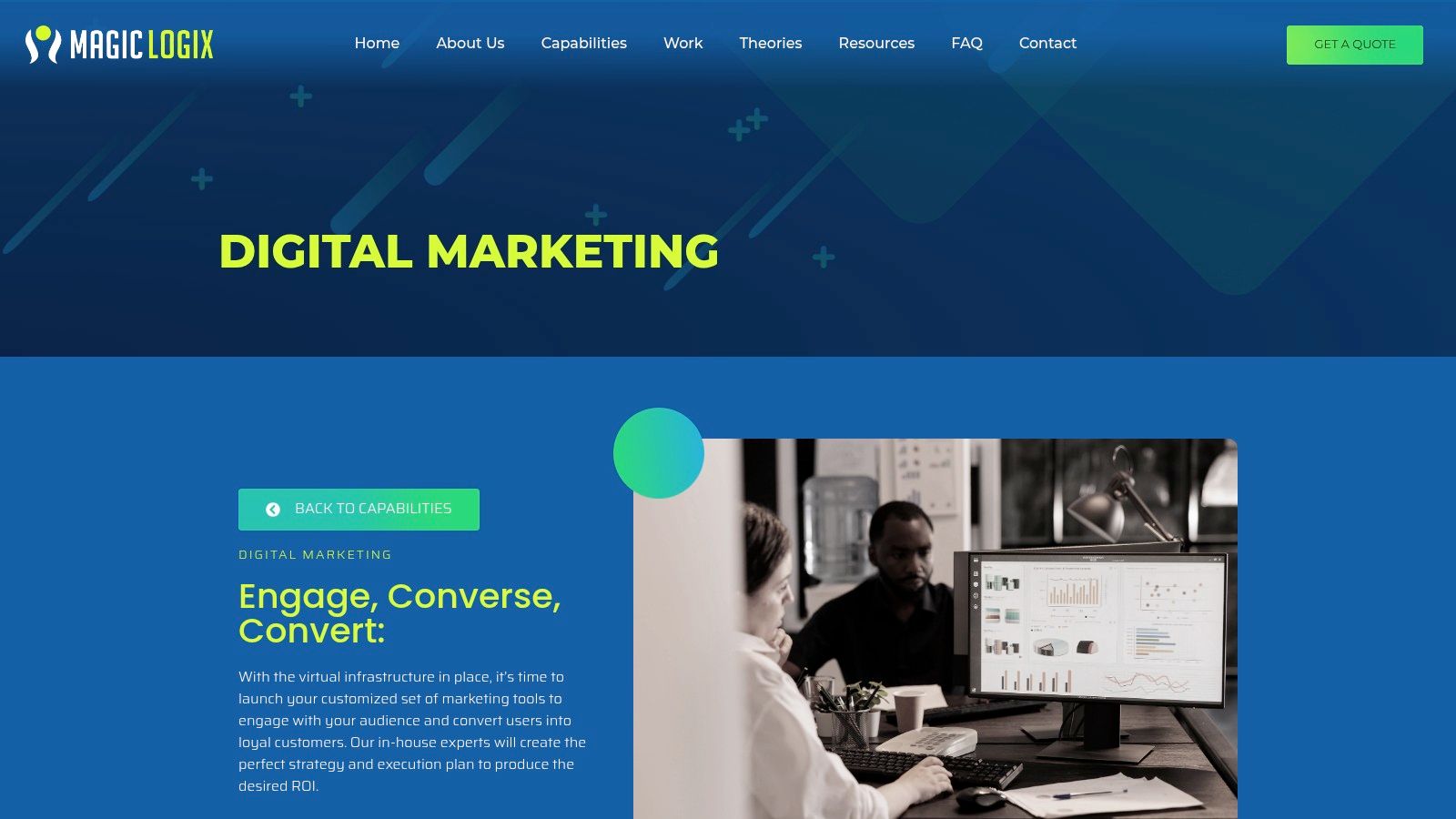
Magic Logix's "Engage, Converse, Convert" offering transcends the traditional definition of a platform by delivering a comprehensive, managed digital marketing service. Rather than providing a single tool, this solution functions as an integrated program that orchestrates the entire customer engagement lifecycle. It stands out as one of the best customer engagement platforms for businesses seeking a holistic, data-driven strategy executed by a team of experts.
This service is uniquely designed to unify disparate marketing channels, such as content, SEO, social media, and paid advertising, ensuring they work in concert. It leverages a powerful combination of predictive analytics, business intelligence, and social intelligence to not only attract visitors but also to nurture them through meaningful, personalized interactions that drive conversions and foster long-term loyalty.
Key Features & Analysis
- End-to-End Lifecycle Management: Unlike siloed tools, this service manages the entire journey from initial awareness to post-conversion loyalty, ensuring a consistent brand experience. It actively optimizes every touchpoint for maximum impact.
- Data-Driven Optimization: The core of the service is its use of advanced analytics. By analyzing user behavior and market trends, campaigns are continuously refined to target the right audiences with the most effective messaging, significantly improving ROI. To truly master the "Engage, Converse, Convert" cycle, understanding how to increase social media engagement with proven tips is paramount.
- Customized Strategy: The approach is not one-size-fits-all. Strategies are tailored to a company's specific goals, market position, and operational maturity, making it suitable for both ambitious SMBs and large-scale enterprises.
Ideal Use Cases
This service-based platform is ideal for organizations that lack the in-house resources to manage multiple complex marketing technologies but require a sophisticated, results-oriented engagement strategy. It is particularly effective for companies aiming to integrate their sales and marketing efforts, using data to bridge the gap and drive measurable revenue growth. For those looking to deepen their understanding of the underlying technology, this resource explains in detail what a customer engagement platform is and how its components work together.
Pros:
- Integrated Approach: Coordinates all digital channels to work cohesively.
- Data-Centric: Uses advanced analytics for precise targeting and continuous optimization.
- Scalable & Customized: Tailored strategies for businesses of all sizes.
- Full-Funnel Focus: Designed to attract, nurture, and convert for higher LTV.
Cons:
- Significant Investment: Comprehensive, bespoke programs require a larger budget and time commitment.
- Integration Complexity: Relies on successful integration with existing tech stacks, which can require technical coordination.
Learn more at Magic Logix
2. Salesforce Marketing Cloud Engagement (Marketing Cloud Engagement+)
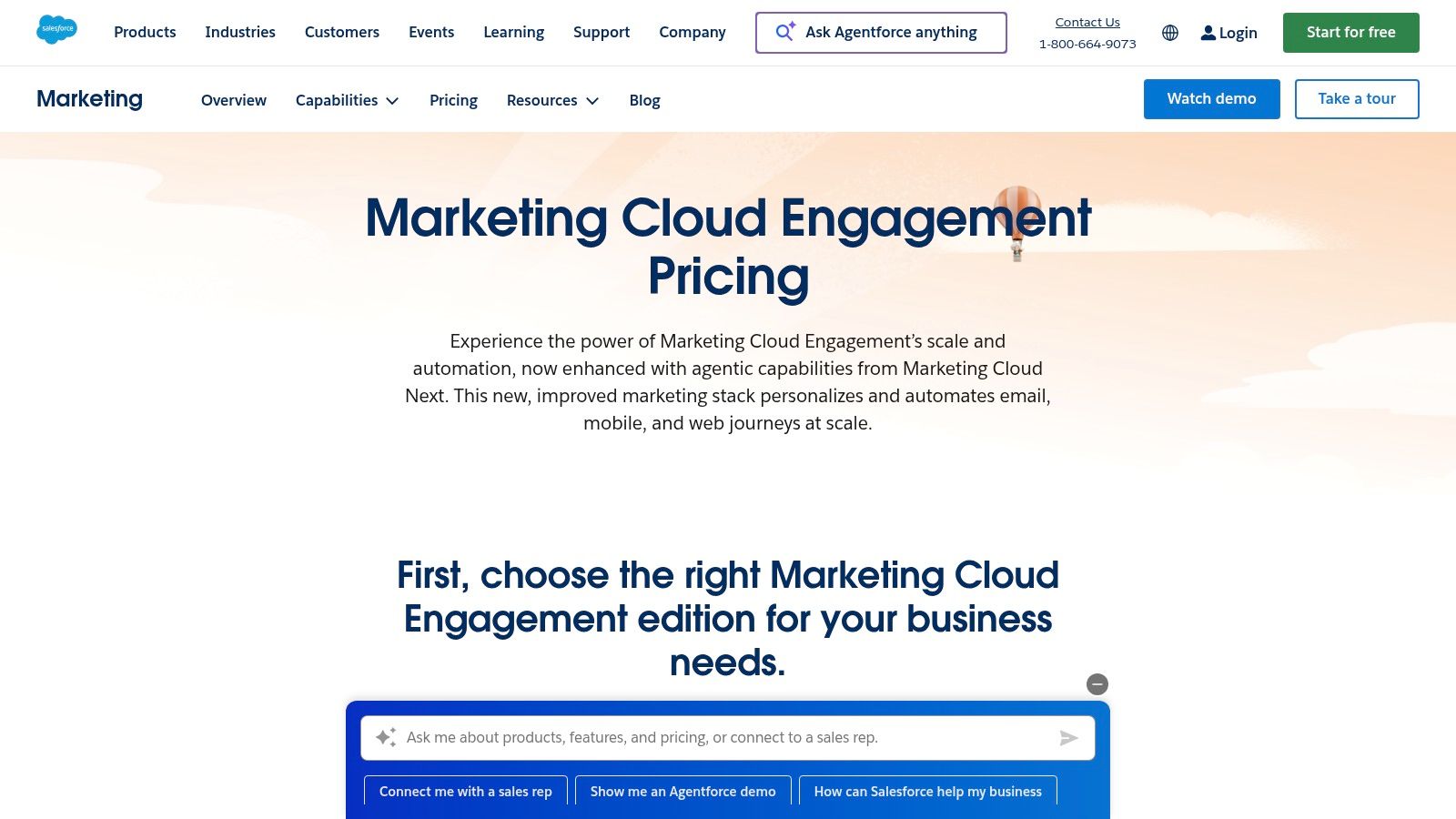
For large organizations, particularly those already integrated into the Salesforce ecosystem, Marketing Cloud Engagement stands out as an enterprise-grade solution. It excels at orchestrating complex, cross-channel customer journeys at a massive scale. Its primary strength lies in its deep, native integration with Salesforce CRM and Data Cloud, allowing for a unified view of the customer to power personalization across email, mobile (SMS, push notifications, WhatsApp), and web channels.
This platform is not merely a messaging tool; it’s a core component of a sophisticated tech stack. Its AI-powered Einstein features provide predictive insights for send-time optimization and engagement scoring, directly impacting campaign performance. The robust governance and multi-business unit architecture make it ideal for enterprises that require stringent security, role-based access, and departmental separation.
Key Considerations
- Best For: Enterprises already using Salesforce CRM or planning a full-stack implementation.
- Pros: Unparalleled integration with Salesforce products, strong enterprise security and governance, and a vast partner ecosystem for support and implementation.
- Cons: Higher price point with mandatory annual contracts. The platform’s full value is heavily dependent on being part of the wider Salesforce ecosystem.
Pricing & Implementation
Salesforce Marketing Cloud Engagement uses a tiered "Plus" packaging model (Pro+, Corporate+, and Enterprise+) with pricing based on contact volume and feature sets. Expect a significant investment, as this is a premium platform. Successful implementation often requires a dedicated team or a partner like Magic Logix to handle the complexities of data integration and journey building, aligning the tool with your core marketing operations. For a deeper dive into this area, learn more about what marketing operations entails and how it can drive efficiency.
Website: https://www.salesforce.com/marketing/engagement/pricing/
3. Adobe Journey Optimizer
For data-rich enterprises committed to the Adobe Experience Cloud, Adobe Journey Optimizer provides a powerful engine for real-time, omnichannel journey orchestration. Its core strength is its native foundation on the Adobe Experience Platform (AEP), enabling it to leverage unified, real-time customer profiles for highly personalized interactions. This makes it one of the best customer engagement platforms for brands that need to activate complex data sets for immediate, context-aware messaging and offer decisioning across email, SMS, and in-app channels.
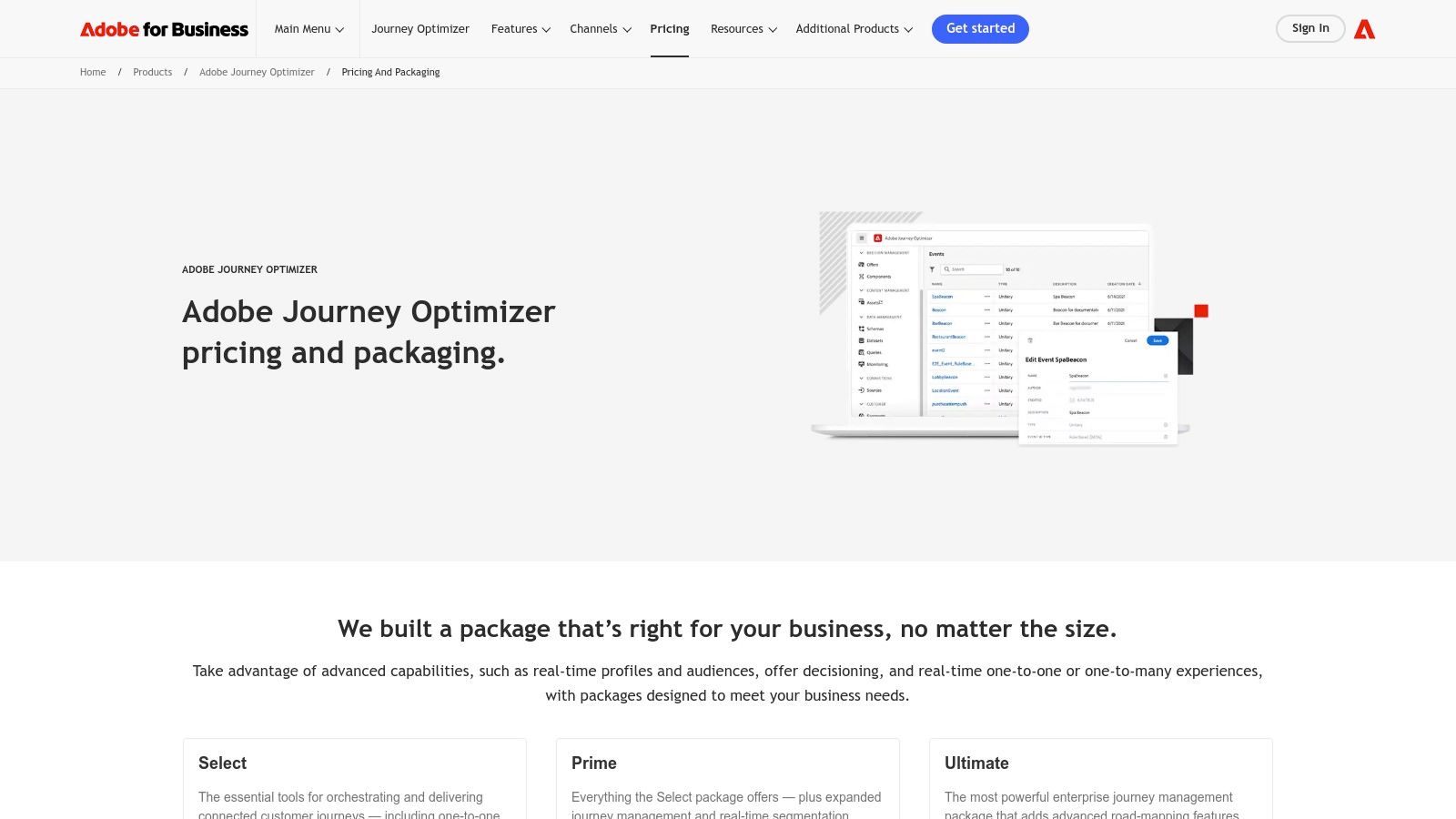
The platform moves beyond standard journey building by incorporating AI and machine learning models for next-best-offer decisioning. This allows marketers to dynamically present the most relevant offer to each individual at the moment of interaction. Its enterprise-grade privacy and governance tooling, inherited from AEP, ensures that data is managed securely and compliantly, which is critical for large, regulated organizations. The integrated simulation and reporting tools also provide a clear view of campaign performance.
Key Considerations
- Best For: Large enterprises, especially those already invested in the Adobe Experience Platform and other Adobe Cloud products.
- Pros: Deep integration with the AEP data model, robust privacy controls, and powerful AI-driven offer decisioning and orchestration tools.
- Cons: Pricing is quote-based and represents a significant investment. The platform's true potential is unlocked primarily within the broader Adobe stack.
Pricing & Implementation
Adobe Journey Optimizer is available in three tiers: Select, Prime, and Ultimate, with custom pricing provided through their sales team. Implementation is a complex undertaking that typically requires expert resources or a partner like Magic Logix to configure AEP, integrate data sources, and build sophisticated journey logic. Harnessing the platform’s AI capabilities effectively requires a solid data strategy, which is a key component of digital marketing predictive analytics and a crucial step to maximize your ROI from the tool.
Website: https://business.adobe.com/products/journey-optimizer/pricing.html
4. HubSpot Marketing Hub
HubSpot Marketing Hub excels by combining a powerful, user-friendly marketing automation platform with a natively integrated CRM. This tight coupling makes it a go-to choice for small to mid-market businesses seeking a single source of truth for their sales, marketing, and service data. It simplifies the process of creating cohesive customer experiences across email, landing pages, forms, and digital ads, all managed from one interface.
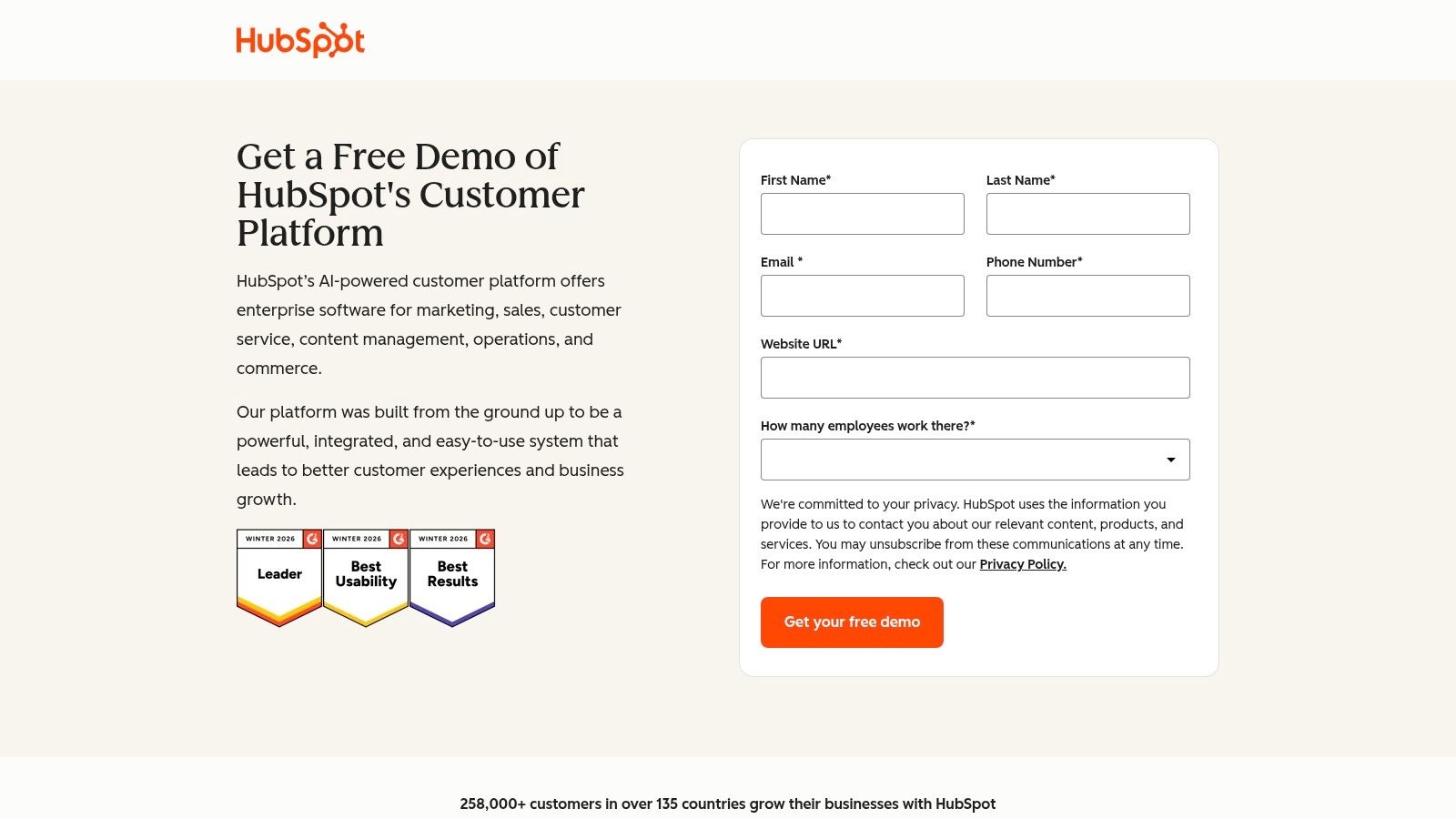
The platform is renowned for its fast time-to-value and intuitive user experience, supported by a vast ecosystem of learning resources and integrations. Its core strength is providing clear visibility into the entire customer journey, from initial contact to post-purchase engagement. Features like multi-touch revenue attribution and customer journey analytics empower teams to connect their activities directly to business outcomes, making it one of the best customer engagement platforms for demonstrating marketing ROI.
Key Considerations
- Best For: SMBs and mid-market companies that need an all-in-one CRM and marketing automation solution with a focus on ease of use.
- Pros: Excellent user experience and fast implementation, a strong native CRM, and a massive ecosystem for learning and support.
- Cons: Costs can escalate quickly as contact lists grow and add-ons are included. Mandatory onboarding fees apply to Professional and Enterprise tiers.
Pricing & Implementation
HubSpot offers a free tier for basic tools, with paid plans (Starter, Professional, Enterprise) that scale based on marketing contact volume and feature sets. While you can start for free, unlocking true engagement capabilities requires a paid subscription. Implementation is generally straightforward, but to maximize its potential, businesses often partner with an agency like Magic Logix to configure advanced automation and reporting. This ensures you can accurately track and improve your most critical digital marketing performance metrics from day one.
Website: https://www.hubspot.com/products/pricing-cr115
5. Braze
For modern, mobile-first B2C brands, Braze has established itself as a leading cross-channel customer engagement platform. Its core strength is enabling real-time, contextually relevant communication across a vast array of channels, including email, SMS, push notifications, in-app messages, and web. Braze is architected for speed and scale, allowing marketers to ingest customer data and trigger personalized journeys instantaneously, making it a top choice for industries like retail, media, and on-demand services where immediate interaction is key.
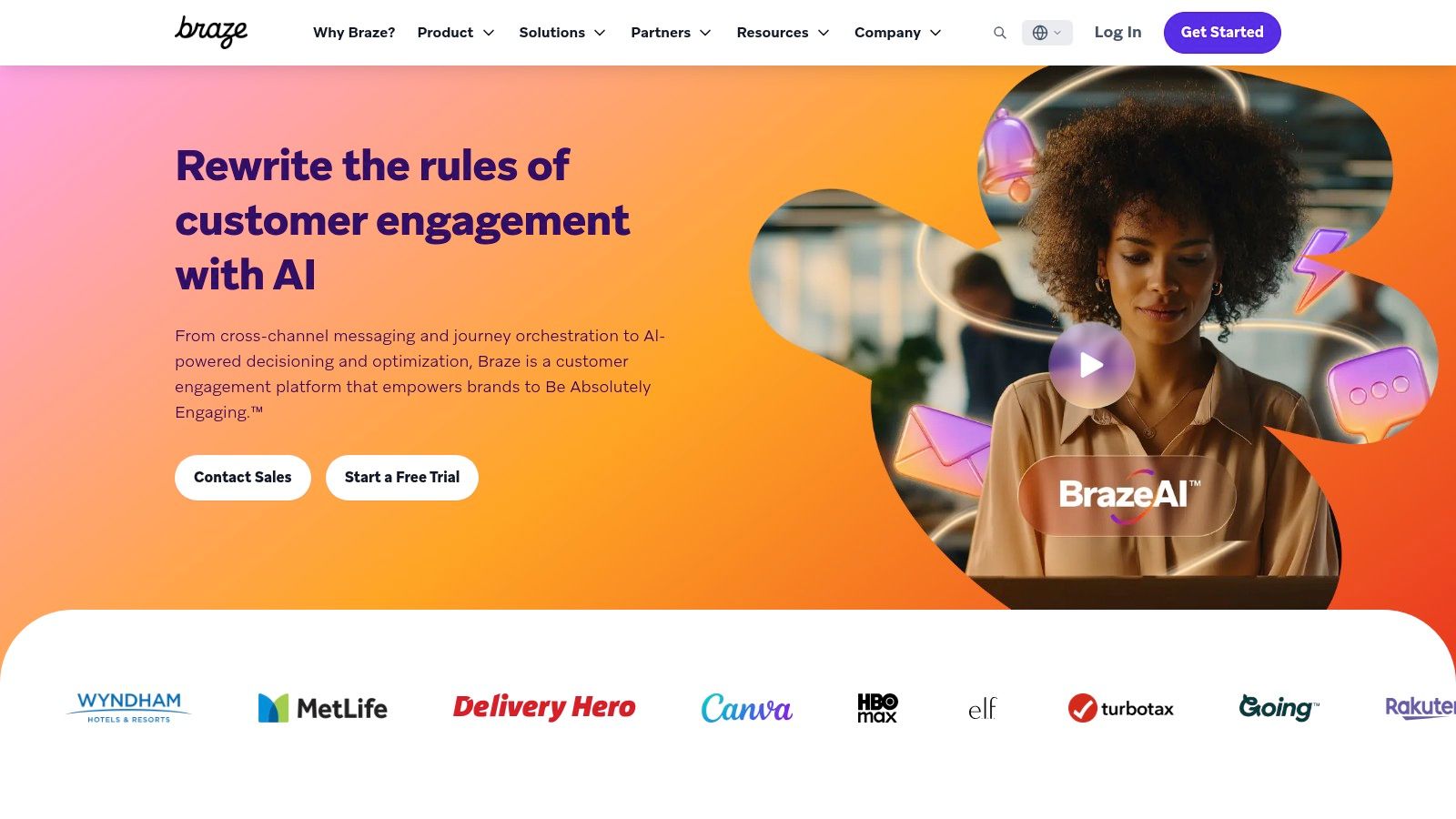
The platform’s sophisticated segmentation capabilities and its journey orchestration tool, Canvas Flow, allow for the creation of intricate, multi-step user experiences that adapt based on user behavior. Braze also heavily invests in AI with BrazeAI, which provides predictive analytics, intelligent channel selection, and personalization at scale. Its robust experimentation and growth tooling are built directly into the platform, empowering teams to test and optimize every aspect of their engagement strategy without relying on separate tools.
Key Considerations
- Best For: Mobile-centric B2C companies and enterprises that require high-speed, scalable, and real-time cross-channel messaging.
- Pros: Strong mobile and in-app messaging capabilities, enterprise-grade scalability, extensive partner ecosystem, and strong analyst recognition.
- Cons: Pricing is not publicly listed and is generally geared toward the mid-market and enterprise segments. The platform's sophistication can require experienced teams or partners for full implementation.
Pricing & Implementation
Braze’s pricing is customized based on data consumption, monthly active users, and the specific package of features required. You will need to contact their sales team for a detailed quote. Implementation often involves integrating their SDKs and connecting various data sources, a process that can be streamlined by working with an experienced partner like Magic Logix. This ensures that your data architecture is correctly configured to power the real-time personalization and complex journey building that make Braze one of the best customer engagement platforms available.
Website: https://www.braze.com/
6. Iterable
Iterable positions itself as a premier AI-powered communication platform designed for modern, data-first marketing teams. It excels at activating real-time behavioral data to orchestrate highly individualized experiences across email, SMS, push notifications, and in-app messages. Its core strength is its composable architecture, allowing it to seamlessly integrate with modern data stacks like Snowflake and Segment, making it a flexible component in a best-of-breed martech ecosystem.
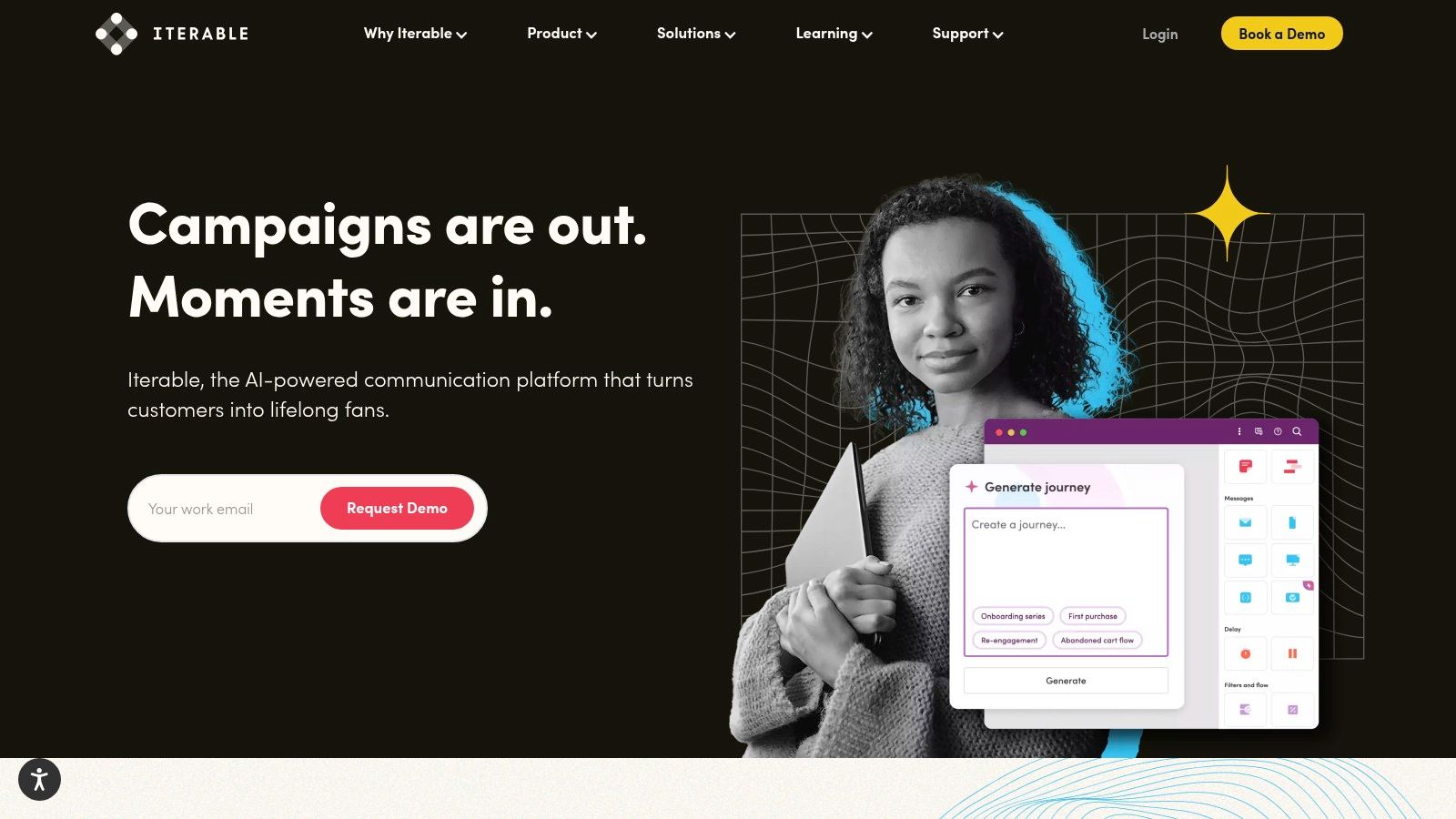
This platform is more than a messaging tool; it is a sophisticated system for turning customer moments into measurable business outcomes, like increased customer lifetime value (CLV). Features like AI-assisted Journey Assist and Predictive Goals help marketers optimize campaigns with data-driven recommendations, while its commitment to enterprise-grade security and frequent product updates makes it a reliable choice for scaling brands.
Key Considerations
- Best For: Data-savvy marketing teams in mid-market to enterprise companies seeking a flexible, AI-driven platform that integrates with their existing data warehouse.
- Pros: Strong focus on AI features and analytics, robust composable integrations, and a well-regarded roster of large brand customers.
- Cons: Pricing is not publicly available and requires sales engagement. Achieving the best outcomes depends on having a solid, well-organized data foundation.
Pricing & Implementation
Iterable's pricing is customized based on factors like contact volume, message sends, and the specific feature set required. You will need to contact their sales team for a detailed quote. Successful implementation hinges on a clear data strategy. Partnering with an agency can ensure your data sources are properly connected and that your initial campaigns are structured to leverage the platform's advanced segmentation and AI capabilities from day one.
Website: https://iterable.com/
7. MoEngage
MoEngage positions itself as an insights-led customer engagement platform, built for brands that prioritize a deep understanding of user behavior to drive their marketing strategies. It integrates analytics, segmentation, and multi-channel campaign execution into a unified dashboard, enabling marketers to move seamlessly from data analysis to action. The platform's strength is its AI engine, Merlin, which powers predictive segmentation, anomaly detection, and personalized recommendations across email, SMS, push notifications, and in-app messages.
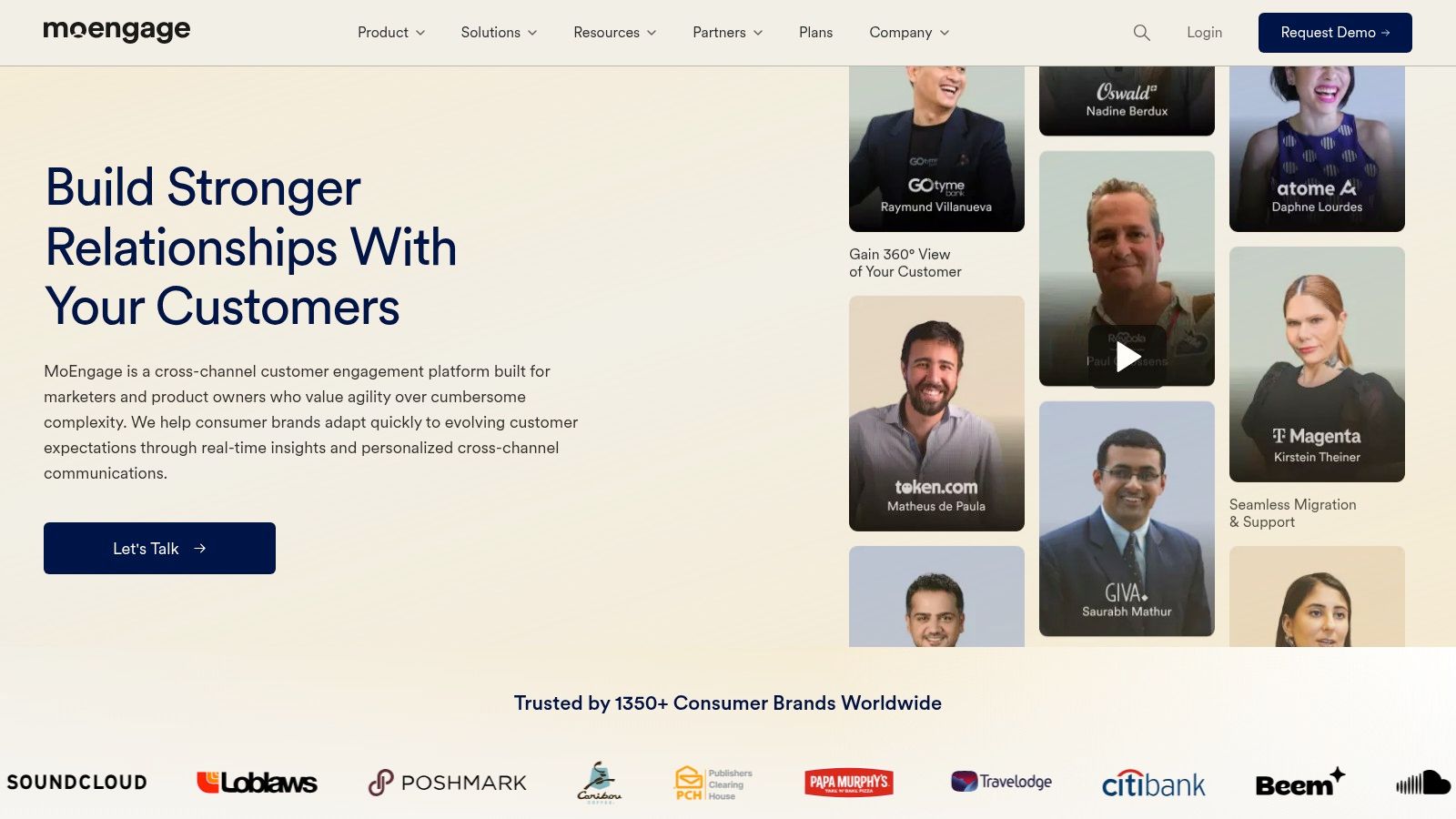
This platform is particularly noteworthy for its focus on providing a smooth transition for businesses migrating from other tools, offering dedicated support through its "MoUpgrade" program. With a growing presence in North America supported by regional data centers, MoEngage addresses critical data residency and performance needs for global companies. This combination of powerful analytics and practical support makes it a strong contender among the best customer engagement platforms for data-driven teams.
Key Considerations
- Best For: Mid-market and enterprise B2C companies in sectors like e-commerce, media, and fintech that need strong analytics and AI-driven personalization.
- Pros: Strong integration of analytics and engagement tools, AI-powered predictive insights, and dedicated support for platform migration and North American data residency.
- Cons: Pricing is not publicly available and requires direct sales contact. While comprehensive, the depth of specific channel features may vary compared to niche, best-of-breed solutions.
Pricing & Implementation
MoEngage uses a custom pricing model based on monthly tracked users (MTUs), features, and support levels. You must contact their sales team for a personalized quote. Implementation involves integrating their SDKs and connecting data sources, a process that can be streamlined with technical support. For businesses looking to maximize their ROI, a partner like Magic Logix can help map complex customer journeys and ensure the platform's powerful segmentation capabilities are fully leveraged from day one.
Website: https://www.moengage.com/
8. CleverTap
CleverTap carves out a niche as an all-in-one customer engagement platform with a strong focus on mobile-first businesses. It excels in industries like subscriptions, fintech, gaming, and ecommerce by combining deep analytics, segmentation, and multi-channel orchestration. Its primary strength is its ability to map and influence the entire user lifecycle, from acquisition to long-term retention, using a suite of powerful, data-driven tools.
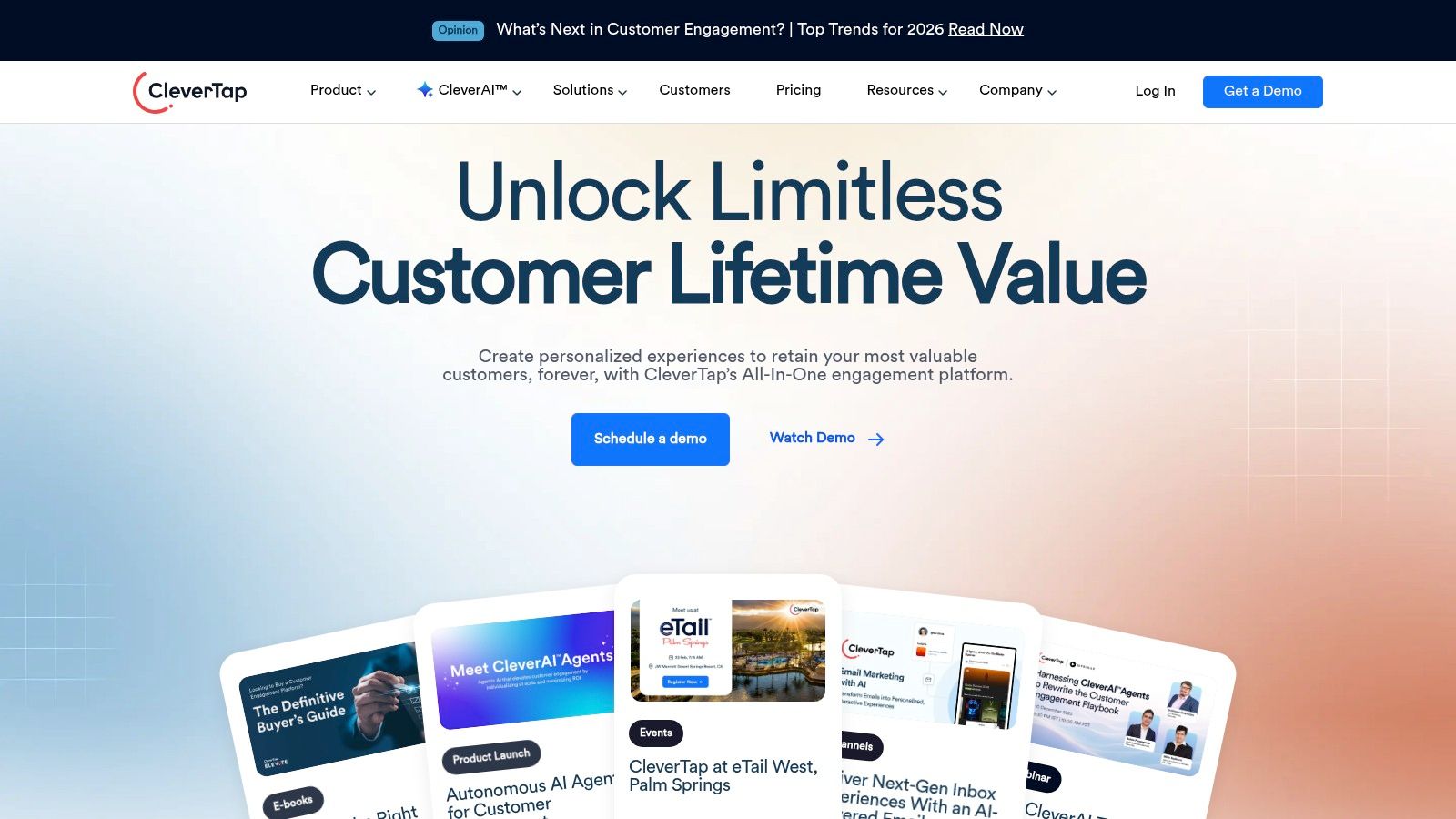
The platform integrates its AI engine, “Truly CleverAI,” to provide predictive insights, optimize send times, and personalize campaign content across push notifications, in-app messages, and email. CleverTap stands out by offering pre-built industry playbooks and solutions, which help businesses accelerate their engagement strategies without starting from scratch. This makes it a compelling choice for teams that need to demonstrate ROI quickly.
Key Considerations
- Best For: Mobile-first businesses, including subscription apps, gaming, and ecommerce startups.
- Pros: Accessible starter pricing for early-stage teams, strong mobile engagement features, and practical vertical-specific playbooks.
- Cons: Costs can escalate as your monthly active user (MAU) count grows. Advanced enterprise governance and security features are often reserved for higher-tier plans.
Pricing & Implementation
CleverTap offers several pricing tiers, including a transparent "Essentials" plan designed for startups, which provides a clear entry point into its ecosystem. Custom pricing is available for "Advanced" and "Enterprise" plans that offer more sophisticated features, higher MAU limits, and dedicated support. Implementation is generally more straightforward than enterprise-level systems, especially when leveraging their pre-built solutions. However, a partner like Magic Logix can ensure your data is properly integrated to unlock the full potential of its analytics and segmentation capabilities, aligning the tool for maximum user retention.
Website: https://clevertap.com/
9. WebEngage
WebEngage positions itself as a full-stack retention and engagement platform, effectively combining a customer data platform (CDP) with powerful omnichannel orchestration. It excels at unifying user data from various sources to build a single customer view, which then fuels real-time personalization across web, mobile apps, email, SMS, and WhatsApp. The platform’s ability to use product and revenue analytics to trigger automated journeys makes it a strong contender for businesses focused on user retention and conversion optimization.
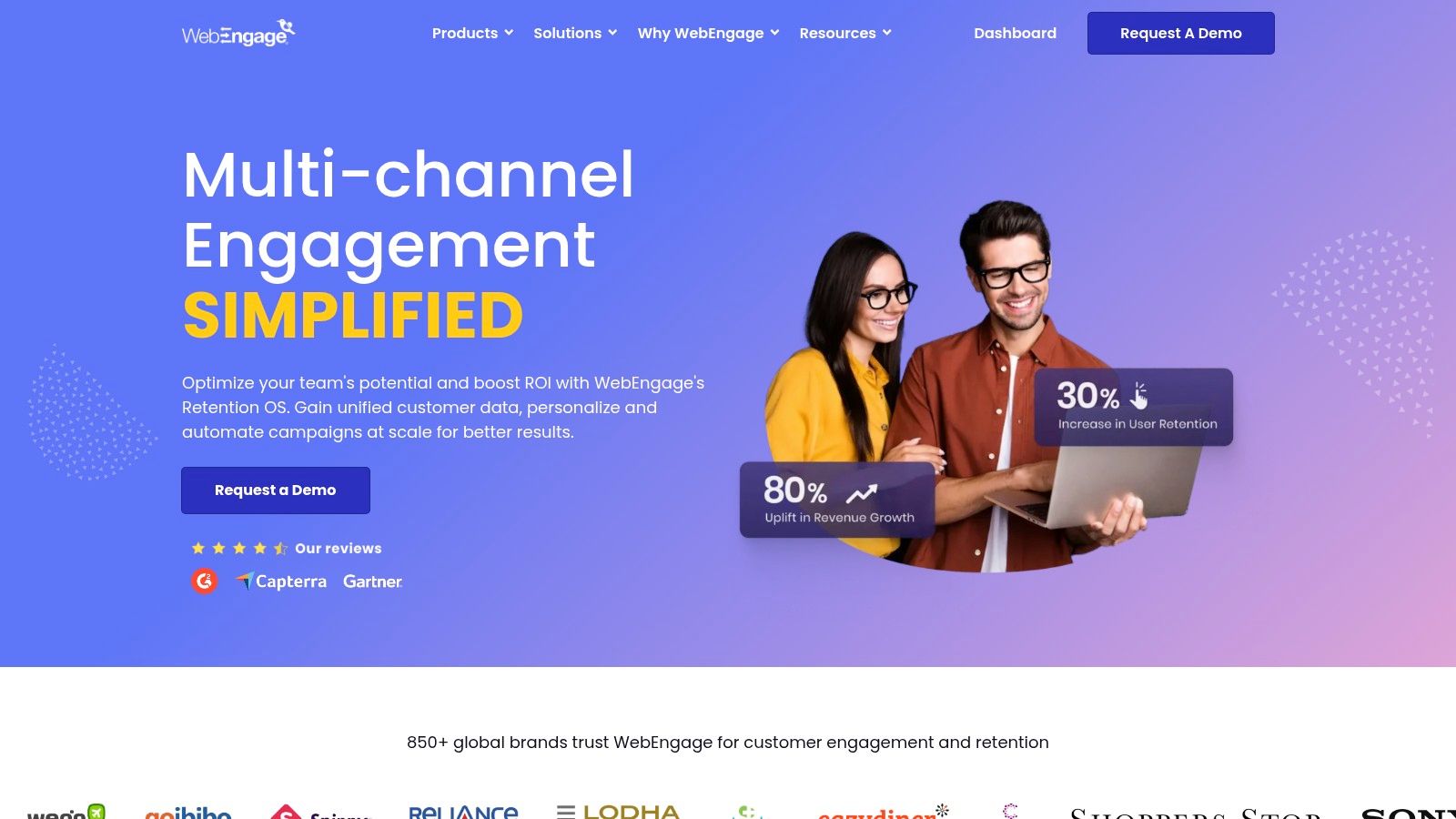
Unlike many competitors, WebEngage’s architecture is built to handle both marketing communication and transactional messaging, powered by real-time triggers. This makes it a versatile tool for e-commerce, fintech, and travel brands that need to react instantly to user behavior, such as cart abandonment or in-app actions. Its integrated journey designer and A/B testing capabilities allow marketers to build, test, and deploy sophisticated campaigns without heavy reliance on developers.
Key Considerations
- Best For: E-commerce, fintech, and consumer tech companies focused on personalizing the user journey to drive retention.
- Pros: Combines a CDP with a campaign engine for a unified solution, strong web and app personalization features, and flexible purchasing options via AWS Marketplace.
- Cons: Pricing is not publicly listed and is often based on Monthly Active Users (MAU), which can be less predictable. It has a smaller US market presence compared to some established giants.
Pricing & Implementation
WebEngage's pricing is customized based on your volume of Monthly Active Users and the specific feature set required. A key advantage is its availability on the AWS Marketplace, which can simplify procurement and billing for companies already using Amazon Web Services. Implementation involves integrating its SDK and connecting data sources, a process that Magic Logix can help streamline by ensuring your data architecture is properly configured to feed the platform and maximize its personalization capabilities.
Website: https://webengage.com/
10. Twilio Segment (Connections/CDP + Engage)
For organizations prioritizing a data-first approach, Twilio Segment offers a powerful foundation for customer engagement. It begins as a market-leading Customer Data Platform (CDP) that excels at collecting, unifying, and routing customer data from over 700 sources. This robust data pipeline becomes the engine for its Engage product, which enables multichannel campaign orchestration across email, SMS, and other channels.
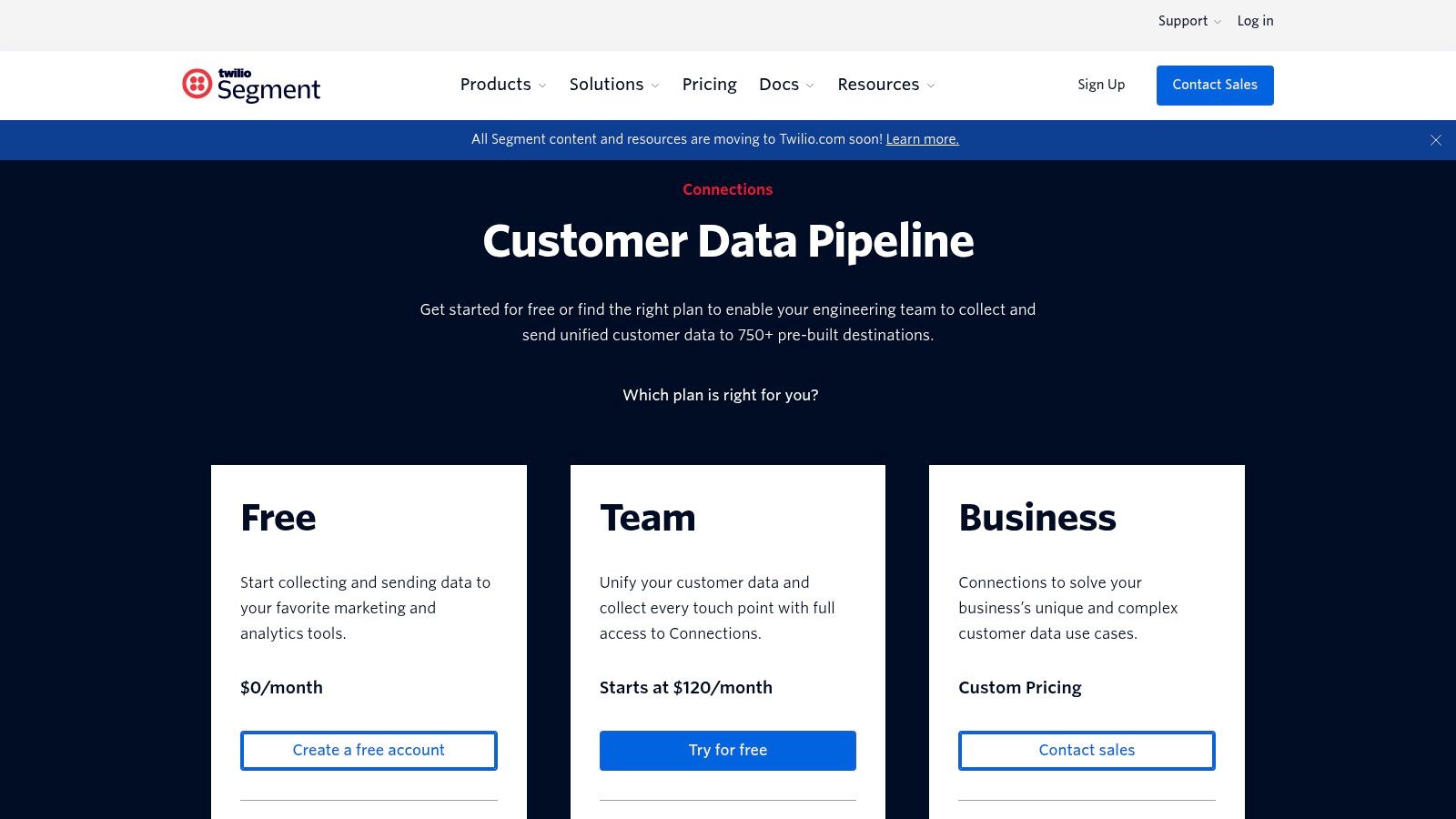
Segment's key differentiator is its warehouse-native architecture, making it a natural fit for companies with modern data stacks. It allows businesses to build a comprehensive customer profile and then activate that data for personalized engagement. The platform is highly extensible, natively integrating with Twilio's communication APIs for SMS, WhatsApp, and voice, providing a seamless path from data unification to direct customer interaction.
Key Considerations
- Best For: Companies with established data teams or those building a modern, warehouse-centric data stack.
- Pros: Exceptional data foundation with extensive integrations, flexible entry points with free/team plans, and a clear upgrade path to a full-featured CDP and engagement tool.
- Cons: Engage pricing is custom and requires sales contact. Activating campaigns and managing orchestration may require data expertise, and messaging costs are usage-based.
Pricing & Implementation
Twilio Segment offers a transparent entry point with its Connections product, featuring Free and Team tiers based on Monthly Tracked Users (MTUs). The full CDP and Engage suite is custom-quoted. Implementation success hinges on a strong data strategy. Businesses often partner with data specialists like Magic Logix to ensure that the initial data collection and identity resolution processes are architected correctly, which is crucial for unlocking the platform's full potential for personalized engagement.
Website: https://segment.com/pricing/connections/
11. Intercom
Intercom excels as an AI-first platform for companies prioritizing conversational, support-led customer engagement. It combines a sophisticated messenger, AI-powered chatbots like Fin, proactive support tools, and a unified inbox to manage customer interactions across web, in-app, and email. Its primary strength lies in creating seamless, real-time conversations that can handle everything from simple support queries with AI agents to proactive engagement through product tours and targeted messages.
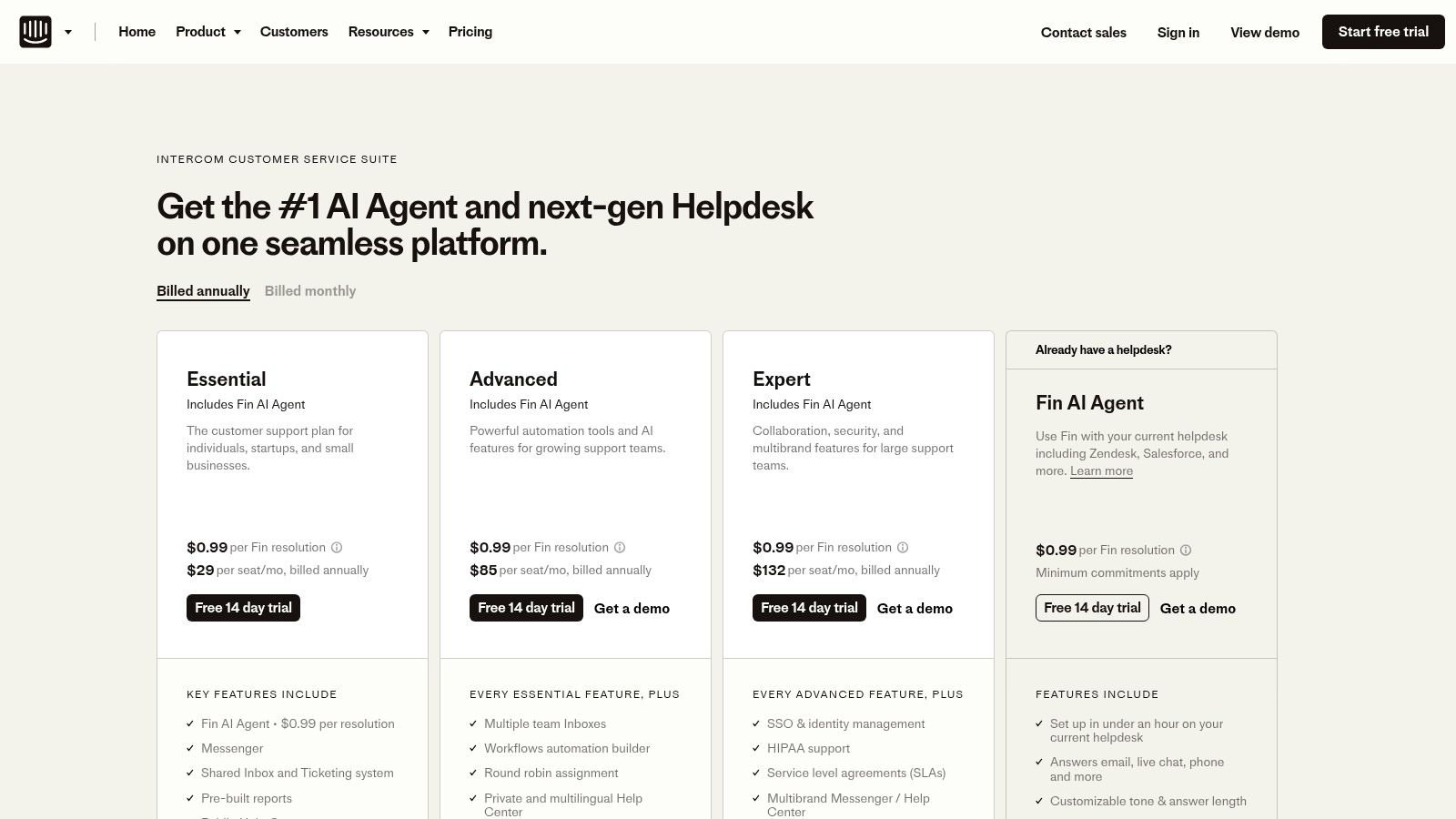
This platform is engineered for immediate impact, enabling teams to deploy quickly and start resolving customer issues faster. Automation workflows handle repetitive tasks, while tools like surveys and in-app posts allow for continuous feedback and announcements. By centralizing communication and leveraging AI, Intercom helps businesses scale their support and engagement efforts efficiently, making it one of the best customer engagement platforms for support-driven growth.
Key Considerations
- Best For: SaaS and e-commerce companies focused on providing exceptional conversational support and proactive in-app user engagement.
- Pros: Quick to deploy with transparent plans, strong in-app messaging and self-serve support experiences, and powerful AI chatbot capabilities.
- Cons: Usage-based charges for certain features (like the Fin AI Agent) can add variability to costs. It is better suited for support and conversational marketing than for complex, multi-channel marketing orchestration.
Pricing & Implementation
Intercom offers several plans, including Essential, Advanced, and Expert, with pricing based on the number of agent seats and contacts. Add-ons like Product Tours, Surveys, and Phone are available for an extra cost. The Fin AI Agent is priced per resolution, offering a flexible model. Implementation is generally straightforward, but to maximize its value, a strategy session with a partner like Magic Logix can help align its conversational tools with your broader customer lifecycle and data strategy, ensuring it complements your marketing stack effectively.
Website: https://www.intercom.com/pricing
12. Capterra – Customer Engagement Software Category
While not a platform itself, Capterra’s dedicated Customer Engagement Software category is an indispensable research tool for any business evaluating its options. It acts as a comprehensive marketplace and directory, allowing you to discover, compare, and shortlist hundreds of tools based on real user reviews and data-driven filters. This resource excels at providing a broad, unbiased market overview, helping you move from initial exploration to a curated list of potential vendors efficiently.
For teams just starting their search for the best customer engagement platforms, Capterra provides a crucial first step. Its strength lies in its extensive filtering system, which allows you to narrow down over 700 products by pricing model, deployment type, essential features, and business size. This level of detail empowers you to make informed initial comparisons before committing time to vendor demos.
Key Considerations
- Best For: Businesses in the initial research and discovery phase of selecting a new customer engagement platform.
- Pros: Free to use and offers a fast, efficient way to scan a wide array of options and read recent, verified user reviews.
- Cons: Listing order can be influenced by sponsored placements, and it is crucial to validate all feature and pricing details directly on vendor sites.
Pricing & Implementation
Capterra is a free resource for software buyers. Its business model is based on referral fees from vendors, so there is no cost to browse listings, read reviews, or use the comparison tools. Implementation doesn't apply directly, but using the platform effectively means leveraging its filters to create a shortlist and then using the direct links to vendor websites to schedule demos. A partner like Magic Logix can help you navigate this selection process, ensuring the platforms you shortlist align with your specific integration needs and strategic goals.
Website: https://www.capterra.com/customer-engagement-software/
Top 12 Customer Engagement Platforms — Feature Comparison
| Product | Core features | UX / Quality (★) | Price / Value (💰) | Target (👥) | Standout (🏆 / ✨) |
|---|---|---|---|---|---|
| Magic Logix — Digital Marketing | Content, SEO, social, retargeting, automation, predictive analytics | ★★★★☆ | 💰 Custom / integrated programs | 👥 SMB → Enterprise | 🏆 ✨ Integrated data + creativity |
| Salesforce Marketing Cloud Engagement | Journey Builder, email/SMS, CRM & Data Cloud, analytics | ★★★★☆ | 💰 High / annual contracts | 👥 Enterprise, Salesforce users | 🏆 ✨ Deep Salesforce integration & governance |
| Adobe Journey Optimizer | Real-time profiles, offer decisioning, personalization, AEP | ★★★★☆ | 💰 Quoted / premium | 👥 Data-rich enterprises | 🏆 ✨ Real-time offer decisioning |
| HubSpot Marketing Hub | Native CRM, email, forms, landing pages, automation | ★★★★☆ | 💰 Free → Paid (scales with contacts) | 👥 SMB → Mid-market / Sales-led teams | ✨ CRM-native UX & fast time-to-value |
| Braze | Email, SMS, push, in-app, experimentation, BrazeAI | ★★★★☆ | 💰 Custom / sales | 👥 B2C & high-scale apps | 🏆 ✨ Strong mobile & growth tooling |
| Iterable | Behavioral activation, AI-assisted journeys, integrations | ★★★★☆ | 💰 Custom / sales | 👥 Data-forward mid → enterprise | ✨ AI journey assist & analytics |
| MoEngage | Analytics, segmentation, orchestration, Merlin AI, migration | ★★★★☆ | 💰 Custom / contact sales | 👥 Mid-market → Enterprise (NA focus) | ✨ Insights-to-action workflows & Merlin AI |
| CleverTap | Lifecycle analytics, segmentation, mobile optimization | ★★★★☆ | 💰 Starter pricing → scales | 👥 Mobile-first startups & apps | ✨ Starter plans & vertical playbooks |
| WebEngage | CDP + analytics, omnichannel campaigns, personalization | ★★★★☆ | 💰 Custom / MAU-based | 👥 Ecommerce & product teams | ✨ CDP + personalization; AWS Marketplace |
| Twilio Segment (Connections + Engage) | CDP (Connections), Engage orchestration, 700+ integrations | ★★★★☆ | 💰 MTU-based; free/team entry | 👥 Data & engineering teams | 🏆 ✨ Warehouse-native CDP & extensibility |
| Intercom | Messenger, campaigns, product tours, AI agents, inbox | ★★★★☆ | 💰 Transparent plans + usage fees | 👥 Support-driven SMBs & product teams | ✨ Conversational support & AI agents |
| Capterra — Marketplace | 700+ product listings, reviews, filters, buyer guides | ★★★★☆ | 💰 Free to use (sponsored listings) | 👥 Buyers researching vendors | ✨ Wide catalog & user reviews |
Moving from Platform to Performance
Navigating the landscape of the best customer engagement platforms can feel overwhelming, but the journey from selection to tangible results is where the real transformation happens. We've explored a comprehensive array of tools, from enterprise powerhouses like Salesforce Marketing Cloud Engagement and Adobe Journey Optimizer to the agile, mobile-first solutions offered by Braze and CleverTap. Each platform presents a unique philosophy on how to connect with customers, whether through HubSpot's inbound methodology or Twilio Segment's data-first foundation.
The core takeaway is that the "best" platform is not a universal title; it's a designation specific to your business's unique context. A B2B enterprise in Dallas aiming for deep, multi-year client relationships will have vastly different needs than a global B2C e-commerce brand focused on high-volume, real-time mobile interactions. The right choice hinges on a clear-eyed assessment of your goals, technical maturity, and, most importantly, the expectations of your customers.
Your Roadmap to Choosing the Right Platform
Selecting a tool is just the first step. To truly move from platform investment to business performance, you must approach this decision strategically. Your final evaluation should be a practical exercise, not just a feature comparison.
Here are the critical factors to guide your final decision:
- Scalability and Future-Proofing: Don't just buy for your current needs. Consider your three-to-five-year growth plan. Will this platform's data architecture, channel support, and pricing model grow with you, or will it become a bottleneck? Platforms like MoEngage and WebEngage often offer more flexible growth paths for mid-market companies.
- Data Integration and Unification: Your engagement platform is only as smart as the data it receives. How easily does it integrate with your existing CRM, e-commerce platform, and data warehouse? A Customer Data Platform (CDP) like Twilio Segment can be a game-changer here, but even without one, native integration capabilities are non-negotiable.
- Ease of Use for Your Team: A powerful tool that no one can use is worthless. Consider the technical skill level of your marketing team. Do they need a user-friendly, visual journey builder like the one in HubSpot, or are they equipped to handle the more complex, developer-friendly environments of tools like Iterable?
- Total Cost of Ownership (TCO): Look beyond the subscription fee. Factor in implementation costs, the need for specialized developers or consultants, training expenses, and potential add-on modules for features like advanced analytics or AI. The advertised price is rarely the final price.
From Implementation to Optimization
Once you've made your choice, the real work begins. Successful implementation isn't about flipping a switch; it's a change management process. Start with a pilot program focused on a specific customer segment or journey. This allows you to demonstrate early wins, work out technical kinks, and build internal expertise before a full-scale rollout.
Remember that customer engagement is not a "set it and forget it" discipline. The most successful brands continuously test, learn, and optimize. Use the powerful analytics and A/B testing features within your chosen platform to refine everything from email subject lines to push notification timing. The goal is to create a perpetual feedback loop where data-driven insights fuel ever-more-relevant customer interactions.
Ultimately, the best customer engagement platforms are not magic wands. They are powerful enablers that, when paired with a clear strategy and a customer-centric mindset, empower you to build the lasting, profitable relationships that define modern business success.
Choosing the right platform is critical, but successful implementation and integration are what drive ROI. At Magic Logix, we specialize in helping businesses connect their technology stack, from CRMs to the best customer engagement platforms, ensuring your data flows seamlessly to create truly personalized experiences. Let our team of Dallas-based experts help you architect a solution that turns your platform investment into measurable performance by visiting us at Magic Logix.