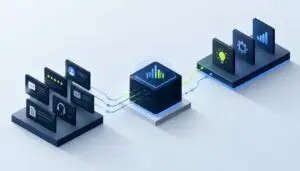

A voice of customer (VoC) program is an ongoing system for collecting customer feedback from every touchpoint, analyzing it for patterns, and turning it into visible decisions. A single survey is one input. A program adds goals, named owners, a review rhythm, and a way to tell customers what changed. This guide shows you how to build one, which methods to use, how to analyze the data, and how to tell whether it is working.
TL;DR
- A VoC program is continuous and cross-functional. A one-off survey is a snapshot with a report at the end.
- Mix direct feedback (surveys, interviews), indirect feedback (reviews, support tickets, social) and behavioral signals (usage, churn, repeat purchases).
- Start small: one executive sponsor, one day-to-day owner, two or three outcomes, and a weekly review.
- Rank themes by frequency, severity and business impact, then check effort before you commit.
- Close the loop with the customers who spoke up, and measure against business outcomes such as retention, not only NPS.
Table of Contents
- What a voice of customer program is
- Why it matters to your business
- Voice of customer methods: where the feedback comes from
- How to build a VoC program, step by step
- How to analyze VoC data
- Closing the loop
- Measuring whether your VoC program works
- Our perspective
- Common mistakes to avoid
- Putting VoC to work in your marketing
- FAQ
- Sources
What a voice of customer program is
A VoC program is the practice of capturing, analyzing and acting on customer feedback from several channels to improve products, services and the overall experience. Salesforce describes it as drawing on satisfaction surveys, interviews, social media and customer service interactions. The New York State government frames it as a structured approach built on data collection, data analysis, actionable insights, closing the loop and continuous improvement.
The common thread is action. Think of feedback as water and the program as the plumbing. Without pipes that carry it to the people who can fix things, you just have a puddle in a dashboard.
VoC program vs. collecting feedback
Many owners already collect feedback. The difference is what happens afterward. QuestionPro’s guide contrasts the two this way: a survey is a single snapshot owned by one team that ends in a report, while a program is recurring, cross-functional, tied to metrics and unifies several channels into one view.
| One-off feedback collection | VoC program | |
|---|---|---|
| Cadence | Occasional | Regular, scheduled |
| Channels | Often one | Many, combined in one view |
| Ownership | One team | Named owners across teams |
| Output | A report | Action plans tied to metrics |
| Customer experience | Rarely hear back | Told what changed |
Why it matters to your business
The business case is retention, revenue and smarter investment. Gainsight’s guide lists revenue growth, higher retention, product innovation and customer loyalty as the main outcomes, on the logic that customers who feel heard are more likely to renew and expand.
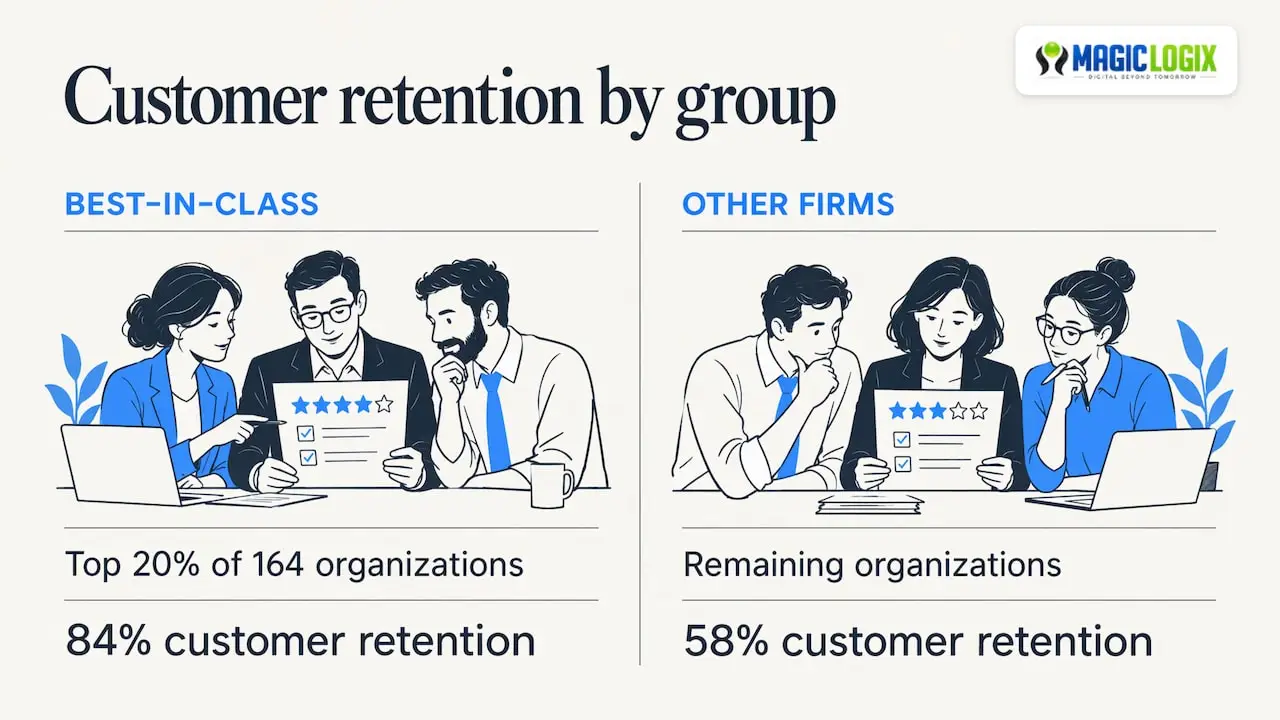
One frequently cited data point comes from a January 2018 Aberdeen Group study, reproduced in an analyst document hosted by Verint. It compared the top 20% of 164 organizations (the “best-in-class”) with everyone else. The leaders reported 84% customer retention versus 58% for the rest. This is a correlation from a survey of firms, now several years old, so treat it as directional evidence and not a promise of what your program will deliver.
There is also a creative benefit. Harvard Business School Online notes that hearing customers can break cognitive fixedness, the mental blocks that keep a team seeing a product only the way it has always been used.
Voice of customer methods: where the feedback comes from
The most useful way to organize methods is by how the feedback reaches you. Miro’s guide groups them into direct, indirect and inferred feedback. Programs that rely only on surveys miss a lot, a point Smaply makes when it says survey-only programs miss half the picture.
| Type | What it is | Examples |
|---|---|---|
| Direct | Customers know they are giving input | NPS, CSAT or CES surveys, post-purchase surveys, interviews, focus groups, customer advisory boards |
| Indirect | Customers talk, but not to you | Reviews, social posts, community forums, support tickets |
| Inferred | Behavior tells the story | Website analytics, feature adoption, churn patterns, repeat purchases |
The Aberdeen study quoted above found best-in-class firms were more likely to use customer behavioral data as indirect feedback (61% versus 37%) and to run a process encouraging feedback across multiple touchpoints (85% versus 51%). The practical lesson: do not assume feedback only counts when a customer fills out a form. A repeat purchase, a renewal or an unprompted social post says something too.
Choosing methods for your size
You do not need every method on day one. A practical starting set for a small or mid-size business:
- One short survey at a key moment, such as after purchase or after a support interaction.
- Support tickets and reviews, which you probably already have.
- Website behavior, such as where visitors drop off.
- A handful of customer conversations each quarter to explain the numbers.
Add channels as the loop starts working. Our guide to data-driven customer insights covers how to bring these sources together.
How to build a VoC program, step by step
Salesforce outlines eight steps: define objectives, identify touchpoints, select tools, design feedback methods, collect feedback, analyze it, act on insights, and monitor and iterate. Below is a leaner version for teams that want to move quickly.
Step 1: Write a one-page charter
Perspective AI’s guide says a charter should answer five questions:
- Executive sponsor: one VP or C-level owner.
- Operational owner: the person who runs the program day to day.
- Scope: which segments, journey stages and product surfaces are covered in year one.
- Success criteria: two or three outcomes the program is accountable for.
- Decision rights: who can act when an insight surfaces.
The last item is the one most teams skip, and it is where programs stall.
Step 2: Map the moments that matter
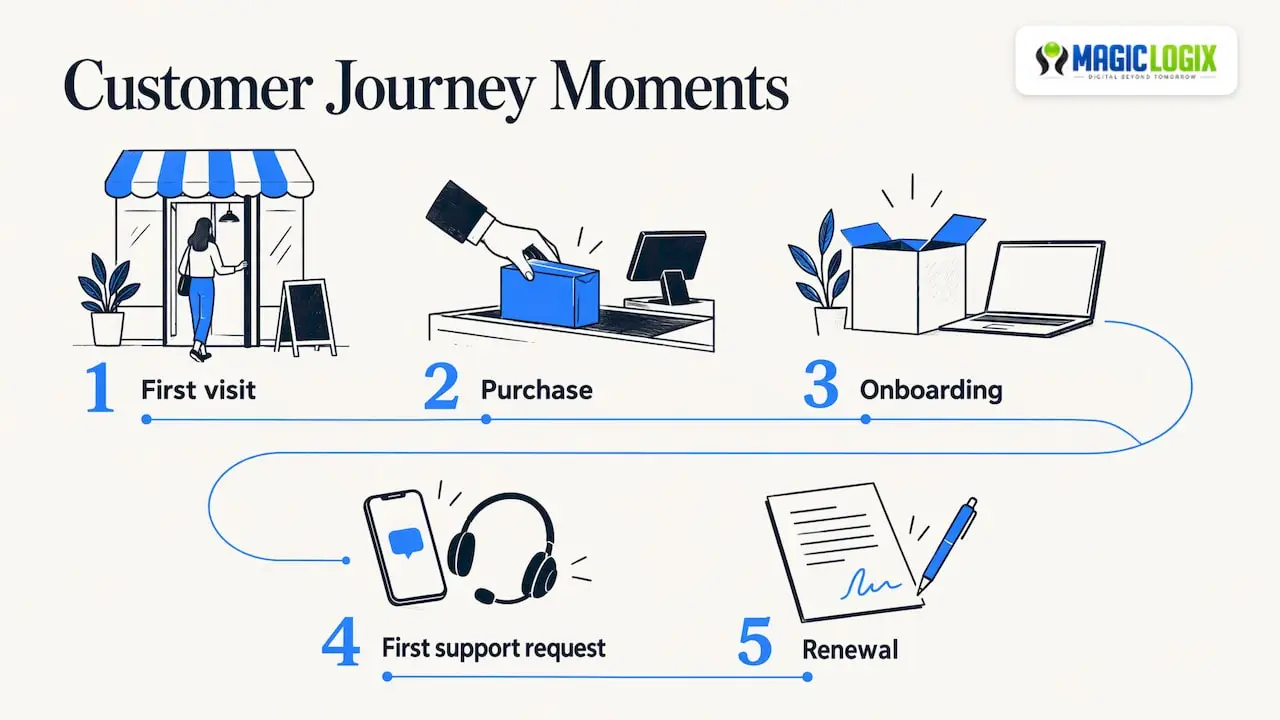
List the points where a customer’s opinion forms: first visit, purchase, onboarding, first support request, renewal. A customer journey map makes this concrete and shows where you currently have no listening post at all.
Step 3: Consolidate what you already have
Before launching anything new, gather existing feedback into one place. Most businesses discover they already hold hundreds of comments in support inboxes, review sites and sales notes.
Step 4: Keep questions short and timely
Ask at the moment of experience, on the channel the customer already uses. Qmeter’s guide recommends short questions and a few chosen metrics. One question about satisfaction and one open text box often beats a ten-question form.
Step 5: Set a rhythm
A small business can run a 30-minute weekly review. Customer Echo’s SMB guide suggests that cadence, automated daily, weekly and monthly reports, and a quarterly check on whether your channels, workflows and metrics still fit.
How to analyze VoC data
Analysis is where most programs lose momentum. A Zonka Feedback guide describes the loop as Collect, Unify, Understand, Fix, and says most programs break between Understand and Fix. Plan for that gap.
Compare by segment, product and time
SurveyMonkey advises examining each dataset and comparing results by segment, product and time period, then using text analysis on open-ended answers to surface recurring themes and sentiment. An average score hides problems. A new-customer segment that scores 20 points below long-term customers is a finding; the blended number is not.
Rank themes by frequency, severity and impact
Listen Labs’ practitioner guide suggests prioritizing on three dimensions plus a feasibility gate:
- Frequency: how many customers raised it.
- Severity: how strongly it affects experience and behavior.
- Business impact: what fixing or ignoring it costs in revenue, retention or acquisition.
- Effort (the gate): a big theme needing 18 months of engineering may rank below a slightly smaller one that can ship in two weeks.
Here is an illustrative example, not a client result. Suppose a local home-services company sees three themes: slow quote responses (mentioned often, moderate severity, fix is a routing rule), confusing invoices (mentioned sometimes, high severity, fix is a template change), and a request for a mobile app (mentioned rarely, big build). The first two go first.
Use AI as an assistant, not a verdict
AI theme analysis can sort thousands of comments quickly. Spot-check its groupings against real verbatims and keep a person accountable for the final call. Methods and tools in this area are evolving, so review your approach at least once a year.
Closing the loop
Collecting and ranking feedback only matters if something changes and customers hear about it. Perspective AI describes a minimum viable loop with four stages:
- Capture: log the insight with the verbatim, source, journey stage, segment and a proposed tag.
- Triage: review weekly, cluster duplicates, and lift the most frequent or severe items.
- Action: give every actionable insight a named owner outside the VoC team, with a two-week window to acknowledge with a plan and six weeks to ship or defer with a written reason.
- Loop back: tell the customers who raised it what happened.
Those time windows are one team’s suggestion, not a standard. Pick numbers you can keep and write them down.
Share insights beyond one department. HBS Online recommends circulating them across product, customer experience, sales and marketing, and support, and building internal dashboards so the data stays accessible and actionable. Marketing teams can also feed what customers say back into campaigns, and marketing automation can trigger a follow-up message when a customer’s feedback has led to a change.
Measuring whether your VoC program works
Start with a small set of metrics. Customer Echo recommends at least one quantitative satisfaction measure, with NPS as the usual starting point for small businesses. Then connect it to outcomes.
An Enghouse Interactive guide makes a useful distinction: a target like “improved NPS” is an indicator of sentiment, not a business outcome. It suggests testing whether NPS correlates with retention so you can estimate what a one-point change is worth. The same guide recommends pairing numbers such as ROI and KPIs with real customer verbatims when you report to executives.
A simple scorecard:
| Measure | What it tells you | Review |
|---|---|---|
| NPS or CSAT | Customer sentiment | Monthly |
| Retention or repeat purchase rate | Whether sentiment becomes behavior | Quarterly |
| Share of top themes with an owner and a decision | Whether the loop runs | Weekly |
| Share of responders who heard back | Whether you close the loop | Monthly |
| Time from insight to shipped change | Speed of response | Quarterly |
Set a baseline before launch, so you can compare later. If you cannot yet connect scores to revenue, say so in your reports and work toward it.
Our perspective
Most of the VoC programs we see stall for the same reason: the listening is fine, but nobody owns what comes next. Feedback sits in one tool, search data in another, campaign results in a third.
We think of VoC as part of a wider digital system. What customers say in reviews and support chats shows what to fix on your website, what questions your content should answer, and which messages belong in your email and automation flows. As more people ask AI assistants and answer engines for recommendations, the language customers use about you also shapes how you are described online. We cannot promise any ranking or AI citation, but clear, customer-informed content is a sound foundation.
Our advice to owners is to start small and keep it honest: one owner, a few channels, a weekly review, and a rule that every top theme gets a decision. At Magic Logix, our focus is Digital Beyond Tomorrow: combining data, design and automation so what you learn becomes what you do.
Hassan Bawab
Common mistakes to avoid
- Treating the survey as the program. Without analysis, action and reporting, it is a survey habit.
- Relying on one channel. Add reviews, tickets and behavior to see the whole picture.
- No decision rights. If nobody can act on a finding, the finding dies.
- Ignoring the silent majority. Most customers never fill out a form, so inferred and indirect signals matter.
- Never telling customers. A short “you said, we did” message builds the trust that gets you more feedback next time.
Putting VoC to work in your marketing
Feedback is also marketing research. Customer wording can sharpen website copy, FAQs and ad messages. Recurring complaints show where your site or checkout creates friction. Our customer engagement strategy template can help you plan how insights turn into outreach, and the guide on how to develop a marketing strategy shows where customer evidence fits in planning.
If you want help connecting customer insight to your website, search visibility and automation, Magic Logix works with small businesses, mid-size companies and enterprise brands. You can explore our marketing automation services or Marketing & Growth Systems offering, and start with a conversation about what you currently collect and where it stalls.
FAQ
What is the difference between VoC and a customer satisfaction survey?
A satisfaction survey is one input that produces a score. A VoC program combines several inputs, such as surveys, reviews, support tickets and behavior, and adds owners, analysis, action and communication back to customers. The survey is a tool inside the program.
How often should we review VoC data?
A small team can start with a 30-minute weekly review and a deeper quarterly check on channels, workflows and metrics. Weekly triage keeps urgent issues from waiting, and the quarterly review keeps the program aligned with your goals.
Which VoC method should a small business start with?
Begin with what you already have: support tickets, reviews and sales notes. Add one short survey at a key moment, such as after purchase, and a few customer conversations each quarter. Add channels once the weekly review is running smoothly.
Who should own a VoC program?
Name an executive sponsor and a day-to-day operational owner, and give every actionable insight an owner in the team that can fix it. Perspective AI’s charter approach also asks you to define decision rights, so it is clear who may act on what the program finds.
Sources
- What is Voice of the Customer (VoC)? A Complete Guide, Salesforce
- Voice of Customer (VoC) Programs and Survey Methods, New York State
- Voice of Customer Program: How to Build and Strengthen It, QuestionPro
- The Essential Guide to Voice of the Customer, Gainsight
- Voice of the Customer: How to Properly Listen and Act on Customer Needs, Aberdeen Group study hosted by Verint
- Voice of the Customer: Strategies to Listen and Act, Harvard Business School Online
- Voice of the Customer: A Complete Guide, Miro
- How to Build a VoC Program That Drives Action, Smaply
- How to Build a Voice of Customer Program from Scratch, Perspective AI
- VoC Metrics: 10 Voice of Customer KPIs to Track, Qmeter
- How to Build a Voice of Customer Program, Customer Echo
- What Is Voice of Customer (VoC)? The Complete Guide, Zonka Feedback
- How to Build a Voice of the Customer Program, SurveyMonkey
- Voice of Customer Analysis: A Practitioner’s How-To, Listen Labs
- The Inner Circle Guide Voice of the Customer US Edition, Enghouse Interactive