

A PPC audit is a structured review of your pay-per-click account’s settings, structure and results, done to find wasted spend and missed opportunities. Start with conversion tracking, because every other conclusion depends on it. Then work through structure, budgets and bidding, keywords and search terms, ads, and landing pages. Finish by ranking fixes by impact and urgency. The checklist below follows that order and works as a PPC health check for a quick monthly pass or a deeper review.
TL;DR
- Audit conversion tracking first. If the data is wrong, bids, budgets and reports built on it will be wrong too.
- Then check campaign settings, impression-share losses, bid strategy, search terms, negative keywords, ads and landing pages.
- Rank every finding as high (fix now), medium (next few weeks) or low (longer term), and tie each action to a finding.
- Run a quick spend check often, a performance review monthly, and an extra audit after any major site, CRM or tracking change.
- Treat AI-driven features as things to test and measure, not as guaranteed fixes.
Table of Contents
- What a PPC audit covers
- When to run an audit
- Before you start: set up the audit
- The PPC audit checklist
- A quick scoring sheet
- How to prioritize and measure the fixes
- Our perspective
- When an outside review makes sense
- FAQ
- Sources
What a PPC audit covers
A PPC audit looks at three layers: how the account is set up, how it is performing, and whether it still matches your business goals. A thorough audit commonly covers conversion tracking, campaign structure, bidding, ad copy and assets, keyword and search-term quality, and landing page alignment. That is the backbone of the checklist here.
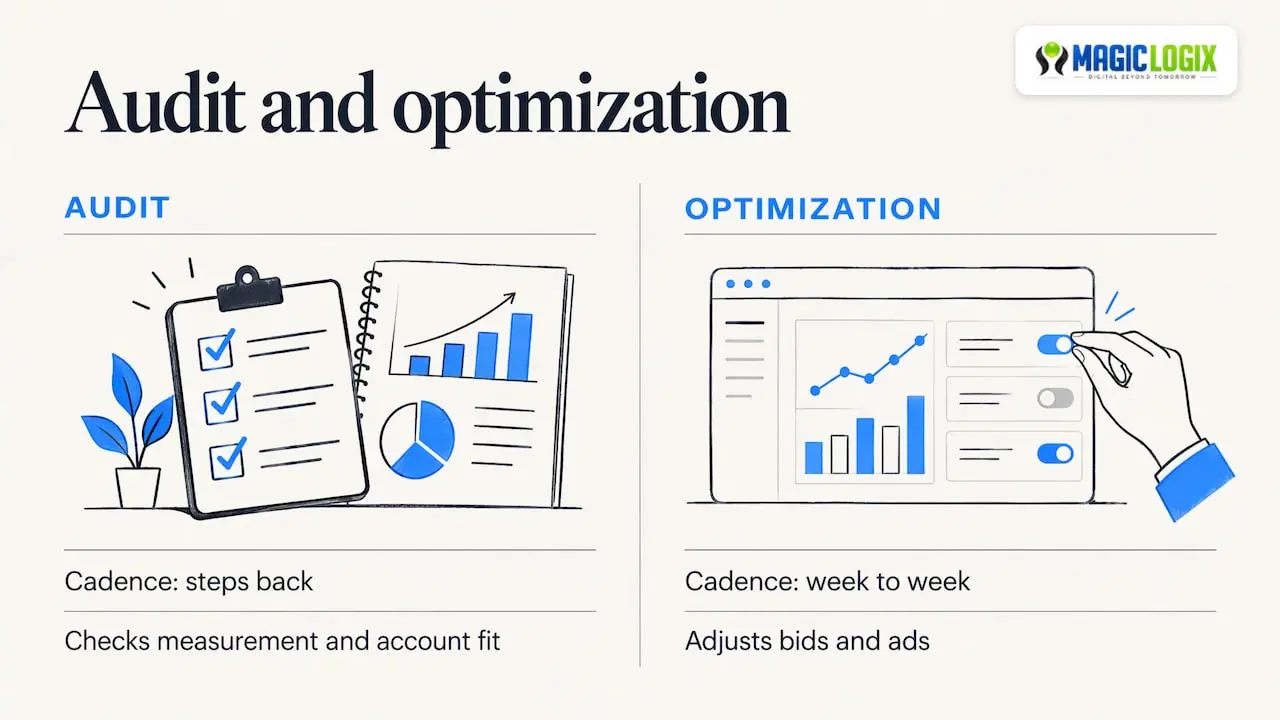
An audit is not the same as routine optimization. Optimization adjusts bids and ads week to week. An audit steps back and asks whether the foundations are sound: are we measuring the right things, is money going to the right queries, and does the account structure still make sense?
Google Ads is the example throughout because most search ad spend in the US runs through it, but the same logic applies to Microsoft Advertising and other platforms.
When to run an audit
There is no single schedule that fits every account. A sensible pattern has three tiers:
- Daily, under five minutes: check spend pacing and obvious errors. One PPC management guide recommends a fast daily scan like this and a monthly review focused on performance trends and KPI summaries.
- Monthly: review trends, search terms and KPI summaries.
- Full audit: before scaling, after taking over an account, on a regular cadence, and after major site, consent, CRM, conversion, market or account changes.
Search Engine Land lists declining performance, a best-practice check, a push for more results and evaluating an agency proposal as common reasons to audit. If a site migration or a tag manager change just happened, do not wait for the calendar. A missed snippet change can produce several days of zero performance or wasted spend.
Before you start: set up the audit
A few minutes of preparation saves hours later.
- Write down the goal. Leads, sales, booked calls, revenue at a target return? An audit without a goal produces a list of opinions.
- Export the data. Pull at least 90 days of campaign, ad group, keyword, search term, ad and location data so you can compare periods.
- Get the real numbers. Know your lead-to-customer rate, average order value or margin from your CRM or store. You will compare these with what Google Ads reports.
- Make a copy of the findings sheet. One row per finding: what you saw, why it matters, the fix, the priority and the owner.
The PPC audit checklist
1. Conversion tracking and measurement
Start here. Brad Geddes argues in Search Engine Land that inaccurate conversion data can make every other conclusion in the audit unreliable. Smart Bidding learns from these signals, so bad inputs mean bad bidding.
Check the following:
- Conversion actions match business value. Google’s conversion guidance describes choosing valuable conversion actions and configuring them as primary or secondary. Primary actions are the ones that should drive bidding. Soft signals like page views or scroll depth should not be primary.
- Tags fire correctly. Verify with Tag Assistant and confirm the Conversion Linker is present in Google Tag Manager if you use it.
- Auto-tagging is on and the click ID survives redirects and cross-domain journeys. Google’s website conversion help covers these points, along with site-wide tagging.
- Untracked actions are counted. Phone calls, chats and form submissions often go unmeasured. The same Search Engine Land guide flags conversion counting rules and which goals feed account-level bidding.
- Reported conversions reconcile with your CRM. Compare the two to expose attribution gaps or double counting. A small difference is normal. A large one needs an explanation.
- The conversion window fits your sales cycle. A 30-day window can be too short for long B2B sales cycles, which leads to under-counting.
When numbers disagree between tools, remember that Google Ads reports conversions on the ad-impression date, while other tools may use the conversion date. Use conversion-time columns to line reports up, and allow 24 to 48 hours for Google Analytics data to sync with Google Ads.
A useful habit: give tracking a confidence rating at the start of the audit, such as broken, partial or reliable. If it is broken, pause optimization decisions until it is fixed. Our own guide to what conversion tracking is and how to set it up walks through the basics.
2. Account and campaign settings
Look for settings that quietly work against each other. Search Engine Land’s audit tips point to inconsistent languages, locations, networks, schedules and bid strategies across campaigns.
Quick checks:
- Location targeting set to people in or regularly in your area, not just those showing interest.
- Search campaigns not accidentally opted into the Display network.
- Ad schedules that match when your team can answer calls or leads.
- Language settings that match your ads and landing pages.
- Device bid adjustments that reflect real performance, not guesses.
3. Campaign and ad group structure
Structure decides how cleanly you can read results. Ask whether each campaign has one clear purpose (brand, non-brand, a product line, a service area), whether budgets can be set for each purpose independently, and whether ad groups contain tightly related keywords.
A common red flag is one ad group with dozens of loosely related keywords sharing three generic ads. Relevance suffers, and you cannot tell which message works. A second is a campaign mixing brand and non-brand terms, which hides the weaker performance of non-brand behind cheap, high-converting brand clicks.
4. Budgets and impression share
Impression share is the percentage of eligible opportunities in which your ad actually showed. Search Engine Land recommends separating lost share into budget loss and ad-rank loss, since rank is affected by bid, Quality Score and ad assets.
The two losses call for different fixes:
| Finding | What it usually means | Typical action |
|---|---|---|
| High lost share to budget, good conversion cost | You are profitable and capped | Raise budget or shift it from weaker campaigns |
| High lost share to rank | Bids, ad quality or relevance are lagging | Improve ads and landing pages, review bid targets |
| Low lost share, poor results | Visibility is fine, but targeting or offer is off | Review search terms, ads and landing pages |
Do not raise budgets before step 1 is solid. More money into broken measurement only wastes more.
5. Bidding strategy
Confirm each campaign’s bid strategy fits its data volume and goal. Automated strategies need enough conversions and clean signals. Check that targets such as target CPA or target ROAS are realistic against your actual margins, and that campaigns are not constantly changing strategy, which resets learning.
Also check which conversion goals each strategy optimizes for. If a campaign bids toward a low-value action, it will find more of those. Our guide on how to optimize PPC campaigns for return goes deeper on matching bids to business goals.
6. Keywords, match types and search terms
The search terms report shows what people actually typed before seeing your ad. Google explains that it can supply ideas for negative keywords, so it is where wasted spend becomes visible.
Work through it like this:
- Sort search terms by cost, then by conversions. Look at the top spenders with no conversions.
- Mark irrelevant terms as negatives, at campaign or shared-list level.
- Separate clearly wrong intent (jobs, free, DIY) from borderline terms that need a better landing page rather than a block.
- Compare match types. Broad match with automated bidding can work, but it needs tight negatives and clean conversion data.
- If you run Performance Max next to Search, compare their search terms for overlap and possible negatives.
For planning new terms, see our notes on keyword research for paid search.
7. Quality Score and keyword-ad relevance
Google describes Quality Score as a diagnostic tool that gives a sense of how your ad quality compares with others. It is not a number you optimize for its own sake. Use its components (expected click-through rate, ad relevance, landing page experience) to see where a keyword is weak. A dash in the column means there are not enough searches to report a score, which is not an error.
8. Ads and assets
Review ads at the ad group level:
- Each responsive search ad has a healthy mix of distinct headlines and descriptions.
- Pinning is used sparingly and for a reason, such as legal wording, since heavy pinning limits testing.
- Ads clearly echo the keywords in the ad group.
- Sitelinks, callouts, call and lead assets are active and not disapproved.
- There is always a live test, so you learn something every month.
Search Engine Land advises comparing ad groups on performance and keyword-ad relevance, and reviewing assets, RSA pinning and testing. For a testing method suited to lower-volume accounts, read our two-stage ad creative testing approach.
9. Landing pages
Clicks are the cheap part. Conversions happen on the page. For your top spending ad groups, open the landing page on a phone and ask:
- Does the headline match the promise in the ad?
- Is the next step obvious without scrolling past clutter?
- Does the page load quickly and does the form work?
- Is the page specific to the query, or a generic homepage?
Search Engine Land’s guidance is to examine landing-page relevance and test pages to lift conversion rates. Our overview of website conversion optimization lists tactics to try first.
10. Reporting, access and governance
Last, check the plumbing around the account: who has access, whether billing and policy notices are monitored, whether Google Analytics is linked, and whether your dashboards match the figures you just verified. Decide who reviews what, and when. For metrics worth putting on that dashboard, see our guide to digital marketing performance metrics.
A quick scoring sheet
Use this to turn the checklist into a number you can track from audit to audit. The scale is our own working template, not an industry standard.
| Area | Score 0 (broken) | Score 1 (partial) | Score 2 (sound) |
|---|---|---|---|
| Conversion tracking | Not firing or wrong goals | Fires, but gaps vs. CRM | Reconciles with CRM |
| Structure | Mixed purposes | Some overlap | One purpose per campaign |
| Budget and impression share | Unknown losses | Losses known, not acted on | Budgets follow performance |
| Bidding | Wrong goal or too little data | Right goal, unrealistic targets | Fits data and margins |
| Search terms | Never reviewed | Reviewed occasionally | Reviewed on a schedule |
| Ads and assets | Single ad, disapprovals | Multiple ads, no tests | Ongoing tests |
| Landing pages | Generic page | Relevant, untested | Relevant and tested |
A total below roughly half the maximum points to foundation problems. Fix tracking and structure before tweaking ads.
How to prioritize and measure the fixes
A long list of findings overwhelms a team. Search Engine Land’s agency audit guidance suggests grouping findings under structure, bidding, conversion tracking, targeting and efficiency, then ranking the action plan by impact and urgency:
- High priority, immediate: broken tracking, major budget leaks, disapproved ads on top campaigns.
- Medium priority, near term: negative keyword cleanup, ad tests, bid strategy changes.
- Low priority, longer term: restructures, new landing pages, expanded testing.
Link each action to a specific finding, then measure progress against it. Pick one metric per fix before you change anything. For a negative keyword cleanup, that might be cost on non-converting search terms. For a landing page change, it is conversion rate on that page. Compare the same time window before and after, allow for the conversion delay in your sales cycle, and change one thing at a time where you can.
Be cautious with early readings. Automated bidding needs time to relearn after changes, and small samples mislead.
Our perspective
We see the same pattern in many accounts: owners spend their attention on ads and bids, while the real problem sits one layer down, in what the account measures and what it is allowed to learn from. That is why we start every review with tracking and only then look at spend.
At Magic Logix, our approach, Digital Beyond Tomorrow, joins data analytics with practical creative work. For paid search, that means an audit should end in a short, ranked plan your team can act on, not a 60-page export. It should also connect to the rest of your funnel: the landing page, the CRM and the follow-up process.
We also think audits should stay honest about what is still evolving. Google keeps adding automation and AI-driven campaign types, and best practices shift. We recommend testing new features against your own numbers rather than assuming they will help, and we do not promise rankings or specific results from any audit.
Hassan Bawab
When an outside review makes sense
Many teams can run this checklist themselves. An outside review helps when you have no one with time to do it, when results have declined and the cause is unclear, or when spend is growing and you want a second pair of eyes before scaling. If that is you, our Marketing & Growth Systems team can review your paid search account and help build a prioritized plan. We also explain how agencies structure fees in our guide to PPC management pricing, and how ongoing work fits together in paid search management.
FAQ
How long does a PPC audit take?
It depends on account size. A small account with a few campaigns can be reviewed in a few hours once data is exported. Larger accounts with many campaigns, several conversion actions and CRM reconciliation take longer, often spread over days. Tracking and CRM checks usually take the most time.
What is the difference between a PPC audit and a PPC health check?
A health check is a lighter, more frequent scan of spend, errors and key trends. An audit goes deeper into tracking, structure, bidding and landing pages, and ends with a ranked action plan. Many teams do the first monthly and the second at least once a year or after major changes.
Do I need a separate Google Ads audit checklist for each campaign type?
The core checks are the same: tracking, goals, budgets, bidding and landing pages. Add type-specific checks, such as search terms and match types for Search, or asset and audience signal review for Performance Max. Check Google’s current help pages for each type, since features change.
What should I fix first after an audit?
Fix conversion tracking problems first, then obvious budget waste such as irrelevant search terms, then ads and landing pages. Rank everything by impact and urgency so the biggest issues get attention before cosmetic ones.
How do I know if the audit worked?
Set one metric for each fix before making changes, then compare the same period before and after. Look at cost per qualified lead or return on ad spend rather than clicks, and allow for your sales cycle when judging results.
Sources
- Google Ads audit: 40+ checks (Markifact)
- About conversion measurement (Google Ads Help)
- How Google Ads tracks website conversions (Google Ads Help)
- Data discrepancies: factors and troubleshooting (Google Ads Help)
- 7 tips for conducting Google Ads audits (Search Engine Land)
- How to audit your Google Ads account like a pro (Search Engine Land)
- Agency-grade PPC audits (Search Engine Land)
- 6 Google Ads audit steps for B2B campaigns (Dimen Growth)
- 6 PPC management checklists (Process Street)
- Get negative keyword ideas using the search terms report (Google Ads Help)
- About Quality Score for search campaigns (Google Ads Help)