

Conversational AI marketing uses language models to hold two-way, context-aware conversations with prospects and customers, capturing and qualifying leads, personalizing offers, and supporting ongoing engagement. Marketing leaders are moving quickly: Gartner found that 85% of customer service leaders planned to explore or pilot customer-facing conversational generative AI in 2025. Governance and disclosure matter just as much as the tools.
TL;DR:
- Start with lead capture on one landing page, ask two or three questions, and send summaries to the CRM with a human or form fallback.
- Run a controlled pilot against a baseline with a holdout group, and set handoff triggers for frustration, legal questions, and pricing exceptions before launch.
- Disclose AI involvement in the first message, route health, finance, legal, and complaint conversations to humans, and explain data collection and let users opt out.
- Measure qualified leads, conversion, satisfaction, and incremental revenue against a recorded baseline; use holdouts and session attribution to separate impact from seasonality.
- Assign a content owner to update approved answers and review transcripts each week, because stale knowledge can degrade response quality after launch.
Table of Contents
- What is conversational AI, and how is it different from older chatbots?
- How does conversational AI work inside a marketing stack?
- Which marketing use cases should you pilot first?
- How do you roll out conversational AI step by step?
- How do you measure whether conversational AI is working?
- What governance, disclosure and privacy controls do you need?
- What starter templates can you copy for a pilot?
- A practitioner’s view: start small, measure, assign an owner
- Ready to move from pilot to production?
- FAQ
- Sources
What is conversational AI, and how is it different from older chatbots?
Conversational AI combines natural language processing (NLP), natural language generation (NLG) and large language models (LLMs) so software can interpret what a person means, remember what was said earlier, and reply in fresh wording. You are no longer steering visitors down a fixed menu. You are letting them ask questions in their own words and get useful answers.
The practical gap between a model-driven assistant and a rule-based bot comes down to a few traits:
- Context retention: the assistant remembers earlier turns, so a visitor who mentions a budget in message one does not have to repeat it in message six.
- Generative responses: replies are composed on the fly instead of pulled from a script, which handles the odd phrasing and unexpected questions that break decision trees.
- Knowledge base grounding: answers can draw on your product pages, pricing rules and policy documents, so the assistant speaks from your approved content.
- System integration: the assistant can read from and write to your CRM and marketing automation platform, which turns a chat into a tracked lead.
- Escalation judgment: it can recognize when a question is beyond it and hand off to a person with the conversation attached.
These differences show up in marketing results. Personalization stops being a mail-merge field and becomes a conversation shaped by what the visitor just said. Lead quality improves because qualifying questions adapt to the answers. And ongoing engagement stops meaning “leave your email and we’ll get back to you.”
One caution from Gartner’s research is worth keeping in mind as you evaluate tools. Gartner warns about “agent-washing”, where rule-based bots get relabeled as agentic. Ask any vendor to show you a multistep task completed without a script, and expect human oversight on the complex ones.
How does conversational AI work inside a marketing stack?
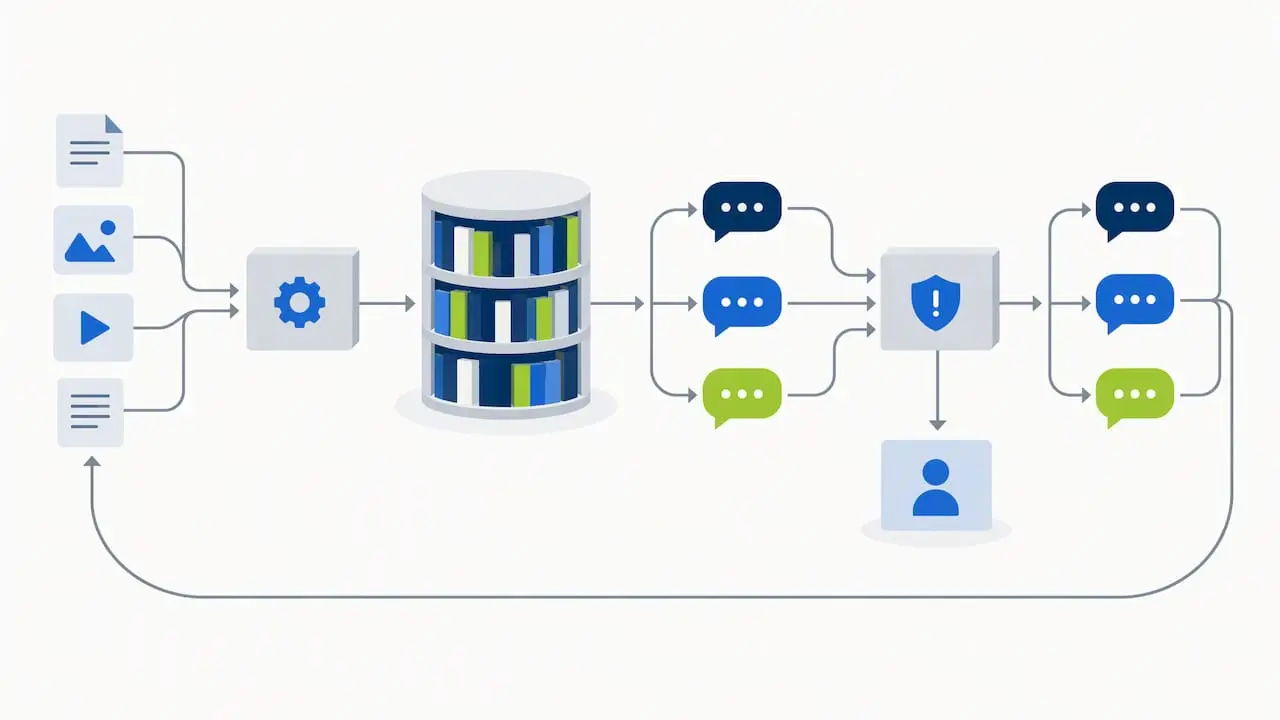
Think of the system as plumbing: visitors pour in at one end, answers and data come out the other, and every joint needs to hold. Five pieces carry most of the load.
- Channels: the places people talk to you, such as your website, SMS, a mobile app or social messaging.
- Understanding layer: natural language understanding extracts intent (pricing question, demo request, complaint) and details like product names or dates.
- Response generation: an LLM drafts the reply, shaped by instructions about tone, scope and what it may not discuss.
- Knowledge base and retrieval: a library of approved content that the model searches before answering. This pattern, called retrieval-augmented generation (RAG), keeps answers tied to your facts instead of the model’s guesses.
- Orchestration and APIs: the connective tissue that passes data to your CRM, books calendar slots, triggers email sequences and routes to humans.
Data moves in a loop. The visitor’s message arrives, the system identifies intent, retrieves matching content from the knowledge base, merges in what your CRM already knows (a returning customer, a past purchase), and generates a reply. The outcome, such as a booked demo or a stated preference, is written back to the CRM so the next interaction starts smarter. McKinsey describes the destination as a “living, dynamic customer graph” that stitches online and offline touchpoints together for real-time personalization, and a well-wired chat assistant is one of the richest feeds into it.
The tooling is only half the job. Someone has to own the content the assistant draws on, update it when prices or policies change, review conversations that went sideways, and define when a person takes over. Gartner notes that knowledge-management backlogs are a known barrier to generative AI deployments, so budget staff time for the library, not just the software.
Pro Tip: Before you shop for tools, list your most common pre-sale questions and write an approved answer for each. That list becomes your first knowledge base and your first test script.
Which marketing use cases should you pilot first?
Pick use cases that sit close to revenue and carry limited risk. Gartner groups the most valuable conversational AI work into four areas: agent enablement, low-effort self-service, operational support automation and agentic AI. Marketing teams can map their own pilots onto the same ideas.
- Lead capture: the assistant greets a visitor on a pricing page, asks two or three qualifying questions (team size, timeline, current tools), offers a gated asset or a demo slot, and pushes the record to your CRM with the conversation summary attached.
- Personalization: for a known visitor, the greeting references their past activity, surfaces an offer that fits their segment, and adapts product suggestions as they answer questions. The chat itself becomes a content personalization surface.
- Conversational commerce: shoppers describe what they need (“a gift for a runner under a set budget”) and get product suggestions, guided checkout help, or a nudge to recover an abandoned cart.
- Sales enablement and agent assist: during live calls, the system surfaces cues and suggested answers, then drafts follow-ups and summaries afterward. OffBook’s overview of AI-assisted sales conversations shows how real-time coaching tools augment human sellers rather than replace them.
- Support-to-sales: a customer asking how to use a feature may be ready for an upgrade. The assistant can answer the question first, then offer the relevant add-on or flag the account for a sales follow-up.
If you can only run one pilot, start with lead capture. The path from conversation to booked meeting is short, the outcome is easy to count, and a failed chat has a low cost because a form or a human is always the fallback. Placement matters too: entry points on key landing pages and the pages around them influence how many visitors start a conversation, which is where good web design pays off.
How do you roll out conversational AI step by step?
A phased plan keeps the pilot small and the learning fast. Here is the sequence we recommend to marketing teams.
- Phase 0, goals and pilot choice: write down the business goal, choose two or three KPIs, and pick a low-risk, high-value pilot such as lead qualification on one landing page. Tie the goal to your wider customer engagement strategy so the pilot is not an orphan project.
- Phase 1, foundation: gather and clean the knowledge base, connect the assistant to your CRM and marketing automation platform, and configure one channel. Keep the first data scope minimal: only the fields the conversation truly needs.
- Phase 2, controlled pilot: run the assistant against a holdout group or an A/B split. Build the human fallback before launch, with clear triggers for handoff (frustration, legal questions, pricing exceptions). Monitor transcripts daily at first and collect feedback from sales and support.
- Phase 3, scale with guardrails: extend to more channels and use cases once the pilot beats your baseline. Add agentic workflows, where the assistant takes multi-step actions, cautiously and only behind governance checks.
Three roles keep the work accountable. A content owner maintains the knowledge base. A data steward controls what customer data the assistant can read and write. An AI disclosure lead makes sure users know they are talking to an AI and signs off on how that is communicated.
A sample timeline for a mid-sized team: allow time for goals and content preparation, integration and configuration, and the controlled pilot, followed by a decision review. Your own pace will depend on how clean your content and CRM data are, and a rough plan beats a perfect one.
Pro Tip: Write your handoff rules before you write your first prompt. A chat that knows when to stop is safer than one that knows how to keep going.
How do you measure whether conversational AI is working?
Choose KPIs before launch, then compare against a baseline you recorded beforehand. The core set for marketing teams:
- Qualified lead rate: the share of conversations that produce a lead meeting your sales criteria.
- Conversion rate: visitors who chat versus those who do not, taken through to the same final action.
- Average time to conversion: whether conversations shorten the path from first visit to booked meeting or purchase.
- CSAT and CSAT change: satisfaction with the interaction, and how it moves against your prior channel.
- Handle time: how long conversations take, and how often a human has to step in.
- Incremental revenue: revenue you can credibly attribute to the assistant beyond what would have happened anyway.
To make those numbers believable, run A/B tests with holdouts so a share of traffic never sees the assistant. Add session-level attribution to connect chats to downstream pipeline, and use lift analysis to separate the assistant’s contribution from seasonal swings. Comparing funnel conversion step by step shows where the chat helps and where it adds friction.
Expect measurable signals within the first pilot cycle for engagement and lead capture, with revenue impact taking longer as deals move through your sales cycle. Plan for ongoing resources too: someone reviewing transcripts, updating content and tuning prompts each week. Performance drifts when the knowledge library goes stale, so treat it as a maintained asset, not a launch deliverable.
Adoption signals are strong, which is useful for setting expectations with leadership:
85% of customer service leaders planned to explore or pilot customer-facing conversational generative AI in 2025. Your competitors are testing this, so a measured pilot of your own is a reasonable bet, not a risky one.
What governance, disclosure and privacy controls do you need?
Regulators are paying attention to consumer-facing chatbots. In September 2025 the Federal Trade Commission issued 6(b) orders to examine how companies that offer AI chatbots monetize engagement, disclose advertising relationships and handle data, with special attention to children and teens. That inquiry targets companion chatbots, but the questions it asks are ones every marketing team should be able to answer.
Research points the same direction. A study of ads placed inside LLM chat found that advertising in chat can change how users perceive the experience, and that simple web-style disclosures often are not enough. Disclosure has to live inside the conversation.
For a risk framework, the NIST AI Risk Management Framework organizes the work into four functions: govern, map, measure and manage. NIST also publishes a generative AI profile that suggests actions on governance, content provenance, pre-deployment testing and incident disclosure. On the industry side, practitioners at IAB call for human oversight to verify AI inputs and outputs, mitigate bias and audit how personal data is collected and stored.
Put that guidance to work with these controls:
- Disclose at the start: tell users they are talking with an AI in the first message, in plain language.
- Add provenance metadata to AI-generated content where your tools allow it.
- Route sensitive topics to people: health, finance, legal and complaint conversations get human review.
- Test before launch and monitor after: red-team the assistant with tricky prompts, then review live transcripts on a schedule.
- Build privacy into the chat UI: show what data is collected, link your privacy notice and let users opt out.
- Assign an AI disclosure lead and document why you made each materiality call. For the technical side of data handling, Bitrupt’s AI data governance playbook is a useful companion.
What starter templates can you copy for a pilot?
Adapt these short flows to your brand voice and test them against real questions.
- Lead capture: greet the visitor and disclose the AI, ask what they are trying to solve, ask team size and timeline, offer a demo slot or a gated asset, confirm the booking, then push the contact and a chat summary to your CRM.
- Personalization: identify the user from login or a cookie, greet them with a relevant offer based on past activity, ask one question to confirm intent, log the signal, then trigger a follow-up email matched to what they said.
- Agent assist trigger: when a prospect raises an objection or a pricing question on a call, surface the matching knowledge base article and a suggested reply for the rep, who edits and sends it, then log the outcome.
A practitioner’s view: start small, measure, assign an owner
I have seen the same pattern across client programs: teams that start with one narrow pilot, a clean knowledge base and a named owner get results, while teams that launch everywhere at once can end up with a messy transcript archive and a nervous legal team. Magic Logix builds advanced analytics and AI-driven engagement into client programs, and the lesson that repeats is that governance is not a brake on performance. My advice is to pilot one use case, measure it against a holdout, and assign disclosure and content ownership before you go live.
— Hassan
Ready to move from pilot to production?
Moving from a promising pilot to a working program takes content, integration and measurement all pulling in the same direction. Our digital marketing and marketing automation services cover the integration, analytics and engagement work behind conversational AI, backed by our project experience. Book a discovery call, and we will map your first use case with you.
FAQ
What is conversational AI marketing in simple terms?
It is the use of AI that can hold natural, two-way conversations to engage prospects, answer questions, qualify leads and personalize offers. Unlike older scripted chatbots, it understands context and adapts its replies to each person.
What are the benefits of conversational AI for lead generation?
It engages visitors at any hour, asks qualifying questions and books meetings without waiting for a form follow-up. Because it writes conversation data back to your CRM, sales teams get richer lead records.
Do I have to tell users they are talking to an AI?
Clear disclosure at the start of the interaction is the safest practice. Research on advertising in LLM chat found that simple web-style disclosures often fall short, so build the notice into the conversation itself.
How long before conversational AI shows results?
Engagement and lead capture signals usually appear within a first pilot cycle, while revenue impact follows your sales cycle. Keep the knowledge base updated, since outdated content may affect the quality of responses.
Sources
- Gartner Survey Reveals 85% of Customer Service Leaders Will Explore or Pilot Customer-Facing Conversational GenAI in 2025
- Artificial Intelligence Risk Management Framework (AI RMF 1.0)
- FTC Launches Inquiry into AI Chatbots Acting as Companions | Federal Trade Commission