
Predictive analytics gives marketing leaders propensity scores and demand forecasts they can act on today: lift conversion, cut churn, and prioritize spend. That value only shows up when you have integrated customer data, a way to operationalize scores inside campaigns, and a measurement plan to prove it. The most practical next step for most teams is a focused pilot on a single use case, not a company-wide rollout.
TL;DR:
- A successful predictive marketing pilot requires integration of customer data, clear objectives, and measurement plans, with a focus on a single use case over a company-wide rollout.
- Key use cases include propensity scoring for acquisition, churn prediction, personalized content, media optimization, and B2B lead scoring, with predictive personalization needing relevant targeting rather than just precision.
- Data quality, identity resolution, and latency are critical, and most failures stem from operational issues such as poor data plumbing or untrustworthy scores.
- Effective measurement relies on randomized tests and control groups to accurately assess incremental revenue, conversion lift, and model calibration, avoiding reliance solely on model accuracy.
- Governance, privacy, and fairness testing are essential to comply with regulations and avoid bias, with ongoing audits and transparency needed throughout the model lifecycle.
Table of Contents
- What predictive analytics in marketing actually does
- Where predictive analytics moves marketing KPIs
- The data and technology stack predictive marketing requires
- A step-by-step roadmap for your first pilot
- Proving ROI without fooling yourself
- Governance, privacy, and what regulators expect
- Common pitfalls that stall predictive programs
- Our pilot checklist for predictive personalization
- Why discipline beats ambition in predictive marketing
- How we help you move from pilot to scale
- FAQ
- Sources
What predictive analytics in marketing actually does
Predictive analytics differs from descriptive analytics in one key way: descriptive reporting tells you what happened, while predictive models estimate what will happen next for a specific customer or segment. Predictive analytics uses historical data and statistical models to forecast outcomes such as who is likely to buy, churn, or respond to an offer.
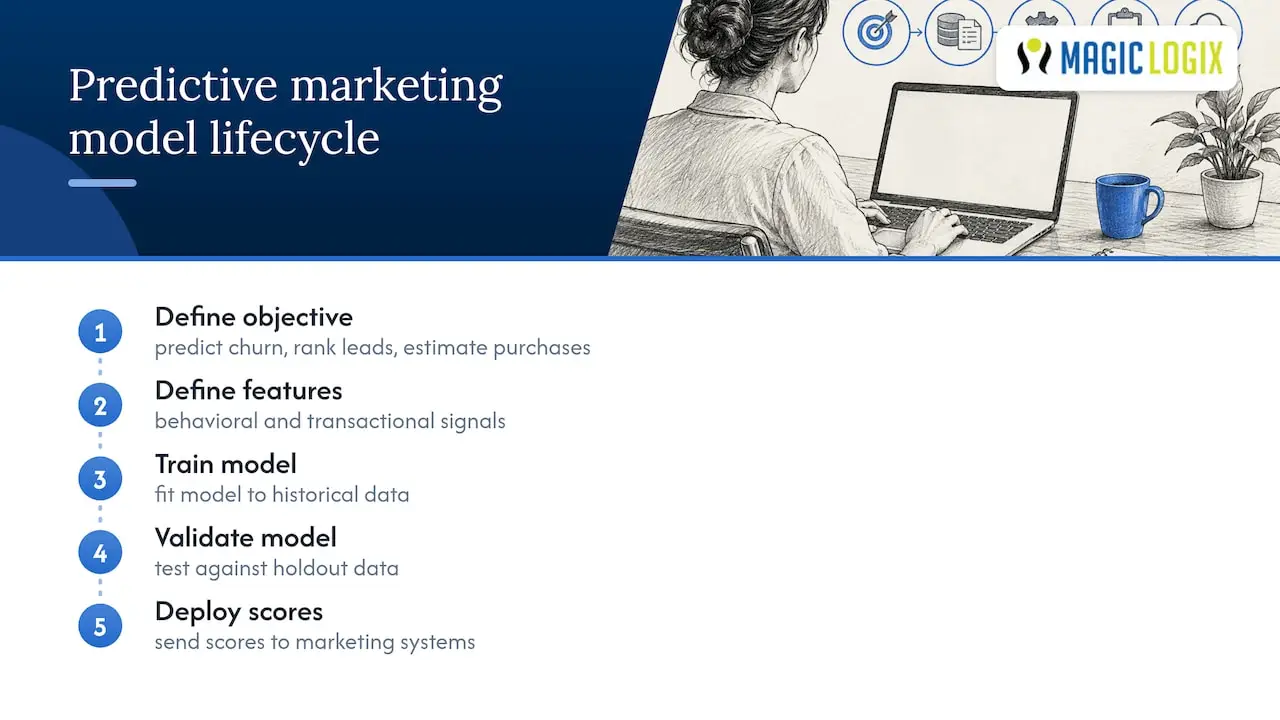
Every model follows a similar lifecycle. You start with an objective (predict churn, rank leads, estimate purchase likelihood), then define features (the behavioral and transactional signals the model will learn from), train the model, validate it against holdout data, and deploy it into production so scores reach the systems your team actually uses. Skipping validation is how teams end up trusting a model that only looks accurate on the data it was trained on.
Marketing teams generally work with three score types. Propensity scores estimate the likelihood of an action, like buying or upgrading. Risk scores estimate the likelihood of a negative outcome, like churn or payment default. Ranking scores order a list, such as leads by probability of closing. Some use cases need realtime scoring (a website recommendation engine reacting to a session in progress), while others work fine on a daily or weekly batch (a churn list refreshed for retention outreach).
Two quick examples ground this. A propensity-to-buy model might flag a subset of email subscribers as 70% more likely to convert in the next two weeks, prompting a targeted offer. A churn-risk model might surface accounts with declining usage patterns months before a formal cancellation, giving a retention team a window to intervene.
Where predictive analytics moves marketing KPIs
Not every use case deserves a pilot. These five consistently produce measurable results when the underlying data is in reasonable shape:
- Propensity scoring for acquisition and next-best-offer: ranks prospects by likelihood to convert, typically measured through conversion lift or a lower cost per acquisition.
- Churn prediction for retention prioritization: flags at-risk accounts early enough for intervention, measured through churn rate reduction or lifetime value uplift.
- Predictive personalization across site, email, and messaging: tailors content and offers to individual behavior patterns, measured through average order value and conversion lift. Our guide to predictive analytics in digital marketing walks through how this connects to campaign ROI, and these website personalization examples show what the activations look like in practice.
- Media optimization and budget allocation: shifts spend toward channels and audiences with the highest predicted incremental lift, measured through incremental ROAS rather than last-click attribution.
- B2B lead scoring and opportunity prioritization: directs sales attention to the accounts most likely to close, measured through win rate and sales cycle length.
Predictive personalization deserves particular attention because precision alone does not guarantee results; leveraging push notification personalization that actually recovers revenue can help make the experience more relevant and effective. Greater targeting precision does not automatically improve outcomes; the real value comes from making the experience more relevant, not simply narrowing who sees an ad. An emerging architecture worth watching here is the customer digital twin, a continuously updated model of an individual customer’s behavior that can support near-real-time churn and next-purchase predictions when paired with ongoing measurement. Treat it as a promising direction, not a finished substitute for validated models.
The data and technology stack predictive marketing requires
Predictive scores are only as good as the data feeding them, and that data has to reach the systems where campaigns actually run. Six data types typically feed a marketing model: transactional history, behavioral and engagement signals, CRM records, product or catalog data, campaign response history, and external enrichments like firmographic or demographic data.
On the systems side, most programs need:
- A CDP or CRM to unify customer records across channels and touchpoints.
- A data warehouse to store historical data at the granularity models need.
- A feature store to compute and reuse signals consistently across models, which also simplifies audits since feature provenance is tracked in one place, a point McKinsey highlights as a practical enabler of reproducible predictive work.
- A model training environment separate from production, so experimentation does not risk live scoring.
- A model serving endpoint that delivers scores with the latency each use case needs.
- An orchestration layer that routes scores into email platforms, personalization engines, ad platforms, and sales CRMs on a schedule or in real time.
Identity resolution across devices and channels is often the quiet blocker here: a model is only as useful as its ability to match a score to the right customer record at the moment of activation. Latency trade-offs matter too. A website recommendation needs scores in milliseconds; a retention campaign can tolerate a daily refresh.
Pro Tip: Before building a new model, audit whether your existing CRM and CDP already capture the signals you need. Most pilots stall on data plumbing, not model accuracy.
A step-by-step roadmap for your first pilot
A focused pilot, run over roughly 8 to 14 weeks, gives you a defensible proof point before you scale. The sequence matters more than the speed.
- Define the objective. Pick one use case, set a target KPI and success threshold, and agree on governance boundaries (what data you will and will not use) before any modeling starts.
- Audit the data and define features. Map where each signal comes from, how long you can retain it, and whether consent covers the intended use.
- Build, validate, and calibrate the model. Test against holdout data and check that predicted probabilities match observed outcomes, not just that rankings look plausible.
- Integrate score delivery. Decide how scores reach email, ad platforms, personalization engines, or sales CRM, and design the workflow around the people who will act on them.
- Set a measurement and retraining plan. Build in randomized holdouts, define an incremental test, and set a cadence for retraining as customer behavior shifts.
Pro Tip: Budget time for user training alongside the technical build. A model’s output only creates value once the people using it trust and act on it.
Proving ROI without fooling yourself
Model accuracy on a test set is not the same as business impact, and conflating the two is the most common measurement mistake in predictive marketing. Randomized holdouts and A/B tests are the only reliable way to isolate the incremental effect of acting on a score, separate from what would have happened anyway.
- Track incremental revenue and conversion lift against a true holdout group, not just performance against last year.
- Check calibration: when a model predicts a 30% probability of churn, roughly 30% of that group should actually churn.
- Set precision and recall thresholds deliberately based on the cost of a false positive versus a false negative for your use case.
- Design campaign and media tests so the predictive group and control group are randomized at the individual level, not by market or time period.
Set realistic accuracy expectations with stakeholders up front. Our guide to digital marketing performance metrics and our piece on measuring digital marketing effectiveness both go deeper into building a measurement plan that holds up under scrutiny.
Governance, privacy, and what regulators expect
Predictive models run on customer data, which means governance is not optional. A workable checklist covers consent mapping (what each customer agreed to and for what purpose), provenance records (where each data point originated), a retention policy, access controls, and ongoing explainability and fairness testing.
- Map consent to each intended use of customer data before a model touches it.
- Keep provenance records so you can trace any prediction back to its source data.
- Run fairness testing periodically, not just at launch, since model behavior drifts as data changes.
- Document retention limits and enforce them in the systems storing training data.
The FTC has warned that using data contrary to stated privacy commitments, concealing material uses, or training on improperly obtained data can trigger enforcement, including orders to delete derived models. Privacy-enhancing technologies like multi-party computation can support aggregate analysis without exposing raw personal data, but the FTC is clear that these tools are not a substitute for truthful disclosure and real governance.
Historically, analytics that are not tested for fairness have excluded underserved populations from opportunity, a pattern the FTC documented in its review of big data practices, which is why fairness testing belongs in the pilot plan, not as an afterthought.
Common pitfalls that stall predictive programs
Most failures trace back to people and process, not the model itself. A 2024 AMA field study covering 9.7 million transactions across 12 companies found that predictive tool effectiveness depends heavily on customer characteristics and on how skilled the salesperson using the tool is with technology. A score that nobody trusts or understands does not change behavior.
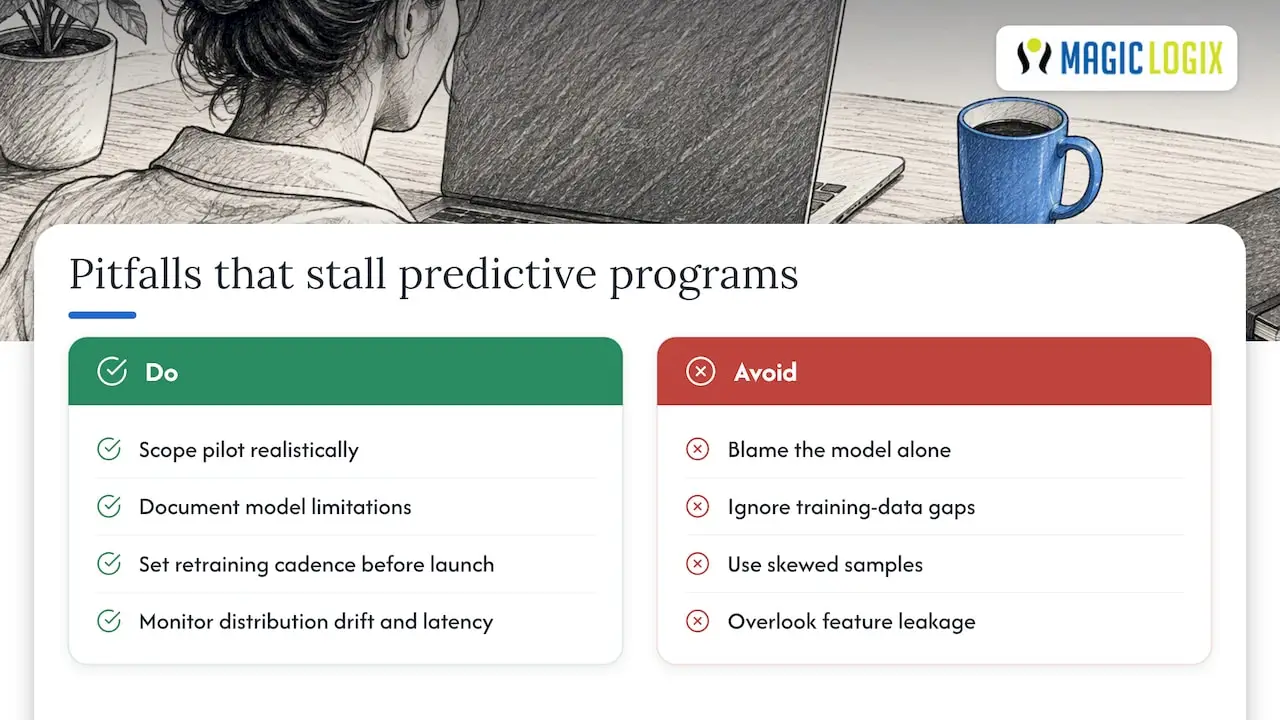
Data problems show up quietly: missing populations in your training data, skewed samples that overrepresent your best customers, or feature leakage where a model accidentally learns from information it would not have at prediction time. Operationally, distribution drift (customer behavior shifting away from what the model learned) and mismatched scoring latency both erode performance if nobody is watching for it.
The fix is unglamorous: realistic pilot scope, documented limitations, and a retraining cadence set before launch rather than after performance drops.
Our pilot checklist for predictive personalization
Running a predictive personalization pilot in 8 to 14 weeks works best with a fixed structure rather than an open-ended exploration. A workable checklist includes:
- A single stated objective and the one KPI that defines success.
- Identified datasets and a documented sample size sufficient for validation.
- Clear integration points: which campaign systems will receive the scores.
- A test design with a randomized holdout built in from day one.
- A retraining plan with a set cadence, not an open-ended “as needed.”
We have documented this process in our predictive personalization playbook, which lays out deliverables and timeline expectations for a first pilot in more detail.
Why discipline beats ambition in predictive marketing
Teams get excited about predictive analytics and want to model everything at once. We think the better path is narrower: pick one use case, prove incremental impact with a real holdout, and only then expand. Governance is not a brake on ambition, it is what makes the results defensible to finance and legal later. Align your data, analytics, and campaign owners on the same success metric before you scale anything.
— Hassan
How we help you move from pilot to scale
We build the pilot structure described above into actual campaign systems, so a propensity score or churn flag does not sit in a spreadsheet, it reaches your email platform, your ad accounts, and your sales CRM where someone can act on it. Our predictive analytics and business intelligence services cover the model, integration, and measurement work together rather than leaving you to stitch vendors together.
- We scope a single pilot use case and the KPI that will prove it.
- We handle the integration work connecting scores to your existing marketing stack.
- We build the measurement plan, including the holdout, before launch.
If you want a partner to run this alongside your team, our digital marketing and marketing automation services page is the place to start a conversation about scope and timeline.
FAQ
What is predictive analytics in marketing?
Predictive analytics in marketing uses historical customer data and statistical models to forecast future behavior, such as who is likely to buy, churn, or respond to an offer. Marketers use these forecasts to prioritize spend, personalize outreach, and focus retention efforts where they matter most.
What are the four types of predictive analytics models used in marketing?
Marketing teams commonly rely on propensity models (likelihood of an action like purchase), churn or risk models (likelihood of a negative outcome), lead scoring or ranking models (ordering prospects by probability of conversion), and personalization or recommendation models (predicting relevant content or offers for an individual). Each type feeds a different part of the customer journey.
What are the four steps in a predictive analytics process?
A predictive analytics process generally moves through defining the objective and features, building and validating the model against holdout data, deploying it so scores reach production systems, and measuring real-world impact with a plan to retrain as data shifts. Skipping validation or the measurement step is the most common reason programs fail to show results.
What is an example of a predictive function in marketing research?
A common example is churn prediction, where a model flags accounts showing declining engagement months before they cancel, giving a retention team time to intervene. Another example is propensity-to-buy scoring, which ranks prospects by likelihood of converting so campaigns can target the highest-potential segment first.
How long does a predictive analytics pilot typically take?
A focused predictive analytics pilot on a single use case, like churn prediction or predictive personalization, typically runs 8 to 14 weeks from objective definition through initial measurement. That timeline covers data audit, model build and validation, integration into campaign systems, and a first read on incremental results against a holdout group.
Sources
- AI companies: Uphold your privacy and confidentiality commitments
- What Is Predictive Analytics? 5 Examples