
A marketing case study is a customer-centered story that proves your approach worked, backed by real numbers instead of adjectives. That’s why it remains one of the most trusted content formats in B2B: roughly 75% of B2B marketers use case studies or customer stories, and they consistently rank among the highest-performing content types. The Federal Trade Commission also governs how you disclose relationships with the customers you feature, which matters the moment you publish one. Below, you’ll find real examples, a working template, and a distribution plan.
TL;DR:
- Nearly 87% of B2B marketers in the tech sector publish case studies, and 62% consider them the most effective content format.
- Effective case studies highlight a specific, verifiable number in the headline and include raw data alongside percentages for credibility.
- They should be produced with a clear structure: headline, challenge, approach, measurable results, a customer quote, and a call to action.
- Distributing case studies through sales, LinkedIn, email, and paid ads increases their impact and pipeline contribution.
- Scaling production involves building a pipeline of interviews, legal clearances, and measuring their influence on sales, not just page views.
Table of Contents
- What Counts as a Marketing Case Study?
- Why Do Case Studies Work So Well?
- Which Case Studies Should You Actually Study?
- What Sections Does Every Case Study Need?
- How Do You Write a Case Study From Scratch?
- Where Should You Actually Publish a Case Study?
- How Does an Agency Scale Case Study Production?
- What Legal Risks Go Beyond FTC Disclosure Rules?
- What Should Marketers Prioritize Right Now?
- Get Help Building a Case Study Program That Scales
- Sources
- FAQ
What Counts as a Marketing Case Study?
A case study is a documented story of how a real customer used your product or service to solve a specific problem, told with enough detail and evidence that a prospect can see themselves in it. It’s not a testimonial (a quote) or a reference (a name on a slide). It’s a narrative with a beginning, middle, and measurable end.
Not every case study looks the same, and matching the format to your audience matters more than most teams realize:
- Campaign case study: Focuses on a single marketing initiative and its results, ideal for showing marketing teams a repeatable playbook.
- Product case study: Walks through how a specific feature or product solved a workflow problem, useful for product-led sales conversations.
- Customer success story: Broader narrative covering the full relationship, best for enterprise buyers evaluating long-term partnership fit.
- Video case study: Condenses the same story into two to four minutes, effective on landing pages and in sales decks where attention is short.
- One-pager: A single-page summary for sales reps to drop into an email or leave behind after a meeting.
Choose based on where the reader is in their decision. A one-pager closes deals faster than a 2,000-word narrative ever will, and a video often outperforms both on a homepage.
Why Do Case Studies Work So Well?
Case studies work because they replace your claims with someone else’s proof. Prospects don’t trust a company describing its own strengths, but they trust a peer describing a result they achieved. That’s the entire psychology behind social proof, and it’s why case studies punch above their weight in B2B buying committees.
Among B2B marketers, case studies and customer stories rank as one of the top three most effective content types, according to Content Marketing Institute’s 2025 benchmarks research. In the technology sector specifically, 87% of marketers published case studies and 62% called them their most effective format.
That effectiveness shows up in a few concrete ways:
- Credibility transfer: A named customer with specific numbers carries more weight than any headline you’d write about yourself.
- Sales enablement: Reps use case studies to answer the “has anyone like us done this?” question without inventing an answer on the spot.
- Thought leadership lift: Edelman-LinkedIn research found that buyers exposed to strong, data-backed thought leadership are more likely to invite that company into an RFP, and case studies are often an effective form of evidence you can pair with it.
- Funnel positioning: Case studies do their heaviest lifting in the middle and bottom of the funnel, when a prospect already knows the category and needs proof it works for someone like them.
Which Case Studies Should You Actually Study?
The best way to learn case study structure is to read good ones and notice what each does differently. Here are ten worth studying, grouped loosely by what they teach.
Visual storytelling and format:
- Written narratives that open with a bold pull-quote metric instead of a headline teach you that the number, not the customer’s name, is often the real hook.
- Video case studies under three minutes that put the customer on camera in their own environment (a warehouse, a store floor) rather than a studio prove authenticity beats production value.
- Interactive case studies with clickable data visualizations show how software companies let prospects filter results by industry or company size instead of forcing one narrative on everyone.
- Infographic-style one-pagers that compress the challenge, approach, and result into a single scannable graphic work well as sales leave-behinds.
Metrics-driven proof:
- Case studies that state both the percentage change and the absolute number (say, “40% increase” and “from 1,200 to 1,680 monthly leads”) build more trust than a percentage alone, because raw numbers are harder to cherry-pick.
- Studies that include a specific time frame (“over a 90-day pilot”) instead of a vague “recently” signal the result wasn’t a fluke sample.
- Multi-metric case studies that track a primary KPI plus a secondary one (revenue and retention, for example) show the win wasn’t a tradeoff.
Distribution-first design:
- Case studies built as modular content, where a long-form PDF gets broken into a landing page, a LinkedIn carousel, and an email snippet, get more mileage from one interview.
- Gated case studies paired with a webinar recap extend the story’s life well past its publish date.
- Short-form customer quotes lifted directly from a longer case study and reused as ad creative prove one good interview can fund a month of paid social.
The pattern across all ten: the strongest case studies lead with a specific, verifiable number and let the customer’s voice carry the emotional weight.
What Sections Does Every Case Study Need?
Every effective case study follows roughly the same skeleton, regardless of format or industry. Skip a piece and the story feels incomplete; add too much and you lose the reader before the results section.
- Headline: States the outcome, not the customer’s industry (“How a regional retailer cut cart abandonment by 28%” beats “ABC Retail Case Study”).
- Executive summary: Three to four sentences up top summarizing the challenge, approach, and headline result, for readers who won’t scroll further.
- The challenge: What was broken, in the customer’s own words where possible, framed as a problem the reader recognizes in their own business.
- The approach: What you actually did, step by step, without turning it into a product brochure.
- The results: Metrics, presented with percent change, the absolute numbers behind them, and the time period measured, so a reader can judge scale for themselves.
- A direct quote: One or two sentences from the customer that a reporter couldn’t paraphrase better.
- A call to action: A next step for the reader, not just a logo wall.
When you present results, always pair the percentage with the raw figure and the sample size or measurement window. “35% faster onboarding” means little without knowing whether that’s five customers over two weeks or five hundred over a quarter.
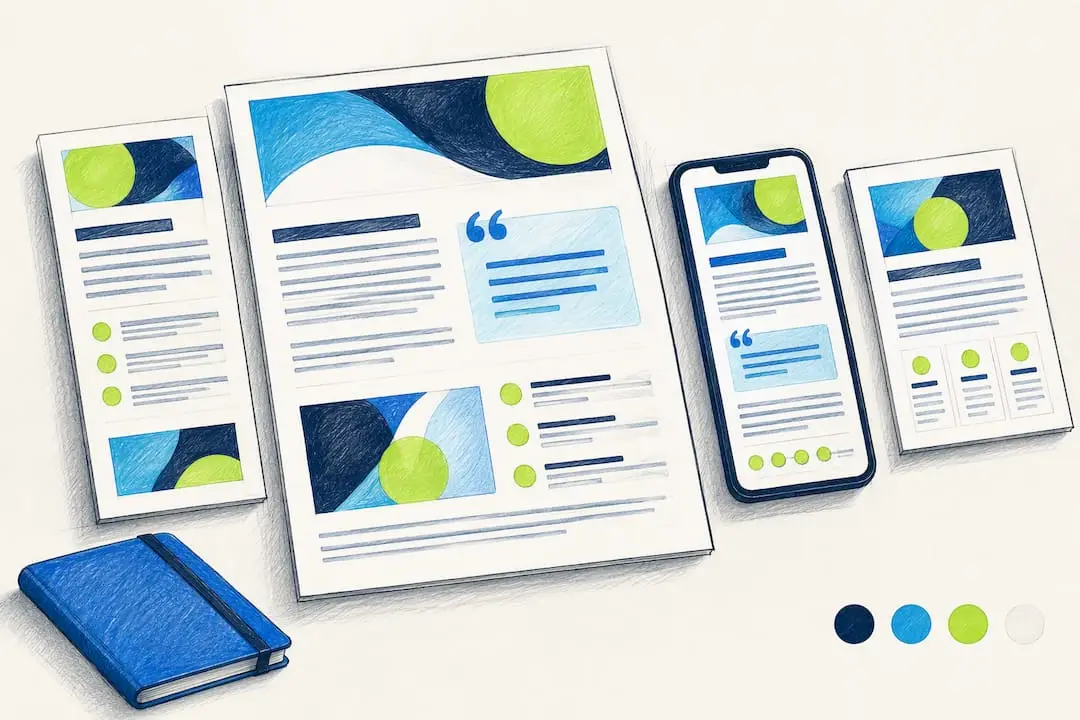
Design matters more than most teams budget for. Break long blocks of text with pull quotes, use consistent brand colors and typography so the piece reads as a professional asset rather than a Word document, and keep line lengths short enough to scan on mobile. The NEXTmsp brand guidelines offer a useful reference for keeping visual identity consistent across a library of case studies.
Pro Tip: Write the headline and executive summary last. Once you know the strongest number in your results section, you can build the headline around it instead of guessing what the story is about before you’ve written it.
How Do You Write a Case Study From Scratch?
Writing one well is less about talent and more about following a sequence that catches problems before they become rewrites.
- Pick a candidate with a clear, quantifiable win. A customer who improved something by 10% with clean data beats one who “loved working with you” but can’t point to a number.
- Get internal buy-in early. Loop in sales and customer success before you approach the customer. They’ll flag relationship sensitivities you can’t see from marketing.
- Interview both sides. Ask the customer what the problem cost them before you helped, what almost stopped them from working with you, and what they’d tell a peer considering the same decision. Ask your internal team what almost went wrong, since that honesty makes the “approach” section credible.
- Draft, then verify every number with the customer. Never publish a metric the customer hasn’t confirmed in writing.
- Route for approval, and build disclosure into that step. If the customer received a discount, free service, or anything of value in exchange for participating, the FTC’s rule on endorsements and testimonials requires that connection to be disclosed clearly. The FTC’s own staff guidance offers plain-language examples of where and how to place that disclosure.
- Publish and route to sales immediately, not weeks later.
A reviewer checklist worth keeping on hand:
- Every metric confirmed by the customer in writing.
- Quotes approved verbatim, not paraphrased after sign-off.
- Any incentive or discount disclosed per FTC guidance.
- Headline states an outcome, not just a topic.
Where Should You Actually Publish a Case Study?
A case study that sits on a resources page and nowhere else is a wasted interview. Distribution decides whether it drives pipeline or just collects dust.
- Sales enablement: Hand reps a one-pager version they can attach to emails without editing it themselves.
- LinkedIn: Native posts summarizing the result outperform a link-out post, since the algorithm favors content that keeps people on the platform.
- Email: A dedicated send to a segment matching the case study’s industry converts better than a generic newsletter mention.
- Paid amplification: Boosting the strongest quote as an ad, rather than the full case study, tends to lower cost per click.
Repurposing stretches one interview across a quarter: cut a 30 second social clip from the video version, build a webinar around the same customer, or gate the full PDF behind a form to capture leads still in the research phase.
Track pageviews and downloads, but weigh them against sales cycle length for deals where the case study was shared, and win rate for opportunities where a rep used it. If you can, tag CRM opportunities that included a case study touch point so you can compare close rates against ones that didn’t.
How Does an Agency Scale Case Study Production?
Scaling case studies past two or three a year takes a pipeline, not a single motivated writer. Magic Logix builds that pipeline by pairing content production with a measurement layer, using an approach similar to marketing mix modeling (miROAS) to attribute downstream impact rather than just counting downloads.
The operational fixes that matter most:
- Document campaign milestones while a project is live, not after it wraps, since retroactive data pulls are where most case studies stall.
- Offer anonymized or aggregated versions when a customer can’t sign off on named data, so proprietary restrictions don’t kill the story entirely.
- Build a standing client review template so approvals take days, not months.
What Legal Risks Go Beyond FTC Disclosure Rules?
FTC disclosure covers the relationship between you and the customer you’re featuring, but two other legal questions deserve equal attention before you hit publish.
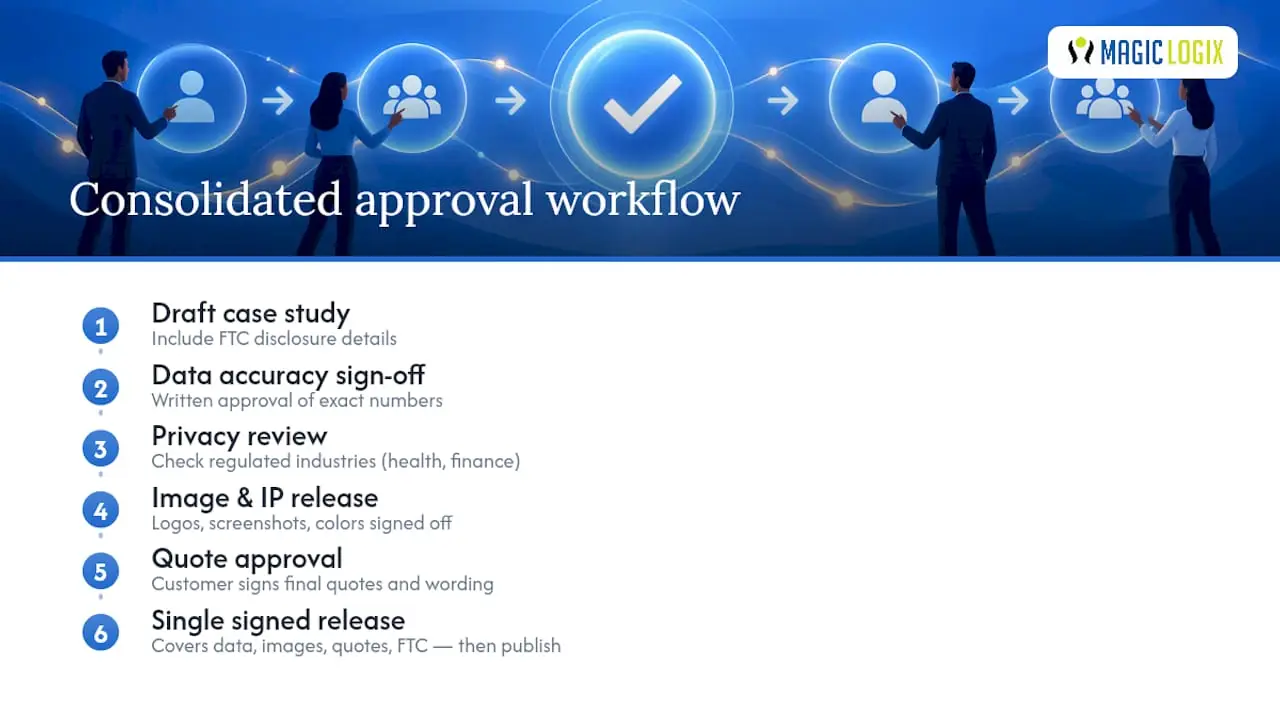
Privacy and data protection. Any customer data you cite, revenue figures, internal metrics, employee counts, belongs to that company, not to you, even after the case study is live. Get written sign off on the exact numbers you plan to publish, not just a verbal “sounds good” on a call. If the customer operates in a regulated industry like healthcare or finance, check whether any of the data you want to cite touches protected categories before it ever reaches a draft; a B2B healthcare marketing case study, for instance, needs a different review process than one for a retail brand.
Intellectual property. Logos, product screenshots, and brand colors belong to the customer, and using them without a signed release is a trademark issue even if the customer verbally agreed to participate. The same goes for your own proprietary methodology; if a competitor could reverse engineer your process from the case study’s “approach” section, you’ve given away more than a testimonial.
Build both into the same approval workflow you use for FTC disclosure. One signed release covering data accuracy, image usage, and quote approval saves you from chasing three separate sign offs later, and it protects the customer relationship as much as it protects you legally.
What Should Marketers Prioritize Right Now?
If you’re building a case study program in 2026, prioritize three things: lead with a verified number in every headline, invest in a short video cut even if the written version stays your anchor asset, and repurpose every interview into at least three formats instead of one. The trend worth watching is interactive, filterable case study libraries that let a prospect self-select the story closest to their own industry, since one story rarely fits every buyer on a committee.
— Hassan
Get Help Building a Case Study Program That Scales
Writing one strong case study is manageable. Building a repeatable pipeline that produces them monthly, tracks their pipeline impact, and keeps disclosure and approvals clean is where most internal teams stall out. Some marketing teams handle that pipeline end to end: interviews, drafting, design, and distribution, backed by a measurement approach to tie each story back to pipeline movement rather than just pageviews.
That includes producing the written and video assets, distributing them through the right channels, and reporting on which ones actually influence deals, work that falls under digital marketing and marketing automation support. If previous case studies took several months and multiple legal review rounds, a structured process can improve timing for future projects. Request a consult to map out what a repeatable case study program would look like for your team.
Sources
This article draws on Content Marketing Institute’s 2025 B2B benchmarks research, the FTC’s guidance on endorsements and testimonials, and the Edelman-LinkedIn B2B Thought Leadership Impact Report, alongside CMI’s practical guide on getting customers to participate in a case study.
- B2B Content Marketing Benchmarks, Budgets, and Trends: Outlook for 2025
- FTC: Consumer reviews and testimonials rule – questions & answers
FAQ
What Is the 3-3-3 Rule for Marketing?
The 3-3-3 rule isn’t a standard framework tied specifically to case studies; definitions vary across marketing disciplines and often refer to content pacing or campaign testing windows. If you’ve seen it applied to case studies specifically, treat it as a informal guideline rather than an established industry standard.
What Are Some Famous Examples of Case Studies in Marketing?
Well-known examples tend to share one trait: a specific, verifiable metric in the headline rather than a vague claim. The strongest ones, across video, written, and interactive formats, pair a customer’s own words with a number that a reader can’t dismiss as marketing spin.
What Makes a Good Case Study Example?
A good case study states the challenge in terms a prospect recognizes, shows the approach without turning into a product pitch, and backs the result with both a percentage and the raw number behind it. The best examples also include a direct customer quote that couldn’t have come from your marketing team.
What Are the Core Components of a Case Study?
The essential sections are a headline, an executive summary, the challenge, the approach, the results, and a customer quote, followed by a call to action. Skipping the executive summary or the quote is the most common shortcut that weakens an otherwise strong story.
Does Magic Logix Help Companies Produce Case Studies?
Yes, Magic Logix supports case study production as part of its broader digital marketing services, covering interviews, drafting, design, and distribution. Pricing depends on scope; visitors should check the provider’s site for the most current rates.