
Your team launched a campaign for a strong healthcare product. The messaging was polished. The landing page looked credible. Sales expected demos.
Then almost nothing happened.
That outcome is common in healthcare b2b marketing, and not because the product is weak. The core problem is timing. By the time many healthcare buyers speak to a vendor, they have already spent weeks or months researching on their own, comparing options, and narrowing the field in private.
Most guides stop at “healthcare is regulated and complex.” That is true, but it does not help you fix the problem. The better question is this: how do you influence buyers before they raise their hand, while still earning trust in a market that penalizes careless automation?
This guide answers that question with a practical playbook. It focuses on two realities shaping healthcare b2b marketing now: the invisible research phase and the need to use AI without sounding like a machine.
The Modern Challenge in Healthcare B2B Marketing
A familiar pattern plays out in healthcare marketing teams.
A company builds a campaign around product features. It buys ads, sends emails, books a webinar, and waits for demand. Sales sees some activity, but the best-fit hospital systems and clinic groups stay silent. Later, the team learns those accounts already evaluated alternatives before anyone filled out a form.
That is the modern challenge.
Healthcare buyers conduct 70% of their research before engaging with vendors, and 85% have already created a shortlist before evaluations begin, according to HealthLaunchpad’s analysis of the invisible research phase. If your marketing only activates when someone requests a demo, you are entering the process late.
Why old outreach-first playbooks break down
Traditional vendor-led outreach assumes the buyer journey starts when a prospect responds.
In healthcare, it often starts much earlier. A hospital CIO may be reviewing integration concerns. A department leader may be gathering peer opinions. A finance stakeholder may be testing whether a project can survive budgeting scrutiny. None of them needs to identify themselves yet.
That means your website, content library, retargeting strategy, and account-level signals matter more than many teams realize.
Key takeaway: In healthcare b2b marketing, visibility before contact matters as much as persuasion after contact.
What the invisible phase looks like in practice
The invisible phase is not mysterious. It is the period when buyers research privately.
They might:
- Compare categories: They are not choosing between vendors yet. They are deciding what kind of solution even makes sense.
- Gather internal language: They need wording for internal conversations with IT, finance, compliance, and operations.
- Test your credibility: They look for signs that you understand healthcare realities, not just software marketing.
A helpful way to think about this is a clinical triage model. Buyers do not admit every vendor into the exam room. They screen first. Your digital presence is part of that screening.
The capabilities that matter now
Winning earlier requires a different set of muscles:
- Searchable educational content that answers real evaluation questions.
- Account-aware website experiences that speak to buyer roles and settings.
- Retargeting and nurture flows that continue the conversation without feeling intrusive.
- Signal detection that helps marketing and sales notice interest before a formal inquiry.
The rest of this guide builds that system from the ground up.
Mapping the Complex Healthcare Buyer Ecosystem
Healthcare does not buy like a single person. It buys like a committee with different incentives, different fears, and different definitions of success.
A marketer may say, “We sell to hospitals.” That sounds clear, but it is too broad to be useful. A hospital is not your buyer. It is a container full of buyers.
The buying committee is the market
One deal can involve IT, operations, finance, clinical leadership, procurement, and executive sponsors.
That is one reason healthcare b2b marketing moves slowly. Martal notes that 69% of healthcare B2B purchases involve sales cycles of 13+ months, and that sales teams using AI-driven buyer intent signals are 43% more likely to connect with high-fit prospects.
That stat matters because it changes how you segment. You are not just sorting accounts by size. You are sorting by likely readiness, likely stakeholder mix, and likely internal friction.
A strong primer on this discipline is Magic Logix’s work on B2B marketing segmentation.
To visualize the challenge, this short video gives a useful overview of healthcare buyer complexity:
Segment by role, not just organization
Firmographics still matter. A regional clinic group does not buy like an academic medical center.
But healthcare marketers get better results when they add role-level segmentation to account-level segmentation.
Here is a simple way to frame it:
| Stakeholder | Main concern | Message that resonates |
|---|---|---|
| CIO or IT leader | Integration, security, system fit | Architecture, implementation path, interoperability details |
| Clinical leader | Workflow, outcomes, usability | Patient impact, staff adoption, evidence-backed use cases |
| Finance leader | Cost, risk, payback logic | ROI model, operational efficiency, budget justification |
| Administrator or operations lead | Throughput, staffing, process strain | Efficiency, visibility, fewer bottlenecks |
| Procurement | Vendor reliability, documentation, process | Clear requirements, responses, implementation clarity |
This table highlights where many teams get confused. They think persona work means giving each buyer a name and a fictional biography. That is not enough.
Useful personas answer four business questions:
- What blocks this person from saying yes
- What proof do they trust
- What internal language do they need
- What happens if they do nothing
Build personas from evidence, not imagination
Do not invent motivations because they sound plausible.
Start with what your sales calls, customer success notes, CRM records, and win-loss conversations already show. Then layer in intent signals. For example, if an account starts researching EHR upgrades, posting for integration roles, or consuming implementation content, that tells you something about timing and likely concerns.
A practical workflow looks like this:
- Begin with 100 target accounts: Enough to spot patterns without becoming vague.
- Tag each account by setting: Hospital system, specialty group, clinic network, payer-facing organization, or healthcare services provider.
- Add stakeholder hypotheses: Who is likely to champion, evaluate, resist, or approve.
- Review with sales: Ask where your assumptions match reality and where they break.
Tip: If marketing says an account is ideal but sales keeps rejecting it, the segmentation model is wrong or incomplete.
What good mapping changes
Once you map the ecosystem well, your campaigns stop sounding generic.
You no longer market “efficiency software” to a hospital. You market implementation confidence to IT, workflow relief to clinicians, and budget defensibility to finance. The same product stays the same. The buying language changes.
That shift is one of the biggest upgrades a healthcare b2b marketing program can make.
Navigating Compliance and Building Unshakable Trust
In healthcare, trust is not a soft brand concept. It is a buying filter.
A polished campaign can still fail if buyers sense carelessness, overstatement, or automation that feels detached from reality. That is why compliance and credibility belong in the same conversation.
Compliance is a marketing issue, not just a legal issue
Many teams treat compliance like a final review step. In practice, it shapes the entire marketing system.
If your campaigns depend on questionable data collection, vague claims, or sloppy audience targeting, legal review cannot save the strategy. The smarter approach is to build with first-party data, clear consent practices, and role-based targeting from the start.
Magic Logix has a useful explainer on what first-party data is and why it matters more as privacy expectations rise.
For healthcare marketers, the practical implication is clear. Use data that helps you understand professional needs and account behavior. Stay far away from anything that would undermine privacy or make buyers wonder how you got their information.
Buyers judge your marketing the way they judge your service
In projected 2026 planning guidance, Slabtown Marketing notes that healthcare buyers are particularly sensitive to trust and authority, and that over-reliance on automated, high-volume ads can damage trust.
That observation matters because healthcare marketing is often a preview of delivery quality.
If your outreach feels generic, buyers infer that onboarding may be generic too. If your content sounds thin, they may question the depth of your team. If every touchpoint feels machine-generated, your authority drops before the first meeting.
A practical example appears in operational patient communication. A guide to choosing an answering service for medical offices is useful because it shows how responsiveness, accuracy, and tone directly affect patient-facing trust. The same logic applies in B2B. Buyers pay attention to how your organization communicates under pressure.
Where AI helps and where people must lead
AI can improve healthcare b2b marketing. It just should not control every touchpoint.
Use automation where speed and pattern recognition matter most:
- Lead scoring
- Intent signal analysis
- Content personalization
- Nurture sequencing
- Channel timing and routing
Keep people highly visible where judgment and credibility matter most:
- Thought leadership
- Executive messaging
- Clinical or technical insight
- High-stakes sales conversations
- Objection handling around risk
Think of AI as an intake and routing layer, not as your brand voice.
Practical rule: If a message asks a buyer to trust your expertise, a human should shape the final words.
A simple trust test
Before launching a campaign, ask:
- Would this message still feel credible if the buyer knew AI helped produce it?
- Does it sound specific to the role and setting?
- Is the claim supportable without exaggeration?
- Would a cautious healthcare executive see professionalism or volume-driven automation?
If the answer to the last question is unclear, revise it before you publish.
Key Marketing Channels for Healthcare Engagement
Many channel guides read like checklists. Use LinkedIn. Run email. Publish content. Host webinars.
That advice is not wrong. It is incomplete.
In healthcare b2b marketing, the right channel depends on what the buyer is trying to do at that moment. Are they learning the category, validating risk, building internal consensus, or preparing to evaluate vendors? Different channels help at different stages.
Account-based marketing for coordinated influence
ABM works well in healthcare because decisions rarely sit with one person.
A smart ABM play does not merely target a hospital logo. It coordinates messages across the stakeholder group. For a hospital department rollout, that might mean one sequence for IT, one for operations, and another for finance.
Here is what that can look like:
- IT receives an integration brief and implementation FAQ
- Clinical leaders receive workflow examples and adoption guidance
- Finance receives a cost-logic worksheet and risk framing
- Executives receive a short strategic summary with clear implications
The point is not to flood the account. The point is to help each participant do their part of the internal evaluation.
Content that earns shortlist consideration
Content in healthcare should reduce uncertainty.
That means your editorial calendar should not be built only around top-of-funnel SEO ideas. It should also answer the practical questions buyers ask before they ever call you.
Useful content types include:
Role-specific assets
A CFO does not need the same asset as a nursing leader.
Create content with a job to do:
- ROI calculators for finance teams
- Clinical outcome narratives for physicians and care leaders
- Security and integration guides for IT
- Implementation roadmaps for operations
- Procurement checklists for sourcing teams
Invisible-phase content
This content is often missed because buyers consume it anonymously.
Examples include:
- Category comparison pages
- “What to ask a vendor” guides
- Integration requirement summaries
- Compliance and workflow explainer articles
- Buyer enablement documents a champion can forward internally
This material helps you influence decisions before the formal buying process begins.
Digital advertising that supports, not interrupts
Digital ads can work in healthcare. The key is restraint and relevance.
Use paid channels to reinforce useful content, not just push demo requests. LinkedIn is often effective for professional targeting because you can shape campaigns around role, organization type, and buying context. Search can help when a buyer is actively trying to solve a defined problem. Retargeting keeps your brand visible after an anonymous visit.
A simple planning model looks like this:
| Channel | Best use | Common mistake |
|---|---|---|
| Role-based awareness and thought leadership | Sending cold product ads too early | |
| Search | Capturing active research intent | Bidding only on branded or generic feature terms |
| Retargeting | Staying visible during research | Showing the same ad to every persona |
| Email nurture | Continuing education after engagement | Treating every lead as sales-ready |
Events still matter, but the follow-up matters more
Healthcare buyers often use events to validate ideas, compare vendors, and hear from peers.
That means in-person conferences and virtual sessions still play a role, especially when the topic is operational, clinical, or technical. But the value rarely comes from the event alone. It comes from what happens next.
The teams that do this well capture intent signals from attendance, content downloads, and post-event behavior, then route people into role-specific follow-up.
Professional networks and peer validation
Healthcare professionals trust informed peers more than polished claims.
That is why networks matter. Not in a spammy, volume-outreach way. In a credibility-building way. Executive posts, expert commentary, panel participation, customer advocacy, and respected practitioner voices all help buyers feel safer engaging.
When in doubt, ask one question: does this channel make us easier to trust during the buyer’s private research stage?
If the answer is no, it may still have value, but it should not lead your strategy.
Building Your High-Performance Marketing Tech Stack
Healthcare b2b marketing becomes much easier when the technology stack mirrors the buying reality.
That reality includes long consideration windows, multiple stakeholders, anonymous research, strict data expectations, and the need to connect marketing activity with revenue outcomes. A scattered stack creates blind spots. An integrated one helps your team see accounts clearly and act early.
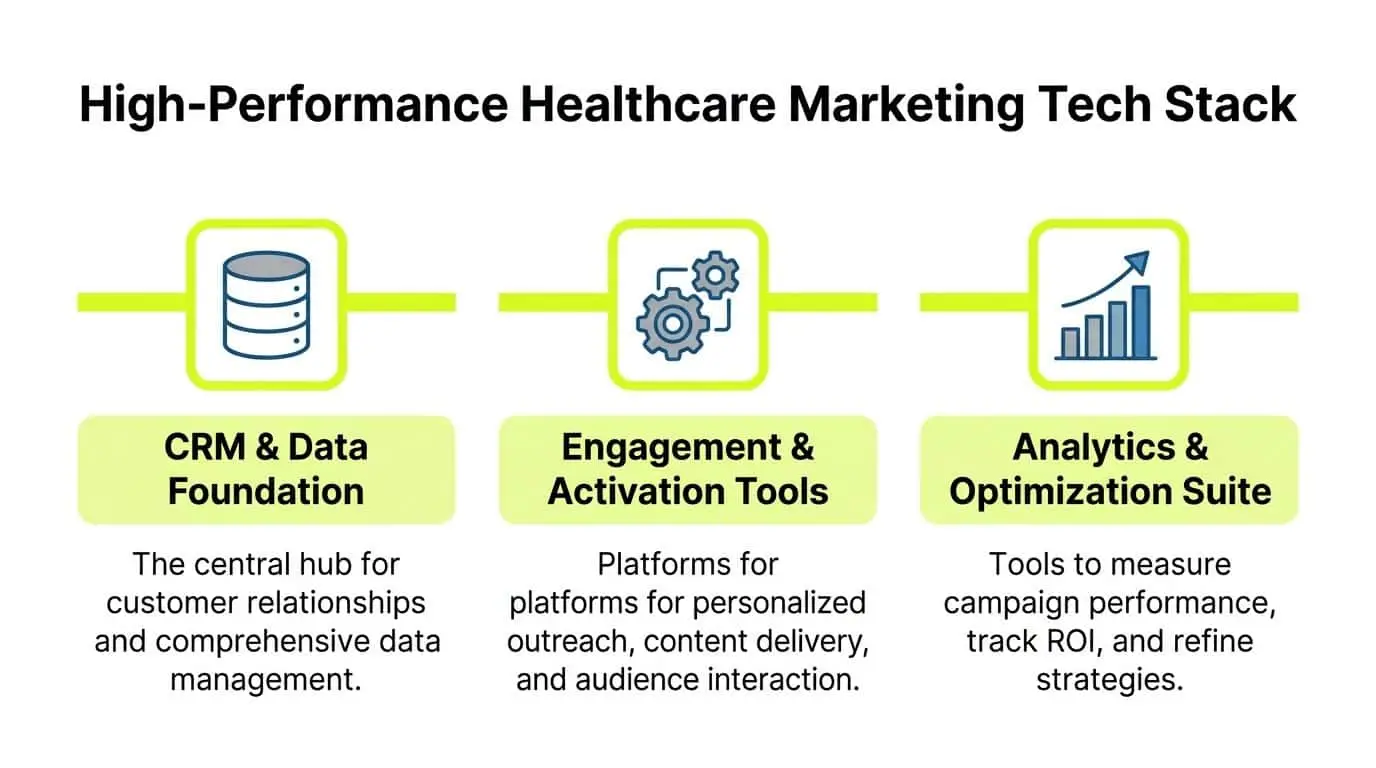
Here is the core architecture:
The three layers that matter most
Think of the stack as three connected systems, not a pile of tools.
CRM and data foundation
Your CRM is the record of account history, stakeholder relationships, deal progression, and sales context.
In healthcare, the CRM should do more than store contacts. It should capture account structure, buying roles, previous interactions, content engagement, and notes from sales and marketing. This becomes the shared memory of the go-to-market team.
Engagement and activation tools
These tools handle outbound and inbound motion.
That includes email workflows, landing pages, advertising platforms, retargeting, content distribution, webinar systems, chat experiences, and personalization engines. Their job is to deliver the right message to the right role at the right time.
Analytics and optimization suite
This layer turns activity into judgment.
It includes dashboards, attribution reporting, account scoring, behavior analysis, and predictive models that flag likely interest or likely drift. Without this layer, teams often confuse motion with progress.
Why integration matters more than tool count
A large stack is not automatically a strong stack.
Value comes from connected signals. A buyer visits a solution page, downloads a security brief, attends a webinar, and returns later from a retargeting ad. If those actions live in separate systems, no one sees the pattern. If they are connected, marketing can adjust nurture and sales can prioritize follow-up.
This is one reason AI-powered personalization has become so central. Active Marketing reports that 93% of healthcare marketers now use AI strategies, and that AI-powered personalization can drive up to a 40% increase in stakeholder engagement.
The takeaway is not “add more AI.” It is “connect your data well enough that personalization is useful.”
A practical stack design approach
A helpful sequence is:
- Start with the data model: What do you need to know about accounts, roles, stages, and engagement?
- Map the handoffs: Where does marketing action become sales action?
- Choose activation tools: Only after you know what workflows they must support.
- Add analytics last: Not because it matters least, but because measurement should reflect the process you built.
If your team needs outside thinking on automation design, an AI automation agency can be a useful reference point for evaluating how workflow automation, routing, and AI-assisted operations fit into a broader marketing system.
For teams comparing platforms, Magic Logix offers a practical resource on marketing automation platform comparison.
Tip: Buy fewer tools that share data well. Healthcare teams lose more value from poor integration than from missing one extra feature.
What a healthy stack enables
A good stack helps your team do five things consistently:
- Recognize account interest earlier
- Tailor content by stakeholder role
- Automate repetitive follow-up
- Surface sales-ready patterns
- Measure real influence, not just campaign activity
That is how technology supports the invisible research phase instead of merely reporting on what happened after the fact.
Measuring Success Through Pipeline and ROI
Healthcare marketers often face a hard question from leadership: how do we prove impact when the sale takes months and many people influence the decision?
The answer is not to chase more vanity metrics. It is to build a measurement model that reflects how healthcare buying works.
Why single-touch thinking fails
A buyer may discover your brand through content, return through search, attend a webinar, click a retargeting ad, forward a guide internally, and only later speak with sales.
If you credit only the last touch, you miss most of the story. If you credit only first touch, you miss what moved the deal forward.
That is why multi-touch attribution matters. Outcomes Rocket notes that implementing multi-touch attribution and AI-powered predictive analytics can accelerate pipeline by 25-30%, and that structured optimization processes can yield up to 30% higher marketing ROI.
The metrics that matter in long sales cycles
In healthcare b2b marketing, useful metrics usually fall into two groups.
Early indicators
These show whether the market is engaging in the right way.
- Account engagement: Are target accounts consuming meaningful content?
- Lead quality score: Are inquiries matching your ideal account and role patterns?
- Channel conversion quality: Which channels produce serious interest, not just traffic?
- Stakeholder depth: Is one contact engaging, or is the account broadening internally?
Revenue indicators
These connect marketing to business outcomes.
- Pipeline contribution
- Sales cycle progression
- Customer acquisition cost
- Marketing-influenced revenue
- Opportunity velocity
A strong guide to this discipline is Magic Logix’s framework for measuring digital marketing effectiveness.
A simple attribution framework
You do not need a perfect model on day one. You need a useful one.
Start by assigning value across three moments:
| Stage | Question | Example signal |
|---|---|---|
| Creation | How did the account first enter awareness | Search visit, ad click, event registration |
| Acceleration | What deepened engagement | Webinar attendance, repeat visits, content downloads |
| Conversion support | What helped sales progress the deal | ROI asset use, product page return, follow-up email response |
This gives leadership a more realistic view of how marketing contributes over time.
Reporting for executives without losing nuance
Executives usually want clarity, not channel trivia.
Frame reports around business movement:
- Which target accounts advanced
- Which programs influenced pipeline
- Where deals stalled
- What content appeared in winning journeys
- What changes the team will make next
Key takeaway: In healthcare, good measurement explains progress before revenue closes. It does not wait passively for the final deal report.
The best reporting systems help marketing act sooner, not just defend itself later.
Sample Campaign Blueprint Launching a New EHR Module
A sample campaign makes the strategy easier to apply, so consider a fictional company launching a new analytics module for an existing EHR environment.
The module helps health systems identify workflow bottlenecks and operational trends. The product is strong, but the market is crowded, buyers are skeptical, and no one wants another generic “AI for healthcare” pitch.
Phase one finding the right accounts
The team does not begin with a broad hospital list.
It starts with a focused account group that fits the product. These are organizations with visible signals of digital modernization, operational complexity, or EHR change activity. Marketing and sales agree on account criteria before launching anything.
Then the team maps the likely stakeholder set:
- CIO or IT lead
- Nursing or clinical operations leader
- Finance leader
- Administrator overseeing implementation or transformation
Instead of building one campaign, the team builds one account strategy with multiple role paths.
Phase two creating role-specific content
The campaign avoids product-first messaging.
For the CIO, the team creates an integration brief, a security-focused FAQ, and a page explaining deployment logic.
For the head of nursing or operations, it publishes workflow examples showing how visibility into bottlenecks can support staffing and process decisions.
For the CFO, it creates a business case template. Not a hype sheet. A practical document the buyer can use internally.
This is the point many marketers skip. They create awareness content but not decision support content.
Phase three activating across channels
The campaign runs as a coordinated ABM program.
LinkedIn ads promote operational and strategic thought leadership to the right roles. Search campaigns target buyers researching EHR optimization and analytics support. Email nurtures deliver content based on role and account behavior. Retargeting reinforces pages the account has already shown interest in.
The website experience also shifts. If a known account returns, the homepage and solution pages surface content aligned to likely concerns rather than generic product copy.
Phase four watching for invisible-stage signals
If multiple stakeholders from one hospital system consume content across a short period, that account moves higher in priority. If one role engages extensively but others do not, the campaign adapts and fills that gap. Sales does not jump in at the first minor signal. It waits until there is enough evidence that the account is actively exploring the problem. When outreach begins, it sounds informed. The rep references the business issue, not just the product category. Here, the tech stack earns its keep.
Sales does not jump in at the first minor signal. It waits until there is enough evidence that the account is actively exploring the problem.
When outreach begins, it sounds informed. The rep references the business issue, not just the product category.
Phase five reporting real contribution
At the end of the quarter, the team does not report only on form fills.
It reports:
- Which target accounts moved from anonymous research into known engagement
- Which personas engaged most extensively
- Which content appeared most often in progressing accounts
- Which channels supported buying-group expansion
- Which opportunities entered pipeline with documented marketing influence
The result is a clearer story. Marketing did not just “run campaigns.” It helped shape shortlist visibility before formal evaluation.
That is the heart of modern healthcare b2b marketing. You are not merely generating leads. You are helping the right people feel informed enough to bring your brand into the conversation.
Your Path Forward in Healthcare Marketing
Healthcare b2b marketing is hard for a reason.
You are selling into long buying cycles, layered committees, privacy expectations, and high trust thresholds. But the complexity is manageable when you stop treating marketing like a loud announcement system and start treating it like a guided decision environment.
The strongest programs do three things well.
First, they influence the invisible research phase with useful content, smart segmentation, and account-aware engagement.
Second, they use technology as infrastructure, not decoration. CRM, automation, analytics, and predictive signals work together to reveal interest early and support timely action.
Third, they protect human trust. AI can personalize, score, route, and optimize. It should not erase judgment, clarity, or authority.
If your current approach depends too heavily on broad outreach, disconnected tools, or generic messaging, the next step is not a full rebuild overnight. It is a disciplined redesign. Sharpen segmentation. Audit your content for invisible-stage usefulness. Rework your stack so signals connect. Tighten the line between automation and human expertise.
Teams that make those changes are easier to find, easier to trust, and easier to shortlist.
If you want a strategic partner to help put this playbook into action, Magic Logix brings together predictive analytics, marketing automation, business intelligence, and creative execution to help healthcare organizations build smarter, more measurable growth systems.