
Think of business intelligence consulting services as the bridge that connects your raw, scattered data to a clear story that actually drives smart decisions. They’re like a specialized pit crew for your business, fine-tuning your data engine so you can finally get ahead in the race.
What Are Business Intelligence Consulting Services

Let's stick with that racing analogy. Your business is a high-performance machine, and your data is the fuel. Business intelligence consulting services are your expert race strategists and mechanics all rolled into one. They don’t just pour more fuel into the tank; they analyze its quality, tune the engine for maximum output, and give you a live dashboard showing your speed, engine vitals, and exactly where the competition is.
This gets right to the heart of what these services do. So many companies are sitting on mountains of data—from sales, marketing, operations, you name it—but it's a jumbled mess. It’s siloed in different departments and almost impossible to make sense of. It's like having a drum of high-octane fuel but no hose to get it into the car.
BI consulting is that hose, and then some. These external experts come in to design, build, and roll out the systems that transform your raw data into a real competitive edge. It’s so much more than just making pretty charts; it’s about architecting a complete system for total organizational clarity.
The Scope of BI Consulting
It's a common mistake to think BI consultants just build dashboards. While visualization is definitely part of the job, their role is far more strategic. A true BI engagement is a partnership aimed at fundamentally improving how your entire organization uses information.
So, what does that actually look like?
- Data Strategy Development: They start by looking at your business goals and current data sources to build a roadmap. This ensures you're measuring the things that truly matter.
- Data Architecture and Integration: This is the plumbing. They build the systems that pull, clean, and organize data from all your different software into one reliable place.
- Dashboard and Report Creation: Here’s where the magic becomes visible. They design intuitive, interactive dashboards that give your teams a live view of their most important metrics.
- Team Training and Adoption: A great system is useless if no one uses it. A key part of the job is making sure your team feels confident using the new tools to find answers and make better decisions.
The ultimate goal of business intelligence consulting services is to move an organization from guessing to knowing. It empowers teams to stop relying on gut feelings and start making decisions based on verified, up-to-the-minute information.
From Data Overload to Strategic Insight
Without a solid BI strategy, teams are often stuck in spreadsheet hell, arguing over whose numbers are right. This leads to "analysis paralysis" and a ton of missed opportunities. Your sales team might not know which leads are actually worth their time, or your marketing team might struggle to prove the ROI on their latest campaign.
Consultants bring order to that chaos. They help you establish a “single source of truth” so everyone is on the same page, working from the same numbers. Some services get even more specific; for instance, engaging a firm for dedicated sales intelligence consulting can supercharge a sales department with data it never knew it had.
This strategic alignment turns data from a confusing headache into your most valuable asset. To get a better sense of the technologies involved, you can check out our business intelligence software comparison.
To put it simply, partnering with a BI consultant brings several immediate and powerful benefits to the table.
Core Benefits of BI Consulting Services
| Benefit | Business Impact |
|---|---|
| Data Clarity | Consolidates data from multiple sources into a single, reliable view. |
| Strategic Insight | Uncovers hidden trends, opportunities, and operational inefficiencies. |
| Improved Efficiency | Automates manual reporting, freeing up hundreds of team hours. |
| Faster Decisions | Provides real-time dashboards for quick, informed decision-making. |
Ultimately, a good BI consultant doesn't just deliver a tool; they deliver a new capability for your entire organization—the ability to see clearly and act decisively.
The Four Pillars of Effective BI Consulting
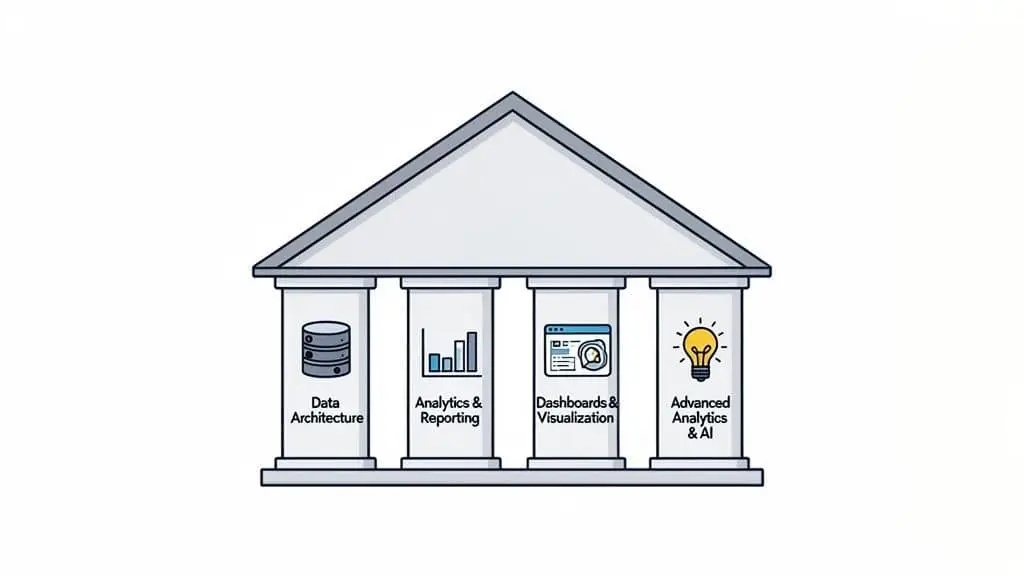
So, what do business intelligence consulting services actually do? It helps to think of it like building a modern, high-tech house. You can't just throw up some walls and call it a day. You need a solid foundation, a sturdy frame, a user-friendly interior, and a smart system to run it all.
Each part supports the others. If one is weak, the whole structure suffers. Let's break down the four essential pillars that come together to create a powerful BI system that genuinely serves your business.
Pillar 1: Data Architecture and Integration
This is the concrete foundation. It's not glamorous, but without it, everything else will eventually crumble. If your data is a mess—inaccurate, inconsistent, and scattered across a dozen different systems—any report or analysis you build on top of it is basically worthless.
This is where a BI consultant first brings order to the chaos. The process involves a few critical steps:
- Data Source Auditing: First, they map out exactly where all your data lives. This means digging into everything from your CRM and ERP to marketing platforms and even those stray operational spreadsheets.
- ETL/ELT Process Design: Next, they build automated data pipelines (Extract, Transform, Load or Extract, Load, Transform). These pipelines pull data from all those sources, then clean, standardize, and format it for analysis.
- Data Warehousing: Finally, all that clean, consolidated data is stored in a central repository, usually a data warehouse. This becomes the single source of truth for the entire company.
When this groundwork is solid, you stop having meetings where teams argue over whose numbers are right. Everyone starts from the same, reliable data.
Pillar 2: Analytics and Reporting
With a solid foundation poured, it's time to erect the framework of the building. This is where your raw data starts to become useful by answering real business questions. Analytics and reporting turn structured data into actionable information.
This is a world away from someone manually pulling numbers into a spreadsheet every week. A consultant automates this work, creating a system that delivers insights directly to the people who need them. A sales manager, for instance, could get a daily performance report automatically, without having to ask a single person to compile it.
This is the stage where data goes from being a passive company asset to an active management tool. We're talking about standardized reports and analytics models that monitor business health, track progress against goals, and automatically flag potential problems before they get out of hand.
Pillar 3: Dashboards and Visualization
Now we get to the interior design—the part that makes the whole structure livable and easy to navigate. A dashboard is an interactive, visual hub that displays your most important Key Performance Indicators (KPIs), often in real time. It’s all about translating complex datasets into charts, graphs, and maps that you can understand in seconds.
A great dashboard does more than just show you numbers; it tells a story. The marketing team can see campaign ROI at a glance. A logistics manager can track shipments moving across a map. The CEO can get a 30,000-foot view of the entire company's health.
Good visualization gives everyone the power to:
- Spot Trends Quickly: Identify patterns and outliers that would be completely invisible in a spreadsheet.
- Drill Down for Details: Click on a high-level metric to explore the underlying data and find the "why" behind the numbers.
- Democratize Data: Make crucial information accessible and understandable to non-technical users across every department.
As you build these dashboards, focusing on the human element is key. For a deeper dive on this, check out our article on generating data-driven customer insights.
Pillar 4: Advanced Analytics and AI
The final pillar is like installing a smart-home system—the intelligence that helps you see into the future and automate smart decisions. Once your business has mastered descriptive analytics (what happened), you can graduate to predictive and prescriptive analytics (what will happen and what you should do about it).
This is where the most forward-thinking business intelligence consulting services deliver truly game-changing results.
This pillar includes things like:
- Predictive Modeling: Using historical data to forecast future outcomes. This could be anything from predicting which customers are about to churn to forecasting demand for a new product.
- AI and Machine Learning: Deploying algorithms that can spot incredibly complex patterns, segment customers with pinpoint accuracy, or even recommend the "next best action" for a sales rep to take.
For example, a retail company could use predictive models to fine-tune its inventory, ensuring popular items are always in stock while avoiding overspending on products that are about to go cold. Together, these four pillars create a complete BI system that shifts your business from reactive firefighting to proactive, data-informed strategy.
How BI Consulting Drives Tangible Business Growth
It’s easy to talk about data architecture and analytics in abstract terms, but what does it all mean for your bottom line? The real magic of business intelligence consulting services is how they turn those technical ideas into measurable, real-world business growth. This is how data stops being an expense and starts being a direct driver of revenue and efficiency.
Think about a marketing team spending thousands on different campaigns. They feel like they're getting results, but they struggle to prove which efforts are actually bringing in high-value customers. BI consulting connects those dots. A consultant can integrate data from your ad platforms, your website analytics, and your CRM to build a single dashboard. Suddenly, you're not just seeing leads; you're seeing the entire customer journey, from the first click to the final sale, revealing exactly which channels bring you your most profitable clients.
It's the same story in sales. A sales manager who relies on gut feelings to forecast revenue is essentially flying blind. A solid BI system can dig into historical sales cycles, average deal sizes, and individual rep performance to build a dynamic, data-backed forecast. This means smarter resource planning and a much clearer picture of the money coming in.
Case Study: Uncovering Hidden Revenue
The impact can be incredibly fast and often surprising. We saw this with a B2B manufacturing client who was struggling with disconnected data. All their sales information lived in a CRM, but their order history and customer financials were siloed in a separate ERP system. They knew they had a good business, but they couldn't put their finger on what truly drove their success.
They brought in BI consultants to merge these two critical data sources. By finally combining sales activity with actual purchase history, they could see a complete, unified customer profile for the first time. This led to a stunning discovery.
The analysis uncovered a small, previously overlooked customer segment that consistently purchased a very specific combination of products. This group had a 3x higher lifetime value than the average customer and was far more likely to place repeat orders.
Armed with this powerful insight, their marketing and sales teams built targeted campaigns aimed squarely at this high-value profile. The result? A 25% surge in qualified leads in just one quarter. It was a perfect example of how a BI project can directly fuel top-line growth.
Investing in Efficiency and Strategic Advantage
This kind of return isn't a fluke. Businesses that embrace BI consulting often report 20-30% improvements in operational efficiency as they move from intuition-based decisions to strategies grounded in solid data. The market is certainly taking notice. Of course, effective business intelligence is built on a strong data foundation; engaging specialized data engineering consulting services can turn that raw data into the actionable insights that fuel this growth.
The global Business Intelligence Consulting Services market is expected to hit roughly $1.15 billion by 2026, growing at a healthy 6.8% CAGR. This growth is all about companies realizing they need to use data for sharper strategic decisions and smoother operations. This is so much more than just another IT project; it’s a core piece of modern business strategy. You can see how this fits into the bigger picture by exploring the benefits of digital transformation.
BI consulting delivers this growth by bringing new clarity to a few key areas:
- Operational Optimization: Finding and fixing bottlenecks in your supply chain, production lines, or internal workflows.
- Customer Insight: Getting a deep, genuine understanding of customer behavior to improve retention and boost lifetime value.
- Revenue Enhancement: Spotting cross-sell and up-sell opportunities that were invisible before.
- Risk Mitigation: Identifying negative trends early, giving you time to act before they become major problems.
At the end of the day, these services give you the tools and the expertise to make smarter, faster, and more profitable decisions in every corner of your organization.
Understanding The BI Consulting Engagement Process
Engaging with a business intelligence consulting services provider isn't like buying a product off the shelf. It’s a collaborative journey, a structured process designed to get you real, predictable results. Think of it less like a transaction and more like commissioning a custom-built car. You wouldn't just throw money at a builder and hope for the best, right?
There's a blueprint phase, a build phase, a series of test drives, and of course, ongoing maintenance. Let's walk through what that looks like.
Phase 1: The Discovery and Audit
Every great partnership starts with listening. The engagement kicks off with a Discovery phase, where the consultants basically become business detectives. Their main job is to get inside your world.
They'll interview your key people—from the C-suite to the front lines—to understand your strategic goals. They need to know what keeps you up at night, where the biggest operational headaches are, and what "winning" actually looks like for your team.
At the same time, they roll up their sleeves for a technical audit of your data. This means mapping out all the places your data lives, checking its quality (is it clean or a mess?), and seeing what tools you’re already using. This deep dive is critical; it prevents a lot of expensive mistakes down the road.
Phase 2: Strategy and Roadmap Development
Once they have a crystal-clear picture of your goals and your data reality, it's time to chart a course. This is where the consultants build a strategic BI roadmap—a detailed plan that lays out the entire project from start to finish.
This isn't a vague document. It's a specific blueprint that usually includes:
- Key Performance Indicators (KPIs): Defining the exact metrics we'll use to track progress and measure success. No more guessing if it's working.
- Technology Recommendations: Suggesting the right tools, whether it's Power BI or Tableau, based on your budget, existing systems, and specific needs.
- Project Milestones: Breaking the project into small, manageable chunks with clear deadlines and deliverables.
This roadmap ensures everyone is on the same page, looking at the same map, and heading toward the same destination.
Phase 3: Solution Design and Implementation
Now we build. With the roadmap as our guide, the consulting team starts architecting and constructing your BI solution. This is the heavy lifting. They build the data pipelines to pull information from all your different systems, like CRM, ERP, and marketing platforms.
Then, they clean, transform, and load that data into a central data warehouse. From there, they design the interactive dashboards and reports that turn raw numbers into clear insights.
This stage is where a BI consultant's technical skill really comes into play. They aren’t just making pretty charts. They're building a scalable, reliable data engine that's designed to perform for the long haul.
The process is highly collaborative. Your team's feedback is gathered at every step to make sure the final product is not only powerful but also intuitive and easy for your people to use.
This visualization shows how a well-structured BI process can connect raw data directly to business growth.
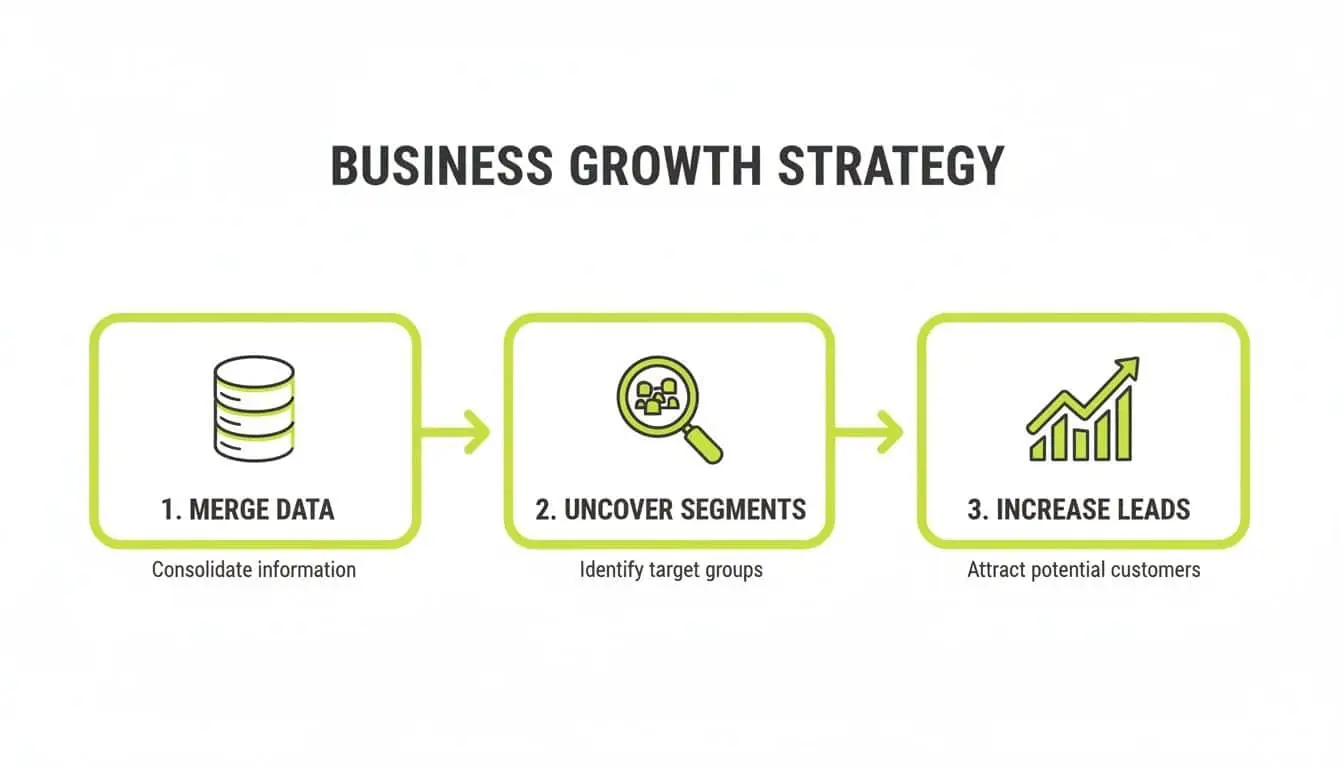
As you can see, the flow is simple but powerful: merge scattered data to find valuable customer segments, which then opens up clear opportunities to increase leads and drive revenue.
Phase 4: Team Enablement and Training
Here’s a hard truth: the most advanced BI system in the world is completely useless if no one on your team knows how to use it. This phase is all about user adoption.
The consultants will lead hands-on training sessions customized for different groups. Executives get training on how to use high-level dashboards for strategic oversight. Analysts learn how to dive deep into the data to uncover new trends.
This is more than just showing people which buttons to press. The real goal is to build data literacy across your organization and foster a culture where making decisions with data becomes second nature. And when it comes to sharing these new insights, looking at a quarterly business review template can provide a great framework.
Phase 5: Ongoing Optimization and Support
Your business doesn’t stand still, and neither should your BI solution. The final phase is all about continuous improvement.
The work isn't "done" at launch. The consulting team stays involved to monitor the system's performance, fix any bugs that pop up, and make tweaks based on user feedback and your company's shifting priorities.
This ongoing cycle of optimization ensures your investment keeps paying dividends long after the initial project wraps up. Your BI system will adapt to new data sources, new business goals, and new opportunities as your company continues to grow.
How to Select the Right BI Consulting Partner
Picking a partner for your business intelligence consulting services is a make-or-break moment for your data strategy. Get it right, and you’ve found a strategic ally who can turn your business ambitions into a technical reality. Get it wrong, and you’re looking at a stalled project, a drained budget, and a fancy dashboard that just gathers digital dust.
The selection process has to be more than a simple technical checklist. You're not just hiring someone who knows a tool; you're bringing on a guide for a very important journey. To find the right fit, you need to look past the sales pitch and dig into what really makes a BI consulting partnership work.
Assess Their Technical Expertise and Practical Skills
Every consultant out there will claim they are experts in tools like Power BI or Tableau. But the real question isn’t whether they know the tool, it's whether they can make that tool solve your unique problems. Generic certifications just don't cut it.
Instead of asking, "Do you know Power BI?", you need to get more specific and focus on results.
- Go Beyond Certifications: Ask them to show you a dashboard they built for a company that had data challenges like yours. Have them walk you through it.
- Probe on Data Architecture: Ask how they approach messy, disconnected data from a dozen different places. A good consultant won't just talk about pretty charts; they'll get into data modeling and ETL processes.
- Test Their Problem-Solving: Give them a real-world scenario. "Our customer churn shot up by 15% last quarter. How would you use data to figure out why?"
This approach quickly separates the theorists from the practitioners—the people who have actually been in the trenches and delivered real results.
Evaluate Their Industry Acumen and Business Understanding
A consultant who already knows the ins and outs of your industry is an incredible asset. They speak your language, they know your critical metrics, and they get the competitive pressures you’re under. This "industry acumen" is a massive shortcut to success.
Without it, you'll burn the first few weeks of the project just teaching them the basics of your business. With it, they can hit the ground running and start asking the right, insightful questions from day one.
Look for a partner who can connect every technical decision back to a core business objective. They should be just as comfortable talking about your sales pipeline or supply chain efficiency as they are about SQL queries.
When you're vetting potential firms, ask them about specific projects they've handled for other companies in your field. If they can't point to any relevant experience, they’re probably not the right choice for your specific needs.
Gauge Their Strategic Alignment and Focus on Adoption
Here’s a hard truth: the biggest reason BI projects fail isn't technical—it's human. A beautiful, powerful dashboard is completely worthless if your team never uses it. The best business intelligence consulting services are absolutely obsessed with user adoption.
You need to ask some pointed questions about how they handle change management:
- "How do you make sure our team will actually use these new tools?"
- "What does your training and onboarding process look like?"
- "How do you track user engagement after the system goes live?"
This focus on people is more important than ever. A recent report highlighted that 56% of organizations name improved decision-making as their top analytics goal. That’s why the global BI market is expected to rocket from $42.26 billion in 2026 to over $116 billion by 2033—companies are scrambling to close that analytics gap. You can find more on these trends in the full BI and analytics report.
Ultimately, you’re looking for a partner whose main goal is to make your team self-sufficient and data-literate. Their job is to build a solution so effective and intuitive that your employees will eventually wonder how they ever managed to work without it.
Frequently Asked Questions About BI Consulting
Jumping into a business intelligence project naturally brings up some big questions. You're thinking about the budget, the timeline, and what you'll actually get for your investment. It’s smart to ask.
Here, we'll tackle the most common questions we hear, giving you straight answers to help you understand what working with a BI partner really looks like.
What Does BI Consulting Typically Cost?
This is usually the first question on everyone's mind, and the honest answer is: it depends. Think of it like a home renovation. A quick kitchen backsplash update is a world away from a full architectural rebuild that involves moving walls and plumbing. BI projects work the same way.
The final price tag comes down to a few key things:
- Project Scope: Are we building a single, focused dashboard for your sales team, or are we designing a data warehouse from the ground up for the entire company?
- Data Complexity: Are we working with two clean, organized spreadsheets or trying to wrangle twenty different, messy systems that don’t talk to each other?
- Team Size: How many experts do we need on deck to hit your deadlines without cutting corners?
- Engagement Model: Are you looking for a one-time project with a fixed fee, ongoing help at an hourly rate, or a monthly retainer for continuous support?
A simple dashboard project might run a few thousand dollars. A complete, enterprise-wide BI transformation could easily be a six-figure investment. A good partner will always give you a detailed quote that breaks down every cost, so you know exactly where your money is going.
How Long Does a Standard BI Project Take?
Just like cost, the timeline is all about the scope. Trying to rush a BI implementation is a recipe for disaster—it often leads to a tool nobody uses because it wasn’t built right in the first place. A phased, deliberate approach is always better.
Here’s a general idea of what to expect:
- Quick Wins (2-4 Weeks): This is for a very specific goal, like building a marketing dashboard using data that's already in good shape.
- Mid-Sized Projects (1-3 Months): This usually involves pulling together several important data sources, creating a set of connected dashboards, and getting your team trained up.
- Full BI Implementations (4-9+ Months): We’re talking about a complete overhaul. This means building a new data warehouse, moving off old systems, and rolling out a new BI platform across the whole organization.
The biggest factor influencing your timeline? The state of your current data and how available your own team members are to give feedback and direction along the way.
What Is the Expected ROI and How Is It Measured?
The return you get from a BI project is almost always significant, and you can measure it with real numbers, not just a "feeling" of being more data-driven.
A BI project isn't an expense; it's an investment in operational excellence and strategic clarity. The goal is to generate returns that far outweigh the initial cost by making your entire organization smarter and more efficient.
We track the ROI with a few key KPIs:
- Improved Efficiency: How many hours are your people no longer spending on mind-numbing manual reports? Automating that work can free up hundreds of hours a month.
- Increased Revenue: Can we measure a lift in sales or customer lifetime value? For example, by using data to find and target your most profitable customer segment.
- Cost Reduction: Where are the savings? We can find them by optimizing inventory, cutting operational waste, or identifying the root causes of customer churn.
- Faster Decision-Making: This one is a little harder to put a dollar amount on, but it’s huge. The ability to get answers in minutes instead of days lets you jump on opportunities and dodge risks before they become major problems.
There's a reason the business consulting field is booming—it delivers tangible results. The market hit $208.8 billion in 2026 and is on track for $273.64 billion by 2031 because companies are hungry for these advantages. Optimizing performance through BI typically leads to 15-25% better strategic outcomes, helping businesses slash costs and gain a serious competitive edge. You can dig into these market trends by reading the full report on business consulting growth.
Do We Need Our Own Data Team to Hire a BI Consultant?
No, not at all. In fact, many companies bring in a consultant precisely because they don't have that expertise in-house. That’s a huge part of what we’re here for.
A consultant can operate in a couple of different ways. We can act as a fully managed service—your outsourced data team—handling everything from strategy to maintenance. Or, we can work alongside your existing IT or business teams, bringing specialized skills for a specific project and training your people along the way.
Ultimately, a good consultant’s goal is to empower your team and make you more self-sufficient over time, not create a permanent dependency.
Ready to stop guessing and start knowing? The experts at Magic Logix build powerful BI solutions that drive real growth and give you the clarity you need. Schedule a consultation today and let's talk about how we can help you make smarter, faster decisions.