
When you're digging into your marketing analytics, you'll constantly run into two terms: views and impressions. They sound similar, but they tell you completely different things about your content's performance. Think of it this way: Impressions are about potential, while views are about action.
Understanding Views Versus Impressions
So, what’s the real story behind these two metrics? An impression is simply a measure of how many times your content—be it a video, a graphic, or a post—was displayed on someone's screen. It could have been scrolled past in a microsecond, but if it loaded, it counts. A view, on the other hand, signals that someone actually paid attention. They made a choice to interact, whether by clicking play or watching for a specific amount of time.
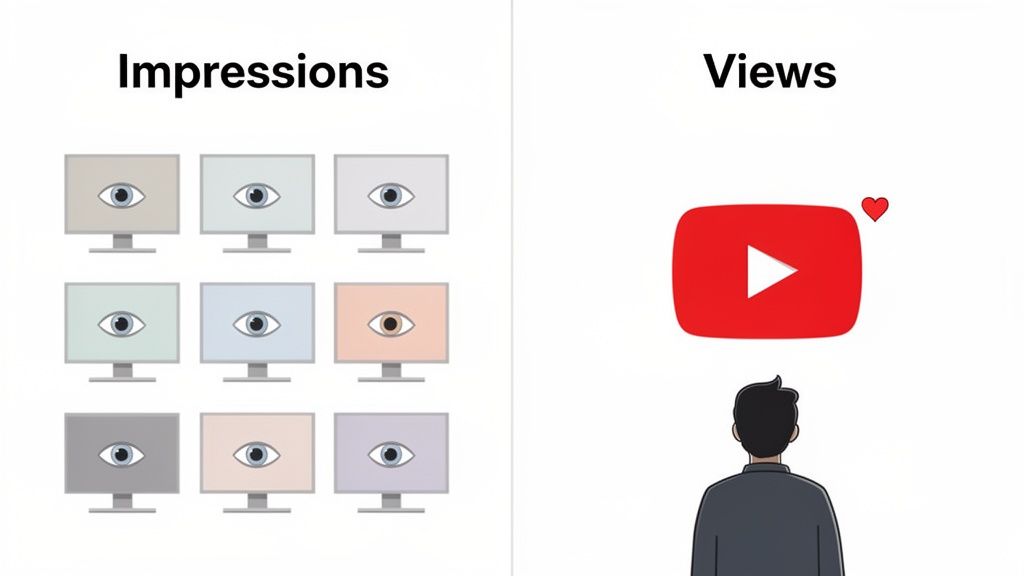
Here are the key differences boiled down:
- View: Requires a deliberate user action, like hitting the play button or watching a video for a minimum length of time.
- Impression: Gets counted the moment your content is rendered on a user’s device, even if they never really see it.
- Engagement Insight: Views give you a peek into genuine user interest, while impressions just tell you about your potential reach.
A high impression count with low views is a classic red flag. It often means your creative isn't grabbing attention or your targeting is off the mark.
Imagine your latest ad generates 10,000 impressions across your target audience. That sounds great on paper, but if it only results in 2,000 views, it means 80% of the people it was served to didn't actually engage. This is where the story gets interesting. High exposure with low engagement is a clear signal that something needs to change, whether it's your messaging, visuals, or audience selection.
Why This Difference Matters
Relying on impressions alone can paint a dangerously misleading picture of your campaign's health. It’s easy to feel good about a huge impression number, but if no one is actually watching, you're just throwing your budget into the void.
When you shift your focus to optimizing for views, you ensure your money is spent on content that genuinely connects with people. This simple change in perspective almost always leads to a better ROI and cuts down on wasted ad spend.
| Metric | What It Measures | User Action Required |
|---|---|---|
| Impressions | Number of times content is displayed on a screen | None |
| Views | Number of times content gets active engagement | Click, play, or minimum watch time |
Platform-Specific Rules Complicate Things
Just to make things more complicated, every platform has its own definition of what counts as a "view." This makes it tricky to compare performance apples-to-apples across channels.
- YouTube: Counts a view only after 30 seconds of watch time (or the full video if it's shorter).
- Facebook & Instagram: Register a view much faster, at around 3 seconds, even on autoplay.
- LinkedIn: Requires at least 2 seconds of watch time while 50% of the video player is visible.
- X (formerly Twitter): Also requires 2 seconds with at least 50% visibility.
Because of these differences, your view-to-impression ratio becomes a critical health check for your creative. We generally aim for a 15% view rate as a baseline, but this can vary. If you're falling short, it's time to start testing.
- Experiment with strong visual hooks in the first 3 seconds.
- Refine your audience targeting based on who is actually engaging.
- Test different calls to action, video pacing, and captions.
By tracking both metrics together, you can pinpoint exactly when your visibility isn't turning into attention. This allows you to make smarter, real-time adjustments to your campaigns.
How To Use These Metrics Strategically
Ultimately, how you prioritize these metrics depends on your campaign goals.
- Building Awareness: If you're launching in a new market or trying to build brand recognition, prioritizing impressions makes sense. You want to maximize reach.
- Driving Conversions: For campaigns focused on getting leads or sales, you need to shift your budget toward ads that drive views and deeper engagement.
- Performance Monitoring: Keep a constant eye on your view-to-impression ratio. It's one of the best early indicators of creative performance or ad fatigue.
For more in-depth strategies on leveraging these insights, check out our guide to Magic Logix social media marketing.
Defining What Actually Counts as a View or Impression
To really get to the bottom of the views vs. impressions debate, we have to go deeper than textbook definitions. What matters is understanding the specific technical rules each platform uses, because those nuances are what shape your campaign data and, ultimately, your strategy.
Of the two, an impression is the more straightforward metric, but it still has its layers.
At its most basic, an impression gets logged the second your content is served to a user's device. This just means your ad or post was delivered and loaded onto their screen. The catch? This happens whether the person actually saw it or not, which brings us to a critical distinction.
Served vs. Viewable Impressions
This is where things get interesting for marketers who care about true visibility. You have to separate your impressions into two camps.
- Served Impressions: This is the raw count. It confirms the ad server did its job and delivered the content to the app or webpage. That's it.
- Viewable Impressions: This metric is far more valuable. The Media Rating Council (MRC) sets the standard here: a display ad impression is only "viewable" if at least 50% of its pixels are on screen for one continuous second. For video, that requirement jumps to two continuous seconds.
Today, most savvy advertisers treat viewable impressions as the real baseline. It’s the only way to filter out all those times your content loaded below the fold or was scrolled past in a flash, never actually entering a user's line of sight.
Key Takeaway: Think of it this way: an impression is the opportunity for your content to be seen. A viewable impression confirms it was physically on-screen. A view confirms someone actually interacted with it.
What Constitutes a View
Unlike an impression, a view always requires a specific user action or a minimum watch time, giving you a signal that at least some attention was paid. This is where the definitions really start to splinter across platforms, making cross-channel reporting a headache for even the most experienced marketers.
A "view," for instance, means wildly different things in different places. YouTube famously has a high bar, requiring someone to watch for a full 30 seconds (or the entire video if it's shorter) to count it as a view. This is designed to measure genuine interest and weed out accidental clicks.
Meanwhile, platforms built for quick scrolling have a much lower threshold.
- Meta (Facebook & Instagram): A video view is triggered after just 3 seconds of watch time, and yes, that includes autoplay.
- LinkedIn & X (formerly Twitter): Both platforms register a view after 2 seconds, as long as 50% of the video player is visible.
These differences are precisely why you can't treat a view on one platform as equal to a view on another. The quick-trigger views on social feeds are great for measuring initial thumb-stopping power, whereas YouTube’s longer requirement signals dedicated engagement. Getting these rules straight is fundamental to knowing what you're actually measuring.
And while sorting out views and impressions is your first step, it’s just as important to learn how to measure reach to understand your unique audience exposure. This gives you the full picture of your content’s visibility and true impact.
How Major Platforms Measure Views and Impressions
If you want to understand the real difference between views and impressions, you have to get granular. A "view" on YouTube means something entirely different than a "view" on Instagram, and the value of an impression shifts dramatically in the professional context of LinkedIn. This is where a lot of marketers get tripped up—each platform plays by its own rules, so you can't compare performance apples-to-apples without knowing the definitions.
This is why it's so critical to break down how each platform counts these metrics. First, let's visualize the basic journey from a delivered ad to one that's actually seen.
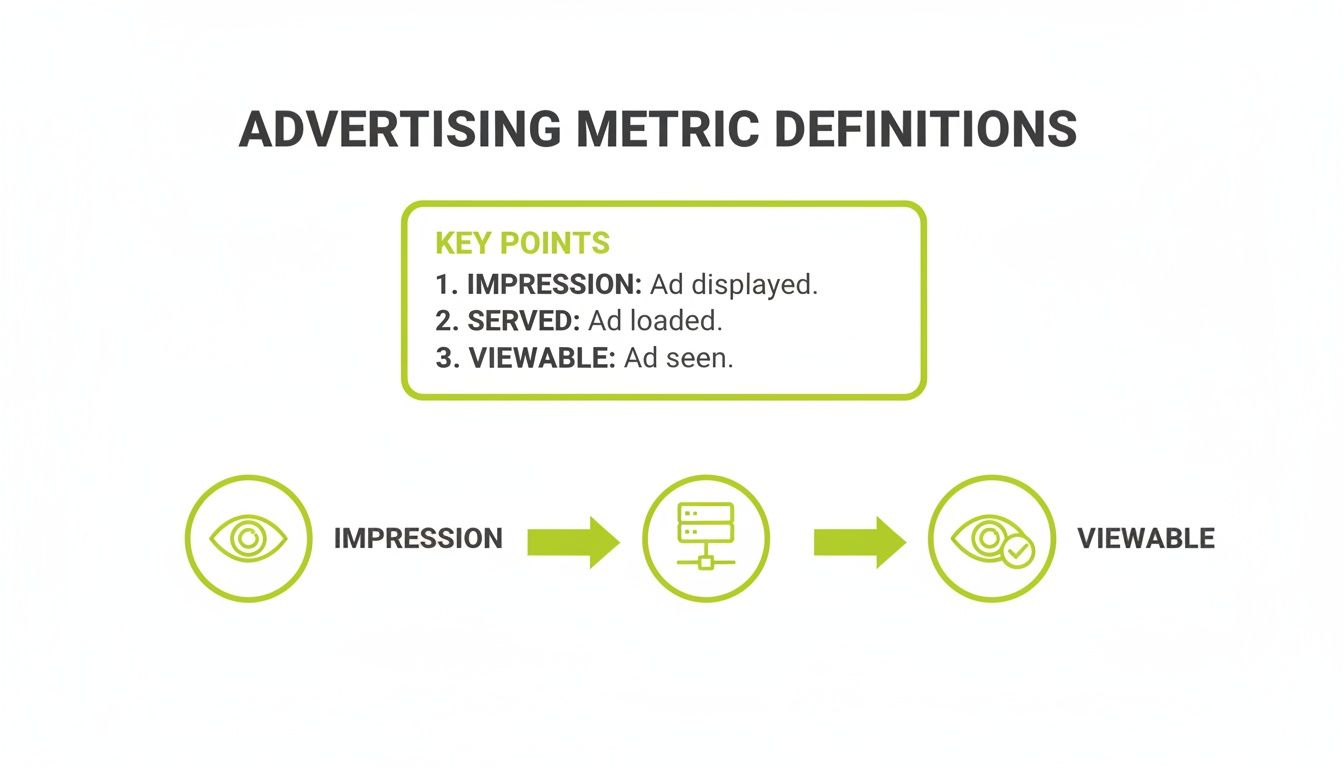
As you can see, just because your content was served doesn't mean it was ever viewable, let alone actively watched. This is why we have to dig deeper than surface-level delivery metrics to measure what truly matters.
YouTube: The Gold Standard for Engagement
When it comes to measuring genuine interest, YouTube sets the highest bar in the industry. Its definition of a "view" is specifically designed to weed out accidental clicks and passive glances, making it a reliable signal of true audience engagement.
- Impression: An impression is counted any time a user is shown a video thumbnail. That could be on their homepage, in search results, or in the "Up Next" sidebar. It’s an opportunity for a click, nothing more.
- View: Here’s the key difference. A view is only recorded after someone watches for at least 30 seconds (or the entire video, if it's shorter than that).
This tough standard makes YouTube views an incredibly valuable metric for anyone focused on education, detailed product demos, or deep storytelling. If you want sustained attention, this is the metric to watch. Understanding how this ties into monetization is also useful; learning the CPM meaning YouTube gives you insight into how the platform values these high-quality impressions.
Meta (Facebook and Instagram): The Scroll-Stopping Challenge
On Facebook and Instagram, the game is all about speed. In these fast-paced, scroll-heavy feeds, the definition of a view is built for rapid-fire content consumption. Meta's approach is designed to measure initial interest in an incredibly crowded space.
- Impression: An impression is logged every single time a post—whether it's a photo, video, or carousel—appears on a user's screen.
- View: A video view is counted after just 3 seconds of watch time. This includes silent, auto-playing videos in the feed. For static images, Instagram now often reports "views" as a primary metric, which basically acts like an impression.
Because the 3-second threshold is so low, a "view" on a Meta platform is more of a signal of thumb-stopping creative than deep engagement. It proves your content was compelling enough to make someone pause their scroll, even for a moment.
If you're running campaigns on Instagram, it's worth taking a closer look at what are impressions on Instagram and how to properly leverage them.
X (Formerly Twitter): A Hybrid Approach
X operates in real-time, and its metrics reflect that by offering a balanced look at both broad visibility and initial engagement. This gives marketers a more rounded perspective on their content's performance.
- Impression: An impression is counted every time a post is displayed, whether on a user's timeline or in search results. Just like on other platforms, this can include multiple views from the same person.
- View: For videos, a view is registered when someone watches for at least 2 seconds while at least 50% of the video player is visible on their screen.
This dual-metric system is great for tracking the overall reach of your message through impressions while also measuring how many people started to engage with your video content.
LinkedIn: Professional Context and Intent
On LinkedIn, users are in a professional mindset, so the metrics are defined to reflect deliberate action rather than mindless scrolling.
- Impression: An impression is counted when your content appears in a member's feed. Because of the platform's professional focus, even a brief exposure here can help build brand credibility and stay top-of-mind with a relevant audience.
- View: LinkedIn follows a similar standard to X. A video view is counted after a user watches for at least 2 seconds with at least 50% of the player in view.
This standard ensures that a "view" represents a conscious decision to consume content, which is a powerful signal for B2B marketers trying to educate and influence industry decision-makers.
Platform Metric Definitions at a Glance
To make it easier to see how these platforms stack up, here’s a quick summary of the key differences.
| Platform | What Counts as an Impression | What Counts as a Video View | Key Strategic Consideration |
|---|---|---|---|
| YouTube | Thumbnail is displayed on screen | 30 seconds of watch time (or full length if shorter) | Best for measuring deep engagement and educational value. |
| Meta | Content is displayed in a user's feed | 3 seconds of watch time (including autoplay) | Ideal for gauging initial, thumb-stopping appeal. |
| X | Post is displayed on a user's timeline | 2 seconds with 50% of the player visible | Balances broad reach measurement with initial video interest. |
| Content is displayed in a user's feed | 2 seconds with 50% of the player visible | Strong indicator of professional interest and B2B engagement. |
Understanding these nuances is the first step toward building a smarter, more effective cross-channel strategy. You can't optimize what you don't measure correctly.
Choosing the Right KPI for Your Campaign Goals
Once you get past the definitions, the real strategy begins. The choice between prioritizing views or impressions isn't about which metric is "better"—it's about matching your key performance indicator (KPI) to what you actually want your campaign to accomplish. Failing to make this connection is one of the fastest ways to waste a marketing budget.
The guiding principle is simple: match the metric to the customer's stage in their journey. Are you trying to get in front of a cold audience for the first time, or are you hoping to nudge a warm lead toward the next step? Your answer points directly to your primary KPI.
When to Prioritize Impressions for Maximum Reach
Impressions are the currency of awareness. If your main goal is simply to get your brand, product, or message seen by the largest possible audience, then maximizing impressions is the right play. This strategy is all about reach and frequency, not deep engagement.
Think about these common scenarios where impressions should be your North Star:
- New Product Launches: When you're launching something new, your first task is to saturate the market. You need your name and product visuals in front of as many relevant eyeballs as you can, as often as you can. The immediate goal is recognition, not action.
- Brand Awareness Campaigns: For a brand-new company or a business stepping into a new market, building brand recall is everything. A high volume of impressions helps you stay top-of-mind, making your brand feel familiar before a customer even knows they need you.
- Major Announcements: Are you announcing a huge company milestone, a rebrand, or a big-name partnership? Impressions get the news out far and wide, generating buzz and signaling that you're a major player.
In these situations, a low cost per thousand impressions (CPM) becomes a crucial measure of efficiency. You're buying visibility, and the more efficiently you can purchase it, the further your budget will go.
An impression-focused campaign is like putting up billboards all over town. You're not tracking how many people stopped to read every word; you're betting on the power of repeated exposure to build familiarity and recall over time.
This approach accepts that most people won't engage on their first, second, or even third contact. By optimizing for impressions, you're playing the long game—building mental real estate in your audience's mind. For a deeper dive into measuring marketing success, check out our guide on key digital marketing performance metrics.
When Views Are the Key to Measuring Intent
Impressions build awareness, but views measure attention and intent. Once your goal shifts from broad visibility to active engagement, education, or conversion, views become a much more powerful KPI. A view means someone consciously gave a moment of their time to your content.
Here are the times when prioritizing views is the right move:
- Educational Content and Demos: If you're a B2B company showing off a complex software demo or an e-commerce brand explaining a product's unique features, you need to know people are actually watching. A view confirms your message was consumed, not just served.
- Lead Generation: Campaigns built to drive sign-ups, downloads, or webinar registrations depend on an engaged audience. Someone who watches a good chunk of your video is a far warmer and more qualified lead than someone who just scrolled past it.
- Building Community and Trust: For thought leadership content or behind-the-scenes videos, views act as a measure of connection. They show that your content is interesting enough to hold someone's attention, which is the bedrock of a loyal community.
Focusing on views is especially critical for video marketing, which has become the go-to format for driving action. In fact, video marketing statistics reveal that views are the number one KPI for 67% of video marketers. With short-form video now delivering the highest ROI at 41% and 49% of consumers making monthly purchases based on influencer content, the line between views and purchase intent is clearer than ever. You can explore more of these powerful video marketing statistics on HubSpot.
Ultimately, aligning your KPI with your campaign objective is non-negotiable. Choosing impressions for an awareness play or views for a conversion-focused campaign ensures you're measuring what matters, spending your budget wisely, and getting results that truly move the needle.
Moving Beyond Impressions with Audience-Centric Measurement
For years, the digital marketing playbook had a simple, singular goal: maximize impressions. The thinking was straightforward—more eyeballs meant more opportunities. But this volume-first approach is quickly becoming a relic, making way for a smarter, more efficient strategy that prizes audience quality over sheer quantity.
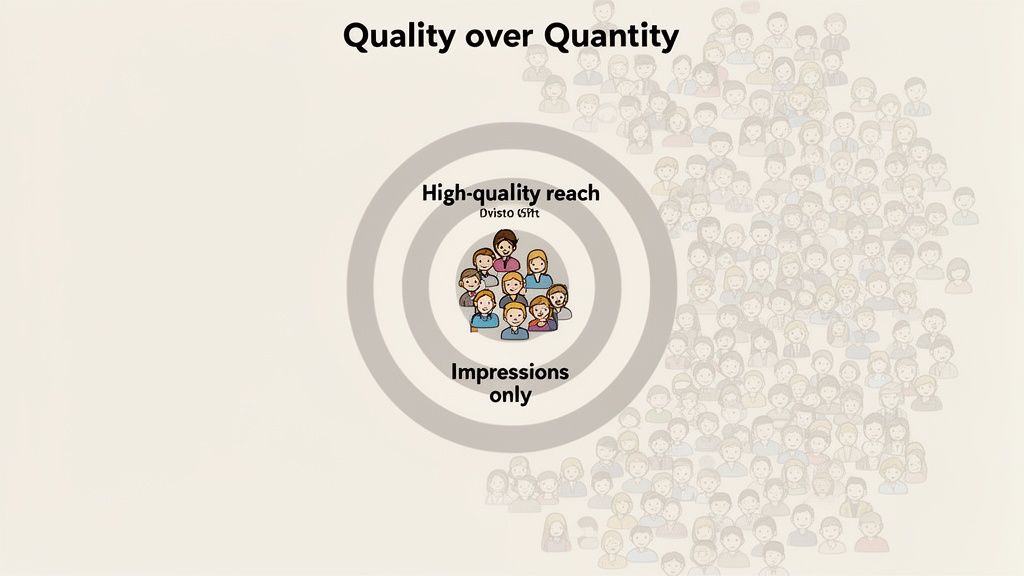
Today, the goal isn’t just to be seen, but to be seen by the right people. This is the heart of audience-centric measurement, a strategy that makes every impression count by ensuring it reaches someone genuinely interested in your message. It’s a fundamental shift from shouting into a crowd to having a meaningful conversation with a select few.
This evolution is driven by advanced analytics and AI that allow for incredibly precise audience modeling. Instead of casting a wide net and hoping for the best, marketers can now pinpoint and target high-intent individuals with surgical accuracy.
The Financial Impact of Quality Over Quantity
The difference between a well-targeted impression and a generic one is staggering, and it shows up right on the bottom line. Consistently reaching a smaller, more relevant audience delivers better conversion rates and dramatically lower acquisition costs. A blind focus on maximizing impressions isn't just inefficient; it's a major drain on your marketing budget.
The most expensive impression is the one that reaches the wrong person. Audience-centric measurement ensures that your ad spend is directed toward individuals who have a genuine potential to become customers, eliminating waste and maximizing ROI.
This data-driven approach transforms impressions from a vanity metric into a powerful tool for growth. It validates the idea that a campaign reaching 10,000 highly qualified users is infinitely more valuable than one reaching 100,000 indifferent ones.
AI-Powered Audience Modeling in Action
Modern advertising platforms are leaning heavily into AI to make this shift possible. These systems analyze countless data points—from browsing behavior to past engagement—to predict which users are most likely to convert. The results speak for themselves.
For example, AI-powered audience modeling has been a massive driver behind Meta's advertising revenue, which recently surged to $164.5 billion. Campaigns using old-school models saw only 35% of impressions hitting their ideal audiences. In contrast, AI-driven models boosted this to 65%.
This efficiency has a ripple effect. Companies have reported a 73% decrease in cost per lead (CPL) and an 80% drop in cost per acquisition (CPA). Numbers like these prove that the quality of an impression is far more important than the raw number.
This level of targeting ensures that when you're analyzing views vs impressions, the impressions you're generating are already pre-qualified for higher engagement.
Practical Steps Toward Audience-Centric Measurement
Making this strategic shift requires a more deliberate approach to setting up and analyzing your campaigns. It means moving beyond surface-level demographics and embracing more sophisticated targeting methods.
Here are a few ways to start implementing an audience-centric strategy:
- Build Custom and Lookalike Audiences: Use data from your existing customers, website visitors, or email lists to create custom audiences. Then, let the platform algorithms build lookalike audiences to find new users with similar characteristics.
- Utilize Advanced Behavioral Targeting: Go beyond simple interests. Target users based on their recent purchase intent, online behaviors, and life events. This ensures your message is not only relevant but also timely.
- Continuously Refine and Test: Audience quality isn't a "set it and forget it" task. Continuously A/B test different audience segments to see which groups deliver the highest engagement and conversion rates, then reallocate your budget accordingly.
By combining these tactics with precise tracking, you can make sure your measurement strategy is aligned with modern best practices. To properly attribute conversions from these targeted campaigns, it's essential to understand how to use UTM parameters to track user journeys accurately. This lets you connect specific audience segments to tangible business results, closing the loop on your audience-centric approach.
Got Questions? We’ve Got Answers.
As you get deeper into the weeds of views vs. impressions, a few common questions always seem to pop up. Let's tackle them head-on so you can apply these concepts with total confidence.
Can One User Generate Multiple Impressions but Only One View?
Yes, this happens all the time. In fact, it perfectly illustrates the fundamental difference between these two metrics.
Think about your own social media feed. You might scroll past the same video ad several times in one day. Each time it renders on your screen, it counts as an impression. But if you only stop to actually watch it long enough to meet the platform's threshold once, that’s just a single view. This is exactly why your impression numbers will almost always dwarf your view counts.
Which Metric Is Better for Measuring ROI?
This is a trick question. Neither one is inherently "better" for measuring return on investment—it all comes down to what you’re trying to accomplish with your campaign. The right KPI is the one that aligns with your specific goal.
Key Takeaway: If your goal is broad brand awareness, getting your name out there to as many eyeballs as possible, then impressions are a crucial indicator of your reach. But if your objectives are tied to engagement, education, or conversion, views are a much stronger signal of performance and have a more direct line to a positive ROI.
How Can I Improve My View-to-Impression Ratio?
A better view-to-impression ratio means you're successfully turning passive scrolling into active attention. Getting this number up really boils down to two things: your creative and your targeting.
- Make Thumb-Stopping Creative: Your ad needs to be strong enough to halt someone mid-scroll. Grab them with a powerful visual hook in the first three seconds, deliver a clear message, and don't skimp on quality.
- Sharpen Your Targeting: At the same time, you need to be sure you're reaching people who are actually likely to care about what you're showing them. A perfectly targeted ad served to the right person has a much higher chance of earning that coveted view.
The best way to figure out what works is to constantly A/B test different ad creatives and audience segments. Over time, you'll systematically improve this ratio.
Do All Platforms Treat These Metrics the Same?
Absolutely not, and this is probably the most critical thing to remember when you're looking at performance across different channels. A "view" means very different things depending on where you are. YouTube has a tough 30-second requirement, while a platform like Facebook sets the bar much lower at just 3 seconds.
It’s vital to know the specific definitions for every platform you advertise on. This is the only way you can accurately compare performance, set realistic benchmarks, and make smart strategic decisions based on data you can actually trust.
At Magic Logix, we help businesses look past surface-level metrics to find the deep, actionable insights that truly drive growth. Our experts can help you fine-tune your campaigns by focusing on the KPIs that make a real difference to your bottom line. Find out how we can transform your digital strategy at https://www.magiclogix.com.