
Trying to write a marketing plan from scratch can feel like staring at a blank page. What comes first? How do you connect big ideas to actual, real-world tasks? The key is to follow a structured process: conduct a situation analysis, define your target audience and SMART goals, outline your strategy and tactics, set a budget, and establish metrics to measure success.
This isn't just about filling out a template; it’s about creating a living document that turns your business objectives into a practical roadmap for growth.
Building Your Foundation for a Winning Marketing Plan
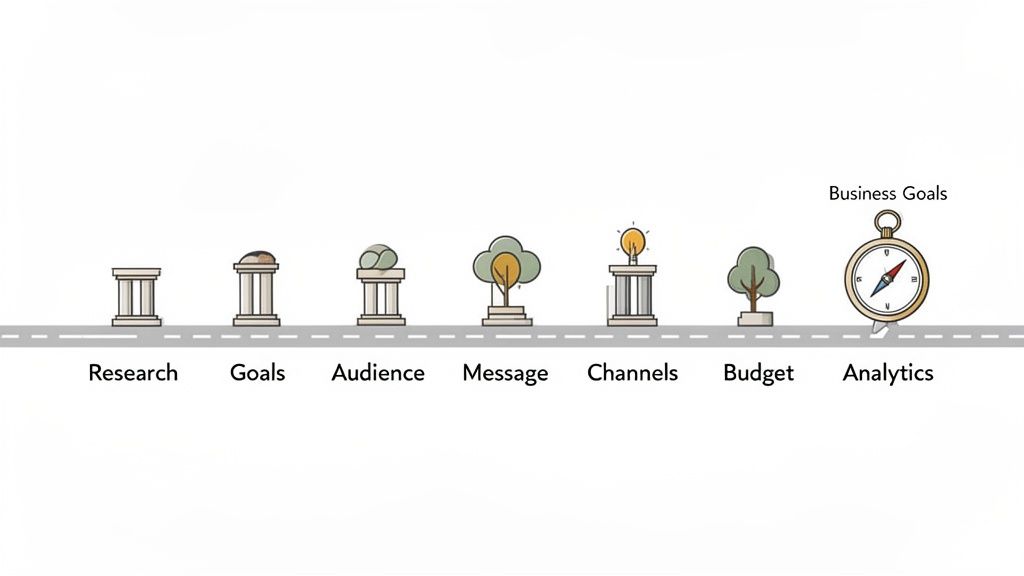
Let’s be honest: those hundred-page marketing binders of the past are dead. They were written, filed away, and never looked at again. A modern marketing plan is different. It’s a dynamic, agile guide—a strategic compass that directs every campaign, content piece, and dollar you spend.
Think of it as the critical link between your company's high-level ambitions and the daily activities that actually produce results. Without a plan, marketing efforts often devolve into a series of disconnected tactics, burning through budgets on activities that don't really move the needle. This guide is here to get you beyond generic templates and into real strategic thinking.
What an Effective Marketing Plan Looks Like Today
A truly effective plan is built on data, not assumptions. It forces you to ask tough questions and make deliberate choices instead of just chasing the latest trend. The whole point is to create a tool that not only directs your team but also justifies your budget and demonstrates a clear return on investment to the people upstairs.
So, what are the pillars of a plan that works?
- Honest Research: It all starts with a clear-eyed look at your market, your competitors, and—just as important—your own internal capabilities. No rose-colored glasses allowed.
- Sharp Goals: This is where you translate vague business aims like "grow the company" into specific, measurable marketing objectives.
- Deep Audience Insight: Forget basic demographics. You need to dig into the true motivations, pain points, and behaviors of your best customers.
- Intelligent Budgeting: Your money should go where it will have the biggest impact, not just where it was spent last year out of habit.
- Continuous Measurement: The plan needs a built-in feedback loop for tracking performance and optimizing your strategy as you go.
A great plan does more than just provide direction; it provides clarity. It ensures everyone—from the C-suite to the newest marketing hire—understands the 'why' behind the 'what,' fostering alignment and accountability across the organization.
The entire process is held together by a solid understanding of marketing operations, which is the engine that ensures your strategic vision can actually be executed efficiently. We'll walk through each of these components, giving you the actionable steps to build a plan that steers your company toward measurable, sustainable growth.
Conducting Research and Setting Clear Objectives
Before you can chart a course for where you’re headed, you need a brutally honest assessment of where you are right now. This is the foundation of any solid marketing plan, separating strategic action from simple wishful thinking. It all starts with a clear-eyed look at your situation, moving past assumptions to build your strategy on a bedrock of facts.
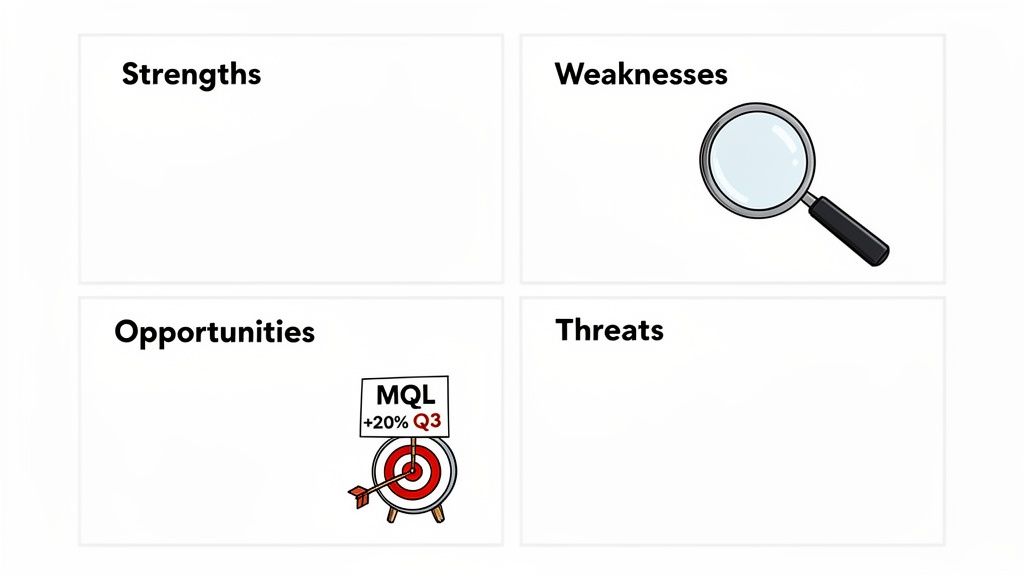
The classic tool for this is the SWOT analysis. It's a straightforward framework that helps organize your thoughts around four critical areas, forcing you to look both inward at your own business and outward at the market you operate in.
Performing an Honest SWOT Analysis
Think of this as an internal audit meets an external market scan. Being completely honest here is critical; glossing over weaknesses or puffing up your strengths will only set your plan up for failure down the road.
- Strengths (Internal): What do you do better than anyone else? This might be proprietary tech, a killer team, a brand that people love and trust, or a fiercely loyal customer base.
- Weaknesses (Internal): Where are the cracks? Get real about your limitations, whether it's a shoestring marketing budget, zero brand recognition in a new market, or a product that’s missing a key feature your rivals have.
- Opportunities (External): What trends can you jump on? Maybe there’s a growing demand for sustainable products, a competitor just had a major PR fumble, or a new social platform is blowing up with your exact audience.
- Threats (External): What’s lurking around the corner that could hurt you? This could be new players entering your space, a major shift in consumer habits, or a looming economic downturn.
This isn't just busy work. For example, a B2B software company might list its superior customer support as a strength but its clunky, outdated UI as a weakness. An opportunity could be new industry regulations that its software helps solve, while a threat is a venture-backed startup swooping in with a similar product at a cut-rate price.
Uncovering Gaps with Competitor Analysis
Once you have a handle on your own position, it’s time to size up the competition. The goal here isn't to just copy what everyone else is doing. It's to find the gaps—the weaknesses you can exploit and the opportunities to make your brand stand out.
A smart first step is to really dig into your top 3-5 competitors. Look at their messaging, their pricing, and the channels they're using to reach customers. Are they all in a race to the bottom on price? Great. That might be your opening to position your brand on premium quality and white-glove service. To get a leg up, it’s crucial to understand how to conduct market analysis effectively.
Don't just look at what your competitors are doing. Dig deeper to understand why they are doing it and, more importantly, what they aren't doing. The most valuable insights often lie in the spaces they've ignored.
If every competitor in your e-commerce niche is dumping their budget into Instagram, you might find a less crowded—and more engaged—audience on Pinterest or TikTok. This is exactly where you spot those market gaps. To help organize your thoughts and findings, you can also use a marketing campaign planning template.
Setting SMART Goals That Drive Business Results
Your research gives you the "why." Your goals give you the "what." Vague objectives like "increase brand awareness" are worthless because you can't measure them. For your plan to have teeth, every single goal needs to be SMART.
This framework is a simple gut check to make sure your objectives are:
- Specific: Nail down exactly what you want to achieve.
- Measurable: Define the metric you’ll use to track success.
- Achievable: Be ambitious, but don't set yourself up for failure.
- Relevant: Make sure the goal actually supports a larger business objective.
- Time-bound: Give yourself a deadline.
Instead of a fuzzy goal, a B2C retailer would set a SMART goal like this: "Increase the average order value (AOV) from $75 to $90 by the end of Q4 by implementing a product recommendation engine." It's specific, you can measure it, and it's tied directly to revenue.
Or for a B2B services firm: "Generate 150 marketing qualified leads (MQLs) from organic search in Q2 by publishing four long-form, SEO-optimized blog posts targeting bottom-of-funnel keywords." This connects a marketing activity directly to the sales pipeline, ensuring your plan is focused on what really moves the needle for the business.
Defining Your Audience and Crafting Your Message
If your marketing tries to speak to everyone, it ends up resonating with no one. This is probably one of the oldest rules in the book, but it's amazing how often it gets ignored. A truly effective marketing plan is built on a deep, almost personal understanding of a specific group of people.
This is where we move beyond broad market analysis and zoom in on the individuals you want to turn into loyal customers. It’s all about creating a human connection through a message that hits home.
Building Buyer Personas That Feel Real
The foundation of this connection is the buyer persona. This isn't just a dry list of demographics; it's a semi-fictional, detailed profile of your ideal customer. Think of it as creating a character sketch for the hero of your brand’s story. You're not just selling a product; you're solving a problem for a real person with unique challenges, pressures, and goals.
To build a persona that’s genuinely useful, you need to dig deeper than surface-level details like age and job title. You have to uncover their motivations, their daily frustrations, and what truly influences their decisions. The goal is to build a profile so vivid that your entire team can picture them sitting across the table.
Here’s what you need to dig into:
- Psychographics: What are their goals, values, and fears? What keeps them up at night? For a B2B software persona, this could be the fear of falling behind on technology or the constant pressure to prove ROI to their boss.
- Pain Points: What specific problems are they struggling with that your product or service can solve? Get specific. Instead of a vague "needs better efficiency," try "wastes 10 hours a week manually compiling reports." That's a pain point you can really sink your teeth into.
- Digital Habits: Where do they spend their time online? Are they scrolling LinkedIn for industry news, listening to podcasts on their commute, or asking for recommendations in niche Facebook groups? This tells you exactly where you need to show up.
Imagine you're a new tech company selling a project management tool. Your primary persona might be "Project Manager Paula," a 38-year-old manager at a mid-sized company. Her biggest headache is juggling multiple projects with a remote team, leading to missed deadlines and constant communication breakdowns.
Knowing this changes everything. You can stop talking about your tool’s features and start talking about how it brings clarity and peace of mind to chaotic projects—a message that speaks directly to her.
Crafting a Unique Value Proposition
Once you have a crystal-clear picture of who you're talking to, you can craft the core of your message: your unique value proposition (UVP). This is a clear, concise statement that explains the benefit you offer, how you solve your customer's biggest problem, and what makes you different from everyone else.
A strong UVP answers the customer’s unspoken question: "Why should I buy from you and not the other guys?" It’s not a slogan. It’s the fundamental promise you make to your customers.
A common mistake is making your value proposition all about you—your features, your company, your technology. A powerful UVP is always about the customer. It focuses on the outcome and the transformation they will experience.
For our tech company targeting "Project Manager Paula," a weak UVP would be: "Our project management software uses an advanced AI algorithm." So what? A much stronger one would be: "The only project management tool that automatically organizes tasks for remote teams, so you can hit every deadline without the stress." See the difference? That version is all about her problem and the result she craves.
Developing Your Core Brand Message and Positioning
Your UVP is the launchpad for your brand messaging and positioning. This is where you decide what specific turf you want to own in your customer’s mind. You can't be the best at everything for everyone. As you learn more about branding and positioning strategy, you'll see that making these strategic choices is the key to standing out.
Take the crowded cybersecurity market, for example. A new startup can't possibly compete with the industry giants on all fronts. But it could carve out a defensible niche by positioning itself as "the simplest cybersecurity solution for small businesses that don't have an IT department." This messaging immediately resonates with a specific, underserved audience.
Every single piece of content you create—from a website headline to a social media post—should echo and reinforce this core message. Consistency is what builds trust and makes your brand memorable over time. The goal is to weave an authentic narrative that connects with your defined audience at every touchpoint, turning your marketing plan from a static document into a powerful engine for building real relationships.
Choosing Your Channels and Allocating Your Budget
You’ve figured out who you’re talking to and what you want to say. Now for the million-dollar question: where do you spend your time and money? This is where your marketing plan gets real, turning goals into a concrete action plan backed by a budget. You simply can't be everywhere at once, so picking the right channels is an exercise in strategic focus.
The goal isn't just to jump on the most popular platforms. It's about showing up where your ideal customers actually spend their time and are open to hearing from you. If your buyer persona is a C-suite executive, blowing your budget on TikTok ads is a surefire way to waste it. You're far more likely to catch their attention on LinkedIn or within the pages of an industry-specific publication.
Selecting the Right Marketing Channels
Your channel selection should flow directly from all the research you've done so far. A B2B tech company aiming for enterprise clients will see massive returns from SEO and content marketing, establishing themselves as an industry thought leader. On the other hand, a direct-to-consumer fashion brand will probably pour their resources into highly visual platforms like Instagram and Pinterest to drive immediate sales.
Think about how each channel fits into your customer’s journey:
- Awareness: Channels like social media ads or programmatic display are perfect for getting your brand in front of a broad but highly relevant audience.
- Consideration: This is where content marketing, SEO, and email nurturing truly shine. You're building trust by answering questions and solving problems.
- Decision: Paid search, smart retargeting ads, and perfectly timed email offers can give a prospect that final nudge they need to become a customer.
Don't get distracted by every shiny new platform that pops up. A focused, well-executed strategy on two or three high-impact channels will always beat a scattered presence across a dozen. The name of the game is to dominate where it matters most for your audience.
This chart breaks down the essential ingredients for crafting a message that resonates, no matter which channel you choose.
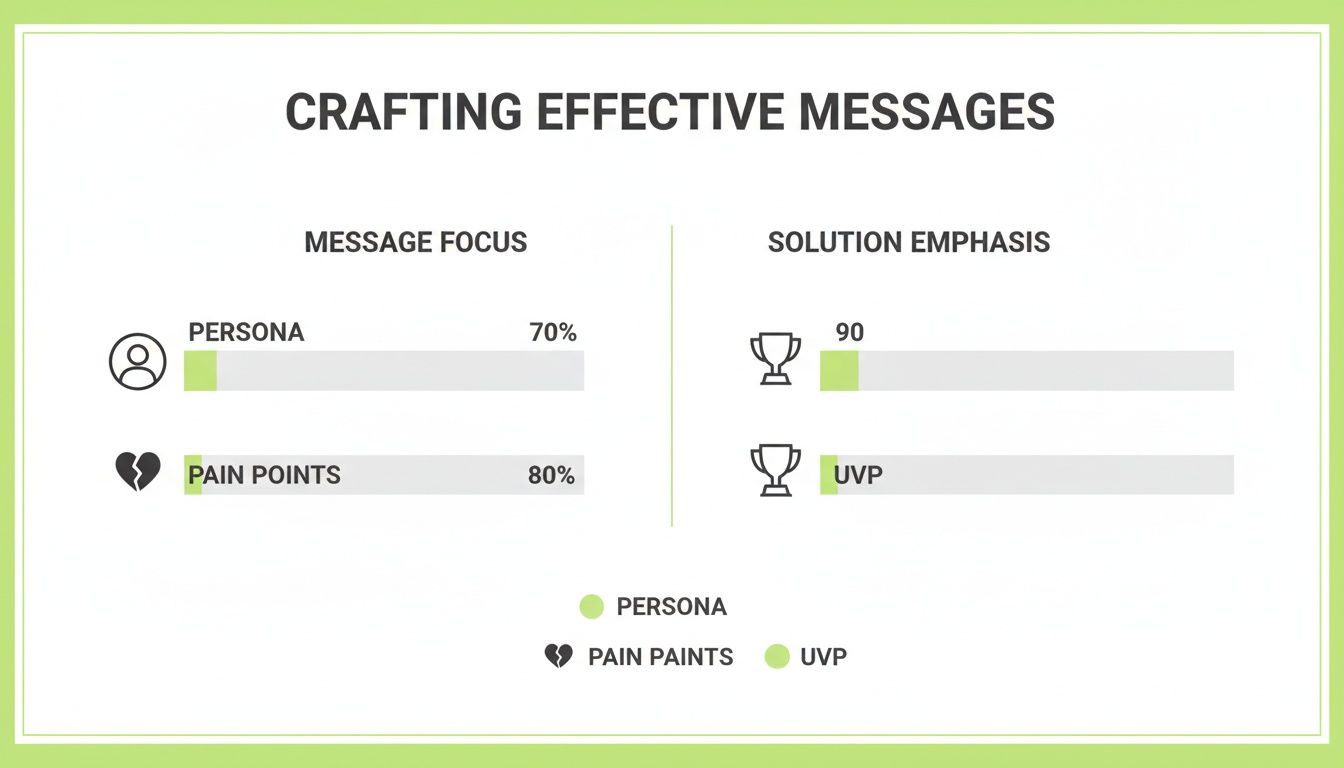
As you can see, a deep understanding of your customer persona and their pain points is the bedrock of a compelling value proposition.
Creating a Data-Informed Marketing Budget
Alright, let's talk money. Budgeting often feels like the most intimidating part of building a marketing plan, but it doesn’t have to be. A solid budget is the engine that powers your entire strategy, giving you the fuel to execute your plan and hit your goals. It’s a clear statement of your priorities.
Global advertising spend is on track to hit a jaw-dropping USD $1.16 trillion in 2025—that's a 6.5% jump from the previous year. This massive scale highlights just how crucial strategic budgeting is. For businesses like Magic Logix, which works with both SMBs and large enterprises, this trend reinforces the need to put money into channels with the highest ROI. While search ads continue to grab the largest piece of the pie, social media ad spend is projected to surge by 13.6% to hit $277 billion in 2025.
So, how do you build a budget that makes sense? While there are a few ways to approach it, the most effective is the objective-and-task method.
- Start with your goals: Go back to the SMART goals you already set (e.g., "generate 150 MQLs from organic search in Q2").
- Identify the tactics: What specific actions will get you there? (e.g., publish four SEO-optimized blog posts, run a backlink building campaign).
- Estimate the costs: Put a price tag on each tactic. This includes tool subscriptions, content creation fees, or agency costs.
- Add it all up: The grand total of these costs is your marketing budget.
This approach stops you from pulling a number out of thin air. Your budget becomes a strategic investment tied directly to measurable results, making it much easier to justify.
Allocating Resources for Maximum Impact
With your total budget in hand, the final piece of the puzzle is allocation. It's time to decide how you'll slice up the pie between different channels and activities.
This breakdown should mirror your strategic priorities. If your main goal is lead generation, a bigger chunk of your budget will naturally go toward paid search and content marketing.
Here’s a sample breakdown for a business with a $100,000 quarterly marketing budget to give you an idea of what this can look like.
Sample Marketing Channel Budget Allocation
This table illustrates how a business with a $100,000 quarterly marketing spend might allocate its funds across various channels based on common strategic priorities.
| Marketing Channel | Budget Allocation (%) | Example Quarterly Spend | Key Objective |
|---|---|---|---|
| Paid Search (PPC) | 35% | $35,000 | Capture high-intent leads and drive immediate sales. |
| Content & SEO | 30% | $30,000 | Build long-term organic traffic and brand authority. |
| Social Media Ads | 20% | $20,000 | Increase brand awareness and target specific demographics. |
| Email Marketing | 10% | $10,000 | Nurture leads and drive customer retention. |
| Tools & Software | 5% | $5,000 | Support all marketing activities with the right tech. |
Of course, this is just an example. Your specific mix will depend entirely on your industry, audience, and goals.
To get a better handle on your own numbers, try using a marketing budget calculator to play around with different scenarios. This will help ensure your marketing plan is ambitious enough to drive real growth while being realistic and sustainable.
Integrating Technology for Smarter Execution
A modern marketing plan isn’t just a static document you file away. It's a living, breathing engine. And to get that engine running smoothly, you need to fuel it with the right technology.
This is where your strategy gets legs. We're talking about automation, predictive analytics, and AI—not as buzzwords, but as tools that give you a serious competitive edge. Technology is what moves your plan from theory to dynamic execution.
It lets you automate the grunt work, personalize customer experiences on a massive scale, and make data-backed decisions with way more confidence. Without it, even the most brilliant plans get bogged down by manual tasks and missed opportunities.
Building Your Marketing Tech Stack
Your marketing technology stack is the collection of software you use to get the job done. Think of it as your team's digital toolkit. The goal isn't just to collect a bunch of shiny new tools, but to build a cohesive system where every piece serves a clear purpose and talks to the others.
You don’t need to break the bank on day one. A great tech stack is built around your core goals.
- Customer Relationship Management (CRM): This is the heart of your operation. It’s your central hub for every piece of customer and lead data, ensuring marketing and sales are always working from the same playbook.
- Automation Platform: This is your workhorse. It handles repetitive jobs like email nurture sequences, social media scheduling, and scoring leads so your team can focus on big-picture strategy.
- Analytics and Reporting Tools: These are your eyes and ears. They pull data from all your channels, letting you track KPIs, visualize what's working (and what's not), and finally prove the ROI on your efforts.
The rule of thumb is simple: your tech stack should directly support your plan's objectives. If improving lead nurturing is a top priority, a solid marketing automation platform is a must-have. If you need to prove ROI to the C-suite, then an advanced analytics tool is non-negotiable.
Harnessing AI and Predictive Analytics
Artificial intelligence has officially moved from sci-fi to a practical marketing necessity. Its real power is in sifting through massive datasets to spot patterns and predict what's coming next. This makes your whole marketing operation smarter and more agile.
Take Generative AI. It can help you scale content creation by drafting blog posts, ad copy, and social media updates. This frees up your team to focus on the high-level strategy and creative polish that a machine can't replicate.
The adoption rate is staggering. By 2026, 63% of marketers are expected to be using generative AI. In fact, over half were already using it to draft content back in 2023. This is a massive shift, especially when you see that 83% of sales teams using AI report revenue growth. You can dig into more of these numbers in recent Salesforce marketing statistics.
Predictive analytics takes things a step further. It analyzes past customer behavior to forecast what they'll do next—like which leads are most likely to buy or which customers might be about to churn. This allows you to stop being reactive and start being proactive, tailoring your campaigns and outreach for maximum impact.
A truly modern marketing plan doesn't just list what you're going to do. It details how technology will make every action smarter, faster, and more effective.
Measuring Success and Optimizing Performance
Your marketing plan isn't a static document you create once and file away. Think of it as a living, breathing guide for growth. Its real power comes from turning it into a dynamic feedback loop where you continuously measure what’s working, learn from what isn’t, and optimize your approach.
Without this final step, even the most brilliant strategy is just guesswork. You need to anchor every single objective to hard data. This is how you prove your impact, justify your budget, and transform your plan into a true performance engine for the business.
Selecting KPIs That Actually Matter
First things first: you have to choose the right Key Performance Indicators (KPIs). It’s incredibly easy to get distracted by vanity metrics—numbers like page views or social media followers that look impressive on a report but don't actually tell you anything about your business's health.
Instead, your plan should focus on actionable metrics directly tied to your SMART goals. These are the numbers that have a clear connection to revenue and customer growth.
- Customer Acquisition Cost (CAC): How much does it really cost you to land a new customer? This is your total marketing and sales spend divided by the number of new customers you brought in.
- Customer Lifetime Value (LTV): What’s the total revenue you can expect from a single customer throughout their entire relationship with your business? A healthy business model demands an LTV that is significantly higher than your CAC.
- Conversion Rate: What percentage of website visitors or leads take a desired action, like filling out a form or making a purchase? This is a direct measure of how effective your messaging and user experience really are.
A common pitfall is tracking dozens of metrics and getting lost in the noise. Your marketing plan should identify 3-5 core KPIs that serve as your North Star. These are the numbers you check weekly and report on monthly to gauge the true health of your strategy.
Building Your Marketing Dashboard
A marketing dashboard is your real-time command center. It's a simple, visual way to track your most important KPIs in one place, pulling data from various sources like your website analytics, CRM, and advertising platforms. This saves you from getting lost in endless spreadsheets and gives you an immediate, at-a-glance view of performance.
With the global digital ad market projected to hit $667 billion in 2024 and paid search commanding nearly 30% of U.S. ad spend, ignoring these metrics is like flying blind. For businesses in competitive markets like Dallas, honing in on benchmarks like an average click-through rate of 3.17% is crucial. As a business intelligence firm, Magic Logix thrives on helping clients build plans around these precise numbers. You can check out more digital marketing statistics to inform your own benchmarks.
Establishing a Cadence for Review and Optimization
Data is useless without action. The final piece of the puzzle is to establish a regular review cycle to analyze your results and make smart adjustments. This is what makes your marketing plan agile and responsive. You can learn more about which digital marketing performance metrics to prioritize in our detailed guide.
A typical review cadence looks something like this:
- Monthly Check-in: A review with your marketing team to analyze performance against the month's targets. What campaigns worked? What fell flat? Where are the opportunities?
- Quarterly Business Review: A more formal meeting with key stakeholders to report on progress toward the plan's larger SMART goals. This is where you make bigger strategic decisions, like reallocating your budget from underperforming channels to those delivering a higher ROI.
This disciplined process of measuring, analyzing, and pivoting is what separates a plan that gathers dust from one that consistently drives results. It ensures your marketing efforts are always evolving to be smarter and more effective.
Common Questions About Marketing Plans
Even with the best guide in hand, a few practical questions always pop up when it's time to build and launch a marketing plan. Let's tackle some of the most common ones I hear from marketing leaders.
How Often Should I Update My Marketing Plan?
Think of your marketing plan as a living document, not something you carve in stone once a year. Your big-picture strategy and major goals might be set annually, but the real magic happens in the adjustments.
You should be doing a serious review quarterly. This is your chance to dig into the KPI data, see what's really working, and reallocate your budget. If a channel isn't performing, don't be afraid to pull the plug and double down on what is. It’s also the perfect time to react to any new moves from competitors or shifts in the market.
Beyond that, a quick monthly check-in on your core dashboard is a must. This keeps you agile and lets you spot small issues before they snowball, ensuring your plan stays sharp and effective all year long.
What Is the Biggest Mistake in Marketing Planning?
Hands down, the most common and costly mistake is building a plan around activities instead of outcomes. It's the classic trap of being busy but not effective.
A weak plan is full of vague tactics like, "We will post more on social media." It's an activity without a clear purpose, which makes it impossible to measure its actual value to the business. You're just spinning your wheels.
A strong plan, on the other hand, is specific and tied to a business goal. For example: "We will use targeted LinkedIn content to generate 50 qualified leads per month to support our Q3 sales target." Always, always start with the "why" (the business outcome) before you get to the "what" (the marketing tasks). This one shift transforms your plan from a simple to-do list into a strategic engine for growth.
How Do I Create a Marketing Plan on a Small Budget?
When you're working with a tight budget, ruthless prioritization becomes your superpower. You can't be everywhere at once, so your plan needs to be laser-focused. Forget trying to spread your limited resources across a dozen different channels.
- Focus on one or two key channels. Go where you know your ideal customers hang out and concentrate all your energy there. Don't chase shiny objects.
- Prioritize organic, long-term plays. Lean heavily into strategies that build assets over time, like smart content marketing, local SEO, and nurturing a high-value email list.
- Get creative and be consistent. Your plan should rely on clever ideas, strategic partnerships, and relentless consistency rather than a huge ad spend.
Track every single dollar. You need to know it's pulling its weight and delivering the best possible return. This kind of disciplined approach is how you compete and win, even without a massive budget.
Ready to turn your strategic plan into a high-performance marketing engine? Magic Logix combines data, technology, and creativity to build marketing solutions that deliver real business growth. Learn how we can help you execute your vision by visiting us at https://www.magiclogix.com.