
Website conversion optimization, or CRO, is the practice of systematically getting a higher percentage of your website visitors to take a specific action you want them to take. Think of it as turning the clicks you already get into real-world business results, like sales or sign-ups.
It’s both an art and a science—a methodical way to make your website more persuasive and dead simple for people to use.
Why Website Conversion Optimization Is a Game Changer
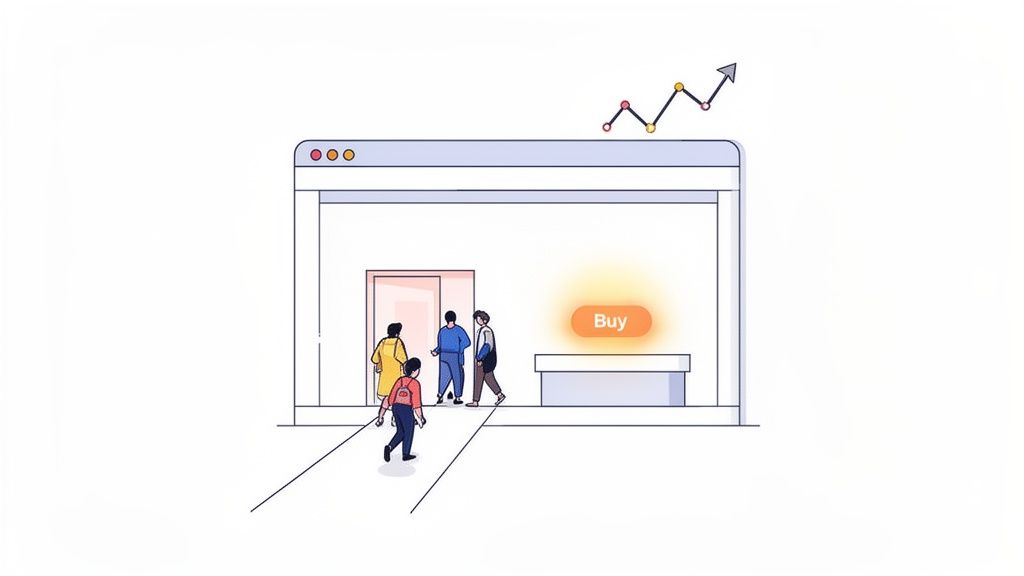
Picture your website as a physical retail store. You spend a good chunk of change on advertising and SEO just to get people to walk through the door. But what happens then? Do they immediately find what they’re looking for, or do they get lost in the aisles, frustrated, and walk out empty-handed?
Website conversion optimization is the digital equivalent of designing an intuitive store layout, putting your best products right at eye level, and making sure the checkout line is short and sweet.
It’s all about digging into visitor behavior to find and eliminate any friction points that stop them from reaching their goal. Instead of constantly chasing more traffic (which gets expensive fast), CRO focuses on getting more value from the visitors you already have. This simple shift is a direct lever you can pull to boost revenue without increasing your marketing spend.
The Real-World Impact of Small Conversion Rate Increases
Even small improvements can lead to massive results. It’s easy to dismiss a 1% lift, but when you run the numbers, its impact on the bottom line becomes undeniable. CRO is a high-ROI activity because it compounds over time.
To put this into perspective, let's look at a simple scenario for an ecommerce site.
| Metric | Scenario A (Before CRO) | Scenario B (After a 1% Lift) | Revenue Impact |
|---|---|---|---|
| Monthly Visitors | 100,000 | 100,000 | No Change |
| Conversion Rate | 2% | 3% | +1% |
| Average Order Value | $100 | $100 | No Change |
| Monthly Revenue | $200,000 | $300,000 | +$100,000 |
As you can see, a seemingly minor 1% increase in the conversion rate leads to an extra $100,000 in monthly revenue. Over a year, that's an additional $1.2 million—all from the same amount of traffic. This is the power of focusing on optimization.
The Power of Incremental Gains
Here's a dose of reality: the average website conversion rate across all industries is a pretty modest 2.3%. Yet, the top-performing sites are hitting 11% or higher. That huge gap shows just how much opportunity is on the table. A solid CRO strategy can be the difference between just getting by and truly dominating your market.
This doesn't mean you need a massive, site-wide overhaul to see a difference. Often, a simple change—like tweaking the text on a button or removing one field from a form—can produce a surprising lift in conversions.
Website conversion optimization is not just a marketing tactic; it’s a business strategy. It transforms your website from a passive digital brochure into an active, high-performing sales engine that works for you 24/7.
From Good to Great
A disciplined approach to CRO gives you incredible insight into your customer's mindset. By analyzing how people actually interact with your site, you can pinpoint the exact pain points and opportunities you never knew existed. This data-driven process lets you make smart, informed decisions that improve the user experience, which in turn builds trust and keeps people coming back.
The core benefits are clear and powerful:
- Increased Revenue: Converting more visitors directly means more sales and leads from the traffic you already paid for.
- Lower Customer Acquisition Costs (CAC): When you convert more of your existing traffic, you don't have to spend as much money to find new customers. Your ROI skyrockets.
- Better User Experience: Removing roadblocks and clarifying your message makes the entire journey smoother and more enjoyable for your visitors, building serious brand loyalty.
To really dig into the mechanics and potential of CRO, we highly recommend this comprehensive ultimate guide to Ecommerce Conversion Rate Optimization.
Speaking the Language of Conversion
To get really good at optimizing your website, you have to know the lingo. These aren't just industry buzzwords; they're the concepts you’ll use to figure out what's broken, track your wins, and actually explain your strategy to the rest of your team. It’s like learning the rules before you play a new sport—without them, you're just running around guessing.
First up is the conversion funnel. This is just a simple way to visualize the journey a visitor takes on your website. Picture someone walking into a brick-and-mortar store: they browse the aisles (Awareness), pick up a few items to look closer (Interest), make a choice (Decision), and then walk to the register (Action). Your website follows a similar path, and mapping it out is the only way to see where people are getting stuck or leaving.
Macro vs. Micro Conversions
Now, not all actions on your site are created equal. This brings us to the difference between macro and micro conversions. Think of it as the ultimate goal versus all the little steps that get you there.
Macro-Conversions: This is the big one, the main action you’re driving people toward. We're talking about the completed purchase on an e-commerce site, the "Request a Demo" form fill for a SaaS business, or the final checkout. This is the stuff that directly grows the bottom line.
Micro-Conversions: These are the smaller, supporting actions a visitor takes that show they're engaged and moving down the funnel. Things like signing up for a newsletter, downloading an ebook, watching a product demo, or even just adding an item to their cart all count.
If you only track macro-conversions, you're like a coach who only looks at the final score of a game. You miss all the crucial plays, assists, and defensive stops that actually led to the win. Micro-conversions give you the full story of how users are engaging, helping you spot opportunities for improvement long before they get to the checkout page.
The Two Business Metrics That Matter Most
Beyond what users are doing, you need to understand the financial side of the equation. Two metrics put all your optimization work into a business context: Customer Lifetime Value (LTV) and Customer Acquisition Cost (CAC).
Customer Lifetime Value (LTV): This is the total amount of money you can expect to make from a single customer over the entire time they do business with you.
Customer Acquisition Cost (CAC): This is how much it costs, in total, across sales and marketing, to bring in one new customer.
A healthy business is one where the LTV is much, much higher than the CAC. For example, if you spend $100 to get a new customer (CAC) and they end up spending $500 with you over their lifetime (LTV), you've got a solid, sustainable model.
Great conversion optimization has a direct impact on this LTV:CAC ratio.
By making it easier for visitors to become customers, you lower your CAC because you're getting more out of the traffic you already have. At the same time, by creating a better experience, you're encouraging people to come back and buy again, which pushes up your LTV. Getting a handle on these ideas is the first real step to building a strategy that turns website traffic into real, sustainable growth.
A Repeatable Framework for CRO Success
Effective website conversion optimization isn’t about guesswork or just copying what a competitor is doing. It’s a disciplined, repeatable process built on data and a deep curiosity about your users. Think of it less like a one-time project and more like a continuous improvement engine—a flywheel that methodically turns data into dollars.
When you adopt a structured framework, you take the emotion and bias out of decision-making. Evidence becomes your guide. This approach ensures your efforts are focused, measurable, and build on each other over time, creating a cycle of learning that consistently lifts your conversion rates.
The Five Core Steps of CRO
At its heart, any successful CRO program follows a five-step cyclical process. Each stage feeds directly into the next, creating a powerful loop of ongoing optimization.
- Research and Analysis
- Forming a Hypothesis
- Testing and Experimentation
- Measuring and Analyzing Results
- Iteration and Implementation
Let’s break down what each of these critical stages really involves.
Step 1: Research and Analysis
Before you can fix a problem, you have to truly understand it. The research phase is where you become a digital detective, gathering clues to figure out why users aren't converting. This means digging into two different types of data.
- Quantitative Data (The "What"): This is the hard data that tells you what’s happening on your site. Tools like Google Analytics can show you high-traffic pages with surprisingly high exit rates, while heatmaps reveal which buttons get completely ignored.
- Qualitative Data (The "Why"): This is the human insight that explains the numbers. User surveys, feedback polls, and session recordings let you hear from and watch actual users, uncovering their frustrations and motivations in their own words.
Combining these two gives you the full picture. Analytics might show a landing page has a 90% bounce rate, but a session recording will show you it’s because a critical button is broken on mobile devices.
Step 2: Forming a Hypothesis
Once you've identified a problem, you need to form a clear, testable hypothesis. This isn't just a vague idea; it's a structured statement that outlines a proposed change, predicts an outcome, and explains the reasoning behind it.
A strong hypothesis follows a simple format: "By making [Proposed Change], we believe it will cause [Predicted Outcome] because [Reasoning]."
For example, a solid hypothesis might be: "By replacing our generic 'Submit' CTA button with a benefit-driven one like 'Get My Free Quote,' we believe we will increase form submissions because it clarifies the immediate value for the user." This statement is specific, measurable, and grounded in what we know about our users.
Step 3: Testing and Experimentation
With a hypothesis ready, it's time to test it. This is where you let your audience tell you which experience is better, using controlled experiments to see if your ideas hold water.
The most common method is A/B testing. You show one version of your page (the control) to half your traffic and a modified version (the variation) to the other half. The version that achieves a statistically significant lift in conversions is the winner. Other methods include multivariate testing (testing multiple elements at once) and split testing (testing two entirely different page designs). The right web design can make all the difference, and testing is how you prove it.
This diagram helps visualize how the conversion process isn't just one big action, but a series of smaller steps.
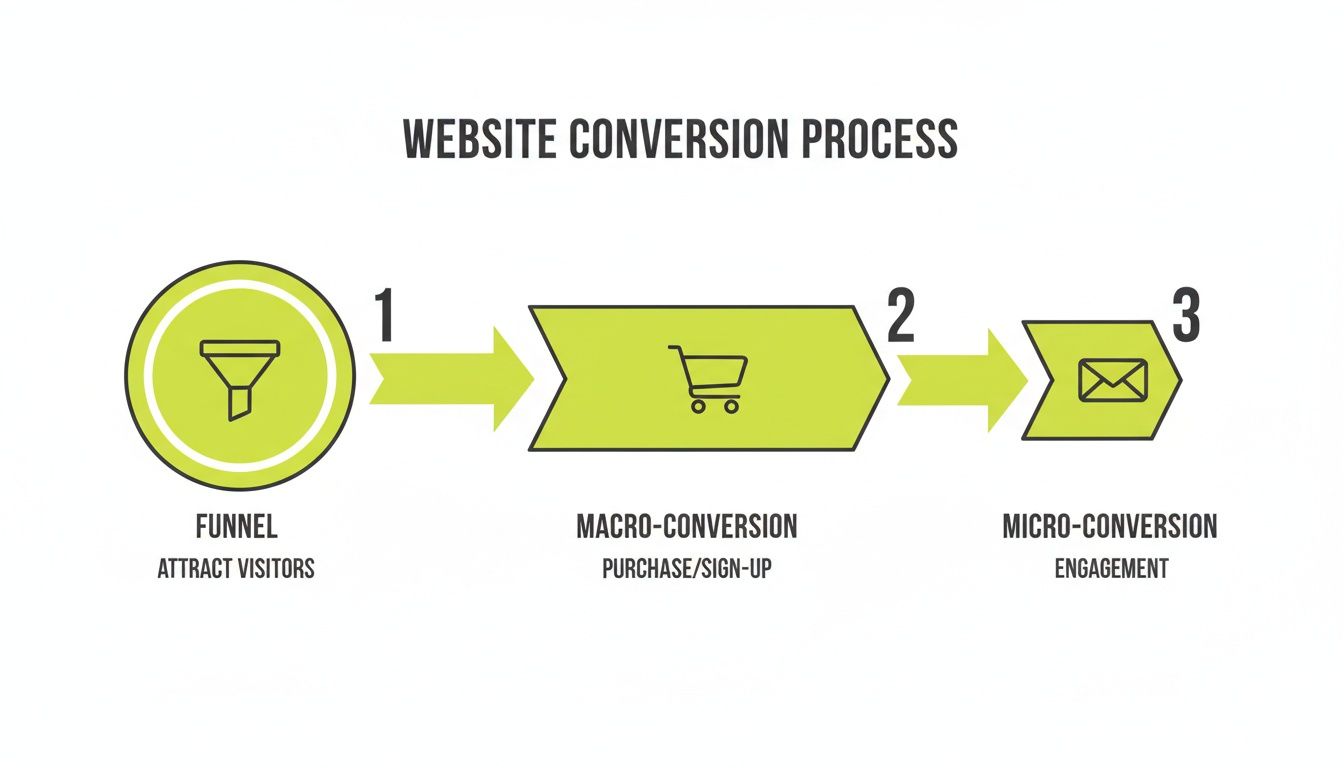
It shows that while a major purchase (a macro-conversion) is the ultimate goal, smaller commitments like an email signup (a micro-conversion) are key milestones along the way.
Step 4: Measuring and Analyzing Results
After a test runs long enough to gather solid data, it’s time to analyze the results. Did the variation win? Did it lose? Or was there no significant difference? The key here is to look beyond just the primary conversion goal. Did the change impact any secondary metrics, like average order value or time on page?
Step 5: Iteration and Implementation
Finally, you take action based on the results. If your hypothesis was proven correct, you implement the winning variation for all users. If it was wrong, you've still learned something valuable about your audience. You then take that insight and use it to inform your next round of research, starting the entire cycle over again. This is the flywheel effect—each test, win or lose, makes your next effort that much smarter.
Advanced CRO Tactics to Gain a Competitive Edge
Once you’ve got a solid, repeatable CRO process humming along, it’s time to move past the basics. A/B testing is foundational, but the real gains—the ones that separate market leaders from the pack—come from more advanced strategies.
These tactics dig deeper. They tap into user psychology and cutting-edge tech to build experiences that aren't just functional, but genuinely compelling and persuasive. This is how you turn a good conversion rate into a great one and build an advantage that your competitors will struggle to copy.
Harnessing the Power of Personalization
Think about it: we all hate the one-size-fits-all approach. Personalization is about tailoring your website to individual users based on what you know about them—their browsing history, location, or past purchases. You stop shouting the same message at everyone and start having a one-on-one conversation.
For an e-commerce store, this might mean showing a returning customer products similar to what they bought last time. If you're a B2B service, you could change the homepage headline to reflect the visitor's industry, which can often be figured out from their IP address. This kind of relevance makes people feel seen and understood, building the trust you need to drive conversions.
Personalization can lift revenues by 5% to 15% and increase marketing spend efficiency by 10% to 30%. By making the user journey more relevant, you directly address their needs at the exact moment they are most engaged.
Leveraging Psychological Principles in Design
Great CRO isn't about trickery; it’s about understanding people. Applying proven psychological principles to your design and copy is an ethical way to guide users by leaning into fundamental human behaviors.
Three of the most powerful principles you can use are:
- Social Proof: This is all about showing, not just telling. Customer testimonials, reviews, and user-generated content prove that other people have bought your product and loved it. A simple stat like "2,500+ companies use our software" can build incredible trust right away.
- Scarcity: When things are limited, we want them more. Highlighting low stock (e.g., "Only 3 left in stock!") or creating time-sensitive offers ("Deal ends in 24 hours") creates a sense of urgency that pushes people to act now instead of later.
- Authority: People trust experts and credible sources. Featuring logos of well-known clients you've worked with, industry awards you've won, or security badges (like Norton or McAfee) signals that you're legitimate and helps reduce any anxiety, especially when it’s time to pull out a credit card.
Tapping into Predictive Analytics and AI
This is where things get really smart. Predictive analytics uses artificial intelligence (AI) and machine learning to look at past user behavior and make educated guesses about what they'll do next. This tech can spot which visitors are on the verge of converting, letting you step in with a personalized offer or a timely chat pop-up before they click away.
For example, an AI model could predict that a visitor who has looked at three specific product pages and spent over five minutes on your site has an 80% chance of buying in the next hour. Armed with that knowledge, you could trigger a pop-up with a 10% discount to seal the deal. To really get ahead, you can also apply CRO to other formats. Learning to create video content that truly converts on platforms outside your main site is key to a complete strategy.
Optimizing for Speed and Frictionless UX
At the end of the day, the most advanced tactic is perfecting the fundamentals. No amount of clever personalization or psychological nudging will save you from a slow, clunky, or confusing user experience (UX). A high-performing website is built on a foundation of solid technical performance.
Every single second a page takes to load sends your bounce rate soaring, especially on mobile, where patience is thin. A frictionless experience means your site is lightning-fast, navigation is dead simple, and forms are a breeze to fill out. Don't let technical issues undo all your hard work. You can increase your page speed by regularly auditing your site's performance and squashing any bugs that get in the way of a smooth user journey.
Real-World Examples of CRO in Action
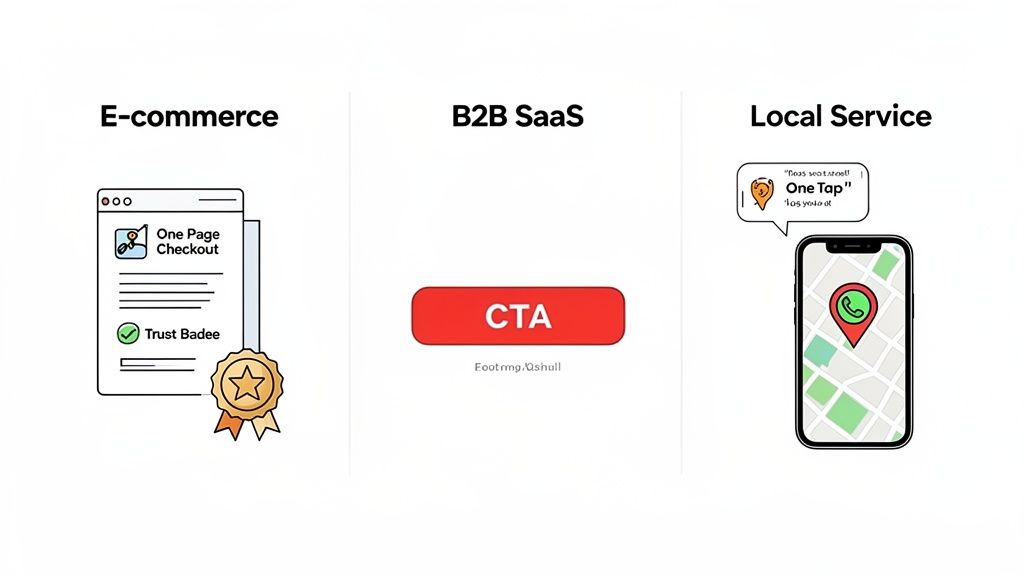
Theory is the map, but seeing website conversion optimization in action shows you the actual destination. The true power of a CRO framework only really clicks when you see how it solves real problems for different kinds of businesses.
Let’s translate the concepts of research, hypothesis, and testing into tangible results across a few distinct industries. Each example follows the same disciplined process, starting with a clear problem and ending with a measurable lift in conversions.
E-commerce: Simplifying the Path to Purchase
An online clothing retailer spotted a huge problem: their cart abandonment rate was stuck at a painful 75%. Digging into their analytics, they saw a clear pattern. Users were eagerly adding items to their carts but bailing during the clunky, multi-step checkout.
- The Problem: A long, five-page checkout process was creating way too much friction for motivated buyers.
- The Hypothesis: If they consolidated the checkout onto a single page and added trust badges (like security seals and payment logos), they could reduce user frustration and get more people to complete their purchase.
- The Test: They ran a straightforward A/B test. Version A was the old five-step checkout, while Version B was the sleek new single-page design.
- The Result: The single-page checkout absolutely crushed it, increasing the checkout completion rate by 28%. This single change slashed cart abandonment and directly boosted revenue.
This win came from homing in on a user pain point and offering a simpler, more trustworthy solution. A great deal of successful e-commerce development is focused on tearing down these exact kinds of barriers.
B2B SaaS: Turning Vague Interest into Qualified Leads
A B2B software company was getting decent traffic to its main product page but just couldn't get people to request a demo. Their main call-to-action (CTA) was a generic "Learn More" button that just dumped visitors onto a long feature list.
The core issue was a total mismatch between what the user wanted and the action offered. Visitors who were ready for a solution were being pushed toward more reading, not a real conversation.
Their team watched user session recordings and saw people hovering over the CTA button, hesitating. This qualitative data pointed to a serious lack of clarity and confidence.
- The Problem: The "Learn More" CTA was too passive and didn't line up with the goals of their most valuable, high-intent visitors.
- The Hypothesis: Replacing the vague CTA with a specific, action-oriented "Request a Live Demo" button—and placing it right next to a compelling client testimonial—would generate more qualified leads.
- The Test: They pitted the old CTA against the new one in an A/B test.
- The Result: The new "Request a Live Demo" button, backed by powerful social proof, delivered a massive 112% increase in qualified lead submissions. It worked because it was specific, told users exactly what to do, and addressed their next logical step in the buying journey.
Local Service Business: Cashing In on Mobile Traffic
A local plumbing company relied on its website to generate service calls. Their analytics showed that over 70% of their traffic was coming from mobile devices, yet their mobile conversion rate was in the gutter. The landing page was a mess on small screens, and the phone number was just plain text—impossible to tap and call.
- The Problem: Mobile users couldn't easily contact the business, which was a massive roadblock when they needed help now.
- The Hypothesis: By optimizing the landing page for mobile with a responsive design and adding big, prominent click-to-call buttons, they would drive more direct appointment bookings.
- The Test: They rolled out the new mobile-friendly page as a split test against the old one.
- The Result: The optimized mobile page led to a staggering 400% increase in calls coming directly from the website. This simple fix made it effortless for users on the go to take immediate action.
Building Your CRO Implementation Roadmap
Knowing the theories behind website conversion optimization is one thing. Actually putting them into practice is a whole different ballgame. The final step is to build a practical, actionable roadmap that fits your company's unique size and resources.
Whether you're a nimble startup or a massive corporation, the journey always begins with clear, tangible steps. The goal isn't to boil the ocean overnight. It's about starting a sustainable process that builds momentum, turning more of your visitors into customers starting today.
A Roadmap for Small and Medium Businesses
For smaller businesses, the name of the game is momentum. You need to focus on quick wins and low-cost tools that prove the value of CRO without a huge upfront investment. Your goal is to gather that initial nugget of data, spot the most obvious opportunities, and run your first simple tests.
Here’s where you should start:
- Install Foundational Tools: First, get free tools like Google Analytics set up to track what users are doing. Then, complement it with a tool like Hotjar, which often has a free plan, to see why they're doing it through heatmaps and session recordings.
- Identify Low-Hanging Fruit: Use your new data to find the easiest wins. Hunt for pages with high traffic but a shockingly high exit rate. Is a button unclear? Is a form way too long? Simple fixes, like rewriting a confusing headline or simplifying a sign-up form, can deliver surprisingly big results.
- Run Your First A/B Test: Don't overcomplicate this. Use a free tool to test one simple thing, like the wording on your main call-to-action button. The goal here is to learn the process, not to hit a home run on your first try.
For SMBs, agility is everything. Use simple tools to find and fix the most glaring user frustrations first. These initial successes will build the case for a more dedicated CRO effort down the line.
A Roadmap for Large Enterprises
For large enterprises, the challenge isn't budget; it's scale, complexity, and getting everyone on the same page. Your roadmap has to address how to build a robust, scalable program that integrates across multiple teams and business units without stepping on toes.
Your initial focus should be on building a rock-solid foundation:
- Build a Dedicated CRO Team: Start with a core team, even if it's just one or two people, who own the optimization process. This team is responsible for prioritizing tests, managing the testing platform, and—most importantly—sharing insights across the entire organization.
- Integrate Advanced Platforms: Invest in a powerful testing platform that can handle complex experiments and plug into your existing analytics and data warehouses. This becomes the central hub for all experimentation.
- Foster a Culture of Experimentation: This is the most critical step. You absolutely need buy-in from leadership to create a culture where testing is encouraged and "failed" tests are seen for what they are: valuable learning opportunities. Share wins and insights widely to get everyone excited about the impact of data-driven decisions.
Whether you're just starting or scaling up, a good roadmap turns abstract goals into a concrete plan. For more ideas on using data to inform your strategy, check out our guide on applying paid search intelligence to better understand user intent.
Your Top Questions About Website Conversion Optimization, Answered
Even with the best game plan, it's natural for a few questions to pop up when you're jumping into something new. Conversion rate optimization is a seriously powerful tool, but figuring out how it plays with your other marketing efforts is the key to unlocking its real value.
So, let's tackle some of the most common questions head-on. My goal here is to give you that extra bit of clarity and confidence to get started, showing you how CRO works with your current strategies, what you’ll need, and what kind of timeline is realistic.
How Is CRO Different from SEO and PPC?
This is a classic, and for good reason. Think of SEO (Search Engine Optimization) and PPC (Pay-Per-Click) as the powerful magnets that pull people to your website. They’re all about getting more folks to walk through your digital front door.
CRO, on the other hand, is what happens after they've arrived. It's the art of turning that foot traffic into action by making the experience on your site so smooth and persuasive that visitors can't help but convert.
SEO and PPC are masters of quantity—they bring you more visitors. CRO is the master of quality—it improves their interactions and boosts the value you get from every single one of them.
They're not rivals; they're partners. Your killer SEO and PPC campaigns bring in qualified, ready-to-act traffic. A solid CRO strategy makes sure you don’t squander that opportunity, making your entire marketing budget work smarter and harder.
How Much Does It Cost to Implement a CRO Strategy?
The price tag for a conversion optimization program can swing pretty wildly. For smaller businesses, getting the ball rolling can be surprisingly affordable. Many of the essential tools, like Google Analytics for digging into data, are completely free. Others, like heatmap and session recording tools, often have free starter plans that are more than enough to begin. Your biggest initial investment? Your time.
For larger companies, the investment can be more significant. We're talking potential salaries for a dedicated CRO team and subscriptions to premium testing platforms. The crucial thing is to view CRO as an investment, not an expense. A well-run program should pay for itself and then some by directly pumping up your revenue.
How Long Does It Take to See Results from CRO?
How quickly you see results really boils down to two things: how much traffic your website gets and how impactful your changes are. To get a trustworthy result from an A/B test, you need enough data to be confident in the outcome.
- A high-traffic site might wrap up a test and have a clear winner in just a week or two.
- A lower-traffic site could need a month or even longer to collect enough data for the same test.
Of course, some quick fixes—like patching up a broken link in your checkout flow—can give you an instant lift. But a real CRO strategy isn't a one-and-done experiment. It's a long-term commitment. The meaningful, lasting growth comes from a continuous cycle of testing, learning, and improving over months and years.
Ready to turn your website into a high-performing sales engine? The experts at Magic Logix combine data, technology, and creativity to build digital experiences that convert. Explore our digital marketing solutions today!