
Paid search intelligence is the strategic brain behind a successful PPC campaign. It’s what turns mountains of raw advertising data into clear, actionable insights that actually move the needle. This isn't just about tracking clicks and impressions; it's about digging deeper to understand competitor behavior, consumer intent, and market trends to find the most direct path to your business goals.
Ultimately, this intelligence is what guides smarter decisions on everything from bidding and ad creative to audience targeting.
Unlocking Smarter PPC Campaigns
Think of standard PPC management like flying a plane with just the basic instruments. You know your speed and altitude, but that's about it. Paid search intelligence, on the other hand, is like upgrading to a full avionics suite—complete with weather radar, terrain mapping, and real-time air traffic control.
Suddenly, you have a complete picture of your entire environment. You can anticipate challenges and spot opportunities long before they appear on the horizon, instead of just reacting to whatever comes your way.
This strategic layer helps you answer the tough questions that basic metrics can't touch:
- Which keywords are our competitors really bidding on, and how aggressive are they?
- What’s the actual intent behind a user’s search, not just the words they typed?
- How do we best allocate our budget to capture the most profitable corners of the market?
- Which ad creatives are truly resonating with specific audience personas?
The Shift From Data To Decisions
At its core, paid search intelligence is all about turning an overwhelming flood of data into a clear, decisive advantage. Without it, marketing teams often get stuck in a reactive loop, constantly adjusting bids and tweaking ad copy based on surface-level performance. This almost always leads to wasted ad spend and missed opportunities for growth.
For companies looking to sharpen their approach, working with top-tier search engine marketing agencies can provide the specialized expertise needed to make this shift.
The market's explosive growth really highlights this need. The global paid search tools market is on track to hit $5.2 billion in 2025 and is projected to grow at a blistering 15% CAGR through 2033. This surge isn't happening in a vacuum; it’s a direct response to fierce competition where businesses need sophisticated tools to target precisely and prove ROI. You can get a better sense of this trend by reading more about the growth of the paid search tools market.
By applying intelligence, you move from simply participating in an auction to strategically controlling your outcomes. It's the difference between guessing where the fish are and using sonar to find them.
In the end, this approach connects every dollar of ad spend back to a tangible business outcome. It gives you the clarity to optimize not just for clicks or impressions, but for real profit and long-term customer value.
The Five Pillars of Modern PPC Intelligence
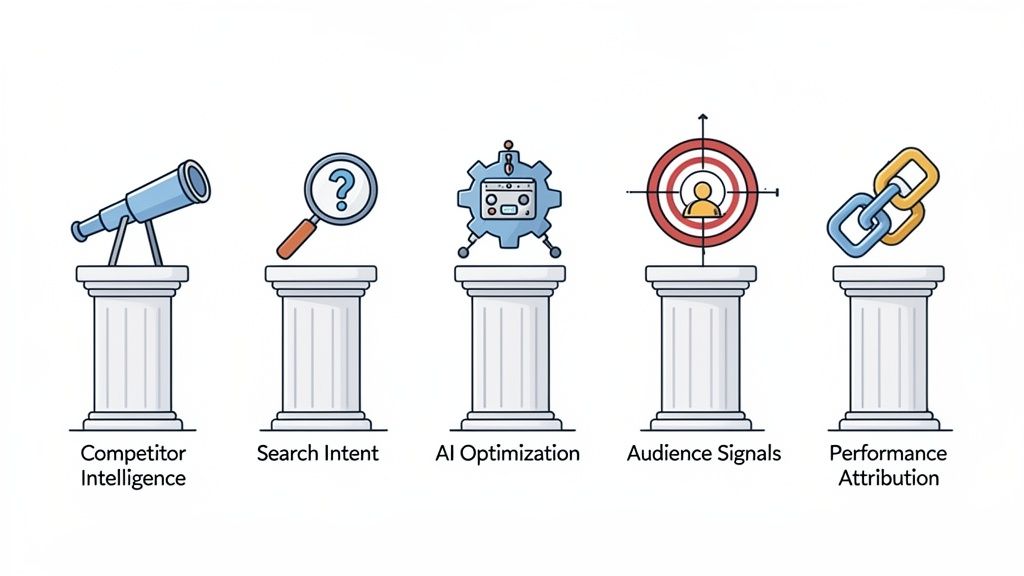
If you want to build a paid search strategy that actually works, you need to think beyond a simple list of keywords and a budget. Real paid search intelligence is built on five core pillars that all work together, creating a powerful system that learns and improves over time. When you get these right, your advertising stops being an expense and starts becoming a strategic engine for growth.
These pillars aren't just separate tactics you can pick and choose from. They’re foundational concepts that feed into and strengthen one another. Let's dig into each one to see how they create a smarter, more profitable way to do PPC.
Pillar 1: Competitor Intelligence
First up, you have to understand the battlefield. And that means more than just knowing who else is bidding on your top keywords. It’s about dissecting their entire playbook to find gaps you can exploit and weaknesses you can turn into your strengths.
Think of it like having a scout reporting back from the front lines. This scout gives you the intel on critical details like:
- Ad Copy Analysis: What kind of messaging are they using? Are they pushing price, features, or service? What are their calls-to-action and unique selling points?
- Bidding Patterns: Do certain competitors get aggressive at specific times of the day or for certain keyword groups? This can tell you a lot about who they consider their most valuable customers.
- Landing Page Experience: Where are they actually sending all that traffic? Sizing up their landing pages shows you how they’re trying to convert visitors and what offers they're leading with.
When you gather this information systematically, you start seeing the holes in the market. Maybe a big competitor has terrible ad copy on mobile, or another is completely ignoring valuable long-tail keywords. This is the kind of intelligence that lets you make precise, strategic moves instead of just reacting to whatever they do next.
Pillar 2: Search Intent Analysis
Keywords tell you what someone is searching for, but intent tells you why. This is the absolute game-changer that separates campaigns that just get traffic from campaigns that get customers. Figuring out the user's real motivation is how you create ads and landing pages that connect.
Search intent is the invisible context behind every query. Ignoring it is like trying to have a conversation while only hearing every other word. You might get the general topic, but you'll miss the meaning.
A person searching for "best running shoes" is in a totally different mindset than someone searching for "Nike Air Zoom Pegasus price." The first user is doing research (informational intent), while the second is much closer to pulling out their credit card (transactional intent).
Smart paid search intelligence doesn't just recognize these intents; it builds the entire ad experience around them. This means your ad copy, your extensions, and your landing page all need to align with what the user is trying to accomplish. Do that, and you'll see your conversion rates and Quality Score climb.
Pillar 3: AI-Powered Optimization
Let's be honest: the sheer scale and complexity of modern PPC campaigns have grown beyond what any human can manage manually. That’s where AI-powered optimization comes in. It’s no longer a luxury; it’s an essential pillar for automating and refining campaign elements at a speed no human team could ever match.
This isn’t about replacing smart marketers; it's about giving them superpowers. AI handles the relentless, data-heavy lifting, which frees up your experts to focus on the big picture—strategy, creative, and competitive analysis.
Here’s where AI really shines:
- Automated Bidding: Algorithms analyze thousands of signals in the blink of an eye—device, time of day, location, past behavior—to set the perfect bid for every single auction.
- Ad Creative Testing: AI can churn through countless combinations of headlines, descriptions, and images to pinpoint exactly what resonates with different audience segments.
- Predictive Analytics: By sifting through historical data, AI can forecast future trends, helping you get ahead of shifts in demand and allocate your budget before your competitors do.
This technology is completely reshaping the industry. The global market for paid search software was valued at $5 billion in 2023 and is projected to hit $9 billion by 2032, a surge driven by machine learning that makes hyper-personalized targeting possible. You can get a deeper dive into this trend and learn more about the paid search software market.
Pillar 4: Audience Signal Targeting
The days of just targeting keywords are long gone. The fourth pillar, audience signal targeting, uses a rich mix of user data to get your message in front of the right people at the right time. It’s all about creating highly specific audience segments based on who people are and what they do online.
These signals can include everything from:
- Demographics: Age, gender, location, income.
- Behavioral Data: Past website visits, content they’ve read, or products they’ve viewed.
- In-Market Audiences: Users who are actively researching products or services like yours.
- Custom Audiences: Your own first-party data, like an email list from your CRM.
By layering these signals onto your campaigns, you can have different conversations with different people. For instance, you can show one ad to a brand-new visitor and a completely different offer to a loyal customer who has bought from you before. This kind of personalization makes your ads far more relevant, which is a direct path to better engagement and ROAS.
Pillar 5: Performance Attribution
Finally, the fifth pillar is what ties everything back to your bottom line. Performance attribution is the science of figuring out which touchpoints in a customer’s journey actually contributed to a conversion. The old "last-click" model, where the final ad a user clicked gets 100% of the credit, is hopelessly outdated and flat-out wrong.
Modern attribution models—like data-driven, linear, or time-decay—give you a much more accurate picture. They distribute credit across the entire path to purchase, from that first search that made them aware of you to the final click that closed the deal.
This complete view lets you measure the true value of every campaign, ad group, and keyword. It shows you which top-of-funnel efforts are bringing in new customers and which bottom-of-funnel ads are sealing the deal. With that intelligence, you can finally optimize your budget with real confidence, doubling down on what’s working and cutting what isn’t.
How to Fuel Your Intelligence Engine with the Right Data
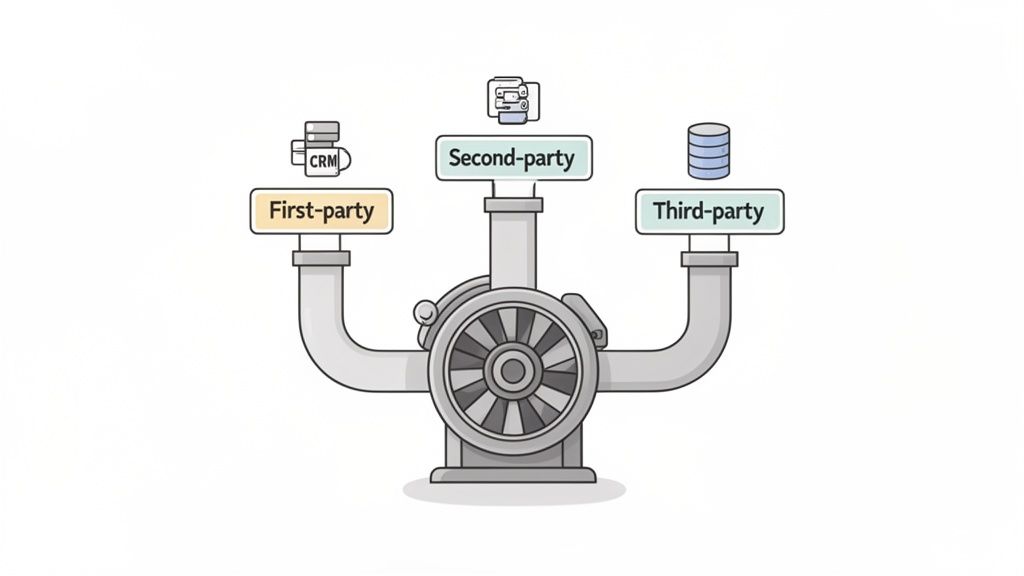
A paid search intelligence system is a lot like a high-performance engine; its power comes directly from the quality of the fuel you put in it. Without clean, relevant, and comprehensive data, even the most advanced tools will just sputter out. To really get a strategic edge, you have to get good at collecting, integrating, and analyzing data from multiple sources.
This means breaking down the walls that usually keep different datasets siloed within a company. When your CRM, website analytics, and ad platforms all live on separate islands, you're only seeing fragments of the customer journey. The goal is to bring all these streams together into a single source of truth that powers smarter decisions across your entire strategy.
Understanding Your Primary Data Fuels
Your journey starts with the data you already own. These datasets are your most valuable asset because they are completely unique to your business and give you a direct line of sight into customer behavior and campaign performance. Think of this as the premium, high-octane fuel for your intelligence engine.
There are three main categories of data you'll need to get a handle on:
- First-Party Data: This is the information you collect straight from your audience. It includes CRM data (like customer purchase history and lifetime value), website analytics (user behavior, conversion paths), and your email subscriber lists. It's the absolute gold standard for understanding who your customers are and what they want.
- Second-Party Data: This is just someone else's first-party data that you get through a direct partnership. For instance, a hotel chain might team up with an airline to share anonymized data on travel trends. This kind of arrangement enriches both companies' audience insights without compromising privacy.
- Third-Party Data: This is aggregated data you buy from external providers who don't have a direct line to your customers. It gives you broad, market-level insights, competitive benchmarks, and demographic info to help you see the bigger picture.
By blending these sources, you can build a rich, multi-dimensional view that informs every piece of your paid search strategy, from audience targeting to creative messaging. For those on Amazon, a key step in fueling your engine and keeping data clean is to regularly audit your Amazon PPC account.
Building Your Data Integration Stack
Just collecting data isn't enough; the real magic happens when you bring it all together in a way that makes it accessible and actionable. This calls for a modern tech stack built to handle huge volumes of information from different places, effectively demolishing those data silos for good.
A solid data stack for paid search intelligence has several key pieces working together.
An integrated data stack turns a chaotic mess of spreadsheets and dashboards into a cohesive intelligence hub. It’s the difference between having a pile of engine parts and having a fully assembled, road-ready vehicle.
The essential layers of this technology stack include:
- Data Warehouse: This is the central hub where all your raw data lives. Platforms like Google BigQuery, Amazon Redshift, or Snowflake are built to house massive datasets from your CRM, ad platforms, and analytics tools in one secure, easy-to-access spot.
- ETL (Extract, Transform, Load) Tools: These are the pipelines that do the heavy lifting. They pull data from its original source (like Google Analytics), clean it up (transform), and then load it into your data warehouse. Tools like Fivetran or Stitch make this an automated, reliable process.
- Business Intelligence (BI) Platform: This is the visualization layer that sits on top of your data warehouse. Platforms such as Tableau, Looker, or Power BI connect to your unified data, allowing you to create interactive dashboards and reports that turn complex numbers into clear, visual insights for your team.
This structure ensures that everyone, from your PPC specialists right up to the C-suite, is working from the same validated data. It fosters a culture where decisions are driven by facts, not guesswork.
Turning Your PPC Insights into Action
Having powerful data is one thing; actually putting it to work is something else entirely. The real value of paid search intelligence gets unlocked only when insights move off a dashboard and into the daily decisions your team makes. This leap requires a clear framework that connects your data to your workflow, ensuring every strategic move is grounded in solid evidence, not just gut feelings.
Operationalizing intelligence is all about creating a system where data-driven actions become second nature. It's about setting up routines, building the right team structure, and giving your people the tools they need to act fast. The end goal is a well-oiled machine that consistently turns analytics into better campaign performance and real business growth.
Establishing Actionable Processes and KPIs
To make intelligence genuinely useful, you first have to define what success actually looks like. That means moving beyond vanity metrics like clicks and impressions and zeroing in on key performance indicators (KPIs) that directly tie back to profitability. Your team's daily, weekly, and monthly routines should revolve around these core metrics.
A foundational metric for any paid search campaign is your Cost Per Acquisition (CPA). This number tells you exactly how much you're spending to get a new customer, giving you a crystal-clear benchmark for efficiency and a starting point for every strategic decision.
Here are the key profit-driving KPIs you should build processes around:
- Return on Ad Spend (ROAS): This is the bottom line. It shows the revenue you generate for every single dollar you spend on ads.
- Customer Lifetime Value (CLV): This KPI forces a long-term perspective, helping you justify a higher cost to acquire customers who will be more valuable over time.
- Conversion Rate by Segment: Slicing your conversion rates by audience, device, or location will show you exactly where your biggest opportunities are hiding.
- Share of Voice (SOV): This competitive metric keeps an eye on your ad visibility compared to your rivals, giving you a read on your market presence.
When you build your workflow around these KPIs, your team can automate the routine stuff and spend their brainpower on high-impact strategic planning. This is a core pillar of effective Google Ads management, shifting the focus from endless manual tweaks to smart, strategic oversight.
Choosing the Right Tools for Your Scale
The tools you use to turn insights into action will look very different depending on your company's size and complexity. A nimble startup has different needs than a global enterprise, and picking the right tech is critical. The key is to match your tools to your team's skills and your business goals.
For instance, this dashboard from a competitive analysis tool gives an immediate snapshot of what a competitor is up to.
This kind of visual intelligence lets your team quickly see a competitor's top keywords, check out their ad copy, and get a feel for their budget—all without tedious manual research.
The right tool doesn't just show you data; it prompts you to act. It should surface the most critical insights and make it obvious what your team's next move should be.
The right tech stack is essential for turning data into decisive action. An SMB might lean on agile, all-in-one platforms, while an enterprise will need a more sophisticated, integrated suite of tools. Here's a look at how those approaches differ.
Paid Search Intelligence Tooling SMB vs Enterprise
| Function | SMB Approach (Cost-Effective & Agile) | Enterprise Approach (Scalable & Integrated) |
|---|---|---|
| Competitive Analysis | All-in-one platforms like Semrush or SpyFu offer broad functionality for tracking competitor keywords and ad copy. | Specialized point solutions for deep ad analysis, combined with custom-built BI dashboards for market-wide intelligence. |
| Bid Management | Primarily relies on the native automated bidding strategies within Google Ads and Microsoft Ads, focusing on goals like Target CPA or Maximize Conversions. | Third-party bid management platforms like Skai or Search Ads 360 that allow for custom algorithms and portfolio-based bidding across multiple accounts. |
| Reporting & Analytics | Uses Google Analytics and Looker Studio to create straightforward dashboards that track core KPIs and campaign performance. | Fully integrated Business Intelligence (BI) platforms like Tableau or Power BI connected to a central data warehouse for a unified view of all marketing data. |
Ultimately, the best tools are the ones that empower your team to act decisively on the intelligence they gather. Whether you're an SMB with a few agile tools or an enterprise with a deeply integrated stack, the goal is always the same: close the gap between insight and execution to drive better results.
Your Paid Search Intelligence Maturity Roadmap
Building real paid search intelligence doesn’t happen overnight. It’s a journey, not a flip of a switch. I like to think of it like building a house: you can't hang pictures on the walls before you've poured the foundation and framed the structure.
This roadmap breaks down that journey into four clear stages. Each one builds on the last, guiding you from basic data tracking all the way to a fully automated, predictive marketing engine. The first step is figuring out where you are today.
The Foundational Stage
Every single organization starts here. The only goal at this point is to establish a single source of truth for your data. Forget fancy strategies for a moment—the focus is purely on clean, reliable tracking and reporting. It’s all about making sure your measurement tools are set up correctly so you can trust the numbers you see.
- Key Objectives: Implement accurate conversion tracking, set up basic analytics dashboards, and ensure you're collecting data consistently across all paid search channels.
- Required Technologies: Google Analytics, Google Tag Manager, and the native reporting tools in Google Ads and Microsoft Ads.
- Expected Outcome: You get a clear view of fundamental metrics like clicks, conversions, and cost-per-acquisition. Decisions are still reactive, but for the first time, they’re based on data you can actually rely on.
The Growth Stage
Once your foundation is solid, it's time to start looking outward. The Growth Stage is all about shifting from just internal reporting to truly understanding the competitive landscape. You'll begin pulling in tools that show you what your rivals are doing and start experimenting with the more sophisticated automation features built right into the ad platforms.
This is the point where you stop just asking, "What happened?" and start asking, "Why did it happen, and what are my competitors up to?" It’s your first real step from simple data collection to genuine intelligence gathering.
The goal here is to add external context to your decision-making. You can start using competitive intelligence to find gaps in the market while leaning on platform-native AI to make your bidding more efficient. This phase is critical for staying ahead, a theme we dive into in our guide on the latest digital marketing trends.
The Advanced Stage
Now you're ready to get predictive. In the Advanced Stage, you move beyond looking at historical data and start forecasting what will happen next. This is where you bring in more powerful analytics and attribution models to understand the entire customer journey, not just the final click. The focus shifts from optimizing individual campaigns to understanding customer lifetime value (CLV).
- Key Objectives: Implement multi-touch attribution models, use predictive analytics to forecast demand, and begin segmenting audiences based on their predicted value.
- Required Technologies: Advanced analytics platforms, deep CRM integration, and potentially a customer data platform (CDP).
- Expected Outcome: You can now allocate your budget based on long-term profitability and optimize the full marketing funnel. Your strategy becomes proactive, not just reactive.
The Visionary Stage
The final stage is all about full integration and automation. Here, paid search intelligence is no longer a siloed marketing function—it’s a core piece of your company's business intelligence (BI) ecosystem. Data flows seamlessly across departments, and marketing actions are automated based on real-time business signals, creating a self-optimizing engine.
AI becomes absolutely central. Spending in AI search advertising is projected to more than double between 2025 and 2026, on its way to surpassing $25 billion globally by 2029. As you can see in this analysis of GenAI search advertising trends, automation is quickly becoming non-negotiable.
The Future of Paid Search Is Proactive, Not Reactive
The journey from simply tracking data to deploying visionary, automated intelligence signals a massive shift in strategy. Winning in paid search is no longer about reacting to last week's performance reports; it’s about proactively shaping next week's outcomes. This is the new frontier.
True paid search intelligence has become predictive. Think about it: what if you could anticipate a sudden spike in consumer demand for a niche product before it happens? Or forecast a competitor's budget cut and instantly adjust your own strategy to capture that opening? This is where AI goes beyond simple automation and steps into the realm of strategic foresight.
The ultimate goal is to build a system that doesn't just respond to the market. It actively anticipates it, seizing opportunities before competitors even know they exist.
Embracing a New Philosophy
This proactive approach demands a change in mindset. It means looking at paid search intelligence not as a collection of tools, but as a core business philosophy—one that's essential for sustainable growth. The timeline below maps out the path from basic data collection to this visionary state.
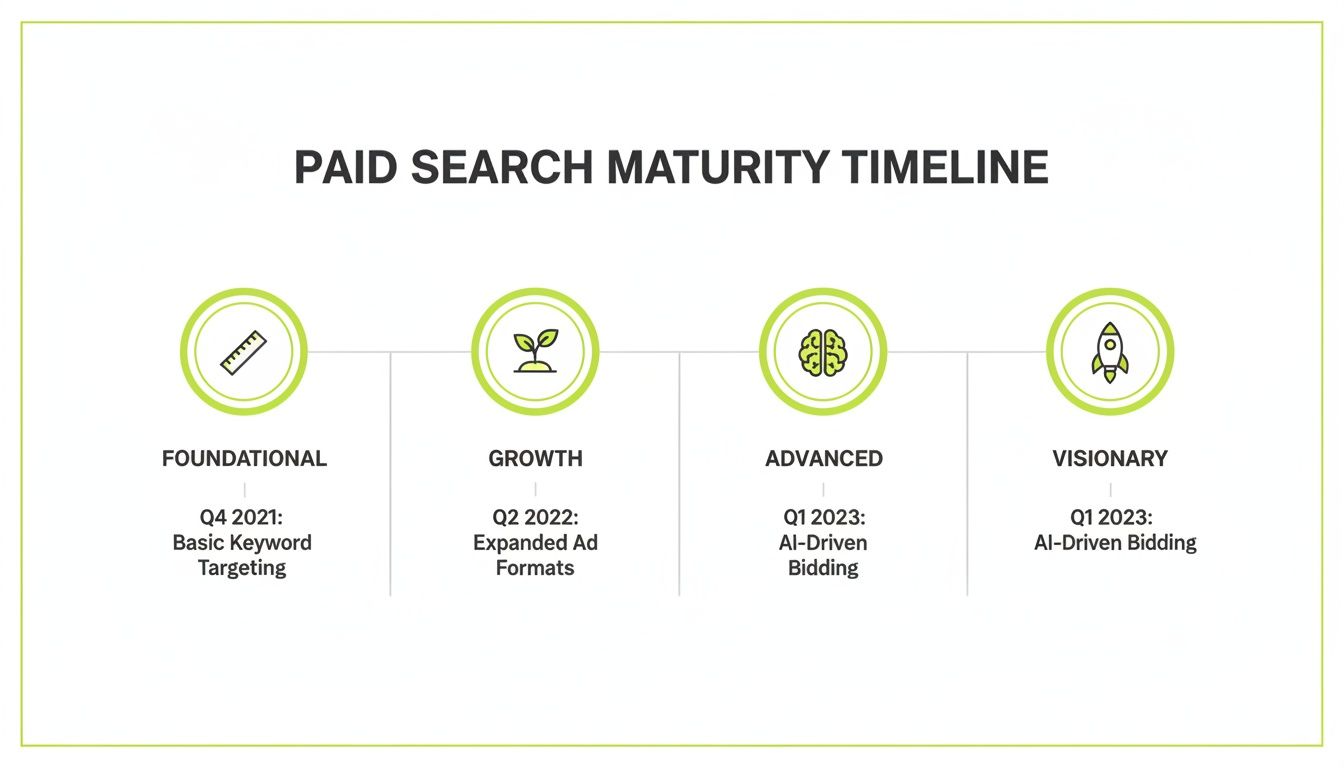
This visual roadmap shows that maturity is a journey. It’s a progressive move from foundational stability toward the kind of advanced, predictive capabilities that create a real competitive advantage.
The tools and concepts are already here. By integrating predictive analytics and business intelligence, companies can build a marketing engine that learns, adapts, and stays one step ahead. As you map out your next move, you can explore more about the role of artificial intelligence in modern business to see its broader impact. Embracing this future is how you turn advertising from an expense into your most powerful growth driver.
Paid Search Intelligence: Your Questions Answered
Moving from old-school PPC management to an intelligence-first approach always brings up good questions. When you start thinking more like a data scientist and less like a campaign manager, the perspective shifts. Here are a few of the most common things we hear from businesses taking that leap.
I'm a Small Business. Where Do I Even Begin?
For a small business, this all comes down to mastering the basics before you even think about buying complex software. Your absolute first step, the one you can't skip, is making sure your conversion tracking in Google Analytics and Google Ads is perfect. This is the foundation for everything else.
Once that’s locked down, just focus on one thing at a time. Start with some simple competitor intelligence—use free or low-cost tools to see what kind of ad copy and landing pages your rivals are running. After that, spend some real time digging into search intent. You want to move past obvious, broad keywords and find those long-tail phrases that scream "I'm ready to buy." This builds a strong, practical base without needing a huge team or budget.
How Is This Different from Just "Doing PPC"?
The biggest difference is the mindset. Standard PPC management is usually reactive; paid search intelligence is proactive. Your typical PPC manager is looking backward, tweaking bids and ad copy based on what happened last week.
An intelligence-driven strategy, on the other hand, is always looking forward. It pulls in competitive analysis, what's happening in the market, and even predictive analytics to see what's coming before it gets here.
Standard PPC asks, "How did our campaign perform last week?" Paid search intelligence asks, "Based on market signals and competitor behavior, what is our most profitable move for next week?"
This adds a strategic layer that turns your ad spend from a simple line item into a real engine for business growth. You stop focusing on short-term tweaks and start building long-term value.
How Do You Actually Measure the ROI on This?
To get the real story, you have to look past simple metrics like Return on Ad Spend (ROAS). Sure, ROAS is important, but a mature intelligence strategy connects your ad budget to much deeper business goals.
You should be tracking KPIs that show the overall health and profitability of the business, like:
- Customer Lifetime Value (CLV): Are you bringing in customers who stick around and buy again? Are they more valuable over the long haul?
- Market Share Growth: Are you capturing a bigger Share of Voice (SOV) against your top competitors in the areas that actually make you money?
- Blended Cost-per-Acquisition (CPA): How is your smarter paid search strategy making your other channels, like organic search, more efficient and lowering your overall cost to get a customer?
When you track these kinds of metrics, you can show exactly how an intelligence-first approach fuels sustainable, profitable growth. The value becomes much clearer than it ever could in a basic campaign report.
At Magic Logix, we don't just manage campaigns; we build proactive, intelligence-driven strategies that turn your paid search data into a true competitive edge. See how our approach can transform your advertising by visiting us at https://www.magiclogix.com.