
Imagine having a weather forecast for your marketing campaigns, giving you the power to see customer actions before they even happen. That, in a nutshell, is digital marketing predictive analytics. It's all about using AI and machine learning to look forward, predicting future outcomes instead of just analyzing what's already in the rearview mirror.
From Rearview Mirror To GPS Navigation
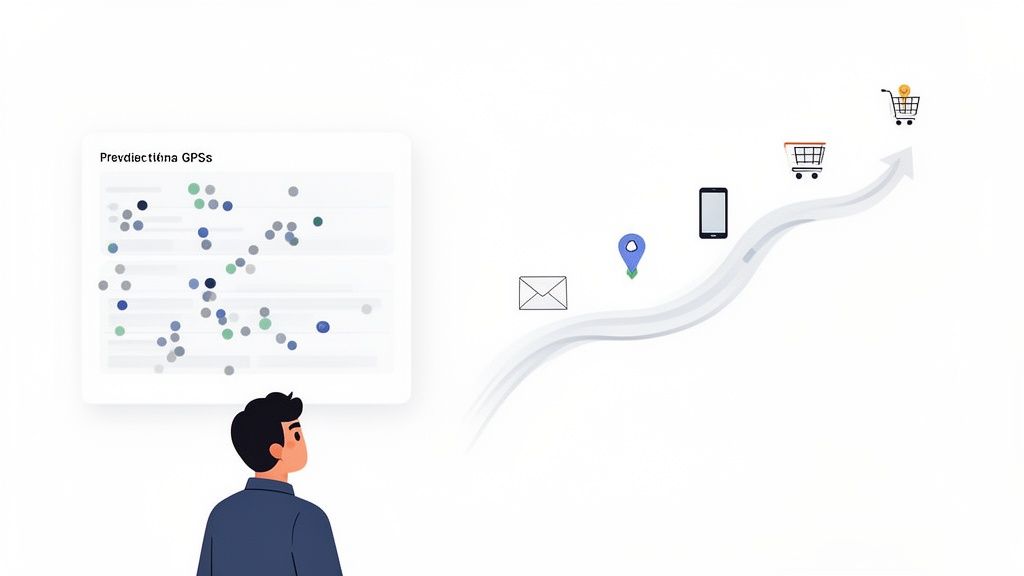
Running a marketing team on traditional analytics alone is a lot like driving a car while only looking backward. You get a perfect view of what just happened—which campaigns took off, which ads bombed, and how users behaved last week. It’s useful information, no doubt, but it’s completely reactive. You're always making decisions based on events that are already over.
Predictive analytics flips that script. It’s the difference between staring in the rearview mirror and turning on a GPS that shows you the traffic ahead, suggests a faster route, and gives you a real-time ETA. Instead of just reporting on historical data, it uses that information to build models that forecast what will likely happen next.
This forward-looking view is what makes it so powerful. It allows marketers to stop being analysts of the past and start being architects of the future.
The Core Idea: Finding Patterns In The Noise
At its heart, the concept is pretty straightforward. By digging through past customer behavior, smart algorithms can spot subtle patterns and calculate the probability of future actions. This isn't about gazing into a crystal ball; it's data-driven forecasting built on solid statistical ground.
The real goal is to get answers to critical business questions before it's too late to do anything about them. This proactive approach transforms how we handle key marketing functions:
- Lead Scoring: Stop guessing which leads are hot. Predictive models can score a lead’s likelihood to convert based on hundreds of tiny data points, telling you exactly where to focus your sales team's energy.
- Customer Churn: Get ahead of customer churn by identifying who is showing early warning signs of leaving. This gives you a crucial window to step in with targeted retention campaigns before they walk out the door.
- Content Strategy: Instead of throwing content at the wall to see what sticks, you can forecast which topics will resonate most with specific audience segments, ensuring your content efforts hit the mark every time.
This shift from reactive to proactive decision-making is why predictive analytics is no longer a niche tool for data scientists. It's becoming a foundational element of modern marketing strategy, enabling a level of precision and efficiency that was previously impossible.
Predictive Analytics vs Traditional Analytics
To really grasp the shift, it helps to see the two approaches side-by-side. Traditional analytics gives you a report card on what you've done, while predictive analytics gives you a game plan for what you should do next.
| Aspect | Traditional Analytics (Looking Back) | Predictive Analytics (Looking Forward) |
|---|---|---|
| Primary Goal | Understand past performance (what happened) | Forecast future outcomes (what will happen) |
| Time Focus | Historical | Future-oriented |
| Key Question | "Why did our sales dip last quarter?" | "Which customers are likely to churn next month?" |
| Methodology | Descriptive statistics, data aggregation | Machine learning, statistical modeling, AI |
| Output | Dashboards, reports, historical summaries | Likelihood scores, forecasts, recommendations |
| Business Value | Informs strategy based on past success/failure | Enables proactive intervention and optimization |
Ultimately, both are valuable, but predictive analytics is what gives you the agility to adapt and win in a constantly changing market.
A Rapidly Growing Market
The widespread move toward these methods signals a fundamental change in how businesses operate. The broader market for data science and predictive analytics is on a tear, projected to hit USD 141.34 billion by 2035 with an impressive 18.8% compound annual growth rate.
This isn't just a trend; it's a reflection of businesses everywhere leaning on forecasting to carve out a competitive edge.
To keep up, marketers need to understand these fundamentals. If you're ready to explore how AI is fundamentally changing the game, check out our guide on unlocking the power of AI for modern marketers.
The Business Impact of Predictive Insights
Understanding the theory behind predictive analytics is one thing, but seeing its real-world effect on the bottom line is what really counts. Let's move beyond the abstract concepts and look at the tangible business results that data-driven forecasting can deliver. We're not talking about small, incremental improvements; we're talking about fundamentally changing how you acquire, keep, and grow your customer base for maximum profit.
Picture two online retailers. The first, "Generic Goods," relies on a traditional scattergun approach. They blast generic email promotions to their entire list and just hope something sticks. Their ad budget is spread thin across broad demographics, and their customer service team only jumps into action when a customer complains. Sure, they make some sales, but their costs are through the roof and customer loyalty is flimsy at best.
Now, let's look at "Insightful Emporium." This retailer uses predictive analytics in digital marketing to guide every single decision. They don't just see customers; they see future opportunities.
Maximizing Marketing ROI
For Insightful Emporium, the marketing budget isn't a sledgehammer—it's a precision instrument. Instead of just guessing, they use predictive lead scoring to pinpoint which prospects are statistically most likely to convert into paying customers.
This allows them to:
- Allocate Ad Spend Intelligently: They can focus 80% of their budget on the top 20% of leads that show the highest purchase intent. This move alone dramatically lowers their customer acquisition costs (CAC).
- Personalize Ad Creatives: Their models predict which message or offer will connect most deeply with specific user segments, making sure their ad creative is always highly relevant. For instance, predictive analytics is a massive help in improving website conversion rates with an AI-driven playbook by spotting user behavior patterns long before someone even clicks "add to cart."
This targeted strategy means they stop wasting money on leads who were never going to buy anyway, instantly boosting their return on investment.
Boosting Customer Lifetime Value
Generic Goods loses customers and often has no idea why until it's far too late. Insightful Emporium, on the other hand, uses predictive churn models to spot at-risk customers before they decide to leave. The system automatically flags users whose engagement has dropped or whose browsing behavior signals they might be unhappy.
This proactive stance completely transforms customer retention. Instead of waiting for a cancellation email, the marketing team can automatically trigger a personalized retention campaign—maybe a special offer or a helpful tutorial—to re-engage the customer and show them they're valued.
By preventing churn, they significantly increase Customer Lifetime Value (CLV), a critical metric for any kind of sustainable growth. They're not just making one-off sales; they are building profitable, long-term relationships.
The Clear Financial Advantage
The difference between these two businesses is night and day. Generic Goods is stuck in an expensive cycle of acquiring new customers and reactively solving problems. Insightful Emporium operates with foresight, making data-driven decisions that are directly tied to revenue, cost savings, and brand loyalty.
This is exactly why the global predictive analytics market is booming. Projections show it rocketing past USD 21.24 billion by 2026 and hitting a massive USD 113.46 billion by 2035. This explosive growth is being fueled by businesses of all sizes realizing that forecasting is the key to staying competitive.
At the end of the day, the business impact is crystal clear. Predictive analytics turns your marketing department from a cost center into a predictable revenue engine, giving you the insights to confidently navigate the latest digital marketing trends.
Your Predictive Analytics Roadmap: A Step-by-Step Guide
Getting started with predictive analytics is all about shifting your marketing from reactive guesswork to a proactive, data-smart operation. This roadmap breaks the whole thing down into four clear stages. Think of it like building a house: you need a solid foundation, the right blueprints, a way to connect the pipes, and a plan for upkeep.
This whole process is about turning raw data into real business growth. It starts with finding the right insights, using those to create personalized experiences, and ultimately, seeing measurable results.
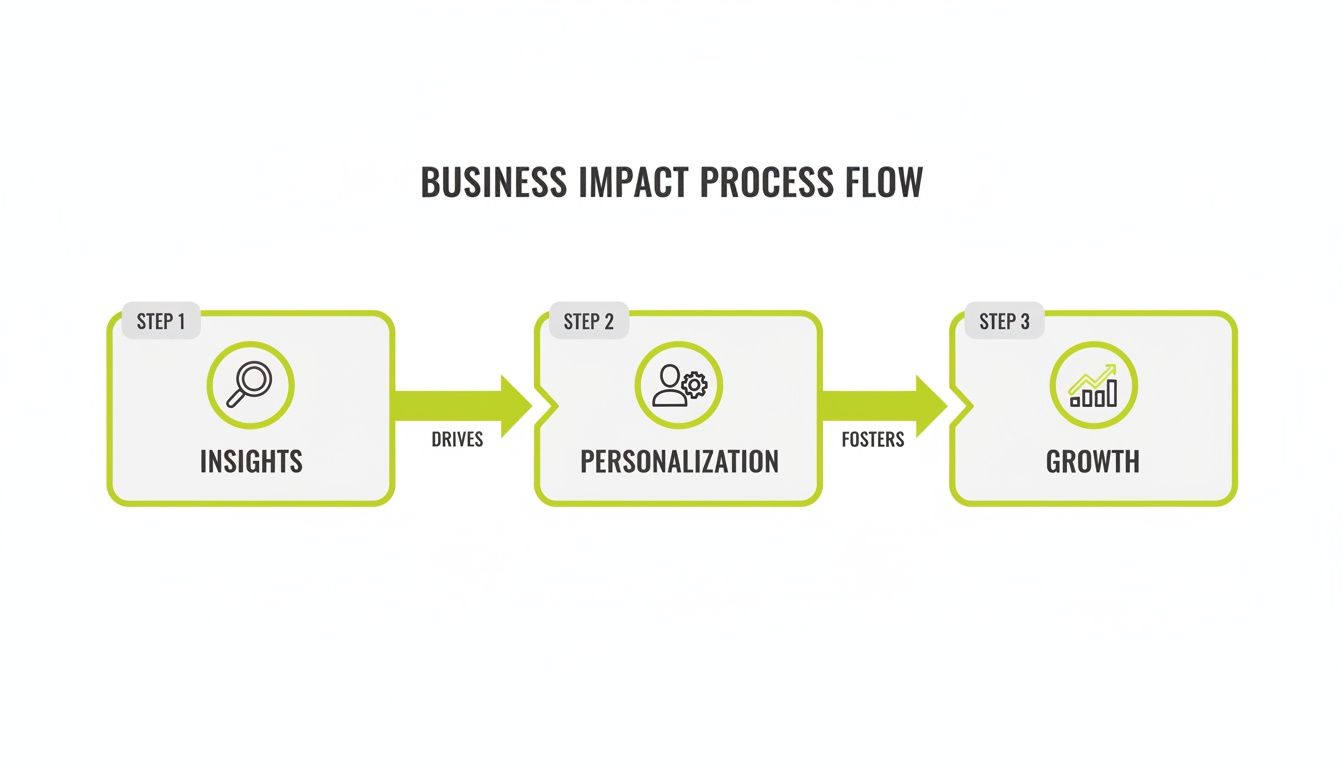
As you can see, powerful insights are the engine here. They fuel the personalization that customers crave, which directly drives sustainable growth for your business.
Stage 1: Build Your Data Foundation
Before you can predict the future, you have to get a firm grip on the past. The first—and most important—step is gathering and prepping the data that will feed your predictive models. This foundation sets the stage for the accuracy of every single insight you generate down the line.
The goal is to create one unified view of your customer by pulling information from all the different places it lives. This isn't just about numbers; it's about piecing together the digital breadcrumbs your customers leave behind.
Typically, your most valuable data sources include:
- Customer Relationship Management (CRM): This is your goldmine. It holds lead information, purchase histories, and all your direct customer interactions.
- Web Analytics Platforms: Tools like Google Analytics are packed with behavioral data—pages visited, time on site, and the paths people take to convert.
- Marketing Automation Systems: Data from your email campaigns, social media activity, and ad platforms show exactly how customers are responding to your marketing.
- Customer Support Logs: Chats and tickets with your support team can reveal pain points and satisfaction levels, which are huge clues about what a customer might do next.
The old saying "garbage in, garbage out" has never been more true than in predictive analytics. Data quality is everything. Taking the time now to clean, standardize, and organize your data will save you from bad predictions and wasted effort later.
Stage 2: Choose Your Models and Tools
Once your data is in good shape, it’s time to pick the right predictive models and the tools to run them. This is where you connect your business goals to a specific analytical approach. You don't need a Ph.D. in data science to start; the trick is matching the model to the question you need to answer.
For marketers, a few models almost always deliver big wins:
- Predictive Lead Scoring: Instead of treating every lead the same, this model scores them based on their likelihood to convert. It learns from the attributes and actions of your past successful customers to pinpoint the hottest prospects in your pipeline right now.
- Customer Churn Prediction: This model acts like an early warning system, flagging customers who are at a high risk of leaving. It spots red flags like dropping engagement or negative support tickets, giving you a chance to step in with a retention campaign before it's too late.
- Customer Lifetime Value (CLV) Forecasting: This model predicts how much revenue a customer will bring in over their entire relationship with your brand. It's a game-changer for identifying your most valuable customer segments so you can focus your budget on finding more people just like them.
The tools for this can range from user-friendly platforms with pre-built models to more advanced open-source options. Your choice really comes down to your team's technical skills and budget.
Stage 3: Integrate and Activate Your Insights
A brilliant predictive model is worthless if its insights are stuck on a spreadsheet. Activation is where the magic happens. This is all about plugging your predictive scores and forecasts directly into the marketing tools you already use every day.
The idea is to automate smart actions based on what the models are telling you. This means building workflows that trigger specific marketing activities as soon as a customer’s predictive score changes.
Think about these real-world examples:
- A lead’s score jumps past a certain point, automatically adding them to a targeted ad campaign and sending an alert to a sales rep.
- A customer gets flagged as a high churn risk, which automatically enrolls them in a re-engagement email series with a special offer.
- A group of users is predicted to be ready for an upsell, so your website automatically shows them personalized product recommendations.
This is how digital marketing predictive analytics moves from being a simple reporting tool to an active, automated system that gets you results in real-time.
Stage 4: Measure and Refine Continuously
Finally, predictive analytics isn’t something you set up once and walk away from. The market shifts, customer behavior changes, and your models need to keep up. This last stage is a constant loop of measuring results and refining your approach.
Start by setting clear Key Performance Indicators (KPIs) to see if your efforts are paying off. Are your high-scoring leads actually converting at a better rate? Has your churn rate dropped since you started predicting it?
Keep a close eye on your model’s performance against what really happens. This feedback is crucial for making your predictions more accurate over time. You’ll periodically retrain your models with fresh data to make sure they stay sharp, relevant, and effective, giving you a consistent edge.
Predictive Analytics in Action Across Digital Marketing
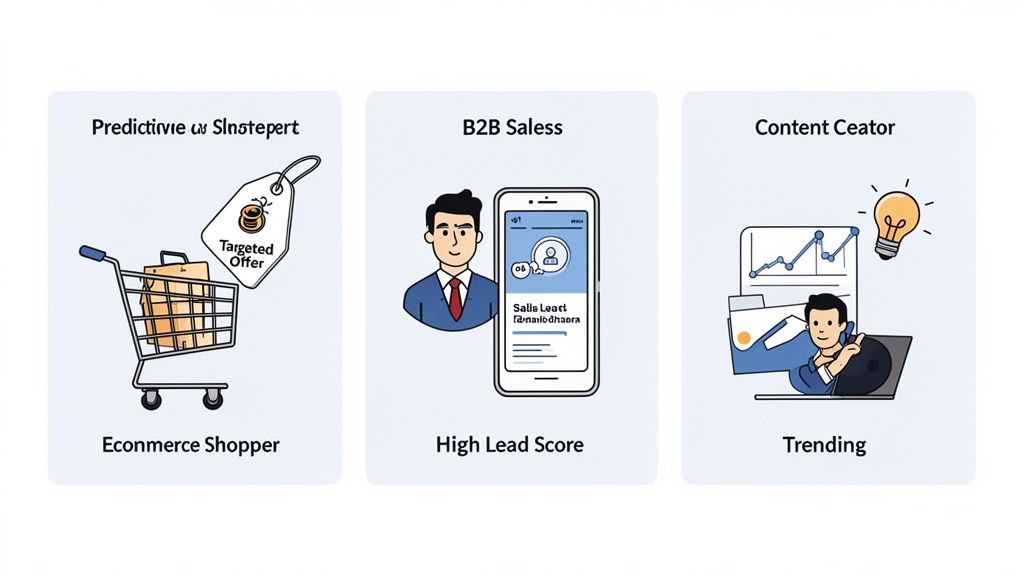
Roadmaps and theory are great, but the real magic of predictive analytics happens when you see it solve actual business problems. Let's move past the frameworks and look at some tangible examples of how companies are turning data into a serious competitive edge.
These aren't far-off concepts. Each scenario tackles a common marketing headache and shows how predictive insights deliver a powerful, targeted solution that gets measurable results today.
Boosting Repeat Purchases for E-commerce Brands
Imagine an online shoe store, "Sole Mates." They get plenty of first-time buyers but can't seem to turn them into loyal customers. Their strategy? Blast a generic "20% off" coupon to anyone who hasn't bought in 60 days. It's expensive, and the results are pretty weak.
This is exactly where predictive analytics flips the script. By digging into past customer data—purchase frequency, average order value, browsing habits—Sole Mates builds a repeat purchase prediction model. This model doesn't just see who's gone cold; it forecasts who is most likely to buy again soon.
The model spots a high-value group of customers who tend to buy new running shoes every 90 to 100 days. Instead of waiting for them to go quiet, the system now automatically sends a personalized email campaign around day 80.
The impact is immediate:
- Targeted Offers: No more generic discounts. The email shows off new arrivals in the customer's favorite brand and correct size.
- Improved Timing: The message arrives just as the customer starts thinking about their next pair of shoes.
- Increased ROI: Marketing dollars are focused on customers with a high probability of converting, slashing wasted spend.
Suddenly, a one-size-fits-all approach becomes a precise, highly effective retention machine.
Prioritizing Leads for B2B Sales Teams
Now, picture a B2B software company called "Innovate Corp." Their marketing team is crushing it, generating hundreds of leads from webinars and content downloads every month. The problem? The sales team is drowning. They have no clue which of the 500 new leads are ready to talk and which are just kicking tires.
To fix this, Innovate Corp. rolls out a predictive lead scoring model. The system sifts through historical data from thousands of past leads, pinpointing the key behaviors and attributes of those who became paying customers.
The model learns that leads who download a specific case study, visit the pricing page three times, and work at companies with over 100 employees are 85% more likely to close.
This single insight completely transforms their sales process. Every new lead gets an automatic score from 1 to 100. The sales team can now filter their dashboard to focus only on leads scoring 80 or higher, dedicating their energy to prospects primed to buy.
This is also where exploring AI Adwords optimization strategies becomes incredibly powerful, as predictive targeting ensures ad spend is directed only at the most promising leads. Our own experience with Google Ads marketing confirms just how effective this laser-focused approach can be.
Forecasting Trends for Content Marketers
Finally, let's look at a lifestyle blog, "Urban Living." The content team faces the age-old question: "What should we write about next?" They pour weeks into creating fantastic articles that get almost no traffic, while a seemingly random post goes viral. It's frustrating and inefficient.
Using predictive analytics, the team creates a content trend forecasting model. This tool pulls data from everywhere—social media chatter, search engine queries, competitor performance—to spot topics gaining steam before they blow up.
The model flags "sustainable home organization" as a topic quickly picking up interest with their target audience. Armed with this data, the Urban Living team produces a series of articles, videos, and social posts on that exact subject. The content goes live just as public interest hits its peak, driving a massive wave of organic traffic, engagement, and new subscribers.
They're no longer guessing what their audience wants. They're predicting it.
Below is a table that breaks down these applications and more, showing how they connect directly to key marketing goals and business outcomes.
Predictive Analytics Applications in Marketing
| Use Case | Marketing Goal | Potential Business Outcome |
|---|---|---|
| Customer Segmentation | Personalize messaging at scale. | Increased engagement, higher conversion rates. |
| Lead Scoring | Prioritize high-quality leads for sales. | Improved sales efficiency, shorter sales cycles. |
| Churn Prediction | Identify and retain at-risk customers. | Lower customer acquisition costs, higher LTV. |
| Product Recommendations | Increase AOV and cross-sell opportunities. | Higher revenue per customer, improved loyalty. |
| Content Trend Forecasting | Create relevant, high-traffic content. | Increased organic reach and brand authority. |
These examples just scratch the surface, but they clearly show how predictive analytics moves marketing from a reactive discipline to a proactive, strategic powerhouse. By anticipating customer needs and market shifts, businesses can make smarter decisions that drive real growth.
Common Pitfalls to Avoid and Best Practices to Follow
Jumping into predictive analytics can be a game-changer, but the road from raw data to real-world impact is full of potential missteps. Pulling off digital marketing predictive analytics successfully isn’t just about having the fanciest software; it’s about having a smart strategy and knowing the common challenges that can trip up even the most ambitious projects.
To get it right, you need to be aware of the mistakes others have made and be proactive with best practices. From the quality of the data you start with to how your team actually uses the insights, every step is critical to seeing a real return on your investment.
Pitfall 1: Ignoring Data Quality
The number one reason predictive models fall flat is painfully simple: garbage in, garbage out. If you feed a sophisticated algorithm messy, incomplete, or just plain wrong data, you’re only going to get flawed and unreliable predictions. It’s an easy mistake to make, and it can doom your entire project before it even gets off the ground.
The best practice here is to treat data preparation as a mandatory first step. Before you even think about building a model, you need to conduct a thorough data audit and cleaning process. This means you’ll be:
- Validating data sources to make sure they’re accurate and relevant.
- Standardizing formats across all your platforms (e.g., making sure "USA" and "United States" are treated as the same thing).
- Handling missing values, either by removing incomplete records or using statistical methods to fill in the blanks.
A clean, well-structured dataset is the bedrock of accurate predictions. Investing time in data hygiene upfront prevents costly errors and builds trust in the model's outputs down the line.
Pitfall 2: Misaligning Models with Business Goals
Another classic mistake is building a complex model that doesn’t actually solve a real business problem. It’s easy to get lost in the technical weeds of machine learning, but if your churn prediction model doesn't give the team clear, actionable steps to reduce churn, it’s just an expensive science project.
Always start with the business question, not the technology. What outcome are you trying to drive? Are you looking to boost customer lifetime value, cut wasted ad spend, or get more leads to convert? Once you have a crystal-clear goal, you can pick the simplest model that gets the job done. This approach keeps your efforts laser-focused on delivering results you can measure.
This strategy is especially powerful for smaller businesses. In fact, small and medium-sized enterprises are the fastest-growing segment in the predictive analytics market, expected to grow at a CAGR of 24.15% through 2035. They use predictive insights to make the most of limited resources by zeroing in on high-impact goals. You can learn more about this trend from a report on the predictive analytics market at Roots Analysis.
Pitfall 3: Failing to Integrate and Activate
Finally, even a perfect predictive model is useless if its insights are trapped on a dashboard somewhere. The goal isn’t just to know which leads are hot; it’s to act on that knowledge automatically and at scale. When businesses fail to plug predictive scores into their marketing automation platforms and CRMs, they leave a massive opportunity on the table.
The trick is to think "start small, iterate, and scale." Begin by integrating one predictive model into a single, simple workflow. For instance:
- Start Small: Automatically tag high-propensity leads in your CRM.
- Iterate: Set up a workflow that shoots an immediate alert to a sales rep when a lead gets that tag.
- Scale: From there, build an automated email nurture campaign tailored specifically to these high-value leads.
This step-by-step approach ensures your digital marketing predictive analytics program starts delivering value right away and grows with your team, truly changing how decisions get made.
Partnering for Success in Predictive Analytics
Throughout this guide, we’ve unpacked how predictive analytics can shift your marketing from rearview-mirror reporting to a forward-looking strategy. It’s the difference between reacting to what’s already happened and actively shaping what comes next, turning your data into a reliable forecast for customer behavior.
This powerful approach is more accessible than ever, but getting from raw data to actionable insights isn't always a straight line. It takes real expertise. This is where having the right partner becomes a game-changer, acting as an accelerator on your journey to smarter growth.
Why a Partner Accelerates Your Success
Going it alone on a digital marketing predictive analytics initiative can be a slow, frustrating process. An experienced team helps you sidestep the common pitfalls and get to a positive return on your investment much faster. A true partner doesn’t just hand you a tool; they help you build a complete, integrated system that actually drives business outcomes.
A knowledgeable partner helps you:
- Develop a Clear Data Strategy: They’ll start by assessing your existing data, identifying any gaps, and building a solid foundation you can trust for accurate modeling.
- Build Custom Models: Forget one-size-fits-all solutions. They create predictive models tailored specifically to your business goals, whether that’s slashing customer churn or supercharging your lead scoring.
- Ensure Full Integration: They make sure predictive insights are wired directly into your marketing workflows, so you can automate intelligent actions across all your campaigns.
The right partnership isn't about outsourcing a task—it's about embedding expertise into your team to build a sustainable competitive advantage and see results faster.
This collaborative approach ensures your predictive analytics program becomes a core driver of your marketing success, not just another tech project. If you're ready to build a roadmap that unlocks your company's full potential, exploring a provider's digital marketing capabilities is the perfect next step.
Frequently Asked Questions
When you start digging into predictive analytics for digital marketing, a lot of practical questions pop up. Let's tackle some of the most common ones marketers ask as they get started.
How Much Data Do I Need to Start?
This is probably the biggest misconception out there. You don't need "big data," but you absolutely need good data. The goal is to have enough clean, relevant history for a model to actually learn patterns.
Think about it this way: to predict which customers might leave (churn), you'd want several months of their purchase history, how often they log in or open emails, and any interactions they've had with your support team. A CRM with at least a year's worth of consistent records is a fantastic starting point. A quick data audit is always the first step to see what you have and what's most valuable.
Is Predictive Analytics Only for Large Companies?
Not anymore. A decade ago, this was a tool reserved for enterprise giants with massive data science teams. Today, the game has completely changed. Cloud platforms and more accessible tools have put predictive analytics squarely in the hands of small and medium-sized businesses.
For many SMEs, it’s a massive competitive advantage.
By using predictive insights, smaller companies can make tight marketing budgets work harder, target niche audiences with surgical precision, and dramatically improve customer retention. The trick is to start small—pick one high-impact business problem to solve first, rather than trying to boil the ocean.
How Quickly Can We Expect to See Results?
The timeline varies, but you can see the first wave of insights surprisingly fast. Building your initial model might spit out a list of your most valuable customer segments in just a few weeks. That alone can give your strategy immediate focus.
However, seeing a major, measurable ROI—like a sustained jump in sales or a real drop in churn—usually takes a few months. That time is crucial for integrating the model's predictions into your live campaigns, seeing how they perform, and then feeding that new data back to refine the model. It's a cycle, and the positive impact grows and compounds with each iteration.
Ready to stop reacting and start predicting? The team at Magic Logix can help you build a tailored predictive analytics roadmap that turns your data into your most powerful marketing asset. Learn how our experts can accelerate your growth today.