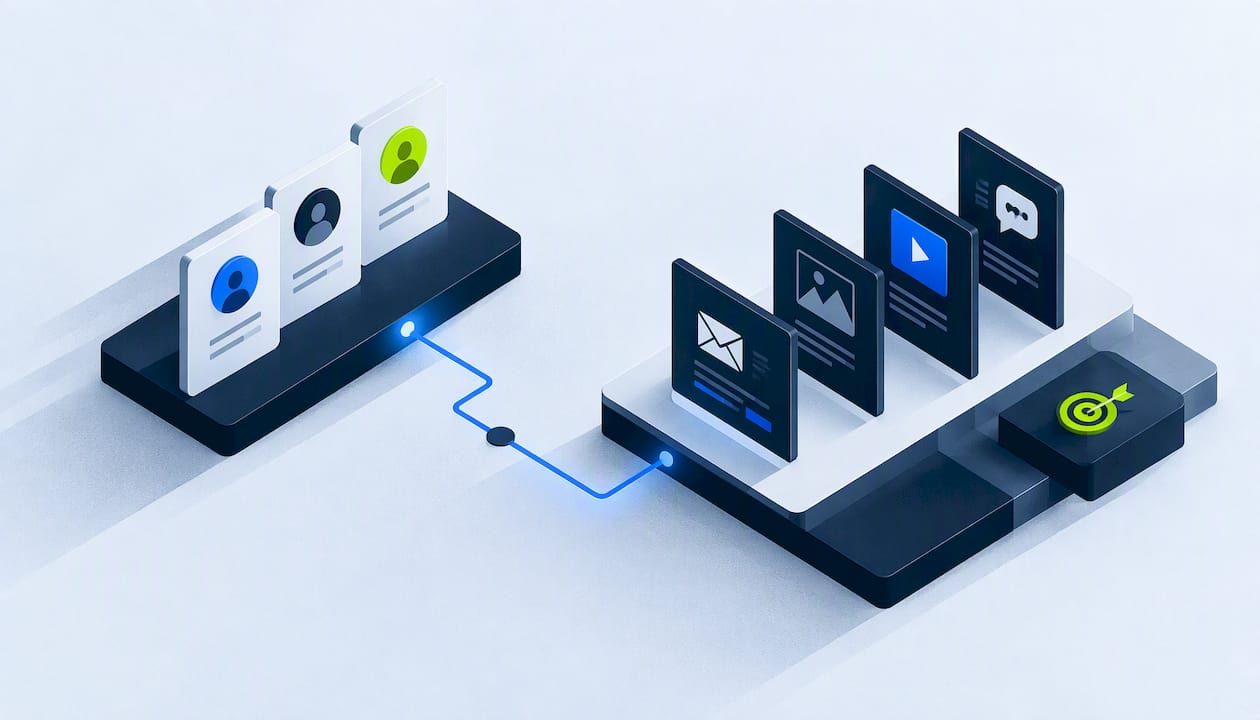
ABM advertising is the paid-media side of account-based marketing (ABM). Instead of buying reach across a broad audience, you pick a list of named companies and show ads, in display, social, search and retargeting, to the people who influence buying decisions there. Account-based advertising is one component of the wider ABM strategy, which also includes outreach, email, events, content and web experiences.
It pays off most when deals are large, cycles are long and several people sign off. If you sell a $30 product to individuals, it is the wrong tool. If you sell a six-figure service to a buying committee, it deserves a serious look.
TL;DR
- ABM stands for account-based marketing. ABM advertising is the paid part: ads aimed at named accounts and the buying committee inside them.
- Start with the account list, not the ad. Sales and marketing agree on an ideal customer profile (ICP), score accounts and validate the list together.
- Platforms for ABM are usually sold on annual contracts, and ad media is often priced separately, so budget for software and media as two lines.
- Judge success at the account level: engagement, pipeline, deal speed and revenue, compared against accounts you did not advertise to.
- Expect longer cycles. Reported study data shows better ROI but slower closes, so do not grade the program on a few weeks of lead counts.
Table of Contents
- What ABM stands for and how ABM advertising differs from ABM overall
- How account-based advertising works
- How to choose target accounts and plan the campaign
- ABM advertising examples
- Benefits and limits to expect
- Choosing ABM platforms and software
- How to measure ABM advertising
- Our perspective
- Where Magic Logix can help
- A 90-day starting plan
- Frequently asked questions
- Sources
What ABM stands for and how ABM advertising differs from ABM overall
ABM means account-based marketing. The IAB’s B2B ABM playbook describes it as sales and marketing aligning around an agreed set of target accounts and using data-driven, customized communications to move buying committees through the customer journey.
The distinction that matters for this keyword:
| Account-based marketing | Account-based advertising | |
|---|---|---|
| Scope | Whole go-to-market strategy | Paid-media component |
| Channels | Sales outreach, email, events, content, web experiences, ads | Display, social, programmatic, search, retargeting |
| Owner | Sales and marketing together | Usually marketing, informed by sales |
| Success depends on | Alignment and orchestration | Account list quality, data and creative relevance |
The IAB’s view is that ABM is not only an advertising tactic: the shift toward marketing and sales alignment is what makes the strategy work. Ads without sales follow-up tend to produce impressions, not meetings.
One more framing from Adobe’s ABM guide: ABM is a strategy, not a piece of technology. Teams move from asking “who is interested?” to “who would benefit?” and then coordinate an experience for the whole buying group rather than chasing lead volume.
How account-based advertising works
Think of traditional B2B advertising as a floodlight and ABM advertising as a spotlight. The mechanics follow a simple order.
- Choose named accounts. HubSpot’s guide treats account selection as the starting point, with campaigns hyper-targeted and hyper-personalized to those accounts.
- Match accounts to people. Firmographic, intent, behavioral and identity data connect a company name to individuals and devices.
- Serve ads where those people are. Display, social, search and retargeting are the common placements.
- Personalize. Messaging can vary by account, domain, role, seniority, buying stage and account-specific needs.
- Follow up. Sales acts on engagement while it is fresh.
How ABM display ads are targeted
The weak spot in many programs is the matching step. IP-based matching reaches everyone on a company network, including people who will never touch the purchase. ZoomInfo’s targeted-display guide says you can layer company or domain, job title and seniority filters to reach likely buying-committee members, and that identity-resolved contact data can be more precise than probabilistic IP matching.
When you brief a vendor or an agency, ask three questions:
- How are accounts matched to audiences: IP, identity data, or both?
- What is the typical match rate for your list size?
- Can we exclude existing customers and active opportunities?
There is also a web side. Adobe describes account-based web personalization as identifying a visitor’s company, comparing it with a predefined account list in real time and showing a tailored message, offer or call to action. An ad that promises something specific and then lands on a generic homepage wastes the match. Our guide to website personalization examples shows how that landing experience can work.
How to choose target accounts and plan the campaign
The IAB playbook lays out a sequence that holds up in practice: agree on goals, identify and score an ICP-based target list, identify buying committees, validate the audience with sales, then plan tailored content and channels.
A practical planning checklist
- Define the goal in one sentence. For example: “Open conversations with 40 of our 150 named accounts this half.” Pick your own numbers; these are illustrative.
- Build the list from fit and potential. Start from ideal-customer fit and revenue potential, as ZoomInfo’s overview describes, then layer intent and behavior.
- Let sales veto. If your sales team does not recognize half the list, the list is wrong.
- Map the committee. Typically an economic buyer, a user-side champion and a technical or finance reviewer. Write a different message for each.
- Decide the tier. One-to-one for your top handful, one-to-few for clusters with shared problems, one-to-many for the rest.
- Agree on follow-up. Who calls whom, within how many days, after which signal?
Segmentation work upstream makes tiering easier. Our piece on B2B marketing segmentation covers how to group accounts by need rather than just size.
Matching effort to tier
| Tier | Accounts | Creative approach | Best for |
|---|---|---|---|
| One-to-one | A handful | Custom ads and landing pages per account | Largest, most strategic deals |
| One-to-few | Clusters sharing a problem | Segment-level messaging by industry or use case | Mid-sized target lists |
| One-to-many | Broad named list | Templated ads with light personalization | Wider lists with lower deal values |
ABM advertising examples
Formats that show up repeatedly: programmatic display, LinkedIn paid ads, content syndication and retargeting. HubSpot notes that the effort is best justified for complex, high-ticket, longer-cycle purchases with multiple stakeholders.
Two concrete illustrations:
- Account-specific landing pages. A 2020 case study from Unbounce describes a pilot by Procurify that built 50 highly personalized landing pages and combined them with video boxes, direct outreach and email follow-ups. The pilot reported a 38% overall demo rate, and YouTube video-ad cost per click was roughly a quarter of search’s. It is one company’s pilot in Canada, not a benchmark you should expect to reproduce.
- Air cover plus follow-up. Salesloft’s ABM guide describes display ads giving target accounts “air cover,” event-based advertising and follow-up, and stage-specific ads that help move deals along.
The pattern: ads warm the account, a personalized destination converts attention, and a human follows up.
Benefits and limits to expect
Benefits. Spend concentrates on accounts that could actually buy. Messages can speak to account-specific needs, which, as TechTarget explains, can improve relevance, strengthen relationships and raise the likelihood of conversion.
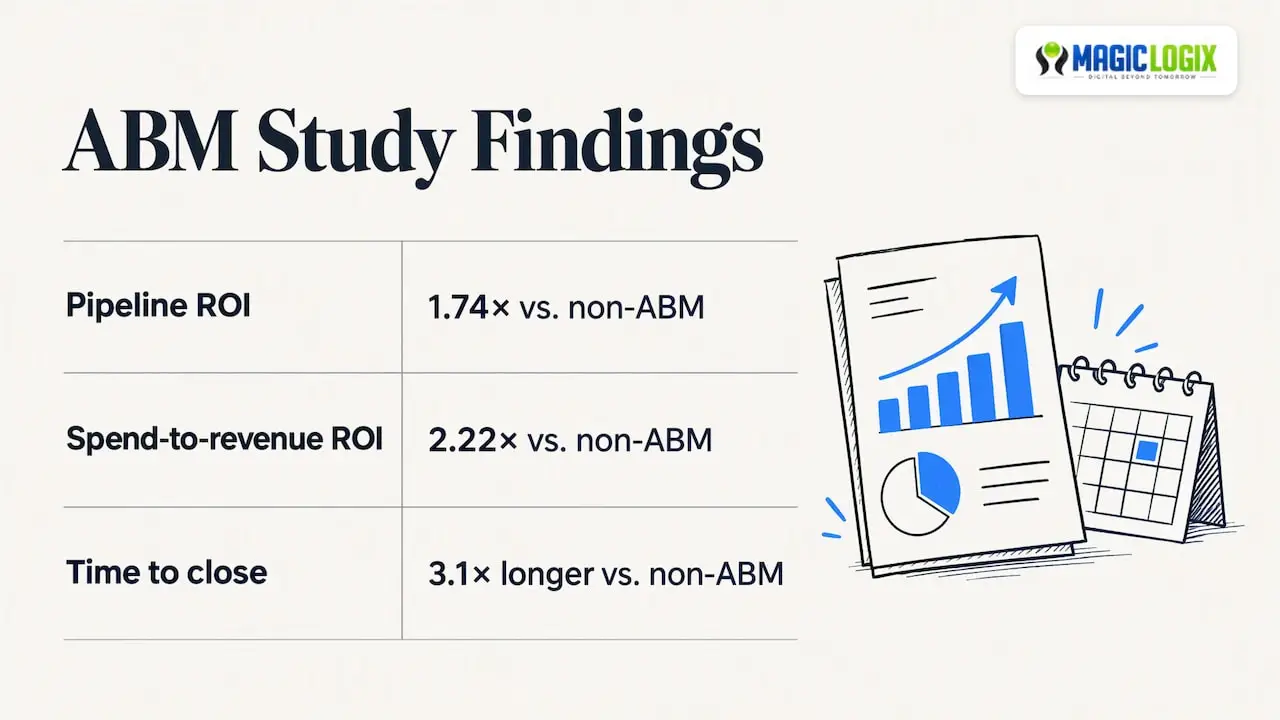
Limits. Personalization requires you to know a select group of accounts well. And the numbers cut both ways. HockeyStack’s study of ABM data, covering January 2023 to March 2024, reported 1.74 times better pipeline ROI and 2.22 times better spend-to-revenue ROI than non-ABM campaigns, while ABM deals took 3.1 times longer to close. Those are one dataset’s findings, not universal benchmarks, but the lesson is useful: ABM can justify a higher upfront cost through bigger opportunities, and you must plan for longer cycles.
Data is the other recurring snag. A summary of a 2018 survey reports that 65% of respondents saw challenges with data availability or quality, alongside organizational buy-in, attribution and orchestration. The survey is older, but those problems still show up in kickoff calls.
Choosing ABM platforms and software
Many readers arrive wanting a ranked list of ABM platforms. A ranking depends on your data, your CRM and your sales motion, so here is how to evaluate by category instead.
| Category | What it does | Questions to ask |
|---|---|---|
| Marketing automation with ABM features | Runs omnichannel campaigns, personalization, sales alignment and analytics for targeted audiences | Does it connect cleanly to our CRM and ad accounts? |
| Intent and predictive account intelligence | Combines buying signals and models to show who to engage, why and when | Where does the signal data come from, and how fresh is it? |
| Advertising-led ABM platforms | Build account lists from intent data, customize journey stages, show account events | Which features sit behind paid tiers? |
| Enterprise suites with integrated ads and sales intelligence | Bundle ads, data and sales tools | What is optional: data records, seats, media? |
| Demand-side platforms (DSPs) | Buy programmatic display inventory directly | Who builds audiences and manages optimization? |
The capability descriptions come from vendor pages such as Adobe’s Marketo Engage page and 6sense’s homepage, so treat them as claims to test in a demo.
What ABM platforms cost
Major platforms generally do not publish list prices, so you will request quotes. Some patterns to plan for:
- One media-industry report says an enterprise ABM suite requires an annual contract and prices advertising media separately on CPM terms, with extra data records and sales-intelligence seats possibly optional.
- A 2026 comparison reports open-web display CPMs of about $5 to $15 on one major demand-side platform and $5 to $20 on another, with higher costs for narrower audiences or premium inventory.
Budget software and media as separate lines, and confirm the contract term before you sign. For a pilot of a few dozen accounts, a smaller toolset plus a managed paid-media team often beats a full suite you will not use for six months.
If you are comparing broader tooling, our roundup of customer engagement platforms is a useful companion.
How to measure ABM advertising
Click-through rate tells you little here. Your audience is small, and the buyer who matters may never click. Measure at the account level across four layers, following Mutiny’s measurement framework:
- Account engagement: multi-contact activity such as site visits, content downloads, event attendance, ad clicks, demos and meetings.
- Pipeline contribution: separate sourced opportunities from influenced ones.
- Deal velocity: time between stages, compared with a non-ABM benchmark.
- Revenue impact: closed-won value, average contract value, expansion revenue and customer acquisition cost.
The comparison is what makes the numbers credible. RollWorks’ documentation recommends comparing ad-influenced and non-ad-influenced accounts on sales-cycle length, opportunity win rate and average opportunity size. Before launch, record a baseline in your CRM: opportunity stage, known contacts, site visits and past content engagement. Where you can, hold out a matched set of accounts that see no ads.
A monthly review rhythm that works:
- Weekly: delivery, match rate, frequency, sales feedback.
- Monthly: accounts engaged versus target, new contacts reached, meetings booked.
- Quarterly: pipeline created, stage movement, win rate, cost per opportunity versus baseline.
Ongoing monitoring and optimization is where many programs slip, and the principles in this guide to reporting for ad campaigns carry over well to account-based work. For the wider metrics picture, see our pieces on measuring digital marketing effectiveness and digital marketing performance metrics.
Our perspective
We see ABM advertising fail for ordinary reasons, not exotic ones. The list is built by marketing alone. The landing page is generic. Nobody in sales knows a campaign is live. The dashboard shows impressions, and leadership asks about pipeline.
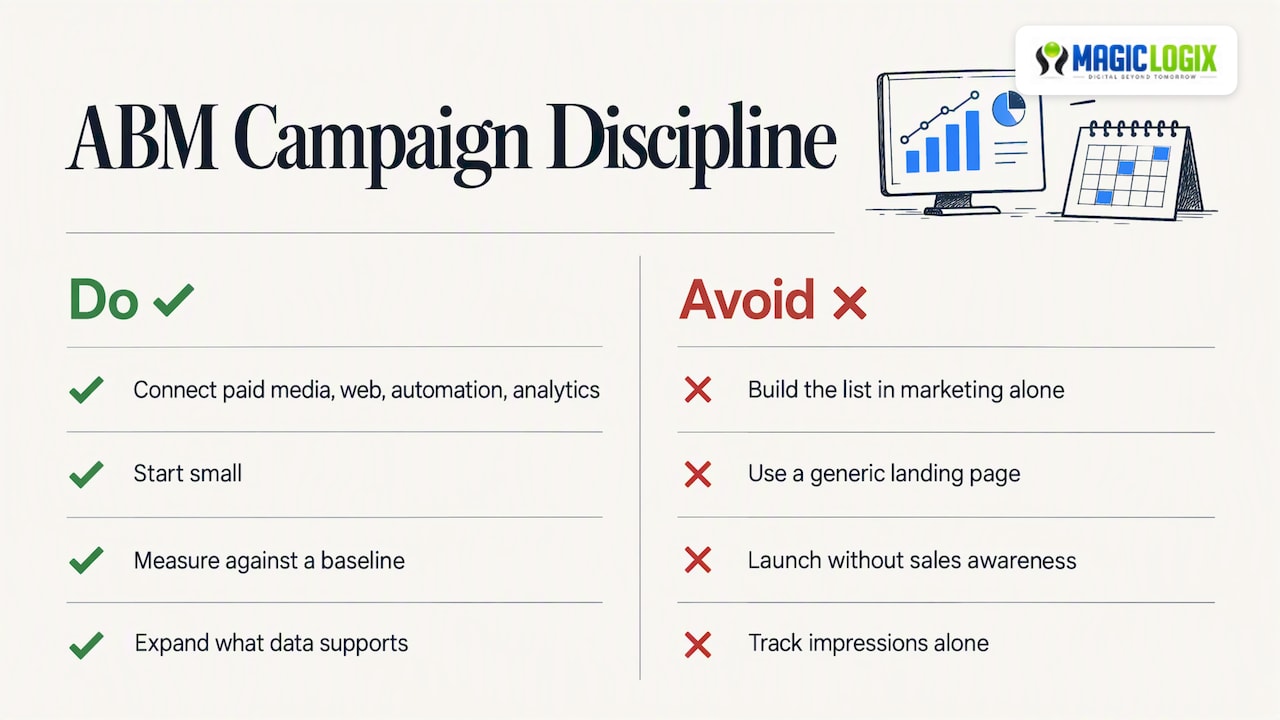
The fix is unglamorous. Treat the ad as one touchpoint in a journey that includes your site, your retargeting, your automation and your sales team. That is why we approach it as connected work: paid media, personalized web experiences, marketing automation and analytics planned together, which fits how we think about Digital Beyond Tomorrow. Our retargeting checklist, with privacy controls, QA and holdouts, reflects the same discipline.
We also think honesty about uncertainty helps. Match rates, intent signals and platform features change, and no vendor or agency can promise a specific ranking, citation or deal count. Start small, measure against a baseline and expand what the data supports.
— Hassan Bawab
Where Magic Logix can help
If you want a second set of eyes on your account list, ad setup or measurement plan, our Digital Marketing & Paid Media services cover paid campaigns and the analytics around them. When the landing experience is the bottleneck, our team can also work on website design and development. To talk through your situation, contact Magic Logix for a consultation.
A 90-day starting plan
- Weeks 1 to 2: Agree on goals, ICP and a starter list of 50 to 150 accounts with sales. Capture CRM baselines.
- Weeks 3 to 4: Map buying committees. Write messaging per tier and role. Build landing pages for your top tier.
- Weeks 5 to 6: Launch on one or two channels, such as LinkedIn and programmatic display, plus retargeting. Set a holdout group if you can.
- Weeks 7 to 12: Review weekly with sales. Cut weak creative, adjust targeting, expand only what moves accounts forward.
This is an example framework, not a guarantee. Complex sales often take longer than 90 days to show closed revenue, so judge the first quarter on engagement and pipeline creation.
Frequently asked questions
What does ABM stand for in advertising?
ABM stands for account-based marketing. In advertising, it refers to paid campaigns aimed at a defined list of target accounts rather than a broad audience. Those campaigns usually run across display, social, search and retargeting.
What is the difference between account-based advertising and ABM display ads?
Account-based advertising is the whole paid approach to named accounts. ABM display ads are one format within it, delivering banner or native creative to people at those accounts across the web. Most programs combine display with social and retargeting.
Is ABM advertising worth it for a small business?
It can be if you sell high-value, multi-stakeholder deals and can name your best-fit accounts. The effort is hard to justify for low-priced, short-cycle purchases. Smaller teams often start with a short list and one or two channels.
How long does ABM advertising take to show results?
Engagement signals can appear within weeks, but pipeline and revenue take longer. One study of ABM data found deals taking about 3.1 times longer to close than non-ABM deals, so plan reviews around full sales cycles.
Sources
- What Is Account-Based Advertising?
- Pre-demo targeted display ads
- B2B Account-Based Marketing Playbook (IAB)
- The Definitive Guide to Account Based Marketing
- How to Succeed in Account-Based Advertising
- How Procurify Scored a Ton of Demos with ABM & Landing Pages
- What Is Account-Based Marketing? An Intro Guide to ABM
- How to effectively personalize your ABM strategy
- The State of ABM
- Using Buyer Intent Data to Manage Account-Based Marketing Risks
- Marketo Engage marketing automation platform
- 6sense revenue intelligence platform
- MarTech Intelligence Report: Enterprise ABM
- Programmatic Display for ABM: DSP + Audience Setup
- How to Measure ABM: Metrics That Prove ROI
- Revenue Impact Report documentation