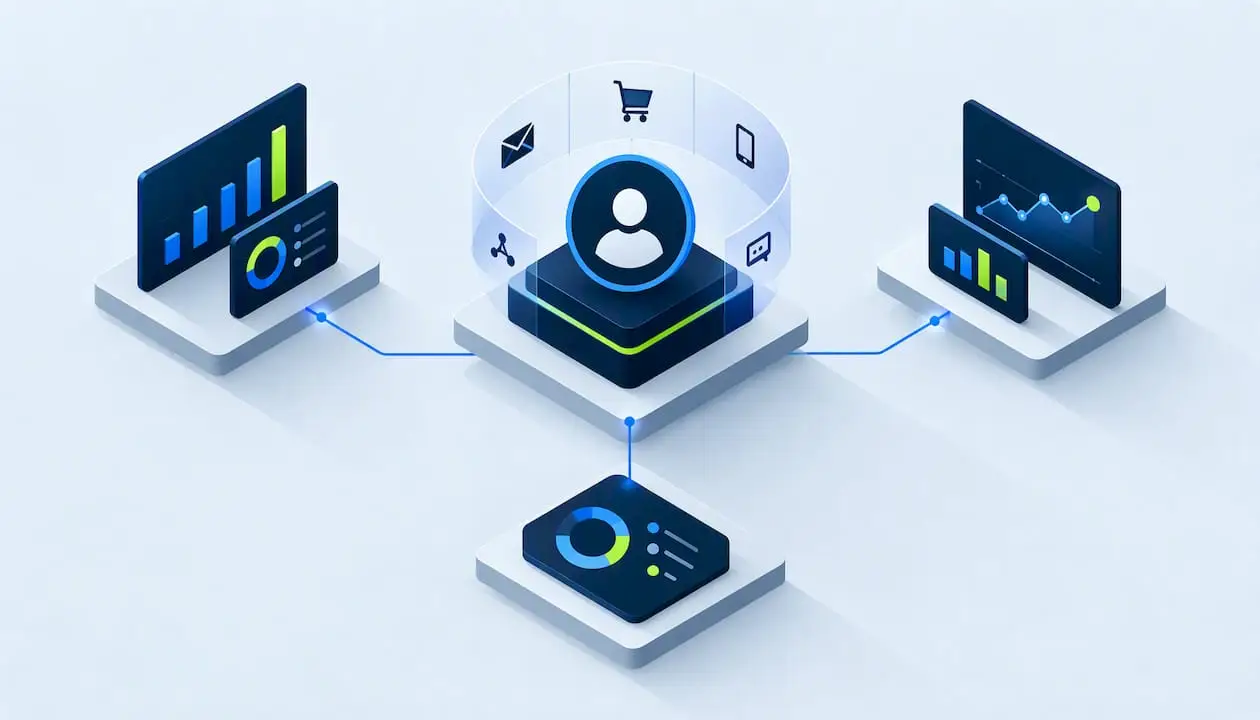
Omnichannel strategy is a customer-centered plan that connects your web, mobile, store, social and service channels into one continuous experience. The payoff is consistency: customers who never have to repeat themselves tend to stay longer and spend more overtime. Below, we walk through the definition, the pillars, a phased roadmap, the technology, the measurement and a checklist you can bring to your next leadership meeting.
TL;DR:
- A poor product or service experience drove 52% of consumers to stop buying from a brand, while 29% cited poor customer experience.
- Start with one high stakes journey, define two or three business KPIs, and run a fixed window pilot before expanding across channels.
- Build identity matching before adding personalization models; prioritize identity first, event capture second, and activation through APIs, so models do not target the wrong person.
- Because 93% of consumers say mishandled personal data harms trust, limit intrusive signals, honor consent, and assign a governance owner from day one.
Table of Contents
- What omnichannel means and how it differs from multichannel
- What omnichannel delivers: benefits and measurable outcomes
- Core pillars of an effective omnichannel strategy
- How to build an omnichannel strategy step by step
- Technology and data architecture essentials
- How to measure omnichannel performance
- Data governance, privacy and consent
- Quick decision checklist for your next leadership meeting
- Examples of omnichannel strategies across industries
- The role of AI and machine learning in omnichannel personalization
- Challenges and common pitfalls, and how to overcome them
- Voice, AR/VR and IoT in an omnichannel approach
- Magic Logix perspective: connected data beats more channels
- Request a diagnostic or consultation
- FAQ
- Sources
What omnichannel means and how it differs from multichannel
Omnichannel means every channel shares the same customer data, the same messaging and the same memory of what the customer already did. Multichannel retail strategy is different: you are present in many places, but each one runs on its own, with its own team, its own data and sometimes its own offer.
The contrast shows up fast in practice. In a multichannel setup, a shopper who abandons a cart on your site gets a discount email from marketing while the store associate quotes full price. In an omnichannel setup, one profile ties those moments together.
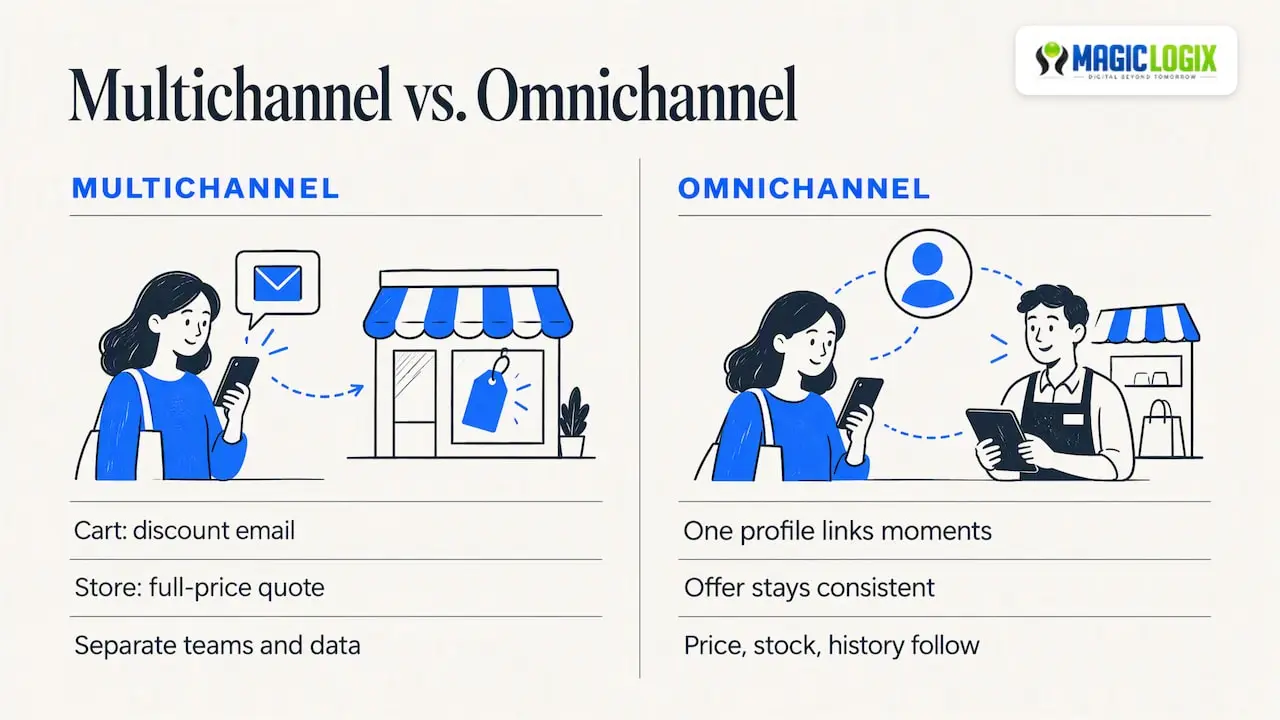
Picture a customer who browses a jacket on mobile, saves it, checks store stock from the product page, tries it on in person and later asks service about an exchange. The price, the stock status and the conversation history follow them at every step. Nothing is repeated, and nothing contradicts the last touchpoint.
What omnichannel delivers: benefits and measurable outcomes
Leaders invest in omnichannel because the experience gaps between channels cost real customers. PwC’s 2025 Customer Experience Survey reports that:
52% of consumers stopped using or buying from a brand after a bad product or service experience, and 29% named poor customer experience as the reason.
That is the risk side. The upside shows up in a handful of areas:
- Retention: a consistent experience gives customers fewer reasons to leave.
- Average order value: relevant recommendations that follow the customer across channels support larger baskets.
- Satisfaction: customers notice when service already knows their history.
- Brand consistency: one voice and one offer across touchpoints builds recognition.
The KPIs most often affected are average order value, repeat purchase rate and NPS, along with behavioral proxies such as cross-channel conversion and service contact rates. Pick two or three before you start, so you can tell whether the work is paying off.
Core pillars of an effective omnichannel strategy
Think of these pillars as the framework for organizing teams, budget and vendor choices. Every one of them depends on the others, so weak spots tend to show up quickly.
- Customer 360 and unified identity: one profile per person, built through reliable identity matching and kept clean. Profile quality decides how good everything else can be.
- Channel experience and thematic cohesion: consistent messaging, design and offers at every touchpoint. Academic work on customer journey design points to thematic cohesion, consistency, context sensitivity and connectivity as the dimensions that shape omnichannel experience.
- Orchestration and automation: journey orchestration, often through a cross-channel marketing hub, coordinates what happens next in each channel. Our guide to customer journey orchestration covers the data and governance side.
- Analytics and activation: real-time signals feed personalization, so the right message reaches the customer at the right moment.
- Governance: a cross-cutting pillar covering consent, access and data quality. It sits under every other pillar, not beside them.
Pro Tip: Assign one named owner to each pillar before you buy any tools. Unowned pillars are where most roadmaps stall.
How to build an omnichannel strategy step by step
Here is a phased roadmap you can assign and budget for. It follows the same logic as the IAB’s cross-channel measurement playbook, which starts with objectives and KPIs and ends with continuous improvement.
- Define goals and KPIs. Set SMART targets tied to revenue, retention or cost to serve, and get sales, service, marketing and IT to agree on them.
- Map priority journeys. Choose the journeys where a break costs the most, then find the high-impact micro-moments inside them. Customer journey analytics helps you see where customers actually drop off.
- Audit tech and data. Inventory your systems, find where identity breaks and scope a minimum viable Customer 360. Our guide to CRM marketing integration recommends mapping leads before choosing tools.
- Run a time-boxed pilot. Pick one journey, one cross-functional team and a fixed window. An 8 to 12 week timeline is a useful model for planning multi-week activations.
- Scale and institutionalize. Automate what worked, add governance and keep a measurement loop running.
For each phase, keep a short list of outputs:
- A one-page goal statement with owners
- A journey map with the break points marked
- A data gap list ranked by impact
- A pilot brief with scope and success metrics
Technology and data architecture essentials
The most practical pattern for Customer 360 is the one in the AWS Big Data Blog: five pillars covering data collection, unification, analytics, activation and governance. It also advises building identity processing and governance as foundations, not afterthoughts.
In practice, these building blocks do the work:
- Customer data platform (CDP): collects and unifies profiles from web, app, store and service.
- Warehouse or lake: holds history for analytics and modeling.
- Identity linking: connects the same person across devices and channels.
- Orchestration tools: decide and trigger the next action in each channel.
Set your integration priorities in this order: identity first, event capture second, API-driven activation third.
Plan for effort. Forrester’s implementation checklist notes that cross-channel marketing hubs involve data management, analytics, experience design, orchestration workflows and integrations, so they need a comprehensive implementation plan and are not plug-and-play.
How to measure omnichannel performance
Start with business-aligned KPIs and SMART targets, then choose attribution only to inform the decisions you actually face. The IAB playbook recommends auditing technical and team capabilities, building a unified data strategy and selecting attribution approaches before you report anything.
No single method answers every question, so use a mix:
- Experiments for causal answers on specific tactics
- Data-driven attribution for day-to-day channel credit
- Econometric modeling where channels are hard to track at the user level
- Revenue-level journey views, such as user journey mapping tied to revenue, to connect visits to outcomes
Then build the routine around it. Set up dashboards and automated reporting, hold a regular measurement review and name an owner for measurement integrity. Audit your tagging and data pipelines on a set cadence, because a quiet tracking failure can distort months of decisions.
Data governance, privacy and consent
Personalization only works while customers trust you with their data. PwC’s survey found that 93% of consumers say mishandling personal data in personalization efforts carries a significant penalty to trust.
Three practical steps protect that trust:
- Use consent management, and limit high-intrusion signals.
- Apply access controls, anonymization and regular data quality checks.
- Put governance roles and a data-steering committee into the rollout plan from day one.
PwC’s practitioner guidance frames privacy as a competitive advantage when you pair transparency with real choice.
Quick decision checklist for your next leadership meeting
Use these five questions to decide whether you are ready to move:
- Business goal clarity: is there one KPI-linked goal everyone accepts?
- Journey scope: have you picked one high-stakes journey?
- Data readiness: can you identify the same customer across two channels?
- Pilot scope and metrics: are the window, team and success measures written down?
- Governance owner: does one named person own consent and data quality?
A sensible next action is a time-boxed pilot on one high-stakes journey.
| Checklist item | If yes | If no |
|---|---|---|
| Business goal clarity | Lock the KPI targets | Run a stakeholder alignment session |
| Journey scope | Start journey mapping | Shortlist three candidate journeys |
| Data readiness | Scope the pilot | Fix identity matching first |
| Pilot scope and metrics | Launch the pilot | Write the pilot brief |
| Governance owner | Embed in the rollout | Appoint an owner this week |
Examples of omnichannel strategies across industries
Retail is where omnichannel is easiest to see. Digital Commerce 360’s 2025 report tracks how leading chains handle curbside pickup, buy online pickup in store (BOPIS), in-store stock status and fulfillment. Those services work because inventory, orders and customer records are visible across channels, not trapped in separate systems.
The 2025 Retail Customer Experience Index adds a useful caution: retailers invest differently, and higher digital maturity correlates with better outcomes in order fulfillment and omnichannel returns. Spending alone does not decide results.
The pattern carries into other industries, even where we are not citing a specific company:
- Banking and insurance: a customer starts an application on mobile, gets a call from an advisor who sees the same progress and finishes in a branch.
- Healthcare and services: appointment booking, reminders and follow-up share one record, so patients are not asked for the same details twice.
- B2B: website behavior, sales conversations and support tickets feed one account view, so outreach matches what the buyer has already done.
Across all three, the shared pattern is the same: one profile, shared context and a next step that matches the customer’s last step. If you want to see how personalization plays out on a website, our website personalization examples show practical formats.
The role of AI and machine learning in omnichannel personalization
AI and machine learning do three jobs well in an omnichannel setup. They sharpen identity matching, predict what a customer is likely to need next and automate the timing and channel of the message.
Prediction is the most visible use. Models can score the likelihood of a repeat purchase, flag customers at risk of leaving or rank which offer fits which profile. Our overview of predictive personalization explains how teams approach this on a realistic timeline.
Automation is the second job. Once the data is unified, orchestration rules and models can decide whether the next message goes by email, app notification or a service call, and they can suppress messages that would clash with an open support issue. That is where marketing automation earns its place in the stack.
PwC’s practitioner guidance recommends using AI with empathy, and we agree. Three guardrails help:
- Keep a human path open for sensitive moments such as complaints or billing disputes.
- Use only the signals customers have agreed to share.
- Review model outputs on a regular schedule, because models drift as behavior changes.
AI cannot fix a broken foundation. If identity matching is weak or data is siloed, a model will personalize confidently on the wrong profile. Fix the data first, then add the intelligence.
Challenges and common pitfalls, and how to overcome them
Most omnichannel programs struggle for organizational reasons before technical ones. These are the pitfalls we see discussed most often, with the fix for each.
- Treating a platform as the strategy. As Forrester’s checklist makes clear, hubs need integrations, workflows and a full implementation plan. Fix: scope the integration work before you sign.
- Starting too broad. Trying to connect every channel at once stalls delivery. Fix: pilot one journey and expand from there.
- Weak identity. If the same person appears as three profiles, every downstream step suffers. Fix: make identity processing a foundation, as the AWS guidance advises.
- Design that stops at the surface. Gao and Jiang’s 2025 research found that value co-creation is driven more by relational, symbolic and cognitive experiences than by sensorial design alone. Fix: invest in utility and connection, not just visuals.
- Measuring everything and deciding nothing. Fix: tie each metric to a decision, as the IAB playbook recommends.
- Privacy as an afterthought. Fix: bring governance in at the start, with a named owner.
A final pitfall is organizational: when sales, service and marketing report to different leaders with different targets, channels drift apart again. Shared KPIs and a single steering group keep the work aligned after launch.
Voice, AR/VR and IoT in an omnichannel approach
Emerging technologies are best treated as additional channels that plug into the same customer profile, not separate projects. The rule is simple: if a new touchpoint cannot read from and write to your Customer 360, it will behave like another silo.
Voice assistants are a service and shopping touchpoint. A customer can ask about an order status or reorder a usual item, and the answer should match what the app and the store system show. Voice raises the bar on data accuracy because there is no screen to soften an error.
AR and VR support the consideration stage. A shopper can preview furniture in a room or try a product virtually, then continue to checkout on web or finish in store. The session data, such as items viewed, should flow back into the profile so the next message reflects it.
IoT turns products into signal sources. A connected device can report usage or a needed refill, which can trigger a service message or a replenishment offer at the right moment. This only works with clear consent, because device data feels personal.
Before adding any of these, run a short test:
- Does it serve a priority journey, not a novelty?
- Can it share events with your identity and activation layers through APIs?
- Is consent captured and respected at that touchpoint?
- Do you have a way to measure its contribution?
We would rather you add one well-connected touchpoint than three disconnected ones. These technologies are still evolving, so expect best practices to shift and revisit decisions as platforms mature.
Magic Logix perspective: connected data beats more channels
Most omnichannel conversations start with channels, and we think that is backward. The channels customers use will keep changing, but the quality of the profile behind them decides whether any of them feels connected. In our view, leaders underestimate how much of the work is unglamorous: identity, clean events, clear ownership.
Our approach combines data, AI and experience design under our “Digital Beyond Tomorrow” positioning. We typically work in three phases: assessment, pilot, then scale. If you would like to test your readiness, we are happy to talk through a capability assessment or consultation.
— Hassan Bawab
Request a diagnostic or consultation
If you want a second set of eyes on your roadmap, we can walk through your data, journeys and tools with you. Start with our Search & AI Visibility capabilities or contact us directly. A consultation gives you:
- A discussion of how your roadmap could align with your KPIs
- A discussion of a potential pilot for one high-stakes journey
FAQ
What is an omnichannel strategy in simple terms?
It is a plan that connects every customer touchpoint so the experience feels like one conversation. Web, mobile, store and service share the same data and messaging, so customers never start over. McKinsey’s explainer describes it as coordinating channels and personalization to drive business value.
How is omnichannel different from multichannel?
Multichannel means you are present on many channels that run separately. Omnichannel means those channels share data and context, so the journey continues from one to the next. The difference shows up in consistency of price, message and service history.
How long does it take to build an omnichannel strategy?
It depends on your data readiness and the scope you choose. A common approach is a time-boxed pilot on one journey, then scaling what works. Platform work is rarely quick, since Forrester notes that marketing hubs require a comprehensive implementation plan.
What KPIs should I track for omnichannel?
Start with the KPIs tied to your business goal: average order value, repeat purchase rate and NPS or behavioral proxies are common choices. Pick a few, set SMART targets and review them on a regular cadence. The IAB playbook recommends defining objectives and KPIs first.
Does omnichannel personalization create privacy risk?
It can if you collect more than customers expect. Use consent management, limit intrusive signals and assign a governance owner. PwC’s survey shows how sensitive trust is when personal data is mishandled.
Sources
- Pwc
- Implementing Cross-Channel Measurement for Marketers Playbook
- The Forrester Cross-Channel Marketing Hub Implementation Checklist | Forrester