
A successful chatbot strategy focuses on measurable customer outcomes, not on replacing agents, by prioritizing the right use cases, designing reliable escalation paths, and governing what the bot says. Customers are already about three times more likely to turn to third-party generative AI than a company-provided chatbot when they need help, and regulators now expect clear disclosure whenever AI is doing the talking.
TL;DR:
- Focus on high-volume, low-ambiguity use cases like FAQ resolution, order updates, and agent assist, which show measurable benefits within weeks.
- Establish clear success metrics such as containment rate, bot CSAT, and conversion lift before launching, and assign ownership to specific teams for each aspect.
- Design conversations with guided choices, context retention, and strong fallback protocols that escalate swiftly to human agents with full context.
- Connect the bot to live data sources, ensure proper handoff procedures, and continuously log conversation metrics to enable ongoing improvements.
- Limit initial pilots to one or two carefully chosen use cases for 8 to 12 weeks to prevent overextension and manage quality effectively during scaling.
Table of Contents
- What chatbots do well, and where they don’t belong
- How to plan a chatbot strategy your team will actually execute
- Designing conversations people actually want to finish
- Turning the plan into a working, production chatbot
- What to measure, and the disclosure rules you can’t skip
- Scaling from one working pilot to a real capability
- How we approach chatbot strategy
- Three trade-offs worth settling before your next planning meeting
- Ready to put a chatbot strategy to work for your business
- FAQ
- Sources
What chatbots do well, and where they don’t belong
Chatbots earn their keep fast in a handful of specific jobs. They’re built to handle repetitive, well-defined questions at volume, which frees your team to focus on the conversations that need a human touch.
The strongest use cases share a pattern: high volume, low ambiguity, and a clear resolution path. Lead qualification bots that ask three or four screening questions before routing a prospect to sales tend to show measurable pipeline impact within the first month, as detailed in practical AI-driven customer engagement strategies. FAQ containment, where the bot resolves shipping, return, or account questions without a ticket, is often the fastest win because the content already exists in your help center. Post-purchase support (order status, simple troubleshooting) keeps customers out of the queue entirely. And agent assist, where the bot suggests answers to a human rep instead of talking to the customer directly, is becoming one of the fastest-growing applications: Gartner forecasts that 73% of organizations will have agent assist in place by the end of 2025.
Where chatbots struggle, and where they can actively damage trust, is anywhere the stakes are high or the path to resolution is genuinely ambiguous. That includes:
- Complex billing disputes or anything involving a refund negotiation
- Medical, legal, or financial advice that carries compliance exposure
- First-time complaints from an upset customer who needs to feel heard before they need a fix
- Any interaction where misrepresenting the bot as human could violate consumer protection rules
Early results usually show up within two to six weeks of launch, once you have enough conversation volume to spot patterns. The mistake most teams make isn’t picking a bad use case. It’s trying to do too many use cases at once before the first one has proven itself.
How to plan a chatbot strategy your team will actually execute
A chatbot pilot without defined success metrics is just an expensive experiment. Before anyone touches a platform, your planning workshop needs to nail down four things: what success looks like, who owns which decision, which use case goes first, and how long the pilot runs before you decide to scale or shut it down.
Start with metrics that tie directly to business outcomes, not vanity numbers:
- Containment or automation rate: the share of conversations the bot resolves without human involvement.
- CSAT on bot-handled conversations: measured separately from your overall CSAT so you can see if the bot is helping or hurting satisfaction.
- Conversion lift: for lead-gen or sales-assist bots, the change in qualified leads or completed purchases attributable to the bot flow.
- Average handle time (AHT) changes: for agent-assist deployments, the time saved per ticket when the bot surfaces suggested responses.
Stakeholder ownership matters just as much as the metrics. A simple RACI avoids the finger-pointing that kills pilots in month two: product owns the roadmap and use-case prioritization, support owns the conversation design and escalation rules, legal reviews disclosure language and data handling, analytics owns the dashboard and reporting cadence, and the vendor or implementation partner is consulted on technical feasibility but doesn’t drive the roadmap.
For prioritization, score each candidate use case on impact and feasibility, one to five each. Impact factors include ticket volume, revenue influence, and customer pain level. Feasibility factors include how clean your existing knowledge base is, how often the answer changes, and how easily the flow can hand off to a human when needed. Anything scoring low on feasibility, even with high impact, should wait until the underlying content or system is ready.
Pro Tip: Run your first pilot on a single, narrow use case for 8 to 12 weeks before adding a second one. Teams that try to launch three use cases simultaneously almost always end up debugging all three at once.
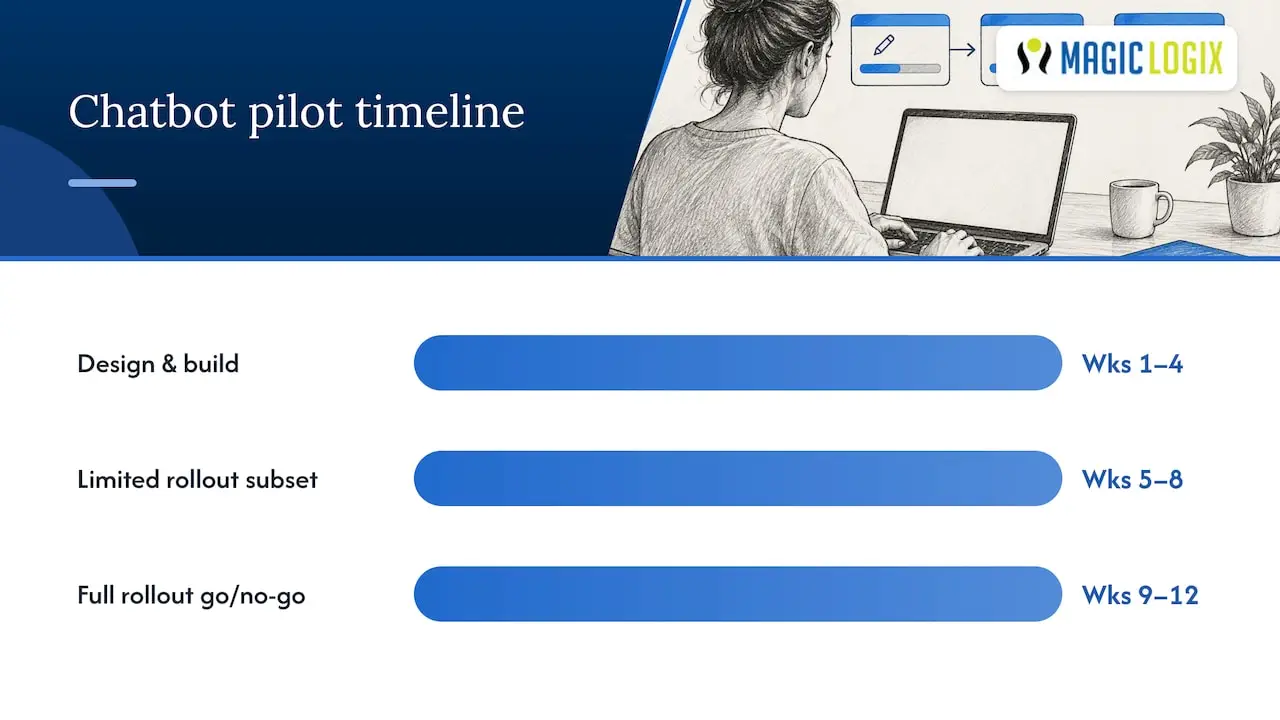
A typical gating structure looks like: weeks 1 to 4 for design and build, weeks 5 to 8 for a limited rollout to a subset of traffic, and weeks 9 to 12 for full rollout with a go or no-go decision based on whether containment and CSAT targets were hit. If you need a starting point for the workshop itself, our customer engagement strategy template walks through how to define these targets before you scope anything technical.
Designing conversations people actually want to finish
Most chatbot failures aren’t technical. They’re design failures, where the bot asks the wrong question, loses context halfway through, or offers no graceful way out when it doesn’t understand.
Good conversation design leans on a few repeatable patterns. Guided choices (buttons and quick replies instead of open text boxes) reduce misinterpretation dramatically in the first few turns of a conversation. Progressive disclosure means asking one question at a time rather than front-loading a form disguised as a chat. Context retention means the bot remembers what the customer already said, so nobody has to repeat their order number three times in one conversation.
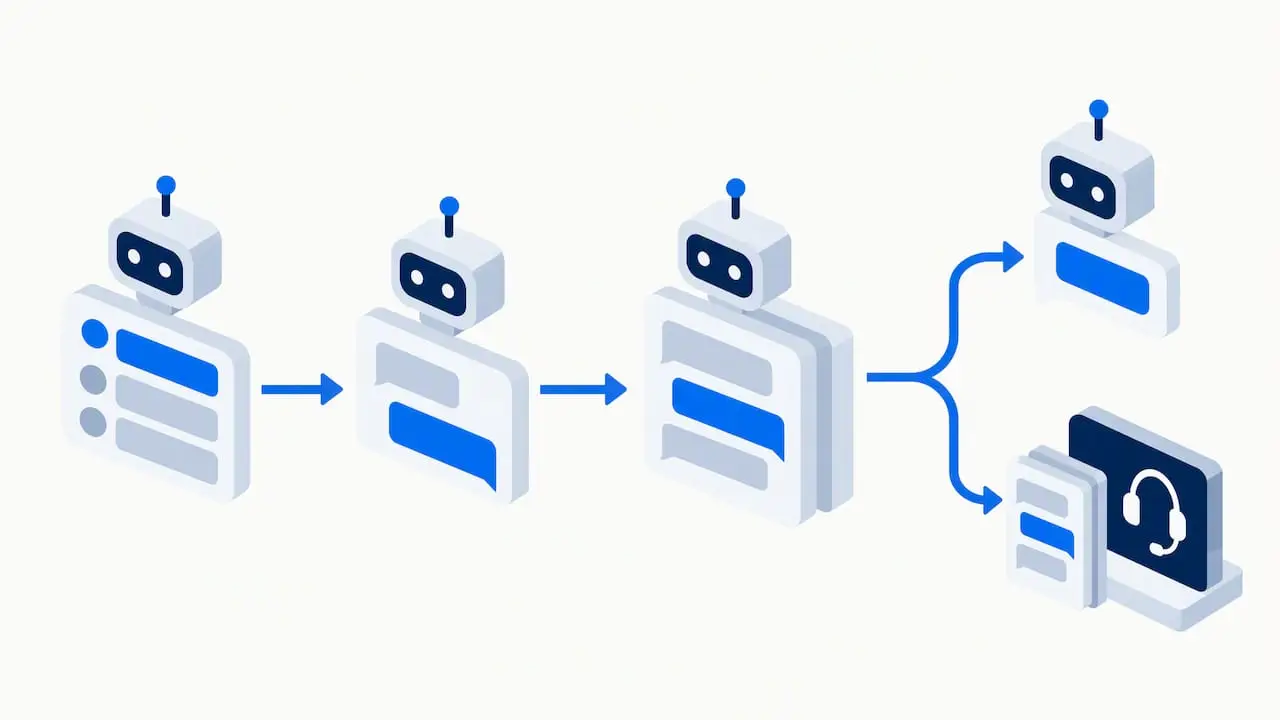
Fallback and escalation deserve special attention because this is where most bots lose customer trust. When the bot can’t resolve something, it needs to say so quickly, not after three failed attempts to guess the intent, and it needs to hand the conversation to a human with full context already packaged: the customer’s previous messages, any account details already collected, and a summary of what the bot tried. An agent who has to ask “can you repeat what you told the bot” has already lost the goodwill the bot was supposed to build.
Tone and disclosure go hand in hand. Your bot’s persona should match your brand voice, but it also needs to clearly identify itself as an AI assistant, not a person, at the start of the conversation. The FTC has made clear that there’s no AI exception to existing consumer protection law, and representing a bot as human or burying its AI nature can expose a business to Section 5 enforcement.
Accessibility is often an afterthought until a customer using a screen reader can’t complete a basic task. Before launch, test:
- Live-region announcements so screen readers catch new bot messages automatically
- Focus management so the cursor doesn’t get stranded after each exchange
- Full keyboard navigation with no mouse-only interactions
- Color contrast and text sizing that meet WCAG standards on the actual embedded widget, not just the vendor’s demo
Pro Tip: Test the widget in your own production environment with a screen reader like NVDA or VoiceOver before launch. Vendor demos are built for sales, not for the configuration your site actually ships.
Turning the plan into a working, production chatbot
Strategy becomes real the moment you choose a channel and connect the bot to live data. This is where most of the engineering effort lives, and where skipping steps shows up fastest in broken conversations.
Channel choice shapes almost everything downstream. A web widget gives you the most design control and the richest context (page history, cart contents, account status) but reaches only people already on your site. Social channels like Messenger or WhatsApp meet customers where they already spend time but limit your UI to platform constraints. SMS works well for appointment reminders and simple status updates but has no room for guided buttons or rich media. In-app bots can access the most context of all but only reach people who’ve already installed something.
Once the channel is set, the harder work is connecting the bot to the systems that make its answers accurate:
- Map every knowledge source the bot will draw from (help center, product catalog, order system) and flag which ones update frequently enough to need a sync schedule
- Pull relevant CRM context into the conversation so returning customers aren’t treated as strangers
- Define what happens when two knowledge sources disagree, because they eventually will
- Set up logging before launch, not after, since you can’t fix what you didn’t record
Telemetry is what turns a one-time launch into a continuously improving system. At minimum, capture full conversation logs, the resolution outcome for each session (contained, escalated, abandoned), and a running measure of intent recognition accuracy so you can see where the bot is guessing wrong. This data is also what feeds retraining later, so plan your logging schema with that reuse in mind rather than bolting it on afterward.
Handoffs deserve a second look here because this is where integration quality either saves or costs you support hours. A reliable handoff passes the full conversation transcript, any structured data the bot already collected, and a plain-language summary to the receiving agent’s screen automatically. If your support platform can’t do this natively, it’s worth treating as a blocker before launch, not a post-launch fix. Our web development team handles exactly this kind of integration work when a chatbot needs to talk cleanly to a CRM, helpdesk, and knowledge base at once.
What to measure, and the disclosure rules you can’t skip
You cannot improve what you don’t track, and you cannot defend a chatbot program to legal or leadership without a measurement plan that was set before launch, not reconstructed after a complaint.
The core KPIs are straightforward to define but easy to measure inconsistently across teams, so write the formula down once and reuse it everywhere:
- Containment rate equals resolved-without-human conversations divided by total conversations
- CSAT is measured on bot-only conversations separately from agent-assisted ones
- Conversion lift compares conversion rate for bot-exposed sessions against a control group that didn’t see the bot
- AHT change tracks the before-and-after handle time for tickets where agent assist was active
McKinsey’s research on scaling generative AI in service operations found that teams who treat governance, human enablers, and use-case sequencing as core to the rollout, not as cleanup after the fact, are the ones who escape pilot purgatory and actually scale.
Monitoring needs to watch for more than just satisfaction scores. Set alerting thresholds for intent-recognition drift (when the bot starts misclassifying a growing share of requests), for hallucinated answers that don’t match your knowledge base, and for any pattern of responses that steers customers away from what they’re actually asking for. That last category carries real regulatory weight: Section 5 enforcement applies to AI outputs that mislead or deceptively steer consumers, which means any steering behavior needs to be both minimized and disclosed.
Reporting cadence should match the pilot timeline: weekly during the first eight weeks, then monthly once the bot is stable. Go or no-go decisions for scaling should be tied to the specific containment and CSAT targets set in the planning phase, not to a gut feeling that the launch “went fine.”
Scaling from one working pilot to a real capability
The jump from one successful pilot to a chatbot program that works across teams is where most companies stall, usually because they try to rebuild everything from scratch for each new use case.
The fix is treating your first pilot as a parts bin, not a one-off project:
- Extract reusable components. Turn your best-performing intents, response snippets, and knowledge base modules into a library the next team can pull from instead of starting over.
- Upskill the agents who’ll work alongside the bot. Short office hours where agents can ask questions about escalations and flag what’s confusing the bot build adoption faster than a one-time training deck.
- Build a standing feedback loop. Agents see the conversations that fail; make sure that feedback reaches whoever owns the bot’s content weekly, not quarterly.
- Stage-gate every new use case the same way you gated the first pilot, with defined resource allocation (who’s building, who’s reviewing content, who owns the metric) before it starts.
Pro Tip: Budget time for change management, not just build time. The technical rollout is often the easy part; getting agents and marketing teams to trust and use the bot’s output takes longer.
The most common scaling mistake is adding use cases faster than the team can monitor them, which lets quality problems pile up invisibly until a customer complaint surfaces them. The correction is almost always the same: slow down, fix the monitoring gap, then resume. A close second mistake is letting each department build its own bot in isolation, which multiplies maintenance work and fragments the customer experience across channels.
How we approach chatbot strategy
Our approach to chatbot work starts with a scoping phase that asks what the bot needs to accomplish before anyone picks a platform. We pair data-first conversation design with the measurement infrastructure to prove it’s working, because a bot nobody can measure is a bot nobody can defend in a budget review.
We lean on the same planning discipline: define the metric before launch, map the knowledge sources before writing a single conversation flow, and build the escalation path before the happy path gets all the attention. For teams building this out internally, our customer engagement strategy template and marketing automation playbook cover the same groundwork we use with clients.
Engaging an agency often makes sense when you have the use case identified but lack the bandwidth to integrate it cleanly with your CRM, knowledge base, and support platform, or when a first attempt stalled and you need an outside audit to find out why. A good pilot audit looks at containment data, escalation logs, and a handful of real transcripts before recommending next steps.
Three trade-offs worth settling before your next planning meeting
Every chatbot program runs into the same tensions: speed versus accuracy, automation versus empathy, and build versus buy. Pick your position on each before the meeting, not during it.
A six-item checklist helps: define the metric, name the owner, pick one use case, write the escalation rule, draft the disclosure line, and set the review date. Run your first pilot on FAQ containment and watch containment rate above all else. If that number holds steady past the first month, you’re ready to add a second use case.
— Hassan
Ready to put a chatbot strategy to work for your business
Turning a chatbot plan into something that actually moves containment, CSAT, and conversion takes more than picking a platform. We bring marketing automation, CRM integration, and measurement dashboards together so your pilot has a clear answer within weeks, not quarters.
If you have a use case in mind but need the technical and UX work done right the first time, our digital marketing team can scope a 90-day pilot with defined KPIs from day one. Reach out through Magic Logix to start that conversation.
FAQ
Which is the most powerful chatbot?
There’s no single “most powerful” chatbot; the right one depends on your use case, whether it’s lead qualification, FAQ containment, or agent assist. Evaluate platforms on knowledge base integration, escalation handling, and how easily they connect to your existing CRM rather than on marketing claims alone.
Can you legally marry a chatbot?
No. Marriage requires a legally recognized human spouse under the laws of every jurisdiction in the United States, and a chatbot or AI system does not meet that legal standard.
What are the five things you shouldn’t tell ChatGPT?
General guidance from privacy and security experts suggests avoiding sharing passwords, financial account numbers, medical records, Social Security numbers, and confidential business information with any AI chatbot. Treat an AI assistant the way you’d treat an unfamiliar third-party service: assume anything you type could be logged or reviewed.
Is ChatGPT a bot or AI?
ChatGPT is a generative AI system, a large language model that generates conversational responses, which makes it a type of AI-powered chatbot rather than a simple rule-based bot. The distinction matters for disclosure purposes, since the FTC’s guidance treats generative AI tools as subject to the same transparency expectations as any AI representing itself in customer interactions.
Does a chatbot strategy need a disclosure statement?
Yes. Any bot that could be mistaken for a human should clearly identify itself as an AI assistant at the start of the conversation, since regulators treat misrepresenting a bot as human as a potential deceptive practice. This applies regardless of industry or chatbot complexity.
Sources
- Gartner press release: Customers are three times more likely to use third-party GenAI than company-provided chatbots
- FTC generative AI resolution and guidance
- From promising to productive: real results from gen AI in services (McKinsey)