

A strong B2B case study tells one customer’s story in a clear order: the situation before, the reason they changed, what they chose, how the rollout went, and the measured results. It works because buyers comparing vendors want first-hand proof that your work held up for a company like theirs. This guide covers each step, from choosing the customer to getting final approval.
TL;DR
- Pick customers because they look like the buyers you want next, not because they are the biggest logo or the most willing.
- Interview in two rounds: one for the story and the facts, a shorter one to confirm numbers and wording.
- Structure the story as before, trigger, choice, rollout, results and proof, and tie every number to a baseline, a time period and a source.
- Get written permission for name, logo and metrics before you draft, and have the customer fact-check the final version.
- Keep it concise. Roughly 700 to 1,400 words, quotes included, is a workable range.
Table of Contents
- What a B2B case study is and why buyers read it
- Step 1: Choose the right customer
- Step 2: Prepare the customer conversation
- Step 3: Run the interview
- Step 4: Structure the story
- Step 5: Verify results and avoid false causation
- Step 6: Get approval and protect confidential information
- Step 7: Publish and put the story to work
- Our perspective
- Turning case studies into a marketing system
- FAQ
- Sources
What a B2B case study is and why buyers read it
A B2B case study is a narrative about a business that overcame a challenge with help from another business. MarketingProfs describes an effective one as backed by data, metrics and a customer testimonial. Your service page explains what you offer. A case study shows that it worked for someone else.
The same source points out that case studies fit best in the consideration stage, when prospects are comparing options and want facts and reassurance from a peer. That tells you who you are writing for: a skeptical buyer who may need to justify the purchase to a boss, a finance team or a committee. Write for that person, not for your own sales team.
For a wider view of how case studies fit into a marketing mix, see our guide to writing and scaling case study marketing.
Step 1: Choose the right customer
The most common mistake is saying yes to whoever volunteers. MarketingProfs’ guidance on case study programs recommends selecting stories around the markets and products Sales wants to grow, not producing one for every customer who agrees.
A simple selection checklist
ScaleVP’s case study guide suggests a customer who resembles your target audience, has an internal advocate and measurable results, and is willing to be named and quoted. Turn that into a quick score:
| Question | Why it matters |
|---|---|
| Does their industry, size and starting problem match a segment you want to win? | Prospects need to see themselves in the story. |
| Is there a named person who will talk and can speak to results? | Without an advocate, the interview stalls. |
| Can the results be measured against a baseline? | Numbers carry the story. |
| Will they allow name, logo and quotes? | Named stories are generally more credible. |
| Who will fact-check and who approves publication? | A workable path to approval decides whether the story ever ships. |
That last row comes from B2B Playbook’s advice to test two things before you commit: whether there is a useful experience to document and whether there is a realistic route to sharing it, including an interviewee, a fact checker and a person who signs off.
Plan the portfolio, not just the story
Before recruiting, list your target segments and use cases and mark which already have a story. GTM Playbook suggests building a matrix by segment and use case, then prioritizing the gaps Sales feels most. If you also run events or webinars to share these stories, a look at event marketing platforms can show you where your coverage by industry and use case is thin before you start asking customers. Our guide to B2B marketing segmentation helps you define those segments first.
Step 2: Prepare the customer conversation
Customers say yes more often when the ask is small and the value to them is clear. MarketingProfs reports that successful programs explain the plan and objectives to the customer’s decision-maker before writing, and that the vendor does the heavy lifting of research and drafting. Make the story about their success, not your product.
Agree these points in writing before you draft, as Prime Chase Data recommends for U.S. customer stories:
- Whether you may use the company name and logo
- Which metrics may be shared
- How sensitive security or compliance language will be handled
- Who approves the draft, and how
Also ask permission to record the interview. A transcript is far more reliable than memory, and it gives you exact quotes.
If you have account usage or onboarding data, review it first. GTM Playbook recommends this so your questions can point to specific evidence instead of generic prompts.
Step 3: Run the interview
Prime Chase Data suggests two sessions: a 45 to 60 minute interview to collect the story, then a 20 to 30 minute follow-up to validate numbers and approve wording. Send your questions and any reports or dashboards you want to see in advance, so the customer can prepare.
Case study interview questions that get a real story
The strongest prompts ask for scenes, not opinions. Ampere recommends openers like “walk me through how the process worked before,” and following every claimed outcome with “How do you know?” Organize your questions by stage:
The before state
- How did the work get done before? Who was involved?
- What did the problem cost you in time, money or missed opportunities?
The trigger
- What happened that made you decide to act now?
The choice
- What alternatives did you consider, including doing nothing?
- What worried you about switching? What tipped the decision?
The rollout
- How did implementation go? What surprised you?
- Who on your team had to change how they worked?
The results
- Which numbers changed? What was the baseline, and over what period?
- What else changed during that time that might have affected the result?
- Which of these figures are you comfortable making public?
- Can you share a report or dashboard that supports them?
The advice
- What would you tell a peer considering the same step?
GoTo’s interview framework uses a similar five-part flow: introduction, problem, selection, implementation and conclusion. It is a handy way to keep a conversation from wandering.
When exact metrics do not exist
Many customers never tracked a baseline. GTM Playbook suggests asking them to estimate time savings, for example hours per week on a task. Label those figures as estimates in the story. Never turn a rough guess into a precise-looking statistic.
Step 4: Structure the story
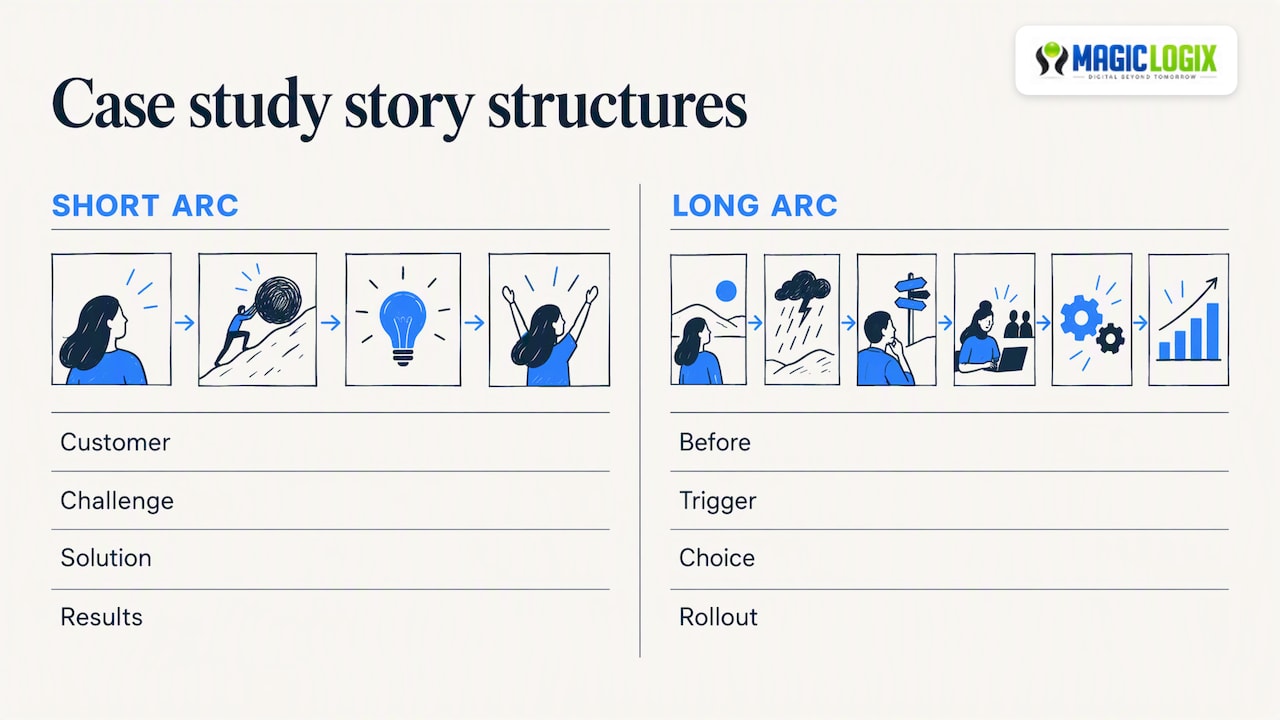
You can use the short arc of customer, challenge, solution and results. For longer pieces, Ampere’s structure adds more texture: before, trigger, choice, rollout, results and proof. Lead with a specific outcome, explain the customer’s situation and decision logic, make implementation visible, and connect every result to a baseline, a period and a source.
A reusable customer story template
Use this skeleton as a starting point and adjust it to the story:
- Headline: the customer, the outcome and the context, in plain words.
- Snapshot box: company, industry, size, product or service used, and one or two headline results.
- The situation: what the customer’s world looked like before, and what it cost.
- The trigger and the choice: why they acted, what else they considered, why they chose you.
- The rollout: what was done, by whom, over what timeline, and what was harder than expected.
- The results: each metric with baseline, period and source. Mention other changes that happened in the same window.
- The customer quote: a specific, believable line, ideally one that names the decision logic or the surprise.
- What’s next: where the customer is going from here, and a relevant next step for the reader.
Write from the customer’s point of view
Ardath Albee and Matt Heinz argue in MarketingProfs that a good case study has a beginning, middle and end, takes the customer’s perspective, stresses the problem and the measurable improvement, and avoids vendor-centered bragging. A useful test: if you swap your company name for a competitor’s and the story still reads fine, it is too generic.
Keep it tight
PostHog’s customer case study handbook recommends real numbers, retained customer quotes and a length of about 700 to 1,400 words including quotes. That is guidance from one company, not a rule, but it is a sensible target for readers with little time. Put the long detail in a downloadable version if a buyer wants it.
Step 5: Verify results and avoid false causation
Case studies lose their power the moment a reader suspects the numbers. For each metric, keep a simple record:
| Field | Example of what to capture |
|---|---|
| Metric | Lead response time, qualified leads, hours saved |
| Baseline | The value before the work started |
| Period | The exact comparison window |
| Source | The report, dashboard or person who provided it |
| Other changes | New hires, pricing changes, seasonality, other campaigns |
Ampere recommends recording exactly this, including what else changed in the same period, so the story does not imply causation it cannot support. Write “after the new process, response time fell from X to Y over Z months,” not “the new process cut response time by Y.” If you want to go deeper on tying marketing work to outcomes, our piece on measuring digital marketing effectiveness covers choosing metrics.
Step 6: Get approval and protect confidential information
Ask the customer to fact-check the draft. PostHog’s process notes that legal and public relations teams may also need to approve, and that private dashboard screenshots should stay in an internal repository until cleared. Treat any screenshot as unpublishable until someone at the customer says otherwise.
MarketingProfs’ practitioners add that editorial control and approval expectations should be clear early. Tell the customer how many review rounds to expect and who has the final word on quotes. Surprises at the approval stage are the main reason finished case studies never go live.
If a customer cannot be named, an anonymized version can still work. ScaleVP notes that named stories generally carry more credibility, so use anonymous ones as a second choice, with enough detail (industry, size, problem) to stay believable.
Step 7: Publish and put the story to work
A case study that sits on a hidden page does nothing. Give it a clear title, a snapshot at the top and a plain next step at the bottom. Then reuse it:
- Link it from the service pages it supports.
- Hand Sales a short summary and the link for deals in the same segment.
- Pull a quote or a single metric for email, social posts and proposals.
- Review it once a year and update or retire figures that have aged.
Think of the case study as one part of a buyer-focused system. Our guide to a B2B content strategy that builds pipeline shows where stories sit alongside other content.
Our perspective
At Magic Logix, our positioning is Digital Beyond Tomorrow, and we see case studies as proof content that deserves the same care as the product it describes. Our view is that the most useful stories are specific and modest. A claim with a baseline, a period and a source persuades more than a big number with none.
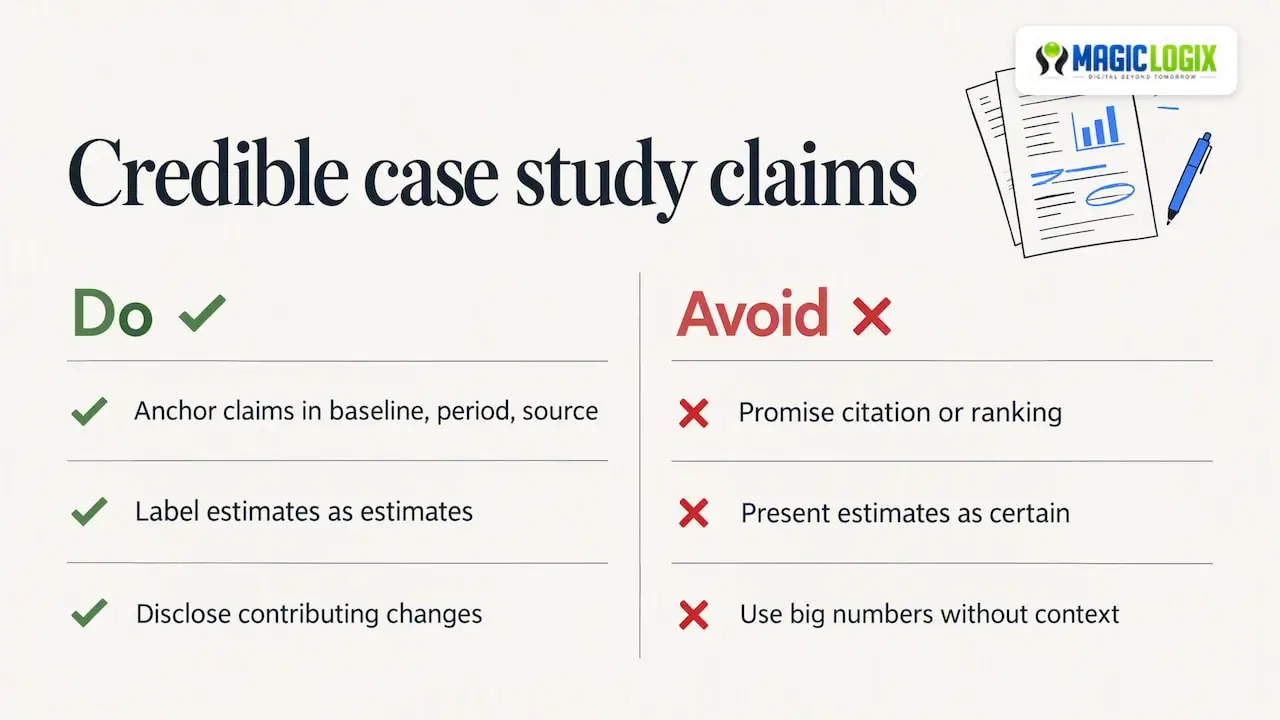
We also think the case study belongs to the search journey. Buyers now look for answers in traditional search and in AI-driven answer tools, and clear, well-structured stories with named facts are easier for both people and machines to understand. No one can promise that a page will be cited or ranked, and best practices here are still changing. What you can control is accuracy, clarity and structure.
Finally, be honest about what you can and cannot claim. If a result is an estimate, say so. If another change contributed, say that too. Readers trust a story that admits its limits.
— Hassan Bawab
Turning case studies into a marketing system
Writing one good story is manageable. Keeping a steady supply tied to your SEO, content and sales process is harder. If you want help planning the stories, designing the pages that present them or connecting them to search and AI visibility, you can explore Magic Logix and talk with our team about what fits your goals. We start from your segments and your sales gaps, not from a template.
FAQ
How long should a B2B case study be?
PostHog’s handbook suggests roughly 700 to 1,400 words including quotes. Shorter pieces get read more often, so put extra detail in a downloadable version or a separate appendix. Let the story decide the length within that range.
What are the main parts of a case study?
Most have four: the customer, the challenge, the solution and the results. Longer versions add the trigger for change, the alternatives considered and proof such as a quote or supporting data. Each result should show its baseline, period and source.
What should I do if the customer has no hard metrics?
Ask for estimates, such as hours saved per week, and label them as estimates in the story. You can also use qualitative evidence, like how a team’s process changed, alongside a direct quote. Do not invent or round up figures to fill the gap.
Can I publish a case study without naming the customer?
Yes. ScaleVP says anonymized case studies can still be useful, though named ones generally carry more credibility. Describe the industry, company size and problem clearly, and get the customer’s approval on the final wording either way.
Sources
- 6 Elements of Effective B2B Case Studies, MarketingProfs
- Secrets of Case Study Winners, MarketingProfs
- Five Tips for Writing Case Studies That Aren’t Boring, MarketingProfs
- Building a great B2B case study, ScaleVP
- Case study, B2B Playbook
- Case Study Development Framework, GTM Playbook
- How to Build US Customer Case Studies, Prime Chase Data
- How to write a B2B case study sales will actually send, Ampere
- Questions to Ask for a B2B Case Study, GoTo
- Customer case studies, PostHog Handbook