
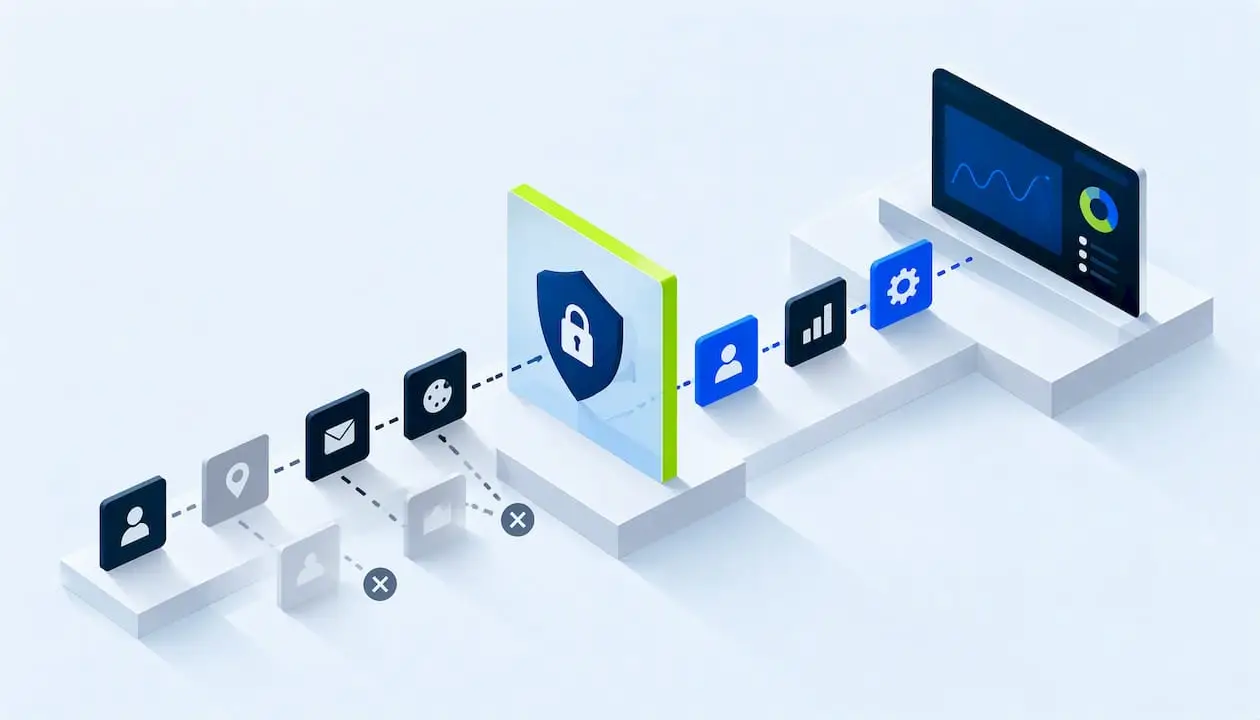
Privacy-first marketing is a way of running campaigns in which consent, data minimization and transparency come before targeting. You collect less, you collect it openly, and you use it for things customers can see the value of. In the US, that also means working inside a patchwork of state laws and active FTC enforcement, so it is as much an operating model as a messaging choice.
This guide covers what the approach involves, how to build a first-party and zero-party data program, how to handle consent, and how to measure results when tracking signals shrink.
TL;DR
- Privacy-first marketing puts consent and data minimization ahead of targeting. It rests on first-party data (what customers do with you) and zero-party data (what they tell you on purpose).
- US compliance is state by state, not national. Build consent and contract flows that can flex by state.
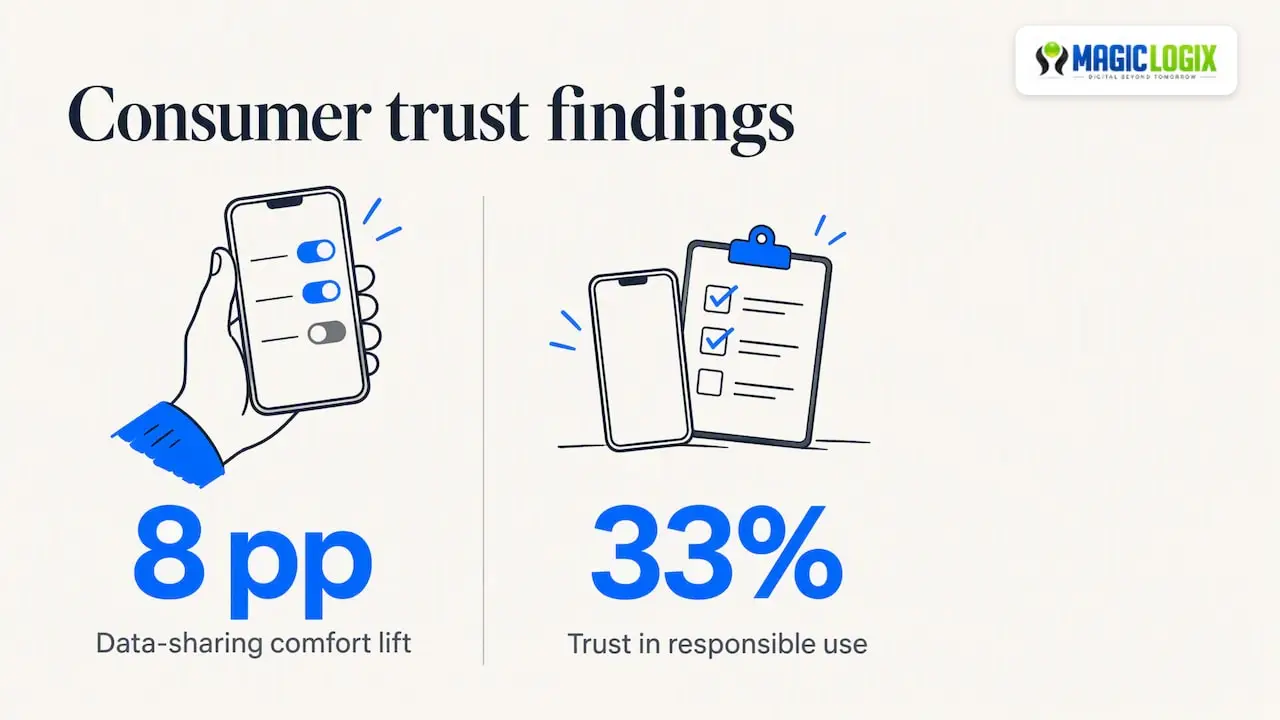
- Trust has a measurable payoff: in one 2025 survey, consumers were more comfortable sharing information with companies they trust, yet only 33% trusted companies to use their data responsibly.
- Tools do not make you compliant on their own. Data clean rooms, analytics vendors and consent banners all need legal and technical setup.
- Start with a data map, a consent record and one value exchange customers actually want.
Table of Contents
- What privacy-first marketing actually means
- Why it matters for your results, not just your legal risk
- The US patchwork: what to plan for
- First-party and zero-party data: the foundation
- Consent management that works for marketing
- Measurement and advertising without tracking people
- Who owns privacy on your team
- A 90-day plan
- Our perspective
- How Magic Logix can help
- FAQ
- Sources
What privacy-first marketing actually means
The phrase gets used loosely, so here is a working definition. A privacy-first program has four traits:
- Consent is explicit and recorded. People know what they are agreeing to, and you can show it later.
- Data collection is limited to a purpose. If you cannot say what a field is for, you do not ask for it.
- Customers have control. Opting out, updating preferences and deleting data are easy.
- Measurement does not depend on following people around the web.
You will also hear it called privacy-centric or privacy-led marketing. The names differ, the practice is the same. The 2025 Usercentrics State of Digital Trust Report frames it as moving past a compliance checkbox toward something closer to customer advocacy, where brands ask for informed consent and control data flows, for example with server-side tagging.
Think of it like plumbing. Customers never see the pipes, but they notice quickly when something leaks.
Why it matters for your results, not just your legal risk
Two pressures push in the same direction.
Customers are cautious. The Usercentrics report, based on a 2025 survey of 10,000 consumers in Europe and the USA plus a 2024 study of 23,000 consumers, found that consumers are 8 percentage points more comfortable sharing personal information when they trust a company’s data practices, and that only 33% trust companies to use their information responsibly. Note the geography: the sample is not US-only, so treat the figures as directional for your audience.
Regulators are active. In January 2025 the FTC finalized an order against Gravy Analytics and Venntel prohibiting the sale of sensitive location data, including visits to health-related sites. It also finalized an order banning Mobilewalla from selling sensitive location data. Separately, the FTC finalized changes to the Children’s Online Privacy Protection Rule that tighten how children’s data can be collected, used and disclosed.
The lesson for marketers is practical: the riskiest data is the data you did not collect yourself and cannot explain.
The US patchwork: what to plan for
There is no single national privacy law for marketing. One tracker counted twenty states with comprehensive privacy laws in effect in 2026, counting Florida, whose law is narrower. The IAB’s State Privacy Law Survey Results notes that the advertising industry is working to comply with 19 comprehensive state laws in effect or coming into effect, and flags that Maryland’s act imposes restrictions that differ from the framework most other states share.
What this means in practice:
- Pick a baseline, then add state exceptions. Most teams design to the strictest workable standard and layer differences on top.
- Treat opt-out signals seriously. Global Privacy Control is a browser signal meant to communicate a do-not-sell-or-share request, and it is required under laws such as the California Consumer Privacy Act. Your consent tooling should honor it.
- Watch for changes. State legislatures keep moving. Delaware’s HB 380 drew a veto request from NetChoice in July 2026 over its departure from the multi-state framework. That is one side’s view, but it shows how quickly requirements can diverge.
This is not legal advice. Have a privacy attorney review your consent language and state coverage, especially if you handle health, location or children’s data.
First-party and zero-party data: the foundation
The two terms are often blurred, so keep them separate.
| First-party data | Zero-party data | |
|---|---|---|
| What it is | Behavior and transactions you observe on your own channels | Information a customer volunteers on purpose |
| Examples | Purchases, site and app activity, email engagement, support history | Preference center choices, quiz answers, stated interests, communication frequency |
| Strength | Scale and consistency | Accuracy and clear permission |
| Weakness | Inferences can be wrong or feel intrusive | Smaller volume, needs a reason to share |
For a deeper look at the first category, see our guide to what first-party data is and how to use it for growth.
How to collect first-party data without eroding trust
- Map every data flow. List each form, pixel, tag, CRM field and vendor. NIST’s guidance for small businesses points out that outsourced analytics still relies on your customers’ data and creates privacy risks, and recommends mapping data flows and putting governance in place early.
- Cut what you cannot justify. For each field, write the purpose in one sentence. If you cannot, remove it.
- Offer a clear exchange. A buying guide, early access, loyalty pricing or faster support gives people a reason to share.
- Collect at the moment of value. Ask for a size preference when someone is choosing a size, not on page one.
- Store consent with the record. Keep the timestamp, the wording shown and the source.
How to build a zero-party data program
Start small. A three-question preference center beats a twenty-question profile no one finishes.
- Ask about topics, frequency and channel.
- Use the answers right away, so people see the effect.
- Let people change their answers whenever they like.
- Review the data quarterly and retire fields that nothing uses.
A useful test: could you explain to a customer, in one sentence, why you asked? If not, rework the question.
Consent management that works for marketing
Consent is where good intentions usually break down. A few principles carry across jurisdictions. The European Data Protection Board, whose rules do not apply to US-only operations but whose guidance is widely cited, says consent must be freely given, informed, specific and unambiguous, and notes that recommending products is not strictly necessary to perform a contract. If you also market to people in the EU, that matters. If you do not, it still works as a quality bar for your banners and forms.
A practical consent checklist:
- Equal prominence for accept and decline.
- Plain wording that names the purpose, not a vague “improve your experience”.
- Separate choices for analytics, advertising and email.
- Opt-out signals such as Global Privacy Control honored automatically where the law requires it.
- A preference center linked from every marketing email.
- Consent records connected to your CRM and ad audiences, so a withdrawal removes the person everywhere.
- A quarterly test of the full flow on mobile and desktop.
A note on data clean rooms
Clean rooms come up often in privacy-first planning. They are useful for analytics and measurement collaboration, but a common myth is that they automatically make data compliant. The IAB’s analysis of data clean rooms under US state privacy laws says otherwise: they are tools that support privacy-enhanced collaboration and still need careful legal and technical setup to fit varying state rules.
Measurement and advertising without tracking people
The measurement landscape keeps shifting. In October 2025 Google announced it was retiring several Privacy Sandbox technologies, including the Attribution Reporting API, after low adoption, and pointed toward interoperable standards. The lesson is not to bet your measurement on any single browser proposal.
A sturdier approach:
- Own your conversion data. Capture conversions in your CRM or commerce platform, then send consented signals to ad platforms.
- Use server-side tagging with care. It gives you control over what leaves your systems, but it is not a loophole. Consent rules still apply.
- Run holdout tests. Compare a group that sees a campaign with one that does not. Incrementality does not need individual tracking.
- Lean on modeled and aggregate reporting, and label it as modeled.
- Judge retargeting by its controls. Our retargeting strategy checklist covers privacy controls, QA and holdouts.
Personalization does not have to disappear either. Using what customers told you, plus on-site behavior they consented to, supports relevant experiences. For an approach to the modeling side, see our piece on predictive personalization.
Who owns privacy on your team
In a small business, privacy often belongs to everyone and therefore no one. Name one owner, even if it is a part-time role. NIST’s Privacy Framework starter guide suggests beginning by deciding what kind of privacy culture you want, whether centered on autonomy, transparency or control of data, and then linking those values to a risk-based approach. Larger organizations may eventually hire dedicated staff, and a salary benchmark such as this privacy officer pay guide helps with budgeting that role.
Also check your stack. Every tool that touches customer data is part of your privacy posture. Our marketing technology stack guide looks at the critical flows to review.
A 90-day plan
| Days | Focus | Output |
|---|---|---|
| 1-30 | Audit | Data map, vendor list, list of fields with a stated purpose, gap list against state requirements |
| 31-60 | Fix the basics | Updated consent banner and preference center, opt-out signal handling, consent records in CRM |
| 61-90 | Prove value | One zero-party data exchange live, one holdout test, a reporting view that separates observed from modeled data |
How to evaluate results
Pick measures you can defend:
- Consent opt-in rate by channel and device.
- Preference center completion rate.
- Email unsubscribe and complaint rates before and after changes.
- Conversion rate of consented versus unconsented audiences.
- Incremental lift from holdout tests.
- Time to honor a deletion or opt-out request.
Set your own baselines before you change anything. Some opt-in rates will drop at first when choices become clearer. Judge the program on the quality of the audience and on lift, not on raw list size.
Our perspective
Most businesses we talk with treat privacy as a legal task handled at the end of a project. We see better outcomes when it is part of the design from the start: the data model, the forms, the analytics setup and the creative all agree on what customers have allowed.
Two habits matter most. First, tie every data point to a customer-facing benefit. Second, build measurement that still works when a signal disappears. We cannot promise any particular lift from either, and platform behavior will keep changing, but both make a marketing program easier to defend and easier to adapt.
Our positioning is Digital Beyond Tomorrow, and in this area that means building systems flexible enough for rules and platforms we cannot predict yet.
— Hassan Bawab
How Magic Logix can help
If you want a second set of eyes on your data collection, consent flows or measurement setup, our team works across analytics, marketing automation, web development and search visibility. You can explore our Search & AI Visibility capabilities or start a conversation through Magic Logix about a project or ongoing support. For visibility in AI-driven search, see our GEO service page.
FAQ
What is the difference between privacy-first and privacy-compliant marketing?
Compliance is the legal minimum: meeting the rules that apply to you. Privacy-first treats consent and data minimization as design principles, often going beyond the minimum. A privacy-first program should be compliant, but a compliant one is not automatically privacy-first.
Is first-party data enough to replace third-party cookies?
For many businesses it covers a large share of needs, such as audience building from customers and email lists, personalization and conversion tracking. It does not replicate broad prospecting reach, so most teams combine it with contextual targeting and aggregate measurement. Your mix depends on your sales cycle and channels.
Do small businesses need a consent management platform?
If your site uses advertising or analytics tags that fall under state opt-out or consent requirements, you need a reliable way to record and honor choices. For some small sites that is a lightweight tool, for others a full platform. Ask a privacy attorney which state laws apply to your customer base.
Does a data clean room make my campaigns compliant?
No. According to the IAB, clean rooms support privacy-enhanced collaboration but still need careful legal and technical setup. You remain responsible for the underlying data and how it is used.
Sources
- Usercentrics, The State of Digital Trust Report 2025
- FTC: order prohibiting Gravy Analytics and Venntel
- FTC: order banning Mobilewalla
- FTC: changes to the Children’s Privacy Rule
- MultiState: comprehensive privacy laws in 2026
- IAB: State Privacy Law Survey Results
- Global Privacy Control
- NetChoice: Delaware HB 380 veto request
- NIST: Data analytics for small businesses
- EDPB: process personal data lawfully
- IAB: Data Clean Rooms and US state privacy law
- Google Privacy Sandbox: update on plans
- NIST Privacy Framework starter guide