
Data-driven creative means using performance signals, not guesswork, to decide what you make, test, and scale next. Done right, it looks like this: teams tag every ad at the element level, run fast tests against fixed thresholds, and feed each verdict into the next brief. The payoff is faster winner detection and, when generation stays grounded in your own performance data, measurable gains in ROAS and click-through rate.
TL;DR:
- Tagging ad components at the element level is essential, with at least five fields including campaign, batch, element, hypothesis, and owner for accurate analysis.
- Grading thresholds and test design, scaled to product AOV, must be fixed before launch to reduce learning noise and avoid re-testing ineffective ideas.
- Early detection of fatigue through declining hook or hold rates and rising CPA enables immediate ad pausing, saving budget and preserving ROAS.
- AI is most valuable when grounded in performance data for generating variations, repurposing formats, and drafting briefs, but requires human oversight for brand and claim accuracy.
- Frequent cross-department communication and designated ownership of the creative loop are crucial to prevent misaligned messaging and maintain measurement integrity.
Table of Contents
- The Closed-Loop Workflow Behind Data-Driven Creative
- Practical Tactics: Tagging, Componentization, and Testing Frameworks
- Creative Fatigue Detection and When to Pause, Rotate, or Scale
- How AI Fits Into Data-Driven Creative
- The Week-1 Playbook We Use With New Clients
- Getting Marketing, Analytics, and Product on the Same Loop
- Ethical Considerations and Privacy in Data-Driven Creative
- How Magiclogix Helps Teams Run This Loop Without Adding Headcount
- What I’d Fix First If I Were Running Your Account
- Sources
- FAQ
The Closed-Loop Workflow Behind Data-Driven Creative
The engine behind data-driven creative is a four-stage loop that never really stops. Each week’s output becomes next week’s input, which is what separates a testing program from a pile of ad variations nobody learns from.
- Diagnose. Pull last week’s signals from your ad platforms and analytics: which hooks held attention, which CTAs converted, where CPA crept up.
- Hypothesize and brief. Turn those signals into a testable angle with engaging content. If short, punchy hooks outperformed voiceover-led ones, the brief says so explicitly, not “make something fresh.”
- Translate and create. Produce assets that are tagged and componentized from the start, so every hook, CTA, and visual can be isolated later.
- Validate and grade. Measure each asset against fixed thresholds, not gut feel, and log the verdict.
That loop only works if grading happens fast enough to inform the next brief before budget gets wasted on something already proven weak. A practitioner workflow model built around research, brief, generate, and grade shows why teams that skip the grading step tend to keep re-testing the same losing idea in new packaging.
A typical week splits ownership cleanly: an analyst owns diagnosis and grading, a creative lead owns the brief and asset production, and a media buyer owns the spend windows and platform-level reporting. When those three roles talk only at the end of the month, the loop breaks. When they sync weekly, the loop compounds.
Practical Tactics: Tagging, Componentization, and Testing Frameworks
You cannot analyze what you cannot isolate. Break every ad into its component parts, hook, hold, CTA, hero visual, thumbnail, and format, and tag each one individually so a winning hook doesn’t get credit it deserves buried inside a losing overall ad.
A workable tagging convention needs five fields at minimum:
- Campaign name so results roll up correctly
- Test batch ID so you know which cohort an asset belongs to
- Element code identifying the specific hook, CTA, or visual variant
- Hypothesis ID linking the asset back to the brief that produced it
- Creative owner so accountability doesn’t evaporate
Test design matters as much as tagging. Fix your batch size, spend window, and pass/fail thresholds before launch, not after you see early numbers. A tight grading system with fixed spend windows and absolute thresholds reduces what practitioners call learning noise, the temptation to keep tweaking a mediocre ad instead of killing it and moving on, according to Selzee’s performance marketer workflow. Thresholds should scale with average order value: a $30 AOV product needs a tighter CPA ceiling than a $300 one, since the margin for error shrinks fast at lower price points.
Pro Tip: Before briefing round two, tag the winning element specifically, not the whole ad. A winning hook paired with a new visual is a real test. Two nearly identical hooks with different music is just noise wearing a new outfit.
Creative Fatigue Detection and When to Pause, Rotate, or Scale
Fatigue shows up in the numbers before it shows up in your gut. Watch three signals closely: a declining hook rate (fewer people stopping to watch), a dropping hold rate (people bailing mid-video), and a rising cost per acquisition on an ad that used to convert cleanly.
Not every dip is fatigue. Run a quick diagnostic split before you touch the creative:
- If hook rate falls but hold rate stays steady, the problem is usually audience saturation, not the asset itself.
- If hold rate drops while hook rate holds, the opening is still working but the middle is losing people.
- If CPA rises while both hook and hold rate stay flat, check delivery and placement before blaming the creative at all.
Early detection tends to protect blended ROAS more effectively than rushing out replacement assets, since a paused ad stops bleeding budget immediately while a new one still has to prove itself. That’s the core insight behind fatigue-aware programs: catching the decline early preserves spend that late detection simply burns.
Timelines vary. A strong hook can break out and prove itself within three days of launch, showing an unmistakable lift in hold rate and conversions almost immediately. Fatigue, by contrast, tends to creep in over a full week, a slow bleed in hook rate that’s easy to miss if you’re only checking dashboards every Monday. Given that a 2023 ANA study found a meaningful share of programmatic ad spend gets wasted industry-wide, tightening this detection cadence isn’t optional polish, it’s where real budget gets recovered.
How AI Fits Into Data-Driven Creative
Grounded generation means AI trained on your own tagged performance data, learning which hooks, formats, and CTAs actually worked for your account. Blind generation means asking a general model to “make an ad” with no performance context feeding it. The difference in output quality is not subtle.
AI adds real value in specific spots:
- Generating hook variations fast, once you know which angle already tested well
- Repurposing a winning format across new placements or aspect ratios
- Drafting first-pass briefs from diagnosis data so creatives start from a summary, not a blank page
Human judgment still has to own narrative coherence, brand tone, and any claim that requires real proof, AI can draft a hook, but it can’t verify a testimonial. Every generated asset should pass through a brand guardrail deck and a short QA checklist before launch, with a creative lead signing off, not just a media buyer eager to hit a deadline. Grounded workflows like this, paired with fatigue detection, have driven measurable ROAS lifts in live accounts, typically in the high single digits.
The Week-1 Playbook We Use With New Clients
We start clients on a five-day rhythm: Monday, pull last week’s signals; Tuesday, write briefs from those signals; Wednesday, produce tagged assets; Thursday, run QA; Friday, launch and set the grading clock. It’s a small structure, but it forces discipline that ad-hoc testing rarely survives past week two.

Teams already comfortable with two-stage creative testing or predictive analytics can run this in-house. Teams without a dedicated analyst, or without bandwidth to grade weekly, tend to get more value calling in a managed partner before the backlog of untagged creative gets unmanageable.
Getting Marketing, Analytics, and Product on the Same Loop
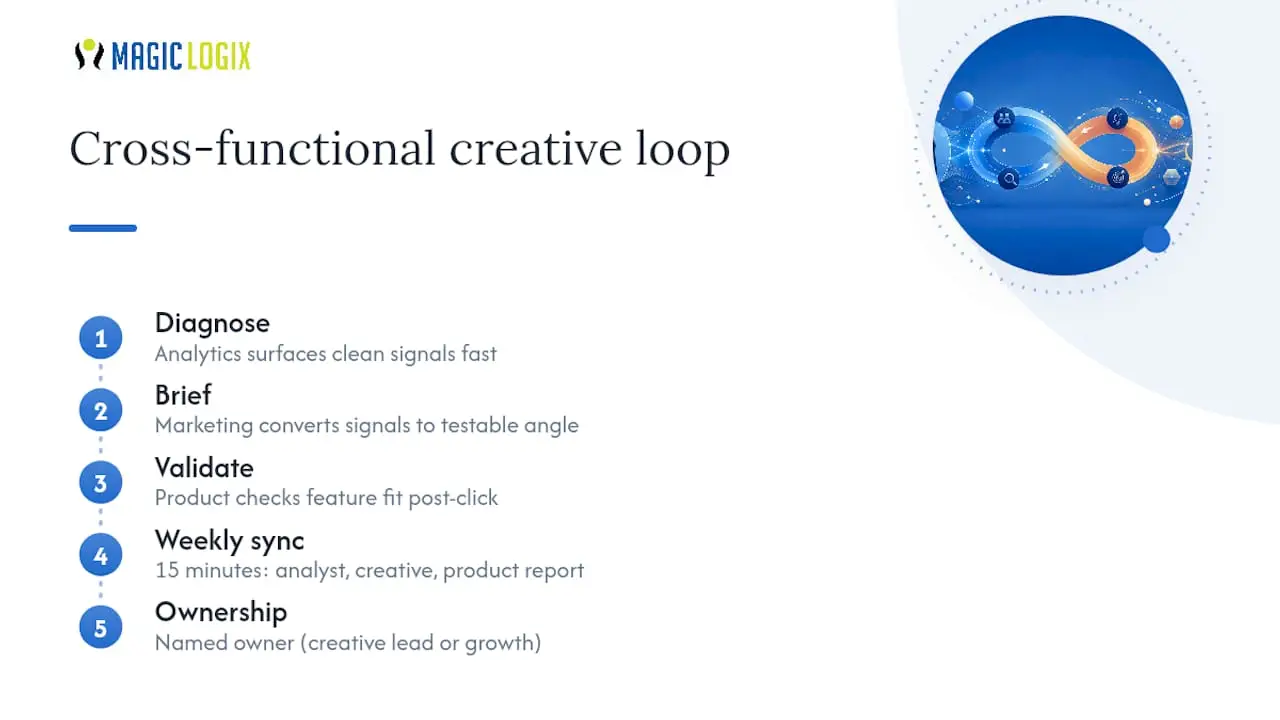
Data-driven creative stalls the moment analytics, marketing, and product operate as separate departments reading different dashboards. The diagnosis step depends on analytics surfacing clean signals fast; the brief step depends on marketing translating those signals into a testable creative angle; and increasingly, the validate step depends on product weighing in when a creative promise doesn’t match what the product actually delivers post-click.
A practical fix is a shared weekly sync, fifteen minutes, where the analyst reports the prior week’s winners and losers, the creative lead previews what’s in production, and a product stakeholder flags any feature change that might affect messaging accuracy. Skip this and you get a common failure mode: marketing scales an ad promising a feature product just deprecated, and the fatigue signal that follows gets misread as creative fatigue when it’s actually a trust problem.
Ownership matters as much as communication. Assign one person, usually the creative lead or a growth marketer, as the single point of accountability for the loop itself. Without a named owner, diagnosis happens sporadically, briefs slip, and the loop quietly reverts to ad-hoc creative requests. Forbes’ panel of agency experts specifically flags using past performance to guide future creative as a discipline that erodes fastest when no single team owns the handoff between departments.
Ethical Considerations and Privacy in Data-Driven Creative
Using consumer data to shape creative decisions carries real obligations, not just technical ones. Most of what fuels good data-driven creative, engagement patterns, purchase history, on-platform behavior, is aggregate and behavioral rather than personally identifying, and that distinction should guide what you build tests around.
Americans are notably uneasy about how companies handle their personal data. Pew Research has found that a majority of U.S. adults feel they have little to no control over the data companies collect about them, and many report concern about how that data gets used. That sentiment should shape two concrete practices: be transparent about what signals inform your targeting, and avoid building creative hooks around inferred sensitive categories, health conditions, financial distress, and similar, even when the data technically supports the inference. What’s technically possible with granular targeting is often the fastest way to erode the trust your creative testing program depends on. Building your first-party data strategy around explicit, disclosed signals rather than inferred ones keeps your testing program compliant and keeps the relationship with your audience intact.
How Magiclogix Helps Teams Run This Loop Without Adding Headcount
Most marketing teams don’t lack ideas, they lack the analyst hours to tag creative, grade it against fixed thresholds, and turn verdicts into next week’s brief on a reliable cadence. This kind of managed service fills the gap instead of hiring a full internal analytics function just to keep a testing loop honest.
Magiclogix’s Digital Marketing service pairs paid media management with the analytics discipline this article describes, so tagging, grading, and briefing happen on a fixed weekly rhythm instead of whenever someone finds time. For teams whose creative promises are outrunning what the product actually supports, the Ecommerce Development and consultation services help close that gap before it shows up as a fatigue signal you misread. And if predictive forecasting is the missing piece, Predictive Analytics support turns last week’s signals into a forecast for what’s likely to work next, rather than a rearview mirror.
If your team has the creative talent but not the bandwidth to run diagnosis, tagging, and grading every week, book a consultation through Magiclogix’s digital marketing page and find out what a managed loop looks like for your account.
What I’d Fix First If I Were Running Your Account
If your team only fixes one thing this quarter, fix tagging. Without element-level tags, every other tactic in this article is guesswork wearing a dashboard. Start week one with: tag your last 20 live assets retroactively, set fixed pass/fail thresholds before your next launch, and name one owner for the weekly grading call.
— Hassan
Sources
Before you can brief well, you need one view of performance, not five disconnected ones. Consolidate data from ad platforms, web analytics, mobile measurement partners, first-party CRM signals, and even review or comment sentiment, since fragmented dashboards quietly degrade brief quality more than any single missing tool ever will.
Track these at the element level, not just the campaign level:
- How AI-Powered Creative Optimization Is Redefining Ad Performance
- Key findings about Americans and data privacy
- Does AI Ad Creative Actually Perform? Real 2026 Data
- AI Ad Creative: A Performance Marketer’s Workflow
Three tool categories cover most of this: creative tagging and automation platforms that componentize assets on upload, unified analytics dashboards that merge ad-platform and first-party data, and dedicated A/B testing or creative management systems that enforce your spend windows and thresholds automatically.
FAQ
What does it mean to be data-driven in creative advertising?
Being data-driven means creative decisions, which hook to use, which format to scale, come from tagged performance signals rather than opinion or precedent. It requires a closed loop where diagnosis feeds the brief, and grading feeds the next diagnosis.
Can you give an example of data-driven design in practice?
A common example is testing five hook variations against a fixed three-day spend window, then scaling only the one that clears a preset hold-rate threshold. Teams using grounded generation tied to past performance report measurable ROAS lifts when this process runs consistently rather than as a one-off test.
What are the main steps in data-driven decision making for creative?
The core sequence is diagnose, hypothesize and brief, create, and validate, then repeat. Each stage feeds the next, and skipping the grading step is the most common reason teams stall.
What does data-driven design actually mean for a marketing team?
It means every visual, copy, and format choice traces back to a specific signal, not a trend or a hunch. That requires tagging assets at the element level so results can be attributed to the exact hook, CTA, or visual that drove them.
How much does managed creative testing support cost through Magiclogix?
Pricing for Magiclogix’s digital marketing and creative testing support is not published and depends on scope, so current rates are available directly through the Digital Marketing page.